Smoke Detector Requirements: Where Alarms Go and the 10-Year Battery Laws
- Primary data
- KBR timeline of statewide 10-year sealed-battery smoke alarm rules, weighted with Census population estimates
- Data period
- Rules 1998 to 2026; population 2010 to 2025
- Latest release used
- 2026-11-15
- Next release
- Census Vintage 2026 estimates, December 2026; state laws checked quarterly
- Geography
- United States, 50 states and DC
- Sources
- 17 (13 Tier 1)
About 42.6 percent of Americans, 145.5 million people, live in the 12 states with a statewide 10-year sealed-battery alarm rule on November 15, 2026. Model smoke detector requirements (IRC R314) put an alarm in every bedroom, outside sleeping areas and on each story, hardwired and interconnected, and NFPA 72 bars alarms within 10 feet of a fixed cooking appliance.
This month in brief
- 42.6 percent of Americans (145.5 million) live in the 12 states with a statewide 10-year sealed-battery smoke alarm rule for homes, up from 1.2 percent in 2010.
- Four states (California, Maryland, New York, Connecticut) ban retail sale of other battery-only alarms; they hold 20.3 percent of the U.S. population.
- IRC R314 requires alarms in every bedroom, outside each sleeping area and on every story, hardwired with battery backup and interconnected.
- A remodel that needs a building permit triggers whole-house alarm upgrades under R314.2.2, with battery-powered alarms allowed for the added units.
- NFPA 72 (2022) bars alarms within 10 ft of a fixed cooking appliance and, since January 1, 2025, requires cooking-nuisance-listed alarms out to 20 ft.
- In 2018 to 2022, 59 percent of home fire deaths occurred with no alarm or one that failed; battery-only alarms operated in 85 percent of qualifying fires vs 94 percent for hardwired.
- 4.2 percent of occupied homes (5.6 million) reported no working smoke detector in the 2023 AHS.
Smoke detector requirements in IRC R314: every bedroom, every story, all wired together
The International Residential Code section R314 sets the floor for new homes in most states. The opened text is Washington's adoption of the 2021 IRC, effective March 16, 2024.
Washington's adopted R314 text requires smoke alarms in each sleeping room, outside each separate sleeping area in the immediate vicinity of the bedrooms, and on each additional story, including basements and habitable attics. Alarms must sit not less than 3 feet horizontally from the door of a bathroom with a tub or shower, so steam does not trip them.
Where more than one alarm is required, R314.4 says they must be interconnected so that one alarm sounds all of them; listed wireless alarms satisfy the rule. R314.6 requires primary power from the building wiring with battery backup, and wiring without a disconnecting switch other than overcurrent protection.
| Rule | What the text says | Section | Source |
|---|---|---|---|
| Where alarms go | Each sleeping room; outside each separate sleeping area near the bedrooms; each additional story including basements and habitable attics | IRC R314.3 items 1 to 3 | WAC 51-51-0314 |
| Bathroom doors | Not less than 3 feet horizontally from the door of a bathroom with a tub or shower, unless that blocks a required alarm | IRC R314.3 item 4 | WAC 51-51-0314 |
| Interconnection | Where more than one alarm is required, actuation of one sounds all; listed wireless alarms allowed | IRC R314.4 | WAC 51-51-0314 |
| Power | Primary power from building wiring with battery backup; no disconnecting switch other than overcurrent protection | IRC R314.6 | WAC 51-51-0314 |
| Remodel trigger | Alterations, repairs or additions requiring a permit, or added sleeping rooms: whole dwelling gets alarms as for new homes | IRC R314.2.2 | WAC 51-51-0314 |
| Remodel exceptions | Exterior work (roofing, siding, windows, doors, porch, deck) and plumbing, electrical or mechanical work are exempt | IRC R314.2.2 exceptions | WAC 51-51-0314 |
| Remodel power relief | Alarms added under the remodel trigger may be battery powered and need not be interconnected to existing alarms that cannot be | IRC R314.6 exception 2, R314.4 exception | WAC 51-51-0314 |
| Listing | Smoke alarms listed to UL 217; combination smoke and CO alarms to UL 217 and UL 2034 | IRC R314.1.1 | WAC 51-51-0314 |
Washington publishes R314 with state amendments; ADU, loft and child-care items are Washington or 2021 additions. Check the edition your jurisdiction adopted.
Source: [8] Washington State Legislature
Smoke alarm vs smoke detector: In code language a smoke alarm is a self-contained device that senses smoke and sounds; a smoke detector is a sensor that reports to a fire alarm control panel. Homes normally use smoke alarms. This report uses the searcher's term, smoke detector, for both.
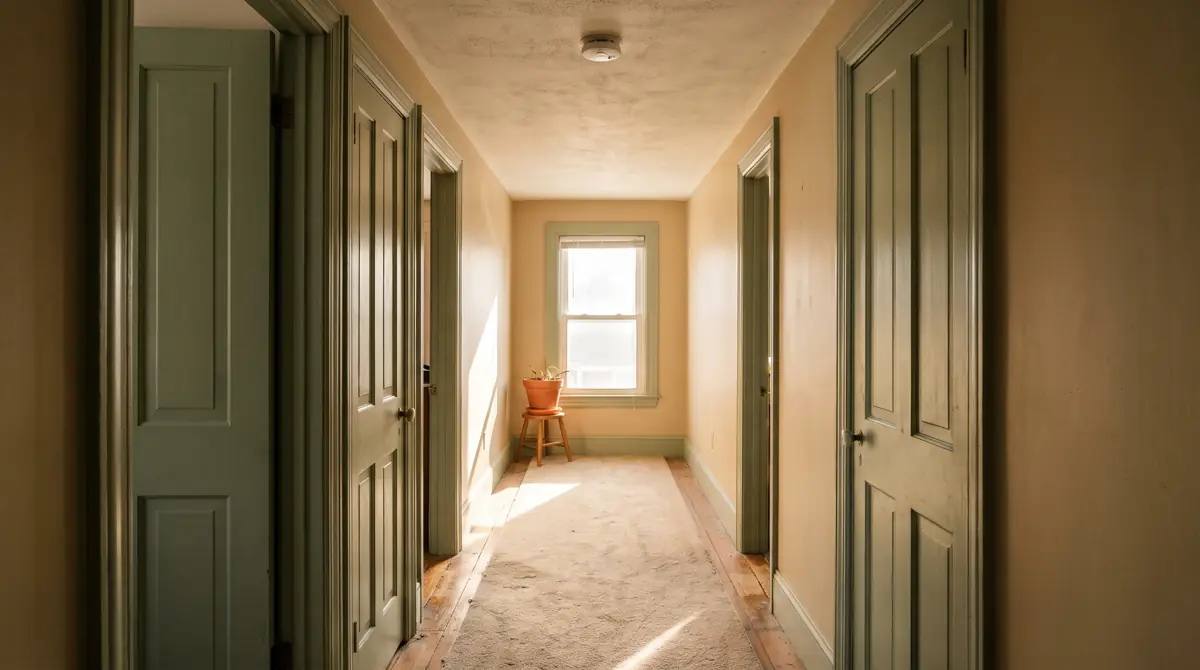
A permitted kitchen remodel can pull the whole house up to new-home alarm rules
R314.2.2 ties alarm upgrades to permits, not to the room being remodeled.
Under R314.2.2, where alterations, repairs or additions requiring a permit occur, or a sleeping room is added, each dwelling unit must be equipped with smoke alarms as required for new dwellings. A kitchen remodel with a building permit therefore reaches the bedrooms and hallways too.
- Exempt: exterior work such as roofing, siding, windows, doors, porches and decks.
- Exempt: installation, alteration or repair of plumbing, electrical or mechanical systems alone.
- Relief: alarms added under R314.2.2 may be battery powered (R314.6 exception 2) and need not be interconnected with existing alarms that cannot be interconnected (R314.4 exception).
Maryland writes its own version into statute: placement in one- and two-family homes must be upgraded when existing alarms exceed 10 years from the date of manufacture, fail testing, or when a building permit is issued for an alteration. Homes built before 1975 may use battery alarms, but only sealed, tamper-resistant long-life units with a hush button (Maryland Public Safety 9-104).
No alarm within 10 feet of the range, and only cooking-resistant models out to 20 feet
The kitchen distance rule lives in NFPA 72, which R314.1 references. Its dates moved twice.
NFPA 72 (2022 edition), section 29.11.3.4, sets a 10 ft radial exclusion zone around a stationary or fixed cooking appliance. Alarms may go between 6 and 10 ft only when the exclusion zone would block a required alarm and no partitions or headers separate the kitchen from adjacent spaces. Between 10 and 20 ft, alarms must be listed for resistance to cooking nuisance under UL 217 8th edition or later (NFPA 72 TIA 22-4).
That listing requirement was first dated May 1, 2022, moved to January 1, 2023 by TIA 22-3 (issued August 26, 2021), then to January 1, 2025 by TIA 22-4 (issued August 12, 2022). Before those dates a photoelectric alarm or one with a silencing means was acceptable in the 10 to 20 ft band.
| Distance from fixed cooking appliance | NFPA 72 rule (2022 edition) | Date in force | Source |
|---|---|---|---|
| Under 6 ft | No smoke alarm or detector | Edition text | NFPA 72 TIA 22-3 |
| 6 to 10 ft | Only when the 10 ft exclusion would block a required alarm and no partitions or headers separate the spaces; device must be listed for cooking nuisance resistance | 2025-01-01 (photoelectric allowed before) | NFPA 72 TIA 22-4 |
| 10 to 20 ft | Device must be listed for cooking nuisance resistance (UL 217 8th edition or later) | 2025-01-01 (photoelectric or hush allowed before) | NFPA 72 TIA 22-4 |
| Over 20 ft | No cooking-specific restriction in 29.11.3.4 items 4 and 5 | Edition text | NFPA 72 TIA 22-3 |
Distances are measured along a horizontal flow path. NFPA 72 applies through the IRC reference in R314.1 or through state adoption.
Source: [10][11] National Fire Protection Association (NFPA); National Fire Protection Association (NFPA)
Cooking is the leading cause of home fires; the counts are in our kitchen fire statistics report. Range hood capture also affects nuisance smoke; see range hood CFM.
Twelve states now require sealed 10-year batteries, covering 42.6 percent of Americans
Coverage grew in three jumps: California in 2014, New Jersey and New York in 2019, Illinois in 2023. Connecticut's sale ban took effect October 1, 2025.
We compiled every statewide rule that requires 10-year sealed or tamper-resistant batteries in battery-only smoke alarms and reaches one- and two-family homes, then weighted each state by its Census population. On November 15, 2026, those 12 states hold 145.5 million people, 42.6 percent of the 50 states and DC. In 2010 the share was 1.2 percent (Oregon only), a gain of 41.4 percentage points.
Rule in force on July 1 of each year (2026: November 15), share of 50-state plus DC population
Source: KBR analysis of BRK and Kidde state law guides, Florida and Maryland statutes, Census Vintage 2020 and 2025 estimates
A narrower group bans the retail sale of battery-only alarms without a sealed 10-year battery: California (July 1, 2014), Maryland (October 2018), New York (April 1, 2019) and Connecticut (October 1, 2025, Public Act 25-123). Those four states hold 69.3 million people, 20.3 percent of the U.S. The other 8 rules work at installation, at sale or lease of a home, or for rentals only.
| Effective | State | What the rule requires | Rule type | Evidence | Population 2025 (millions) |
|---|---|---|---|---|---|
| 1998-01-01 | Oregon | Battery-only ionization alarms sold must have a 10-year battery and hush feature | partial sale rule | corroborated (BRK and Kidde guides) | 4.3 |
| 2011-01-01 | Louisiana | Existing one- and two-family homes need at least one 10-year alarm at lease or sale | point of sale or lease | corroborated (BRK and Kidde guides) | 4.6 |
| 2013-01-01 | North Carolina | Rental homes only: battery-only alarms installed or replaced must be 10-year | rentals only | corroborated (BRK and Kidde guides) | 11.2 |
| 2013-07-01 | Maryland | Rentals and changes of occupancy first; owner-occupied homes by 2018-01-01; sealed long-life units only where battery alarms are allowed | installation | statute text (Maryland statute) | 6.3 |
| 2014-07-01 | California | Battery-only smoke alarms sold or installed must have a 10-year non-removable battery | sale | corroborated (BRK and Kidde guides) | 39.4 |
| 2015-01-01 | Florida | Newly installed or replacement battery alarms in one- and two-family homes and townhomes under repair or level 1 alteration | installation | statute text (Florida statute) | 23.5 |
| 2016-12-01 | Massachusetts | Homes built or modified before 1975: 10-year photoelectric alarms before sale | point of sale | corroborated (BRK and Kidde guides) | 7.2 |
| 2019-01-01 | New Jersey | 10-year sealed battery alarms required unless hardwired alarms are installed | point of sale | corroborated (BRK and Kidde guides) | 9.5 |
| 2019-04-01 | New York | All battery-operated smoke and combination alarms sold must be 10-year sealed | sale | corroborated (BRK and Kidde guides) | 20.0 |
| 2022-07-01 | Iowa | 10-year sealed battery alarms for battery-only installations; centralized systems excepted | installation | corroborated (BRK and Kidde guides) | 3.2 |
| 2023-01-01 | Illinois | Battery alarms in all dwelling units must be 10-year sealed; wireless interconnect excepted | installation | corroborated (BRK and Kidde guides) | 12.7 |
| 2025-10-01 | Connecticut | Battery-only alarms sold in the state must have a sealed battery lasting at least 10 years (Public Act 25-123) | sale | corroborated (BRK guide, Intertek) | 3.7 |
Rules that reach one- and two-family homes through sale bans, installation rules or point-of-sale and lease rules. Multifamily-only, school-only and city ordinances are left out. Evidence: statute text where opened; otherwise corroborated by two manufacturer guides.
Source: [4][17][5][6][7][16][1] BRK (Resideo Technologies); Kidde; The Florida Legislature; Florida Department of State; Maryland General Assembly; Intertek; U.S. Census Bureau, Population Estimates Program
Millions of residents, July 1, 2025
Source: U.S. Census Bureau Vintage 2025 estimates; state list from KBR timeline
| Year | States with any rule | Population covered (millions) | Share of U.S. (%) | States with sale ban | Sale-ban share (%) |
|---|---|---|---|---|---|
| 2010 | 1 | 3.8 | 1.2 | 0 | 0.0 |
| 2011 | 2 | 8.4 | 2.7 | 0 | 0.0 |
| 2012 | 2 | 8.5 | 2.7 | 0 | 0.0 |
| 2013 | 4 | 24.3 | 7.7 | 0 | 0.0 |
| 2014 | 5 | 63.1 | 19.8 | 1 | 12.1 |
| 2015 | 6 | 83.8 | 26.1 | 1 | 12.1 |
| 2016 | 6 | 84.7 | 26.2 | 1 | 12.1 |
| 2017 | 7 | 92.3 | 28.4 | 1 | 12.1 |
| 2018 | 7 | 92.9 | 28.4 | 1 | 12.1 |
| 2019 | 9 | 121.6 | 37.0 | 3 | 19.8 |
| 2020 | 9 | 123.0 | 37.1 | 3 | 19.9 |
| 2021 | 9 | 122.7 | 37.0 | 3 | 19.6 |
| 2022 | 10 | 126.5 | 37.9 | 3 | 19.5 |
| 2023 | 11 | 140.1 | 41.6 | 3 | 19.4 |
| 2024 | 11 | 141.4 | 41.6 | 3 | 19.3 |
| 2025 | 11 | 141.8 | 41.5 | 3 | 19.2 |
| 2026 | 12 | 145.5 | 42.6 | 4 | 20.3 |
A state counts in a year if its rule was in force on July 1 (2026: November 15). Population: Census July 1 estimates; 2026 uses Vintage 2025. Denominator: 50 states and DC.
Source: [1][2][4][17] U.S. Census Bureau, Population Estimates Program; U.S. Census Bureau, Population Estimates Program; BRK (Resideo Technologies); Kidde
The other 57.4 percent of Americans, 196.3 million people, live in states with no statewide 10-year battery rule for houses, although some cities have one (BRK lists New York City, Houston, Phoenix, Philadelphia, Denver and others). Georgia and Wisconsin apply 10-year rules to multifamily buildings only, and Pennsylvania to schools only. Carbon monoxide alarm rules are tracked separately in our carbon monoxide detector requirements registry.
Hardwired alarms worked in 94 percent of fires, battery-only alarms in 85 percent
NFPA's 2018 to 2022 data explain why states push sealed batteries: dead or missing batteries are the most common reason alarms stay silent.
NFPA estimates that smoke alarms were present in 74 percent of reported home fires in 2018 to 2022. Fires in homes with no smoke alarms caused 43 percent of home fire deaths and fires where alarms failed to operate caused 16 percent, together 59 percent.
Hardwired alarms operated in 94 percent of fires large enough to trigger them; battery-only alarms operated in 85 percent. By our arithmetic, battery-only alarms failed 2.5 times as often as hardwired ones. Homes with battery-only alarms accounted for 66 percent of deaths in homes that had smoke alarms. NFPA names missing or disconnected batteries, dead batteries and disconnected hardwired alarms as the most common failure factors.
Percent lower death rate per 1,000 reported home fires vs no alarms or sprinklers, 2018 to 2022
Source: NFPA, Smoke Alarms in US Home Fires (2018 to 2022 data)
| Measure (US, 2018 to 2022 average) | Value (%) |
|---|---|
| Home fires with smoke alarms present | 74 |
| Home fire deaths: no smoke alarm | 43 |
| Home fire deaths: alarm present but failed to operate | 16 |
| Hardwired alarms that operated | 94 |
| Battery-only alarms that operated | 85 |
| Deaths in homes with alarms that had battery-only alarms | 66 |
| Death rate cut: battery alarms, no sprinklers | 30 |
| Death rate cut: any alarm, no sprinklers | 50 |
| Death rate cut: hardwired, no sprinklers | 67 |
| Death rate cut: hardwired with battery, no sprinklers | 71 |
| Death rate cut: alarm plus sprinklers | 90 |
Annual averages. Operation rates are for fires large enough to trigger an alarm. Death rate cuts compare fires with the stated protection to fires with no alarms and no automatic extinguishing system.
Source: [9] National Fire Protection Association (NFPA)
5.6 million occupied homes report no working smoke detector
The 2023 American Housing Survey asks each household whether the home has a working smoke detector.
Weighted AHS 2023 microdata put the share of occupied homes with a working smoke detector at 95.8 percent (standard error 0.12 points). The other 4.2 percent equals about 5.6 million of 132.5 million occupied homes.
Age matters more than tenure. Homes built before 1980 report 94.7 percent, 3.5 points below homes built 2000 to 2009 (98.2 percent). Owner-occupied homes report 96.0 percent and renter-occupied homes 95.7 percent.
Percent of occupied U.S. homes, American Housing Survey
Source: KBR analysis of the AHS 2023 national public use file (SMOKALRM, weighted)
| Group (US, 2023) | Working smoke detector (%) | Standard error (pts) | Homes (millions) |
|---|---|---|---|
| All occupied homes | 95.8 | 0.12 | 132.5 |
| Built before 1980 | 94.7 | 0.17 | 66.3 |
| Built 1980 to 1999 | 96.0 | 0.24 | 33.6 |
| Built 2000 to 2009 | 98.2 | 0.21 | 17.7 |
| Built 2010 or later | 97.6 | 0.3 | 15.0 |
| Owner-occupied | 96.0 | 0.13 | 86.4 |
| Renter-occupied | 95.7 | 0.2 | 44.1 |
Weighted with WEIGHT; standard errors from 160 replicate weights. 253 occupied records with no answer dropped.
Source: [3] U.S. Census Bureau and HUD
UL 217's cooking test arrived 1502 days after its first effective date
The 8th edition of UL 217 added flaming and smoldering polyurethane foam tests and a cooking nuisance test, but its start date slipped by 4.1 years.
A November 18, 2019 CPSC staff letter to UL cites a May 20, 2020 effective date and backs moving it to June 30, 2021. The requirements took effect for alarms being tested as of June 30, 2024, according to UL Research Institutes and NIST.
In the cooking test, two hamburger patties are broiled 10 feet from the alarm; the alarm passes if it stays quiet (NIST). NIST reports that none of 45 previous-generation alarms it tested in 2016 could pass the new standard, and that in its 2024 kitchen tests the new alarms were not universally better at ignoring cooking than older ones.
Ionization vs photoelectric: Ionization alarms react faster to flaming fires; photoelectric alarms react faster to smoldering fires. UL 217 8th edition tests every listed alarm against both fire types, and NFPA 72 (2022) now asks for a cooking nuisance listing near kitchens rather than naming a sensor type.
| Date | Event | Source |
|---|---|---|
| 2015-10-30 | UL 217 8th edition revision date listed in the certification notice | Intertek SUN |
| 2016-11-23 | UL 217 8th edition revision date listed in the certification notice | Intertek SUN |
| 2019-11-18 | CPSC staff letter backs moving the effective date from 2020-05-20 to 2021-06-30 | CPSC |
| 2021-08-26 | NFPA 72 TIA 22-3 sets 2023-01-01 for cooking-nuisance listing near kitchens | NFPA |
| 2022-02-09 | UL 217 9th edition revision date | Intertek SUN |
| 2022-08-12 | NFPA 72 TIA 22-4 moves the kitchen date to 2025-01-01 | NFPA |
| 2024-06-30 | UL 217 8th edition requirements take effect for alarms being tested | UL, NIST, Intertek |
| 2025-01-01 | NFPA 72 (2022) cooking-nuisance listing date for alarms 6 to 20 ft from cooking | NFPA |
Dates as stated in each source.
Source: [10][11][12][13][14][15] National Fire Protection Association (NFPA); National Fire Protection Association (NFPA); U.S. Consumer Product Safety Commission; UL Research Institutes; National Institute of Standards and Technology (NIST); Intertek
Momentum and share analysis
Population share under a statewide 10-year sealed-battery rule (signature)
Formulasum of July 1, 2025 population of the 12 rule states / population of 50 states and DC x 100; for 2010 to 2025, rules in force on July 1 and that year's estimate
Inputs: fact sheet rows 1 to 25; table t2 (fact sheet rows)
Result: 42.6 percent (145.5 million) on 2026-11-15; 1.2 percent in 2010
Sealed-battery rules now reach roughly two in five Americans, mostly through five large states: California, Florida, New York, Illinois and North Carolina.
Limitations: Rules differ in scope (sale bans, installation rules, point of sale, rentals only); counting a state does not mean every home in it has a sealed-battery alarm. State list depends on manufacturer guides where statutes could not be opened.
Retail sale-ban share
Formulasum of 2025 population of CA, MD, NY, CT / U.S. population x 100
Inputs: rows 4, 5, 9, 12 and their population rows (fact sheet rows)
Result: 20.3 percent (69.3 million)
Only in these states is a shopper unable to buy a replaceable-battery alarm off the shelf.
Limitations: Online cross-border sales are not measured.
Battery-only vs hardwired failure ratio
Formula(100 - 85) / (100 - 94)
Inputs: NFPA rows on operation rates (fact sheet rows)
Result: 2.5
Battery-only alarms failed to sound about two and a half times as often as hardwired ones in fires big enough to trigger them.
Limitations: Not adjusted for home age, income or occupant factors.
Homes without a working smoke detector
Formula132.5 million x (100 - 95.8) / 100
Inputs: AHS rows (fact sheet rows)
Result: 5.6 million homes
Survey gaps cluster in older homes, the same stock most often remodeled.
Limitations: Self-reported; the AHS does not test alarms.
UL 217 8th edition delay
Formula2024-06-30 minus 2020-05-20
Inputs: UL timeline rows (fact sheet rows)
Result: 1502 days (4.1 years)
Cooking-resistant alarms reached shelves more than four years after the first planned date.
Limitations: Retailers may still sell earlier-listed stock (NIST).
Findings to track
- 42.6 percent of the 50-state plus DC population (145.5 million people) lived under a statewide 10-year sealed-battery smoke alarm rule on November 15, 2026 (KBR analysis).[1][4][17]
- That share was 1.2 percent in 2010, 19.8 percent in 2014 and 37.0 percent in 2019.[1][2][4]
- Retail sale bans in California, Maryland, New York and Connecticut cover 20.3 percent of Americans (69.3 million), 2026.[1][4][16][17]
- 57.4 percent of Americans (196.3 million) live in states with no statewide 10-year battery rule for houses, 2026.[1][4]
- Florida has required newly installed or replacement battery alarms in one- and two-family homes under repair or level 1 alteration to have a 10-year nonremovable battery since January 1, 2015.[5][6]
- In Maryland, one- and two-family homes must upgrade alarm placement when alarms exceed 10 years from manufacture or a permit is issued for an alteration.[7]
- IRC R314.2.2 (2021 text as adopted in Washington) requires whole-dwelling alarms as for new homes when permitted alterations, repairs or additions occur.[8]
- NFPA 72 (2022) sets a 10 ft exclusion zone around fixed cooking appliances and a cooking-nuisance listing requirement out to 20 ft effective January 1, 2025.[10][11]
- Smoke alarms were present in 74 percent of reported U.S. home fires, 2018 to 2022.[9]
- No smoke alarm (43 percent) or a failed alarm (16 percent) accounted for 59 percent of U.S. home fire deaths, 2018 to 2022.[9]
- Hardwired alarms operated in 94 percent and battery-only alarms in 85 percent of U.S. home fires large enough to trigger them, 2018 to 2022.[9]
- Hardwired alarms with battery backup were tied to a 71 percent lower death rate per 1,000 home fires than no protection, 2018 to 2022.[9]
- 95.8 percent of occupied U.S. homes reported a working smoke detector in 2023; homes built before 1980 reported 94.7 percent.[3]
- UL 217 8th edition took effect June 30, 2024, 1502 days after the May 20, 2020 date cited by CPSC staff in 2019.[12][13]
Questions people ask
How far should a smoke detector be from the kitchen?
NFPA 72 (2022) keeps smoke alarms out of a 10 ft radius around a fixed cooking appliance. Between 6 and 10 ft is allowed only when no wall or header separates the kitchen and the alarm is listed for cooking nuisance. From 10 to 20 ft, alarms installed since January 1, 2025 must carry that listing (UL 217 8th edition or later).
Do smoke detectors need to be hardwired?
In new homes, yes: IRC R314.6 requires primary power from building wiring with battery backup. Battery-only alarms are allowed where there is no commercial power and for alarms added to existing homes during permitted remodels under R314.2.2.
How long do smoke detectors last?
Maryland law treats alarms more than 10 years past their manufacture date as due for upgrade, and the state sealed-battery laws in our timeline require batteries rated for 10 years. NFPA data show dead or missing batteries are a leading reason alarms fail.
Do I have to upgrade smoke alarms when remodeling?
Under IRC R314.2.2, any alteration, repair or addition that needs a permit requires the whole dwelling to get alarms as for a new home. Exterior-only work and plumbing, electrical or mechanical work alone are exempt. Added alarms may be battery powered and need not be interconnected with existing alarms that cannot be.
Download the data
Every table in this report is available as a CSV under CC BY 4.0. The fact sheet lists each value with its source URL and access date.
- derived_metrics.csv (CSV)
- fact_sheet.csv (CSV)
- t1_sealed_battery_timeline.csv (CSV)
- t2_population_covered_by_year.csv (CSV)
- t3_r314_rules.csv (CSV)
- t4_kitchen_distance_zones.csv (CSV)
- t5_nfpa_alarm_outcomes.csv (CSV)
- t6_ahs_working_alarm.csv (CSV)
- t7_ul217_timeline.csv (CSV)
For journalists and researchers
If you cite only a few, cite these
- 42.6 percent of Americans (145.5 million) live under a statewide 10-year sealed-battery smoke alarm rule, November 15, 2026.[1][4][17]
- NFPA 72 (2022) bars smoke alarms within 10 ft of a fixed cooking appliance and requires cooking-nuisance-listed alarms out to 20 ft from January 1, 2025.[11]
- 95.8 percent of occupied U.S. homes reported a working smoke detector in 2023.[3]
Most quotable statistics
- 42.6 percent of Americans live in a state with a statewide 10-year sealed-battery smoke alarm rule as of November 15, 2026, up from 1.2 percent in 2010 (KBR analysis of state laws and Census estimates).[1][2][4][17]
- Only four states, holding 20.3 percent of Americans, ban retail sale of battery-only smoke alarms without a sealed 10-year battery.[1][4][16]
- Battery-only smoke alarms operated in 85 percent of U.S. home fires large enough to trigger them in 2018 to 2022, vs 94 percent for hardwired alarms.[9]
- 59 percent of U.S. home fire deaths in 2018 to 2022 occurred with no smoke alarm or one that failed to operate.[9]
- About 5.6 million occupied U.S. homes reported no working smoke detector in 2023 (AHS, KBR analysis).[3]
- UL 217's cooking nuisance test took effect June 30, 2024, 1502 days after the first planned date.[12][13]
Press summary
Sealed 10-year battery smoke alarm laws now reach 42.6 percent of Americans, according to a Kitchen and Bath Renovators analysis of state laws and Census population estimates. Twelve states had a statewide rule reaching one- and two-family homes on November 15, 2026, up from one state, Oregon, covering 1.2 percent of the population in 2010. Coverage jumped when California's sale ban took effect in 2014, when New Jersey and New York acted in 2019, and when Illinois followed in 2023. Connecticut became the 12th state on October 1, 2025. Only four states, holding 20.3 percent of the population, ban retail sale of other battery-only alarms. NFPA data for 2018 to 2022 show battery-only alarms sounded in 85 percent of qualifying fires, against 94 percent for hardwired units. The 2023 American Housing Survey puts homes without a working detector at 5.6 million. The report also covers IRC R314 placement, the remodel permit trigger and the NFPA 72 10 ft kitchen exclusion zone.
Suggested headlines
- Sealed 10-year smoke alarm laws now cover 42.6 percent of Americans
- Twelve states require 10-year battery smoke alarms; most Americans still live outside them
- Battery-only smoke alarms fail 2.5 times as often as hardwired ones, NFPA data show
- 5.6 million U.S. homes report no working smoke detector
- New smoke alarm rules keep detectors 10 feet from the stove
How to cite this report
Kitchen and Bath Renovators. (2026). Smoke Detector Requirements: Where Alarms Go and the 10-Year Battery Laws. Retrieved from https://kitchenandbathrenovators.com/research/smoke-detector-requirements/
Reuse license
Data and tables are licensed CC BY 4.0. Attribution: “Source: Kitchen and Bath Renovators, Smoke Detector Requirements: Where Alarms Go and the 10-Year Battery Laws” with a link to this page.
Frequently asked questions
Which states require 10-year sealed battery smoke alarms?
Our timeline counts 12 states with statewide rules reaching homes on November 15, 2026: Oregon, Louisiana, North Carolina, Maryland, California, Florida, Massachusetts, New Jersey, New York, Iowa, Illinois and Connecticut.
What share of Americans live under a sealed-battery law?
42.6 percent, or 145.5 million people, based on Census Vintage 2025 population estimates (KBR analysis).
Which states ban selling regular battery smoke alarms?
California (2014), Maryland (2018), New York (2019) and Connecticut (2025) restrict sales of battery-only alarms to sealed 10-year units. Together they hold 20.3 percent of the U.S. population.
Where are smoke alarms required in a house?
IRC R314.3: in each sleeping room, outside each separate sleeping area near the bedrooms and on each additional story, including basements and habitable attics, and not less than 3 feet from a bathroom door with a tub or shower.
Do smoke alarms have to be interconnected?
Yes, where more than one is required (IRC R314.4). Listed wireless alarms satisfy the rule, and alarms added in a remodel need not link to existing alarms that cannot be interconnected.
How many home fire deaths happen without working smoke alarms?
NFPA estimates 59 percent of U.S. home fire deaths in 2018 to 2022 occurred in homes with no smoke alarm (43 percent) or alarms that failed to operate (16 percent).
Are hardwired smoke alarms more reliable than battery ones?
In NFPA's 2018 to 2022 data, hardwired alarms operated in 94 percent of qualifying fires and battery-only alarms in 85 percent.
What is the UL 217 8th edition cooking test?
Two hamburger patties are broiled 10 feet from the alarm, which must not sound (NIST). The edition took effect June 30, 2024 for alarms being tested.
Are ionization smoke alarms banned near kitchens?
NFPA 72 (2022) no longer sets rules by sensor type near kitchens; from January 1, 2025 it requires a cooking nuisance listing for alarms 6 to 20 ft from a fixed cooking appliance.
How many homes lack a working smoke detector?
About 5.6 million occupied U.S. homes, 4.2 percent, reported no working smoke detector in the 2023 American Housing Survey (KBR analysis).
Reproduce this analysis
Every figure comes from the files below. The scripts that pulled and computed them are kept with the report and can be re-run.
| Dataset | Publisher | Source | Query or filter | Rows used | Retrieved |
|---|---|---|---|---|---|
| County population totals Vintage 2025, state rows | U.S. Census Bureau | File or endpoint | SUMLEV 040, POPESTIMATE2020 to POPESTIMATE2025; read from shared copy .tmp/datasets/popest/co-est2025-alldata.csv | 51 state rows (50 states and DC) | 2026-11-15 |
| County intercensal estimates Vintage 2020, state rows | U.S. Census Bureau | File or endpoint | SUMLEV 040, POPESTIMATE2010 to POPESTIMATE2019; shared copy .tmp/datasets/popest/co-est2020-alldata.csv | 51 state rows | 2026-11-15 |
| AHS 2023 National PUF v1.1, household.csv | U.S. Census Bureau and HUD | File or endpoint | INTSTATUS = 1 and SMOKALRM in (1, 2); WEIGHT and REPWEIGHT1 to 160; shared copy .tmp/datasets/ahs/AHS_2023_National_PUF_v1.1_CSV.zip (scripts/02_ahs_smoke.py) | 48274 occupied housing unit records | 2026-11-15 |
| 10-Year Smoke Legislation Guide | BRK (Resideo) | File or endpoint | Statewide rows in the single-family and battery-alarms-sold columns | 12 statewide entries used of 24 listed | 2026-11-15 |
| Fire Safety Laws state summary | Kidde | File or endpoint | State paragraphs mentioning 10-year or sealed batteries | 10 states cross-checked | 2026-11-15 |
Data quality and exclusions
- AHS: 55669 household records; 7142 non-interview or vacant records removed (INTSTATUS not 1); 253 occupied records with SMOKALRM not reported removed; 48274 records used.
- State rules: 24 BRK rows reviewed; 9 city rows and 3 non-single-family state rows (Georgia, Wisconsin, Pennsylvania) excluded, leaving 12 statewide rules.
- Two date conflicts (Iowa, North Carolina) resolved to the later date; Maryland enters the sale-ban series on its October 2018 sale date, not its 2013 rental date.
- Oregon's 1998 rule covers only battery-only ionization alarms; it is counted in the any-rule series and excluded from the sale-ban series.
Methodology
Selection: statewide statutes or regulations that require a sealed, non-removable or tamper-resistant battery rated for 10 years in battery-only smoke alarms and that reach one- and two-family homes through a sale ban, an installation rule, a point-of-sale or lease rule, or a rentals-only rule. Multifamily-only rules (Georgia, Wisconsin), school-only rules (Pennsylvania) and city ordinances are excluded from the count.
Evidence: Florida and Maryland statutes were opened on official legislature sites. For the other ten states the official statute sites refused or timed out on November 15, 2026, so each entry is marked corroborated only where two independent manufacturer compilations (BRK, REV 08/25; Kidde) agree; Connecticut is corroborated by BRK and Intertek, which cites Public Act 25-123.
Conflicts: Iowa is dated June 2021 by BRK and July 1, 2022 by Kidde; North Carolina December 2012 by BRK and January 1, 2013 by Kidde. We used the later date in both cases, which lowers 2021 coverage by 0.9 points and changes no other year.
Population weighting: a state counts in year Y if its rule was in force on July 1 of Y, matching the Census July 1 estimate date (Vintage 2020 file for 2010 to 2019, Vintage 2025 for 2020 to 2025). The 2026 value uses rules in force on November 15, 2026 and the 2025 estimate. Denominator: the 50 states plus DC.
AHS: share of occupied, interviewed homes (INTSTATUS 1) answering yes to SMOKALRM, weighted by WEIGHT with 160 replicate weights for standard errors. Records with no answer were dropped.
Codes: IRC R314 text is quoted from Washington's adopted 2021 IRC chapter because the ICC public code site did not respond; NFPA 72 text is from the two TIAs that amend 29.11.3.4. Last updated November 15, 2026.
This report presents published data with its limitations. It is not legal, financial or investment advice.
Sources, ranked by quality
Tier 1: primary and official sources (13)
- [1] U.S. Census Bureau, Population Estimates Program. County population totals and components of change, Vintage 2025 (co-est2025-alldata, state rows). July 1, 2020 to July 1, 2025. Accessed 2026-11-15.
- [2] U.S. Census Bureau, Population Estimates Program. County intercensal tables and estimates, Vintage 2020 (co-est2020-alldata, state rows). July 1, 2010 to July 1, 2019. Accessed 2026-11-15.
- [3] U.S. Census Bureau and HUD. American Housing Survey 2023 National Public Use File v1.1 (household.csv). 2023 survey. Accessed 2026-11-15.
- [5] The Florida Legislature. Florida Statutes section 553.883, Smoke alarms in one-family and two-family dwellings and townhomes. 2026 Florida Statutes. Accessed 2026-11-15.
- [6] Florida Department of State. Laws of Florida chapter 2014-154 (creating s. 553.883). 2014 session law. Accessed 2026-11-15.
- [7] Maryland General Assembly. Maryland Code, Public Safety section 9-104, smoke alarms in residential occupancies. Current statute text. Accessed 2026-11-15.
- [8] Washington State Legislature. WAC 51-51-0314, Section R314 Smoke alarms and heat detection (Washington adoption of the 2021 IRC). Effective March 16, 2024 (certified March 27, 2024). Accessed 2026-11-15.
- [9] National Fire Protection Association (NFPA). Smoke Alarms in US Home Fires (Tucker McGree). 2018 to 2022 annual averages (page updated 2026-02-04). Accessed 2026-11-15.
- [10] National Fire Protection Association (NFPA). NFPA 72 (2022 edition) Tentative Interim Amendment 22-3, section 29.11.3.4. Issued August 26, 2021. Accessed 2026-11-15.
- [11] National Fire Protection Association (NFPA). NFPA 72 (2022 edition) Tentative Interim Amendment 22-4, section 29.11.3.4. Issued August 12, 2022. Accessed 2026-11-15.
- [12] U.S. Consumer Product Safety Commission. CPSC staff letter to UL on the proposed effective date extension for ANSI/UL 217, 8th edition. Letter dated November 18, 2019. Accessed 2026-11-15.
- [13] UL Research Institutes. UL Research Institutes, UL Standards & Engagement and UL Solutions highlight new smoke alarm and detector requirements. Press release dated October 11, 2024. Accessed 2026-11-15.
- [14] National Institute of Standards and Technology (NIST). New Smoke Alarms Are Better at Detecting Fires but Still Beep for Bacon. Released September 18, 2024, updated February 4, 2025. Accessed 2026-11-15.
Tier 2: trade bodies, market research, company data (4)
- [4] BRK (Resideo Technologies). 10-Year Smoke Legislation Guide: effective dates by property type (REV 08/25). Laws in force as of August 2025. Accessed 2026-11-15.
- [15] Intertek. Standards Update Notice, UL 217 Amendment 1 (issued June 21, 2022). Issued June 21, 2022. Accessed 2026-11-15.
- [16] Intertek. Connecticut Enacts New Rules on Battery-Powered Smoke Detectors/Alarms. Published October 30, 2025. Accessed 2026-11-15.
- [17] Kidde. Fire Safety Laws (state-by-state smoke and CO alarm summary). Current page. Accessed 2026-11-15.