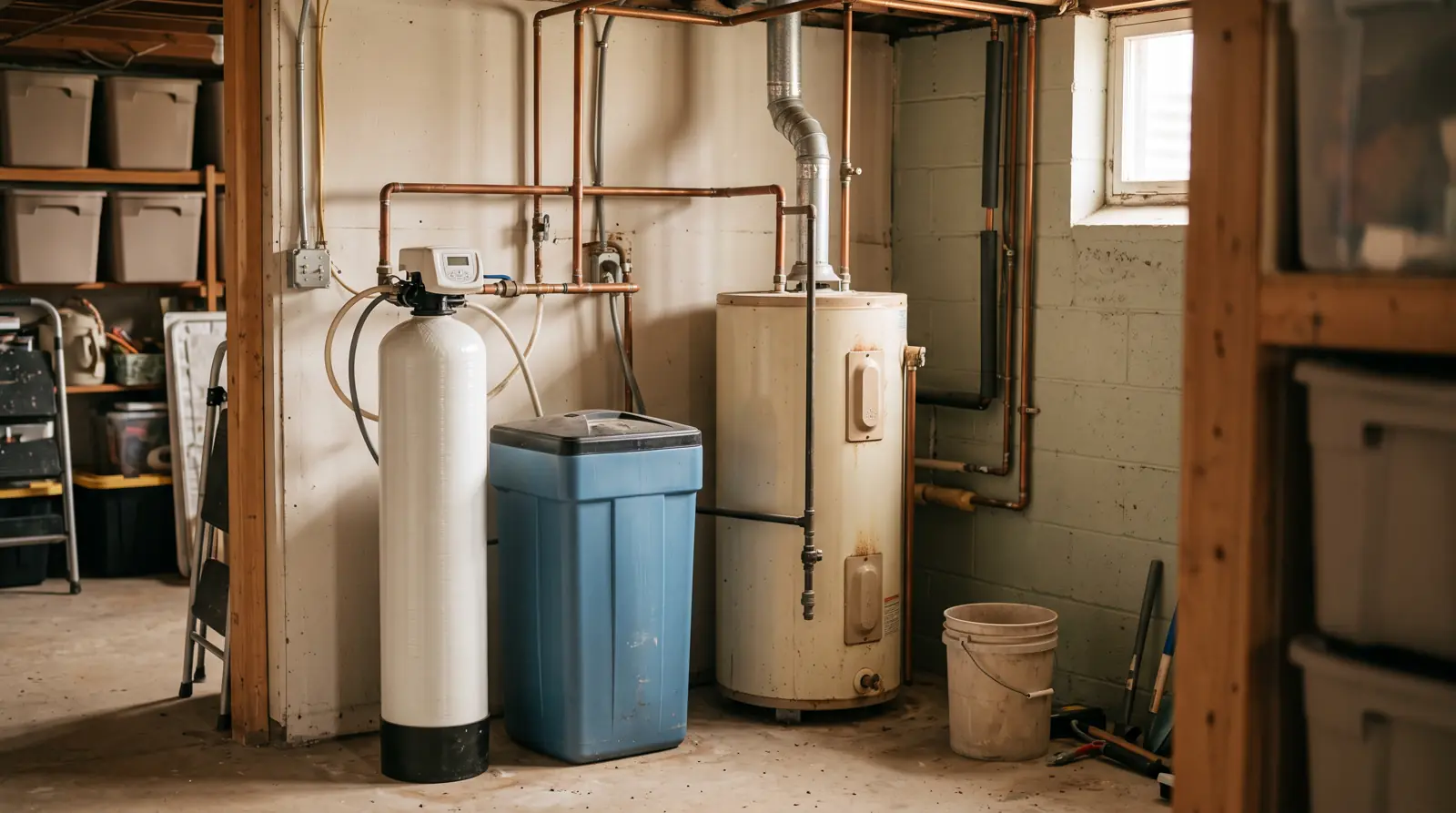
How Long Do Water Softeners Last? Resin, Valves and the Hardness Factor
- Primary data
- KBR softener load model built from ACS 2025 1-year table B25010, the KBR hard water map and WRF REU2016, plus a 15-line manufacturer warranty registry
- Data period
- ACS 2025; utility hardness reports 2021 to 2026; warranty documents 2008 to 2026
- Latest release used
- 2026-10-29
- Next release
- ACS 2026 1-year, expected autumn 2027
- Geography
- 39 large US cities; California, Texas and named local agencies for rules
- Sources
- 27 (14 Tier 1)
Warranties give the firmest answer to how long do water softeners last: across 11 salt-based product lines, the median tank warranty is 10 years and the median control valve warranty 5 years. Hardness and household size set the workload: a modeled San Antonio, TX softener regenerates 80.9 times a year, a Portland one 2.0.
How long do water softeners last? Tanks carry a median 10-year warranty, valves 5
The US Department of Energy publishes lifetime estimates for water heaters and refrigerators; KBR found no federal survival estimate for water softeners. The firmest public evidence is what makers will stand behind in writing.
KBR read warranty documents for 15 product lines from 8 warrantors, dated 2008 to 2026. Across the 11 salt-based lines that state both a tank and a control valve term, the median tank warranty is 10 years and the median control valve warranty is 5 years. The tank is the passive part; the valve, motor and board do the moving.
| Product line | Warrantor | Type | Tank (years) | Control valve (years) | Electronics (years) | Resin or media | Document date | Source |
|---|---|---|---|---|---|---|---|---|
| Kinetico Premier Series and Premier XP | Kinetico | Salt-based, non-electric | 10 | 10 | n/a (non-electric) | 10 years if oxidizers are pretreated | 2021-05-26 | kin |
| Kinetico Signature and Essential Series | Kinetico | Salt-based | 5 | 5 | n/a | 5 years if oxidizers are pretreated | 2021-05-26 | kin |
| Kinetico Powerline PRO | Kinetico | Salt-based, electric | 10 | 5 | 1 (seals and electronic valve parts) | No warranty on resin | 2021-05-26 | kin |
| Whirlpool WHES40 and WHES44 | Ecodyne Water Systems | Salt-based | 10 | 1 (all parts, full) | 3 | Not stated | 2017 | whr |
| GE water softeners | GE Appliances | Salt-based | 10 (brine tank) | 1 (entire appliance) | 3 | Not stated | current page | ge |
| Kenmore Elite 625.384260 and 625.394260 | Sears | Salt-based | 10 (leaks) | 1 (unit) | 3 | Excluded (expendable) | 2008-11-12 | ken |
| Aquasana SimplySoft WH-SF40 and WH-SF60 | Aquasana | Salt-based | 10 | 5 | Within valve | Excluded (wear item) | 2025-09 | aqw |
| Pentair WaterTrust Pro Series | Pentair | Salt-based | 10 | 10 | 5 | 5 | 2026-08 | pen |
| Pentair POE tank systems | Pentair | Salt-based | 5 | 5 | 5 | Not stated | 2026-08 | pen |
| OmniFilter softening systems | Pentair | Salt-based | 10 | 10 | 5 | Not stated | 2026-08 | pen |
| Hague Maximizer 96MM and 6MM | Hague Quality Water International | Salt-based | 15 | 15 | Not stated | Not stated | current page | hag |
| Fleck control valves | Pentair | Valve only | 5 | 2026-08 | pen | |||
| Autotrol control valves (Magnum series 3) | Pentair | Valve only | 5 | 2026-08 | pen | |||
| Structural PolyGlass tanks, US-made, 13 inch or less (14 inch or more: 5) | Pentair | Tank only | 10 | 2026-08 | pen | |||
| SpringWell FutureSoft | SpringWell Water | Salt-free (TAC) | Lifetime | Lifetime | n/a | Media covered for defects | current page | spw |
Checked 2026-11-01. Not a ranking or endorsement. Terms quoted from each warrantor's own document; conditions and exclusions apply.
Source: [18][19][21][24][16][20][22][23] Kinetico Incorporated; Whirlpool, warrantor Ecodyne Water Systems; GE Appliances; Sears, Roebuck and Co.; Aquasana; Pentair; Hague Quality Water International; SpringWell Water
Manufacturer documents dated 2008 to 2026
Source: KBR warranty registry (Kinetico, Ecodyne/Whirlpool, GE Appliances, Sears, Aquasana, Pentair, Hague)
Three lines cover the whole appliance for 1 year (GE, Whirlpool WHES40, Kenmore), with 3 years on electronics and 10 on tanks. Longer terms appear elsewhere: Hague, which sells through dealers, states 15 years on the media tank, brine tank and main control valve, and Pentair's 2026 revision gives WaterTrust Pro Series 10 years on tanks and valves.
Seller and media figures sit above the warranties. Culligan's blog says 10 to 15 years or more with maintenance; Bob Vila puts life expectancy at 15 to 25 years without citing data. The 2014 WRRF-08-06 study for the Bureau of Reclamation used a 10-year life in its cost model and says it chose 10 years from a review of warranty periods.
Seals, pistons and resin are the parts warranties leave out
The written exclusions show which parts makers expect to wear: moving seals, the piston, the brine valve and the resin itself.
Aquasana's SimplySoft warranty excludes media, piston, seals and brine valve from its 5-year control valve coverage and excludes failure from iron, sediment or chlorine degradation. Kinetico covers resin for 10 years on Premier Series units only if oxidizers are pretreated, and gives no resin warranty on Powerline PRO. Kenmore's 2008 manual calls resin an expendable item.
- Resin: covered in 3 of 15 lines (Kinetico Premier, Kinetico Signature and Essential, Pentair WaterTrust Pro), excluded or not covered in 3 (Kenmore, Aquasana, Kinetico Powerline PRO).
- Electronics: 3 years at GE, Whirlpool and Kenmore; 5 years at Pentair WaterTrust Pro and OmniFilter.
- Seals and wear parts: 2 years at Pentair WaterTrust Pro; 1 year on Kinetico Powerline PRO valve seals.
Each regeneration cycles the valve and piston once, so the wear parts see the city load directly. In the KBR model the median household softener runs 297 regenerations in 10 years and a San Antonio, TX unit 809. No maker publishes a rated cycle life for its valve, so that count cannot be turned into a failure date.
San Antonio softeners regenerate 80.9 times a year; Portland's 2.0
KBR combined each city's published tap water hardness with ACS 2025 owner household size and REU2016 indoor use to estimate how much hardness a home softener removes. San Antonio, TX ranks first, ahead of cities with harder water.
Grain of hardness: A unit of hardness equal to about 17.1 mg/L as calcium carbonate in one gallon, the conversion written into California Health and Safety Code 116780.
The model multiplies grains per gallon by gallons softened a day (owner household size times 58.6 gallons per person of indoor use from REU2016) and by 365. It divides the result by 13,269 grains, the NSF/ANSI 44 capacity of a 1 cubic foot Aquasana WH-SF40 at its 3 lb salt setting, to estimate regenerations.
Show all 39 rows
| Rank | City | Grains per gallon | Owner household size (ACS 2025) | Grains removed per year | Regenerations per year | Days between regenerations | Salt per year at 4,423 grains/lb (lb) |
|---|---|---|---|---|---|---|---|
| 1 | San Antonio, TX | 17.5 | 2.87 | 1,074,083 | 80.9 | 4.5 | 243 |
| 2 | Las Vegas, NV | 16.4 | 2.73 | 956,126 | 72.1 | 5.1 | 216 |
| 3 | Indianapolis, IN | 18.5 | 2.41 | 955,588 | 72.0 | 5.1 | 216 |
| 4 | Jacksonville, FL | 15.1 | 2.55 | 826,103 | 62.3 | 5.9 | 187 |
| 5 | Phoenix, AZ | 13.9 | 2.72 | 806,328 | 60.8 | 6.0 | 182 |
| 6 | Mesa, AZ | 14.0 | 2.53 | 757,598 | 57.1 | 6.4 | 171 |
| 7 | San Jose, CA | 11.3 | 3.05 | 738,202 | 55.6 | 6.6 | 167 |
| 8 | Tampa, FL | 12.3 | 2.56 | 675,642 | 50.9 | 7.2 | 153 |
| 9 | San Diego, CA | 11.3 | 2.63 | 638,193 | 48.1 | 7.6 | 144 |
| 10 | El Paso, TX | 10.2 | 2.82 | 617,279 | 46.5 | 7.8 | 140 |
| 11 | Los Angeles, CA | 9.9 | 2.90 | 614,840 | 46.3 | 7.9 | 139 |
| 12 | Long Beach, CA | 8.7 | 2.87 | 531,298 | 40.0 | 9.1 | 120 |
| 13 | Fresno, CA | 7.5 | 3.22 | 519,565 | 39.2 | 9.3 | 117 |
| 14 | Omaha, NE | 9.0 | 2.55 | 490,878 | 37.0 | 9.9 | 111 |
| 15 | Fort Worth, TX | 7.5 | 3.01 | 485,680 | 36.6 | 10.0 | 110 |
| 16 | Houston, TX | 7.9 | 2.70 | 457,612 | 34.5 | 10.6 | 103 |
| 17 | Chicago, IL | 8.1 | 2.58 | 448,246 | 33.8 | 10.8 | 101 |
| 18 | Milwaukee, WI | 8.0 | 2.44 | 418,124 | 31.5 | 11.6 | 95 |
| 19 | Philadelphia, PA | 7.9 | 2.37 | 400,199 | 30.2 | 12.1 | 90 |
| 20 | Louisville, KY | 7.5 | 2.46 | 393,858 | 29.7 | 12.3 | 89 |
| 21 | Washington, DC | 7.4 | 2.28 | 359,335 | 27.1 | 13.5 | 81 |
| 22 | Columbus, OH | 6.5 | 2.45 | 341,692 | 25.8 | 14.2 | 77 |
| 23 | Detroit, MI | 6.3 | 2.40 | 321,210 | 24.2 | 15.1 | 73 |
| 24 | Denver, CO | 6.1 | 2.34 | 307,326 | 23.2 | 15.8 | 69 |
| 25 | Sacramento, CA | 4.9 | 2.73 | 283,423 | 21.4 | 17.1 | 64 |
| 26 | Oakland, CA | 5.1 | 2.52 | 274,229 | 20.7 | 17.7 | 62 |
| 27 | Bakersfield, CA | 4.0 | 3.21 | 273,029 | 20.6 | 17.7 | 62 |
| 28 | Austin, TX | 5.4 | 2.32 | 269,877 | 20.3 | 17.9 | 61 |
| 29 | Minneapolis, MN | 5.6 | 2.24 | 269,817 | 20.3 | 17.9 | 61 |
| 30 | Baltimore, MD | 5.5 | 2.22 | 261,021 | 19.7 | 18.6 | 59 |
| 31 | San Francisco, CA | 3.6 | 2.51 | 194,652 | 14.7 | 24.9 | 44 |
| 32 | Virginia Beach, VA | 3.3 | 2.66 | 186,322 | 14.0 | 26.0 | 42 |
| 33 | Memphis, TN | 2.8 | 2.48 | 148,897 | 11.2 | 32.5 | 34 |
| 34 | Charlotte, NC | 2.3 | 2.66 | 129,760 | 9.8 | 37.3 | 29 |
| 35 | New York, NY | 1.9 | 2.76 | 110,472 | 8.3 | 43.8 | 25 |
| 36 | Seattle, WA | 1.5 | 2.36 | 77,931 | 5.9 | 62.1 | 18 |
| 37 | Raleigh, NC | 1.5 | 2.38 | 74,424 | 5.6 | 65.1 | 17 |
| 38 | Boston, MA | 0.9 | 2.31 | 46,230 | 3.5 | 104.8 | 10 |
| 39 | Portland, OR | 0.5 | 2.39 | 26,905 | 2.0 | 180.0 | 6 |
KBR model. Hardness from the KBR hard water map (15 values are midpoints of published ranges); household size is ACS 2025 B25010 owner-occupied; 58.6 gallons per person indoor use (REU2016); capacity 13,269 grains per regeneration and 4,423 grains per pound (Aquasana WH-SF40, NSF/ANSI 44). Full columns incl. margins of error in the CSV.
Source: [15][1][2][17] Kitchen and Bath Renovators; U.S. Census Bureau; Water Research Foundation; Aquasana
Owner household, 13,269 grains per regeneration
Source: KBR analysis of ACS 2025 B25010, KBR hard water map, WRF REU2016, Aquasana NSF/ANSI 44 rating
San Antonio, TX water (17.5 grains per gallon) is softer than Indianapolis water (18.5), yet the San Antonio household removes 12.4% more hardness a year because owner households there average 2.87 people against 2.41. Las Vegas lands next at 72.1 regenerations a year.
Across the 39 cities the median household removes 393,858 grains a year (Louisville, KY is the median city), regenerates every 12.3 days and uses 89 pounds of salt at the rated efficiency. 7 cities reach weekly regeneration or more; 7, mostly on soft surface water, regenerate monthly or less. Hardness values come from the KBR hard water map; per-person use is covered in average water usage per person.
A 40,000-grain softener delivers 13,269 grains at its efficient salt setting
The grain number on the box is not what a softener delivers each cycle. Rated capacity depends on the salt dose, and the efficient doses deliver about a third of the label.
Aquasana's 2026 data sheet rates the WH-SF40 at 4,423 grains per pound of salt with a 3 lb dose, giving 13,269 grains, or 33.2% of its nominal 40,000. The WH-SF60 delivers 20,443 grains at 4.5 lb, 34.1% of 60,000.
| Model | Salt dose (lb) | Capacity (grains) | Grains per pound of salt | Source |
|---|---|---|---|---|
| Kenmore Elite 625.384260 (1.20 cu ft) | 2.5 | 12,500 | 5,000.0 | ken |
| Kenmore Elite 625.384260 (1.20 cu ft) | 9.4 | 33,300 | 3,542.6 | ken |
| Kenmore Elite 625.384260 (1.20 cu ft) | 16.3 | 42,300 | 2,595.1 | ken |
| Aquasana WH-SF40 (1 cu ft, nominal 40,000) | 3 | 13,269 | 4,423 | aqm |
| Aquasana WH-SF60 (1.5 cu ft, nominal 60,000) | 4.5 | 20,443 | 4,543 | aqm |
| California minimum, installs from 2002 | 4,000 | cahsc | ||
| NSF/ANSI 44 efficiency-rated minimum | 3,350 | aqm |
Grains per pound for Kenmore computed as capacity divided by dose; the manual states 5010 at 2.5 lb.
Source: [24][17][3] Sears, Roebuck and Co.; Aquasana; California Legislature (captured by Internet Archive)
Kenmore Elite 1.20 cu ft, NSF/ANSI 44 ratings
Source: Sears Kenmore Elite owner's manual, Rev. K 2008; KBR calculation
The 2008 Kenmore Elite rating shows the trade-off on one unit: 12,500 grains at 2.5 lb of salt, 33,300 at 9.4 lb and 42,300 at 16.3 lb. Grains per pound fall from 5,000.0 to 2,595.1. Running a median household at that high setting would take about 152 pounds of salt a year instead of 89, 1.7 times as much.
California set a floor on this in 1999 legislation: sewer-discharging softeners installed from 2002-01-01 must be certified at 4,000 grains per pound or better and regenerate on demand. NSF/ANSI 44's efficiency-rated class starts at 3,350 grains per pound.
Chlorine, not hardness, sets the clock on softener resin
Hardness decides how often resin regenerates. The resin maker's own guidance points to oxidizing disinfectants and iron as what shortens resin life.
Purolite, a resin manufacturer now part of Ecolab, says premium strong acid cation resin can give reliable operation for over ten years in a well-designed system, but oxidizers and iron fouling can cut that to less than one year. At 0.3 ppm free chlorine it reports little reduction in cold water; above that, each 1 ppm halves resin life and each further ppm halves it again.
| Free chlorine in feed water (ppm) | Resin life remaining (percent of base) | Note | Source |
|---|---|---|---|
| 0 | 100.0 | Base case; Purolite says premium resin can last over ten years | pur; epa |
| 1 | 50.0 | Purolite rule: first ppm halves life | pur; epa |
| 2 | 25.0 | Each additional ppm halves again | pur; epa |
| 3 | 12.5 | pur; epa | |
| 4 | 6.25 | Equals EPA maximum residual disinfectant level of 4.0 mg/L | pur; epa |
Illustrative application of a manufacturer rule of thumb; Purolite reports little reduction at 0.3 ppm in cold water.
Source: [25][14] Purolite (an Ecolab company); U.S. Environmental Protection Agency
Purolite rule of thumb for premium softening resin
Source: Purolite softening resin guidance; EPA MRDL 4.0 mg/L; KBR calculation
EPA's maximum residual disinfectant level for chlorine and for chloramines is 4.0 mg/L. Under the Purolite rule, resin fed water at that ceiling would keep 6.25% of its base life. Actual residuals vary by utility and are not in this dataset, so the table is a sensitivity, not a city forecast.
No source opened for this report quantifies resin wear per regeneration cycle. KBR therefore does not convert the city regeneration counts into resin lifetimes.
Salt-free TAC units cut scale by 88% or more in lab tests but remove no hardness
Salt-free conditioners and ion exchange softeners solve different problems: TAC limits scale, ion exchange removes the minerals. The certifications differ too.
| Feature | Salt-based ion exchange | Salt-free template assisted crystallization (TAC) | Source |
|---|---|---|---|
| What it does | Swaps calcium and magnesium for sodium or potassium; removes hardness | Turns dissolved hardness into micro-crystals that resist sticking; does not remove hardness | wrrf |
| Performance standard | NSF/ANSI 44 (efficiency rating no less than 3,350 grains per pound of salt) | IAPMO/ANSI Z601 scale-prevention test drafted in 2012; study bench tests followed the German DVGW W 512 protocol | aqm; wrrf |
| Scale left vs untreated, Tempe water at 80 C | 0.06 | 0.04 | wrrf |
| Rated capacity example | WH-SF40: 13,269 grains at 3 lb salt (nominal 40,000) | Not rated in grains | aqm |
| Regeneration and discharge | Brine regeneration to sewer; California efficiency floor 4,000 grains per pound since 2002 | No regeneration, no brine | cahsc |
| Routine upkeep named in sources | Salt refills (WH-SF40 brine tank holds 230 lb); resin cleaner and manual regeneration when fouled | No salt; media and filter replacement counted in vendor O&M quotes | aqm; wrrf |
| Average 10-year life-cycle cost (2012 dollars) | $3,478 | $1,326 | wrrf |
| Average annual operating cost (2012 dollars) | $168 | $27 | wrrf |
| Allowed under California local bans | Banned for new installs where an agency adopts a 116786 or 13148 rule | Not covered by bans on self-regenerating units | cahsc; ab1366 |
Scale results are bench tests at 80 C; costs are 2012 averages of vendor quotes.
Source: [12][17][3][4] WateReuse Research Foundation, cosponsored by Bureau of Reclamation and California State Water Resources Control Board (hosted by the Water Boards); Aquasana; California Legislature (captured by Internet Archive); California Legislature (captured by Internet Archive)
Tempe, AZ tap water at 80 C, WRRF-08-06 bench test
Source: WateReuse Research Foundation WRRF-08-06 (Bureau of Reclamation, California SWRCB cosponsors), Table 4.4
In WRRF-08-06, a study by Arizona State University and HDR cosponsored by the Bureau of Reclamation and the California State Water Resources Control Board, TAC cut scale by 89% to 97% across four test waters, against roughly half for magnetic and electrically induced devices. The rig followed the German DVGW W 512 protocol. The authors state that salt-free alternatives do not remove hardness.
The same study averaged vendor quotes to a 10-year life-cycle cost of $1,326 for TAC and $3,478 for ion exchange in 2012 dollars, a ratio of 2.6. Among warranties, SpringWell states a lifetime defect warranty on its FutureSoft salt-free line.
California lets sewer agencies ban new softeners; Texas licenses the installers
Salt-discharging softeners face local bans in parts of California, where recycled water and chloride limits drive policy. KBR found no comparable ban in Texas, which instead licenses who installs them.
| Jurisdiction | Rule | Date | Evidence level | Source |
|---|---|---|---|---|
| California (statewide) | Sewer-discharging softeners must use demand control and be certified at 4,000 grains per pound of salt or better (3,350 from 2000) | 2002-01-01 | Statute text (Internet Archive capture) | cahsc |
| California local agencies | May limit or prohibit new installs with findings tied to discharge permits (HSC 116786); prospective only | 2003-01-01 | Statute text (Internet Archive capture) | cahsc |
| Santa Clarita Valley Sanitation District, CA | May require removal of installed softeners with voter approval and compensation (HSC 116787) | statute in force (captured 2025-05-30) | Statute text (Internet Archive capture) | cahsc |
| California regions named in AB 1366 | Local agencies may ban, require removal with compensation, or set efficiency and permit rules (Water Code 13148) | 2010-01-01 | Chaptered bill and code text (Internet Archive captures) | ab1366; wat13148 |
| Inland Empire Utilities Agency, CA | No new, replacement or enlarged self-regenerating softeners; removal rebate $300 up to $2,000 | 2011-07-20 | Agency ordinance and web page | ieuaord; ieuafs; ieua |
| Inland Empire Utilities Agency, CA | Rebate application form updated | 2025-12-09 | Agency record | ieuaapp |
| Newhall Ranch Sanitation District, CA | Ordinance prohibiting installation of residential self-regenerating softeners; CEQA notice of exemption filed | 2026-09-16 | Agency record (state CEQA database) | ceqa |
| Texas (statewide) | Contract installers and servicers of softeners must hold a water treatment specialist license unless exempt | in force (checked 2026-11-01) | Agency licensing page | tceq |
Registry checked 2026-11-01. Internet Archive captures used where the official site blocks automated access.
Source: [3][4][5][8][7][10][6][11] California Legislature (captured by Internet Archive); California Legislature (captured by Internet Archive); California Legislature (captured by Internet Archive); Inland Empire Utilities Agency; Inland Empire Utilities Agency; Inland Empire Utilities Agency; Governor's Office of Land Use and Climate Innovation, CEQAnet (filed by Los Angeles County Sanitation Districts); Texas Commission on Environmental Quality
AB 1366 (2009) records a legislative finding that a softener can discharge up to one pound of salt per day. At its rated efficiency the busiest modeled household, in San Antonio, TX, would use 243 pounds a year, 66.6% of that 365-pound bound; at a high-salt setting it would pass it, at about 414 pounds.
Registry last checked 2026-11-01; KBR plans to recheck it each quarter. The City of Santa Clarita municipal code entry reported online could not be opened because the code host blocks automated access, so it is listed in excluded.md rather than here.
What the softener numbers mean when planning a bathroom or kitchen remodel
A remodel is often when a softener gets added, moved or replaced, and the loop location matters for permits in some California districts.
In California, HSC 116785 ties a new sewer-discharging softener to piping that carries unsoftened water to outdoor hose bibs, where the house allows it, and Water Code 13148 lets some agencies require a plumbing permit. Anyone pricing a walk-in shower or kitchen remodel can look up local hardness in the hard water map, the input that drives the softener load above. For other household appliances see how long appliances last.
Ratios behind the comparison
Grains of hardness removed per household per year (signature)
Formulahardness_mg_L / 17.1 x owner_household_size x 58.6 x 365
Inputs: fact rows 2, 5, 1, 3 (fact sheet rows)
Result: Median 393,858 grains; San Antonio, TX 1,074,083; Portland, OR 26,905 (39.9-fold range)
Household size moves the ranking: San Antonio, TX outranks Indianapolis by 12.4% despite softer water.
Limitations: Assumes all indoor use is softened; 15 of 39 hardness values are range midpoints; ACS owner household size includes condos.
Regenerations per year and days between regenerations
Formulagrains_per_year / 13,269; 13,269 / grains_per_day
Inputs: d1, fact row 24 (fact sheet rows)
Result: Median 29.7 a year, every 12.3 days; San Antonio, TX 80.9, every 4.5 days; 7 of 39 cities weekly or more
Hardness and household size together set how often the valve cycles; soft-water cities barely use a softener.
Limitations: Demand controllers hold a reserve, so actual counts run higher; one product's rating used.
Salt per year and the salt-dose penalty
Formulagrains_per_year / 4,423; 4,423 / (42,300 / 16.3)
Inputs: d1, fact rows 24, 27 (fact sheet rows)
Result: Median 89 lb a year at rated efficiency, 152 lb at a high-capacity setting (1.7 times)
Salt setting matters as much as hardness for salt use and brine discharge.
Limitations: Rated efficiency is a lab maximum; the high setting comes from a 2008 model.
Warranty medians
Formulamedian(tank years), median(valve years) over 11 salt-based lines
Inputs: fact row 28, table t2 (fact sheet rows)
Result: Tank 10 years; control valve 5 years
Makers stand behind the tank about twice as long as the moving parts.
Limitations: 15 lines, not a market sample; warranties are not service lives.
Resin life under the Purolite chlorine rule
Formula100 x 0.5^ppm
Inputs: fact rows 30, 23 (fact sheet rows)
Result: 50% at 1 ppm, 25% at 2 ppm, 12.5% at 3 ppm, 6.25% at 4 ppm
Disinfectant level can outweigh hardness for resin life.
Limitations: Manufacturer rule of thumb, not a test series; little effect at 0.3 ppm.
Fully efficient fixture sensitivity
Formularegenerations x 36.7 / 58.6
Inputs: fact rows 3, 4, d2 (fact sheet rows)
Result: San Antonio, TX 50.7 and median 18.6 regenerations a year
Low-flow fixtures cut softener cycling in proportion to water saved.
Limitations: REU2016 projection, not measured use.
Where the numbers diverge
- The median tank warranty across 11 salt-based softener product lines is 10 years and the median control valve warranty is 5 years (KBR registry of manufacturer documents dated 2008 to 2026, US market).[18][20][19][21][22][16][24]
- Hague's Maximizer carries the longest term found, 15 years on the media tank, brine tank and main control valve, while GE, Whirlpool and Kenmore cover the whole appliance for 1 year (manufacturer documents, US).[22][21][19][24]
- Kenmore's 2008 manual excludes softener resin as an expendable item and Kinetico gives no resin warranty on Powerline PRO models (US).[24][18]
- In the KBR model, a softener in San Antonio, TX removes 1,074,083 grains of hardness a year and regenerates 80.9 times, every 4.5 days (ACS 2025, utility hardness, REU2016).[1][15][2][17]
- The median modeled softener across 39 large US cities regenerates 29.7 times a year, every 12.3 days, and uses 89 pounds of salt at its rated efficiency (KBR analysis, 2025 household data).[1][15][2][17]
- 7 of 39 cities produce a modeled regeneration at least weekly and 7 of 39 at most monthly; the busiest and quietest differ 39.9-fold in hardness removed (KBR analysis).[1][15][2]
- The Aquasana WH-SF40 is NSF/ANSI 44 rated at 4,423 grains per pound of salt at a 3 lb dose, which yields 13,269 grains, 33.2% of its 40,000-grain size (2026 data sheet).[17]
- Kenmore's 1.20 cubic foot softener removed 5,000.0 grains per pound of salt at 2.5 lb but 2,595.1 at 16.3 lb, so the largest capacity costs most salt per grain (2008 rating).[24]
- California has required sewer-discharging softeners installed since 2002-01-01 to be certified at 4,000 grains of hardness removed per pound of salt or better, with demand control (Health and Safety Code 116785).[3]
- Purolite says premium softening resin can run over ten years, that 0.3 ppm free chlorine causes little loss in cold water, and that each 1 ppm halves resin life (manufacturer guidance).[25]
- Template assisted crystallization left 0.04 of untreated scale in Tempe water at 80 C versus 0.06 for ion exchange in the WRRF-08-06 bench tests, but salt-free alternatives do not remove hardness (study published 2014).[12]
- Averaged vendor quotes put a 10-year life-cycle cost of $1,326 for TAC and $3,478 for ion exchange in 2012 dollars, a ratio of 2.6 (WRRF-08-06, single-family home).[12]
- The Inland Empire Utilities Agency has barred new, replacement or enlarged self-regenerating softeners since 2011-07-20 and estimates each unit adds up to 30 pounds of salt a month to sewers (California).[8][7]
- AB 1366, approved 2009-10-11 and effective 2010-01-01, lets sewer agencies in four California hydrologic regions and 7 counties ban or remove softeners after a regional board finding.[4][5]
Summary
- No federal agency publishes a survival curve for water softeners, so the most concrete lifespan evidence is warranty terms: the median tank warranty is 10 years and the median control valve warranty 5 years across 11 salt-based product lines.
- Resin is the part least often covered: 3 of the 15 lines in the KBR registry exclude it outright or give it no warranty, and Purolite, a resin maker, puts premium resin life at over ten years in a well-run system.
- KBR modeled the yearly load on a softener in 39 large cities from utility hardness, ACS 2025 owner household size and 58.6 gallons of indoor use per person: the median household removes 393,858 grains a year and regenerates 29.7 times.
- San Antonio, TX tops the model at 80.9 regenerations a year, 12.4% more hardness removed than Indianapolis even though Indianapolis water is harder, because owner households are larger (2.87 vs 2.41 people).
- An efficiency-rated 40,000-grain softener delivers only 13,269 grains per regeneration at its 3 lb salt setting (33.2% of the label); pushing a similar unit toward full capacity costs about 1.7 times the salt per grain.
- Chlorine, not hardness, is the main documented threat to resin: Purolite's guideline halves resin life for each 1 ppm of chlorine, and EPA allows residual chlorine up to 4.0 mg/L.
- Salt-free TAC units left 3% to 11% of the scale seen in untreated water in a Reclamation-cosponsored lab study but remove no hardness; NSF/ANSI 44 rates ion exchange softeners, while a scale-prevention test (IAPMO/ANSI Z601) was still in draft in 2012.
- California lets sewer agencies ban new salt-discharging softeners; the Inland Empire Utilities Agency has done so since 2011 and a Newhall Ranch ordinance cleared a CEQA filing on 2026-09-16, while Texas licenses installers rather than restricting units.
Questions people ask
How do I know if my water softener is bad?
The warranty documents point to the parts that wear: the control valve, its seals and piston, the electronics and the resin. Aquasana excludes media, piston, seals and brine valve as wear items; Kenmore calls resin expendable. Aquasana's own troubleshooting guide lists a unit that is not regenerating or not using salt, alarms, and pressure loss from resin clogged by chlorine, chloramines or iron as the failure signs it checks for.
How long does softener resin last?
Purolite, a resin maker, says premium strong acid cation resin can last over ten years in a well-designed system, but chlorine and iron can cut that to under one year. Its guideline halves resin life for each 1 ppm of chlorine above low levels. Only 3 of 15 warranty lines in the KBR registry cover resin, for 5 to 10 years.
Do salt-free water softeners work?
They reduce scale but do not soften. In the WRRF-08-06 bench tests, template assisted crystallization cut scale formation by more than 88% in all four waters, while the authors state salt-free alternatives do not remove hardness. In 2012 an IAPMO subcommittee was still drafting ANSI Z601, a test to certify devices as scale-preventing.
How often should a water softener regenerate?
It depends on hardness, household size and the capacity setting. In the KBR model an efficiency-set 40,000-grain unit regenerates every 12.3 days in the median city, every 4.5 days in San Antonio, TX and every 180.0 days in Portland, OR.
For journalists and researchers
If you cite only a few, cite these
- Median softener warranty: tank 10 years, control valve 5 years (11 salt-based lines, KBR registry, 2026-11-01).[18][20][22][16]
- Median modeled softener in 39 large US cities: 29.7 regenerations and 89 pounds of salt a year (KBR, ACS 2025).[1][15][2][17]
- Newhall Ranch Sanitation District filed a CEQA notice on 2026-09-16 for an ordinance banning new self-regenerating softeners.[6]
Most quotable statistics
- The median tank warranty across 11 salt-based softener lines is 10 years; the median control valve warranty is 5 years (KBR registry, 2026).[18][20][22][16]
- A modeled San Antonio, TX household softener regenerates 80.9 times a year, the most of 39 large US cities (KBR analysis of ACS 2025).[1][15][2][17]
- San Antonio, TX households remove 12.4% more hardness a year than Indianapolis households despite softer water, because they are larger (KBR analysis).[1][15]
- An efficiency-rated 40,000-grain softener delivers 13,269 grains per regeneration, 33.2% of its label (Aquasana 2026 NSF/ANSI 44 data sheet).[17]
- Template assisted crystallization cut scale by more than 88% in WRRF-08-06 lab tests but does not remove hardness (study published 2014).[12]
- Purolite's guideline halves softening resin life for each 1 ppm of chlorine in the feed water.[25]
Press summary
Water softener warranties, not surveys, give the clearest answer to how long the units last. A Kitchen and Bath Renovators registry of 15 product lines finds a median 10-year tank warranty and a 5-year control valve warranty among 11 salt-based lines, with resin covered in only 3 lines. KBR also modeled softener workload in 39 large US cities from utility hardness, ACS 2025 household size and REU2016 indoor water use. San Antonio, TX ranks first at 80.9 regenerations a year, ahead of Indianapolis, whose water is harder, because San Antonio owner households are larger. The median city sees a regeneration every 12.3 days and 89 pounds of salt a year. An efficiency-rated 40,000-grain unit delivers 13,269 grains per cycle. Salt-free TAC units cut lab scale by more than 88% but remove no hardness. California districts keep restricting salt units: Newhall Ranch filed a CEQA notice on 2026-09-16.
Suggested headlines
- San Antonio, TX, not Indianapolis, works a home water softener hardest
- Water softener tanks get 10-year warranties; valves get half that
- Your 40,000-grain softener delivers 13,269 grains at its efficient setting
- Salt-free softeners cut scale but remove no hardness, federal-cosponsored study finds
- Another Los Angeles County district moves to ban new salt water softeners
How to cite this report
Kitchen and Bath Renovators. (2026). How Long Do Water Softeners Last? Resin, Valves and the Hardness Factor. Retrieved from https://kitchenandbathrenovators.com/research/how-long-do-water-softeners-last/
Reuse license
Data and tables are licensed CC BY 4.0. Attribution: “Source: Kitchen and Bath Renovators, How Long Do Water Softeners Last? Resin, Valves and the Hardness Factor” with a link to this page.
Download the data
Every table in this report is available as a CSV under CC BY 4.0. The fact sheet lists each value with its source URL and access date.
- derived_metrics.csv (CSV)
- fact_sheet.csv (CSV)
- t1_city_softener_load.csv (CSV)
- t2_warranty_registry.csv (CSV)
- t3_salt_vs_saltfree.csv (CSV)
- t4_salt_dose_capacity.csv (CSV)
- t5_restrictions.csv (CSV)
- t6_resin_chlorine.csv (CSV)
Frequently asked questions
How long do water softeners last according to manufacturers?
Across 11 salt-based product lines, the median tank warranty is 10 years and the median control valve warranty 5 years. Hague states 15 years on tanks and valve; GE, Whirlpool and Kenmore cover the full appliance for 1 year.
What part of a water softener fails first?
Warranties cover moving parts for less time than tanks: 5 years median on valves vs 10 on tanks. Seals, piston and brine valve are excluded as wear items by Aquasana, and Pentair covers WaterTrust Pro seals and wear parts for 2 years.
Does hard water make a softener wear out faster?
Hardness raises the number of regenerations, from 2.0 a year in Portland, OR to 80.9 in San Antonio, TX in the KBR model, which cycles the valve more often. No source opened here links cycle count to failure dates, and Purolite names chlorine and iron as the main resin threats.
How many grains does a typical household remove a year?
The median across 39 large cities is 393,858 grains a year, using owner household size from ACS 2025 and 58.6 gallons per person of indoor use.
How much salt does a water softener use a year?
At the WH-SF40 rated 4,423 grains per pound, the median modeled household uses 89 pounds a year and the San Antonio, TX household 243. A high-salt setting raises that about 1.7 times.
Is a 40,000-grain softener really 40,000 grains?
Only at a high salt dose. Aquasana rates its 40,000-grain WH-SF40 at 13,269 grains with 3 lb of salt, 33.2% of the label.
Are water softeners banned in California?
Not statewide. California law lets local sewer agencies limit or ban new installs (HSC 116786, Water Code 13148). The Inland Empire Utilities Agency has barred new and replacement units since 2011-07-20, and a Newhall Ranch Sanitation District ban cleared a CEQA filing on 2026-09-16.
Are water softeners banned in Texas?
KBR found no statewide Texas ban. TCEQ requires anyone who installs or services softeners under contract to hold a water treatment specialist license unless exempt, such as licensed plumbers.
Is a salt-free softener cheaper over 10 years?
In 2012 vendor quotes averaged by WRRF-08-06, TAC cost $1,326 over 10 years against $3,478 for ion exchange, a ratio of 2.6, but TAC does not remove hardness.
Does chlorine damage softener resin?
Yes, per Purolite: little effect at 0.3 ppm in cold water, but each 1 ppm halves premium resin life. EPA allows up to 4.0 mg/L residual chlorine, where the rule leaves 6.25% of base life.
Reproduce this analysis
Every figure comes from the files below. The scripts that pulled and computed them are kept with the report and can be re-run.
| Dataset | Publisher | Source | Query or filter | Rows used | Retrieved |
|---|---|---|---|---|---|
| ACS 2025 1-year summary file, table B25010 | U.S. Census Bureau | File or endpoint | GEO_ID 1600000US place rows for 39 cities; column B25010_E002 and B25010_M002 (owner occupied) | 39 of 39 matched | 2026-11-01 |
| ACS 2025 1-year geography file Geos20251YR.txt | U.S. Census Bureau | File or endpoint | SUMLEVEL 160; NAME matched to 'City city, State' with 3 consolidated-city exceptions | 39 | 2026-11-01 |
| KBR hard water map city table | Kitchen and Bath Renovators | File or endpoint | rows with a non-empty Classification value (mg/L) | 39 of 50 | 2026-11-01 |
| REU2016 executive report | Water Research Foundation | File or endpoint | indoor per-capita use 58.6 gpcd and 36.7 gpcd efficient projection | 2 values | 2026-11-01 |
| Aquasana WH-SF40/60 performance data sheet | Aquasana | File or endpoint | NSF/ANSI 44 efficiency table | 2 models | 2026-11-01 |
| Kenmore Elite softener manual specifications | Sears | File or endpoint | Rated softening capacity at 3 salt doses | 3 doses | 2026-11-01 |
| WRRF-08-06 Tables 4.3 to 4.5 | WateReuse Research Foundation | File or endpoint | normalized scale and life-cycle cost tables | 5 technologies | 2026-11-01 |
Data quality and exclusions
- 11 of the 50 largest cities were excluded because the KBR hard water map has no published hardness value for them (Dallas, Oklahoma City, Nashville, Albuquerque, Tucson, Atlanta, Kansas City, Colorado Springs, Miami, Tulsa, Arlington).
- 15 of the 39 hardness values are midpoints of published ranges rather than system averages; they were used unchanged and flagged in the CSV basis column.
- 3 cities needed manual census place matches: Indianapolis city (balance), Louisville/Jefferson County metro government (balance) and Washington city, District of Columbia.
- Kenmore's stated efficiency (5010) differs from capacity divided by dose (5,000) by rounding; KBR shows the computed value.
- 6 web sources could not be used: 4 hosts blocked automated access (ecode360, the Los Angeles County file server, the Minnesota Pollution Control Agency, Fannie Mae), 1 returned only a script shell (Texas statutes site) and 1 did not respond (Pelican Water). California statute pages were also blocked and were replaced with labelled Internet Archive captures (see excluded.md).
Methodology
Source selection: statutes and agency records for rules; Census, WRF and USGS data for the city model; manufacturers' own warranty documents and NSF/ANSI 44 performance data sheets for product terms; a resin manufacturer for resin life. Seller blogs appear only as labelled claims.
City model: the 39 cities with a hardness classification value in the KBR hard water map CSV, downloaded from the live page on 2026-11-01. Household size is ACS 2025 1-year table B25010 owner-occupied average (posted 2026-10-29), matched by census place name. Indoor use is REU2016's 58.6 gallons per person per day. Capacity is the Aquasana WH-SF40 NSF/ANSI 44 rating of 13,269 grains at 3 lb salt.
Warranty registry: every line whose maker publishes terms in a document KBR could open without bypassing access controls. Years are copied as written; where a whole-unit term is shorter than a part term, the valve column shows the whole-unit term because the valve is covered only by it.
Conflicts: Kenmore states 5010 grains per pound at 2.5 lb while 12,500 grains divided by 2.5 lb is 5,000; the table shows the computed values and notes the stated one. Seller lifespan claims (10 to 15 years, 15 to 25 years) are shown, not averaged.
Access controls: leginfo.legislature.ca.gov, file.lacounty.gov, ecode360.com, pca.state.mn.us and Fannie Mae returned bot challenges. KBR used labelled Internet Archive captures for California statute text and dropped the rest (see excluded.md).
Last updated 2026-11-01. Not a product endorsement or ranking, and not legal, purchasing or financial advice.
This report presents published data with its limitations. It is not legal, financial or investment advice.
Sources, ranked by quality
Tier 1: primary and official sources (14)
- [1] U.S. Census Bureau. American Community Survey 2025 1-year, table B25010 (summary file) and geography file. 2025, posted 2026-10-29. Accessed 2026-11-01.
- [2] Water Research Foundation. Residential End Uses of Water, Version 2: Executive Report (copy hosted by Circle of Blue). 2010 to 2013 data, published April 2016. Accessed 2026-11-01.
- [3] California Legislature (captured by Internet Archive). California Health and Safety Code, Division 104, Part 12, Chapter 5, Article 1, Water Softeners (Internet Archive capture of leginfo.legislature.ca.gov, 2025-05-30). law as captured 2025-05-30. Accessed 2026-11-01.
- [4] California Legislature (captured by Internet Archive). AB 1366 chaptered bill text, Chapter 527, Statutes of 2009 (Internet Archive capture of leginfo.ca.gov, 2026-03-19). 2009. Accessed 2026-11-01.
- [5] California Legislature (captured by Internet Archive). California Water Code section 13148 (Internet Archive capture of leginfo.legislature.ca.gov, 2025-04-13). effective 2010-01-01. Accessed 2026-11-01.
- [6] Governor's Office of Land Use and Climate Innovation, CEQAnet (filed by Los Angeles County Sanitation Districts). Notice of Exemption, Ordinance Prohibiting Installation of Residential Self-Regenerating Water Softening Appliances (SCH 2026090679). notice dated 2026-09-01, posted 2026-09-16. Accessed 2026-11-01.
- [7] Inland Empire Utilities Agency. Water Softener Removal Rebate Program. page updated 2025-12-23. Accessed 2026-11-01.
- [8] Inland Empire Utilities Agency. Regional Wastewater Ordinance (as amended on July 20, 2011), section on self-regenerating water softening appliances. adopted 2011-07-20. Accessed 2026-11-01.
- [9] Inland Empire Utilities Agency. Salt Management Fact Sheet. 2011. Accessed 2026-11-01.
- [10] Inland Empire Utilities Agency. Automatic Water Softener Rebate Program application form (update 2025-12-09). 2025-12-09. Accessed 2026-11-01.
- [11] Texas Commission on Environmental Quality. Occupational Licenses: Water Treatment Specialist. current page. Accessed 2026-11-01.
- [12] WateReuse Research Foundation, cosponsored by Bureau of Reclamation and California State Water Resources Control Board (hosted by the Water Boards). Evaluation of Alternatives to Domestic Ion Exchange Water Softeners (WRRF-08-06), Fox, Wiest, Thomure and Lee. 2014 report, 2012 dollars. Accessed 2026-11-01.
- [13] U.S. Geological Survey. Hardness of Water. current page. Accessed 2026-11-01.
- [14] U.S. Environmental Protection Agency. National Primary Drinking Water Regulations. current page. Accessed 2026-11-01.
Tier 2: trade bodies, market research, company data (11)
- [15] Kitchen and Bath Renovators. Hard Water Map: city hardness table (t1_city_hardness.csv). utility reports 2021 to 2026. Accessed 2026-11-01.
- [16] Aquasana. SimplySoft 40,000 and 60,000 Grain Water Softener 5/10 Year Limited Warranty. PDF created 2025-09. Accessed 2026-11-01.
- [17] Aquasana. Whole House SimplySoft Water Softener 40,000 and 60,000 Grains, installation manual and performance data sheet. PDF created 2026-02. Accessed 2026-11-01.
- [18] Kinetico Incorporated. Limited Warranty for Residential Applications. dated 2021-05-26. Accessed 2026-11-01.
- [19] Whirlpool, warrantor Ecodyne Water Systems. Water Softener Warranty, Models WHES40 and WHES44. 2017 document. Accessed 2026-11-01.
- [20] Pentair. Limited Warranty, Pentair residential filtration (40957 REV P AU26). revision dated August 2026. Accessed 2026-11-01.
- [21] GE Appliances. Water Softener: Warranty. current page. Accessed 2026-11-01.
- [22] Hague Quality Water International. Maximizer 96MM/6MM Water Softener product page and warranty answer. current page. Accessed 2026-11-01.
- [23] SpringWell Water. Warranty Information. current page. Accessed 2026-11-01.
- [24] Sears, Roebuck and Co.. Kenmore Elite water softener owner's manual, models 625.384260 and 625.394260 (Part No. 7282611 Rev. K). manual dated 2008-11-12. Accessed 2026-11-01.
- [25] Purolite (an Ecolab company). Main Factors that Effect Softening Resin Performance and Life. current page. Accessed 2026-11-01.
Tier 3: journalism and expert commentary (2)
- [26] Culligan. How long do water softeners last?. updated 2026-06-16. Accessed 2026-11-01.
- [27] Bob Vila. Solved! How Long Do Water Softeners Last?. updated 2023-04-14. Accessed 2026-11-01.