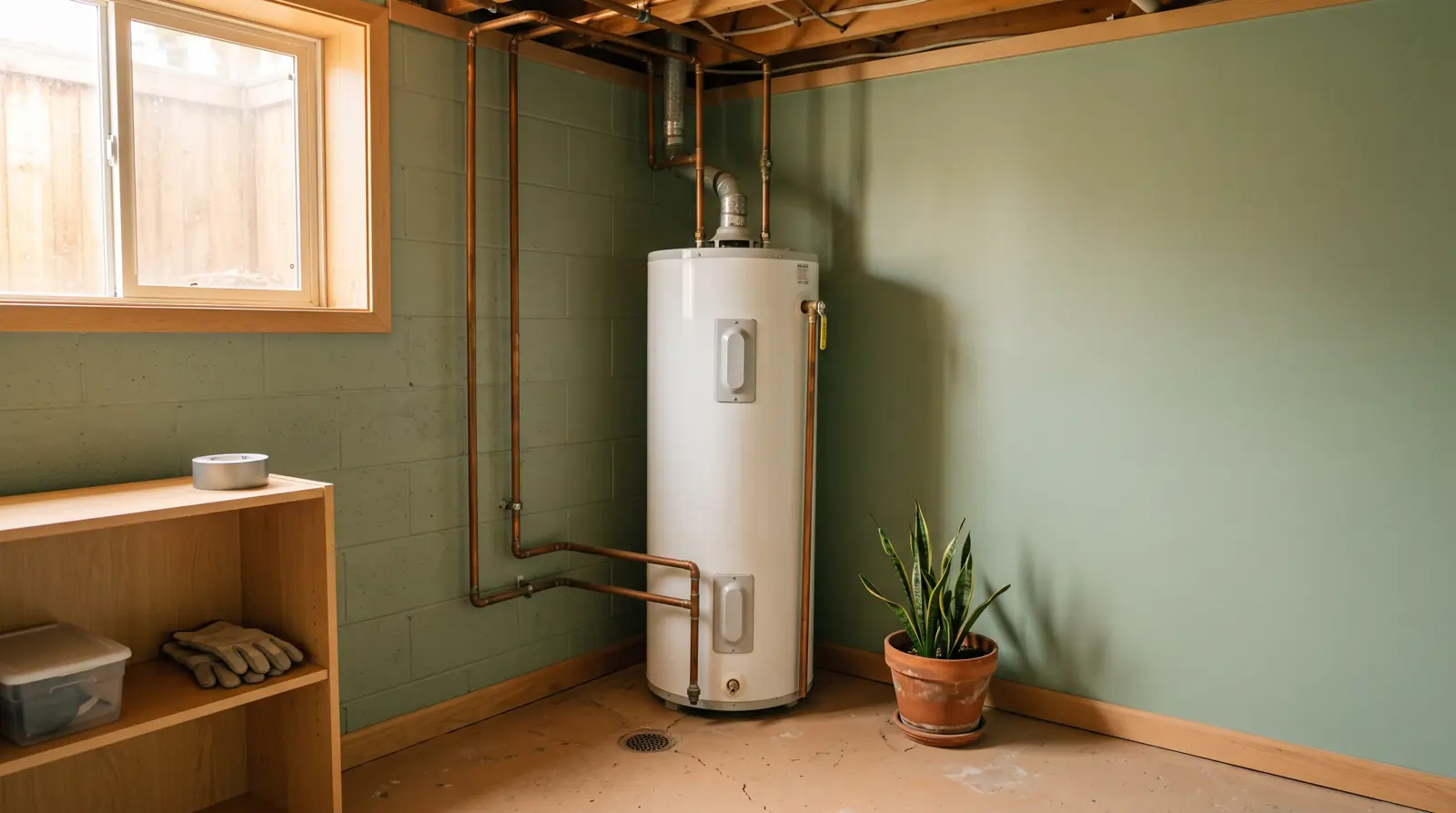
What Size Water Heater Do I Need? First-Hour Ratings vs Household Size
- Primary data
- ENERGY STAR Certified Water Heaters (US EPA), with AHS 2023 and RECS 2020 microdata
- Data period
- Certified list as of 2026-11-01; households 2023; installed tanks 2020
- Latest release used
- 2026-11-01
- Next release
- ENERGY STAR list updates continuously; AHS 2025 not yet released
- Geography
- United States
- Sources
- 21 (18 Tier 1)
78.4% of US households need a first-hour rating of 65 gallons or less, which answers what size water heater do I need for most homes: under DOE's peak-hour worksheet, the median certified 50-gallon-class 240-volt heat pump tank (67 gallons) covers three people. Four people need 85 gallons, the median of an 80-gallon class.
What size water heater do I need? Twenty gallons a person, plus five, in the busiest hour
DOE sizes tank water heaters by first-hour rating (FHR), not tank gallons. The DOE Energy Saver worksheet counts 20 gallons of hot water per shower, 2 per shave and 3 per hand dishwashing; a household where everyone showers in the same hour needs 20 gallons a person plus 5.
First-hour rating (FHR): Federal test language in appendix E: an estimate of the maximum volume of hot water a storage water heater can supply within an hour that begins with the tank fully heated. The test draws water at 3.0 gallons per minute, with 58 F supply water and 125 F outlet water.
DOE's Energy Saver page tells buyers to pick a model whose FHR at least matches peak hour demand, the most hot water the home uses in one hour. Its worksheet values are in the table below. The page's worked example (three showers, one shave, one hand dishwashing) is printed as 66 gallons; the rows add to 65 gallons, a one-gallon slip that does not change the method (DOE Energy Saver, archived 2026-07-02).
| Use | Gallons of hot water per use |
|---|---|
| Shower | 20 |
| Shaving | 2 |
| Hand dishwashing or food prep | 3 |
| Automatic dishwasher | 7 |
| Clothes washer, top-loader | 25 |
| Clothes washer, H-axis | 15 |
| DOE worked example: 3 showers, 1 shave, 1 hand dishwashing (as printed) | 66 |
DOE says the figures are averages from a variety of published sources. The worked example rows add to 65 gallons.
Source: [4] U.S. Department of Energy
Applying the worksheet to every member of a household gives peak hours of 25 gallons for one person, 45 for two, 65 for three, 85 for four and 105 for five (KBR derived metric d1). A top-loading washer in the same hour adds 25 gallons; an H-axis washer adds 15.
The FHR also sets a tank's federal draw pattern: below 18 gallons is very small, 18 to under 51 low, 51 to under 75 medium and 75 or more high (appendix E, Table I). A label that says High-Usage therefore promises at least 75 gallons in the first hour.
Certified 50-gallon-class heat pump tanks deliver a median 67 gallons in the first hour
Across 615 US heat pump listings on the ENERGY STAR certified list, the median FHR climbs from 60 gallons in the 40-gallon class to 67 in the 50-gallon class, 79 at 65 gallons and 87 at 80 gallons for 240 V integrated units.
KBR grouped the 1197 US-market listings on the ENERGY STAR list (rows updated 2026-11-01) by rated storage volume. DOE notes that a nominal 40-gallon tank is often rated at 35 to 36 gallons, because marketed sizes may sit within 10 percent of actual storage (2024 final rule), so the classes start below the round number.
US listings, ENERGY STAR, November 2026
Source: ENERGY STAR Certified Water Heaters dataset, downloaded 2026-11-02; KBR size classes.
| Type | Size class | Listings | Distinct ratings | Rated gallons | FHR min | FHR median | FHR max | FHR per rated gallon | 20-gal showers at median |
|---|---|---|---|---|---|---|---|---|---|
| 240 V heat pump | 40 gal class | 57 | 7 | 36 to 40 | 46 | 60 | 66 | 1.67 | 3.0 |
| 240 V heat pump | 50 gal class | 135 | 37 | 44 to 55 | 52 | 67 | 81 | 1.46 | 3.4 |
| 240 V heat pump | 65 gal class | 119 | 28 | 57 to 68 | 54 | 79 | 100 | 1.32 | 4.0 |
| 240 V heat pump | 80 gal class | 131 | 33 | 71 to 82 | 67 | 87 | 101 | 1.18 | 4.3 |
| 240 V heat pump | 120 gal class | 5 | 2 | 109 to 119 | 105 | 105 | 115 | 0.96 | 5.2 |
| 120 V heat pump | 40 gal class | 11 | 2 | 36 to 40 | 45 | 45 | 46 | 1.25 | 2.2 |
| 120 V heat pump | 50 gal class | 23 | 4 | 46 to 50 | 51 | 52 | 59 | 1.13 | 2.6 |
| 120 V heat pump | 65 gal class | 17 | 3 | 59 to 68 | 63 | 63 | 77 | 1.07 | 3.1 |
| 120 V heat pump | 80 gal class | 17 | 3 | 72 to 82 | 84 | 84 | 94 | 1.17 | 4.2 |
| Split heat pump | 50 gal class | 52 | 6 | 43 to 48 | 50 | 70 | 73 | 1.52 | 3.5 |
| Split heat pump | 65 gal class | 19 | 2 | 60 to 65 | 46 | 82 | 82 | 1.37 | 4.1 |
| Split heat pump | 80 gal class | 24 | 5 | 73 to 83 | 55 | 95 | 121 | 1.3 | 4.8 |
| Split heat pump | 120 gal class | 5 | 3 | 119 to 120 | 83 | 121 | 134 | 1.02 | 6.0 |
| All heat pump | 40 gal class | 68 | 9 | 36 to 40 | 45 | 60 | 66 | 1.67 | 3.0 |
| All heat pump | 50 gal class | 210 | 47 | 43 to 55 | 50 | 67 | 81 | 1.46 | 3.4 |
| All heat pump | 65 gal class | 155 | 33 | 57 to 68 | 46 | 79 | 100 | 1.32 | 4.0 |
| All heat pump | 80 gal class | 172 | 41 | 71 to 83 | 55 | 88 | 121 | 1.19 | 4.4 |
| All heat pump | 120 gal class | 10 | 5 | 109 to 120 | 83 | 110 | 134 | 0.92 | 5.5 |
| Gas storage | 40 gal class | 35 | 2 | 38 to 40 | 86 | 88 | 88 | 2.2 | 4.4 |
| Gas storage | 50 gal class | 35 | 2 | 49 to 50 | 95 | 95 | 118 | 1.9 | 4.8 |
Size classes are KBR groupings of rated storage volume: 35 to under 43, 43 to under 56, 56 to under 70, 70 to under 90, 100 and up. Gas storage covers 4 distinct power-vent designs only.
Source: [1] U.S. EPA ENERGY STAR
Within a class the spread is wide. 240 V units in the 50-gallon class run from 52 to 81 gallons across 135 listings and 37 distinct ratings. Split-system heat pump listings post the highest medians: 70 gallons at 50 gallons of storage and 95 at 80 gallons.
The ENERGY STAR gas storage entries (70 listings) are only 4 distinct power-vent designs from 2 manufacturers, rated 88 and 95 gallons at the 40- and 50-gallon class medians. They show what high-input gas tanks can do, not what a typical atmospheric gas tank delivers. Standard electric resistance tanks are not ENERGY STAR certified and are absent from this list.
Each extra gallon of heat pump storage adds less first-hour capacity
The median heat pump tank delivers 1.67 gallons in the first hour per gallon stored in the 40-gallon class but 1.19 in the 80-gallon class and 0.92 at 120 gallons (KBR derived metric d3).
Median FHR divided by median rated volume
Source: KBR analysis of the ENERGY STAR Certified Water Heaters dataset, 2026-11-02.
Because the rating counts water heated during the test hour, a first hour can exceed the stored volume; that extra counts for more in small tanks than in large ones. The practical effect: moving from the 50-gallon to the 80-gallon class raises the 240 V median from 67 to 87 gallons, 20 more gallons of first-hour water for 28 more gallons of rated storage (median rated volumes of 46 and 74 gallons).
Power supply matters as much as size. The 120 V plug-in heat pump tanks in the 50-gallon class have a median FHR of 52 gallons, 15 gallons below 240 V units of the same class (derived metric d5). That is 2.6 twenty-gallon showers against 3.4 (d4). For operating cost by state, see the heat pump water heater report.
78.4% of US households fit inside that 67-gallon rating
Weighting 2023 American Housing Survey households by size, the median 240 V 50-gallon-class heat pump tank covers the worksheet rush of 78.4% of US households: every home with three or fewer people. Covering four people takes 85 gallons, the 80-gallon-class median of 87 reaches 90.9%.
This is KBR's own calculation (derived metric d2). It joins three public sources: ENERGY STAR median FHRs, the DOE worksheet's 20-gallon shower and the AHS 2023 count of people in each of 133.23 million occupied homes. Standard errors come from the survey's 160 replicate weights.
Worksheet peak hour: 20 gal a person plus 5, AHS 2023
Source: KBR analysis of ENERGY STAR listings (2026-11-02), DOE Energy Saver worksheet and AHS 2023 PUF.
| Tank (median of class) | Median FHR (gal) | Largest household covered | Peak hour for that size (gal) | Households covered (%) | Standard error (pts) |
|---|---|---|---|---|---|
| 120V HPWH 50 gal class | 52 | 2 | 45 | 64.0 | 0.24 |
| 240V HPWH 40 gal class | 60 | 2 | 45 | 64.0 | 0.24 |
| 240V HPWH 50 gal class | 67 | 3 | 65 | 78.4 | 0.2 |
| 240V HPWH 65 gal class | 79 | 3 | 65 | 78.4 | 0.2 |
| 120V HPWH 80 gal class | 84 | 3 | 65 | 78.4 | 0.2 |
| 240V HPWH 80 gal class | 87 | 4 | 85 | 90.9 | 0.16 |
| Gas storage 40 gal class | 88 | 4 | 85 | 90.9 | 0.16 |
| Gas storage 50 gal class | 95 | 4 | 85 | 90.9 | 0.16 |
| HPWH 120 gal class | 110 | 5 | 105 | 96.8 | 0.11 |
Peak hour = 20 gallons per person plus 5 (DOE worksheet). Households from AHS 2023, weighted.
Source: [1][4][11] U.S. EPA ENERGY STAR; U.S. Department of Energy; U.S. Census Bureau and HUD
Households of four or more make up 21.6% of US homes; the 9.1% with five or more need more than 87 gallons in the worksheet scenario (d13), which only the 120-gallon class median of 110 gallons covers. A 120 V 80-gallon-class unit (84 gallons) falls 1 gallon short of a four-person rush.
Two full bathrooms is the most common layout, and bigger households have more of them
32.0% of occupied US homes have two full bathrooms and 30.2% have one, per AHS 2023. Among four-person households, 15.8% still share one full bathroom.
Occupied homes, AHS 2023
Source: KBR analysis of the AHS 2023 national PUF (BATHROOMS).
| People | Share of households (%) | Peak-hour demand (gal) | 1 full bath (%) | 1.5 baths (%) | 2 full baths (%) | 2.5 baths (%) | 3 full baths (%) | More than 3 full (%) |
|---|---|---|---|---|---|---|---|---|
| 1 | 29.7 | 25 | 49.1 | 10.3 | 27.2 | 7.9 | 4.6 | 0.8 |
| 2 | 34.3 | 45 | 25.8 | 10.6 | 34.3 | 15.0 | 12.0 | 2.2 |
| 3 | 14.4 | 65 | 23.2 | 11.1 | 35.0 | 15.1 | 13.1 | 2.6 |
| 4 | 12.6 | 85 | 15.8 | 10.5 | 32.7 | 19.2 | 17.3 | 4.5 |
| 5+ | 9.0 | 105 or more | 16.3 | 9.2 | 33.2 | 17.6 | 18.1 | 5.4 |
Bathroom columns are shares within each household size (rows may not sum to 100 because 'no full bath' is omitted). AHS 2023 national PUF, WEIGHT.
Source: [11][12][4] U.S. Census Bureau and HUD; U.S. Census Bureau; U.S. Department of Energy
The DOE method has no bathroom input; it counts uses in the busiest hour. Bathrooms matter because they decide how many showers can overlap. A home with one full bathroom spreads four showers across the hour, while three bathrooms let them run at once, which raises the flow a tankless unit must supply. For remodel budgets, see bathroom remodel cost and walk-in shower cost.
Half of homes with four or more people ran on a tank under 50 gallons in 2020
In RECS 2020, 50.6% of households with four or more people and their own water heater reported a main tank under 50 gallons: 12.2 million of 24.13 million homes (derived metric d6).
Homes with their own water heater, RECS 2020
Source: KBR analysis of EIA RECS 2020 public microdata v7.
| People | Households (million) | 30 gal or less (%) | 31 to 49 gal (%) | 50 gal or more (%) | Tankless (%) |
|---|---|---|---|---|---|
| 1 | 25.78 | 16.0 | 53.5 | 26.1 | 4.3 |
| 2 | 40.2 | 9.5 | 48.9 | 34.7 | 6.9 |
| 3 | 16.37 | 9.5 | 43.4 | 40.4 | 6.7 |
| 4 | 14.2 | 7.5 | 43.2 | 41.6 | 7.7 |
| 5+ | 9.93 | 9.1 | 41.2 | 42.3 | 7.4 |
| All | 106.48 | 10.8 | 47.7 | 35.1 | 6.4 |
RECS 2020 v7, NWEIGHT; excludes the 13.8% of households whose water heater serves several units.
Source: [14][15] U.S. Energy Information Administration; U.S. Energy Information Administration
Tank size barely follows household size in the installed stock: 26.1% of one-person homes had a tank of 50 gallons or more, against 41.6% of four-person homes and 42.3% of homes with five or more. Tankless units were the main heater in 6.4% of homes with their own water heater.
RECS 2020 v7 is the latest release with water heater size; the preliminary RECS 2024 v1 file (May 2026) does not yet include water heating fields. Age of these units is covered in the water heater lifespan report.
Certified gas tankless units peak at a median 5.4 gallons a minute, about two showers
The 392 ENERGY STAR gas tankless listings sold in the US have a median maximum flow of 5.4 gpm at the test's 67 F rise, enough for 2.16 showers at the federal 2.5 gpm limit (d7).
US listings, max GPM at a 67 F rise
Source: ENERGY STAR Certified Water Heaters dataset, downloaded 2026-11-02.
| Measure | Value |
|---|---|
| Listings with a max GPM rating | 392 |
| Lowest max GPM | 3.8 |
| 25th percentile | 4.8 |
| Median | 5.4 |
| 75th percentile | 5.8 |
| Highest | 6.0 |
| Listings at 5 gpm or more (%) | 66.3 |
| Listings at 5.75 gpm or more (%) | 33.9 |
| Median max input (Btu/h) | 180,000 |
| 2.5 gpm showers at median | 2.16 |
| Median re-stated at a 70 F rise (gpm) | 5.17 |
Max GPM is measured in a 10-minute test at a nominal 67 F rise (58 F in, 125 F out).
Source: [1][6][4] U.S. EPA ENERGY STAR; U.S. Government Publishing Office, eCFR; U.S. Department of Energy
Tankless units are sized by flow, not storage. DOE's Energy Saver example adds a 0.75 gpm faucet and a 2.5 gpm shower for 3.25 gpm, and assumes 50 F incoming water heated to 120 F, a 70 F rise. At that rise the median certified unit's flow works out to 5.17 gpm, or 2.07 showers (d8). Two showers plus a faucet need 5.75 gpm; 33.9% of listings reach it at the test rise (d9).
Ratings range from 3.8 to 6.0 gpm, and 66.3% of listings are at 5 gpm or more. The median listed input is 180,000 Btu per hour, near the 200,000 Btu per hour ceiling for a consumer gas instantaneous heater. Electric tankless units are not ENERGY STAR certified; DOE's page puts them at about 2 gpm for a 70 F rise.
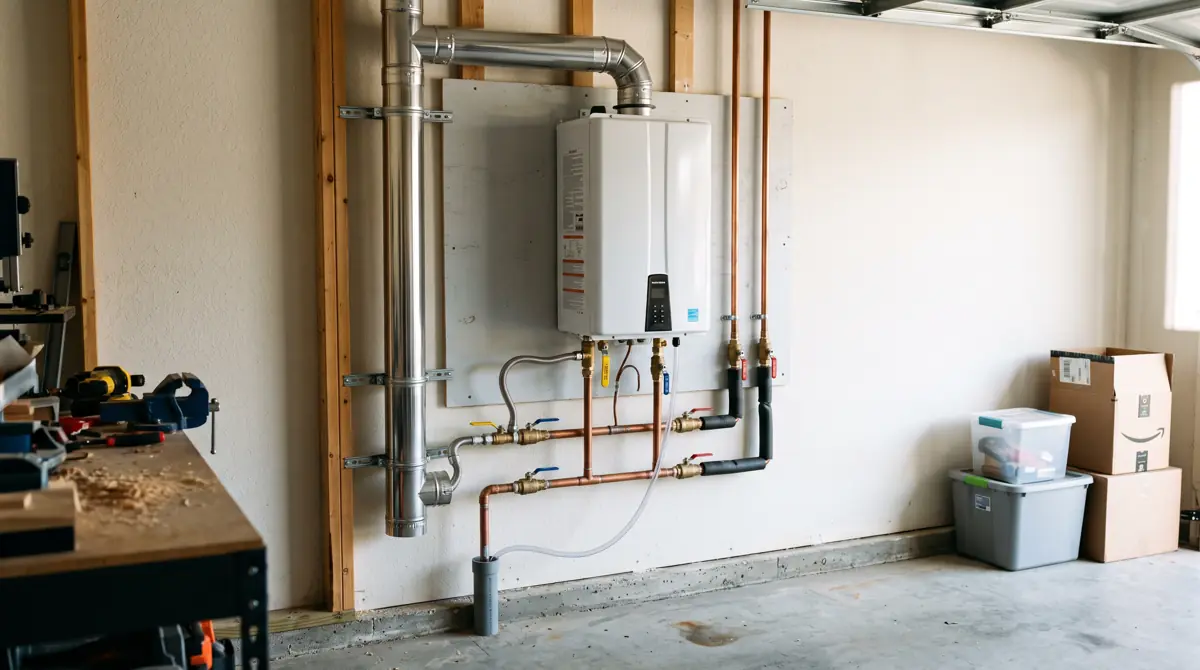
Electric tanks over 55 gallons already need heat pump efficiency; 20 to 55 gallons follow in 2029
Under 10 CFR 430.32(d), electric storage tanks over 55 gallons have needed heat pump-level efficiency since April 16, 2015. The 2024 final rule sets 2.30 UEF for most 20 to 55 gallon electric tanks and 2.50 above 55 gallons from May 6, 2029.
| Rated or effective volume | Before May 6, 2029 (medium draw) | From May 6, 2029 | Technology implied |
|---|---|---|---|
| 20 to 35 gal, FHR under 51 (small electric) | 0.9307 – 0.0002 x V | 0.8808 to 0.9254 formulas kept | Electric resistance |
| 20 to 55 gal, other | 0.9307 – 0.0002 x V (0.9207 at 50 gal) | 2.30 | Heat pump from 2029 |
| Over 55 to 120 gal | 2.1171 – 0.0011 x V (2.0456 at 65 gal) | 2.50 | Heat pump since April 16, 2015 |
| Grid-enabled, over 75 gal | Separate class | Separate class | Electric resistance with activation lock |
From 10 CFR 430.32(d) as of 2026-10-29. Small electric storage tanks are limited to the very small and low draw patterns.
Source: [5][7] U.S. Government Publishing Office, eCFR; U.S. Department of Energy via Federal Register
The current formula for a 65-gallon medium-draw electric tank works out to a minimum UEF of 2.0456, and 2.1538 for an 80-gallon high-draw tank (d10). A 50-gallon resistance tank needs 0.9207; the 2029 level of 2.30 is 2.5 times that. DOE estimated heat pumps were about 3 percent of the electric storage market in 2023 and projected 61 percent in 2030 under the adopted standard.
For sizing, the rule keeps one resistance option: small electric storage tanks of 20 to 35 gallons effective volume in the very small and low draw patterns, which DOE describes as lowboy units with FHRs under 51 gallons. In the worksheet scenario 51 gallons covers two people. Grid-enabled resistance tanks over 75 gallons with an activation lock remain a separate class.
Status as of 2026-11-02: the eCFR text current to 2026-10-29 still carries the 2029 levels. The separate gas tankless standard was withdrawn on 2025-05-20 under the Congressional Review Act, and a gas industry petition noticed on 2026-04-27 concerns commercial water heating equipment and consumer furnaces, not consumer water heaters.
Ratios behind the comparison
Peak-hour hot water demand by household size (DOE worksheet scenario)
Formulademand(n) = 20 gal x n showers + 2 gal (one shave) + 3 gal (one hand dishwashing)
Inputs: rows 1, 2, 3 (fact sheet rows)
Result: 25, 45, 65, 85, 105, 125 and 145 gallons for 1 to 7 people
Every person showers once in the busiest hour, the worst case the worksheet's own example uses for three people.
Limitations: Assumes one shower each in the same hour and no laundry or dishwasher in that hour; real habits vary.
SIGNATURE: share of US households whose peak hour fits a tank's median first-hour rating
Formulasum of AHS 2023 WEIGHT for occupied households with 20 x NUMPEOPLE + 5 <= median FHR, divided by sum of WEIGHT for all occupied households; SE from 160 replicate weights, var = 4/160 x sum (rep - full)^2
Inputs: rows 80, 82, 104 to 110, derived d1 (fact sheet rows)
Result: 78.4% (SE 0.2) for the 240 V 50-gallon class median of 67 gallons; 90.9% for the 240 V 80-gallon class median of 87 gallons; 64.0% for 60 gallons; 96.8% for 110 gallons
A median 50-gallon-class heat pump tank covers every household of three or fewer under the worksheet scenario; four-person households need the 80-gallon class.
Limitations: Median ratings, not any specific model; ENERGY STAR lists only efficient models; household size is a proxy for peak use.
First-hour rating per gallon of rated storage, heat pump tanks
Formulamedian FHR / median rated storage volume within each size class
Inputs: rows 86 to 90 (fact sheet rows)
Result: 1.67, 1.46, 1.32, 1.19 and 0.92 gallons per rated gallon
Smaller tanks deliver more first-hour water per stored gallon than larger ones.
Limitations: Ratio of medians, not median of ratios.
Back-to-back 20-gallon showers per first hour
Formulamedian FHR / 20 gallons per shower
Inputs: row 1 and the ENERGY STAR class rows (fact sheet rows)
Result: 3.4 for the 240 V 50-gallon class, 2.6 for the 120 V 50-gallon class, 4.3 for the 240 V 80-gallon class
Converts a rating into the unit households think in.
Limitations: DOE's 20 gallons is an average assumption.
First-hour gap between 240 V and 120 V heat pump tanks, 50-gallon class
Formulamedian FHR (240 V integrated) - median FHR (120 V integrated)
Inputs: rows 80, 76 (fact sheet rows)
Result: 67 – 52 = 15 gallons
A plug-in 120 V unit of the same nominal size covers two people rather than three in the worksheet scenario.
Limitations: Only 23 120 V listings in this class.
Households of four or more whose main tank was under 50 gallons, 2020
Formulasum NWEIGHT (NHSLDMEM >= 4 and WHEATSIZ in 1, 2) / sum NWEIGHT (NHSLDMEM >= 4), households with their own water heater; SE from 60 jackknife replicates
Inputs: row 126 and RECS size rows (fact sheet rows)
Result: 50.6% (SE 0.8), 12.2 million of 24.13 million households
Tank size tracks household size only weakly in the installed stock.
Limitations: Size class is reported by the respondent; a second water heater is not counted; 2020 data.
Simultaneous 2.5 gpm showers at the median tankless rating
Formulamedian max GPM / 2.5 gpm federal showerhead limit
Inputs: rows 95, 26 (fact sheet rows)
Result: 5.4 / 2.5 = 2.16 showers
Two full-flow showers at once, not three.
Limitations: All-hot flow; mixing with cold water stretches it.
Median tankless flow re-stated at DOE Energy Saver's 70 F rise
Formulamax GPM x 67 F / 70 F (constant heat output), then / 2.5 gpm
Inputs: rows 95, 23, 10, 11 (fact sheet rows)
Result: 5.17 gpm, or 2.07 showers at 2.5 gpm
Colder inlet water trims usable flow.
Limitations: Assumes the heater's output is fixed; modulating controls and efficiency vary.
Share of certified gas tankless models rated for two showers and a faucet
Formulacount of listings with max GPM >= 2 x 2.5 + 0.75 = 5.75 gpm / 392
Inputs: rows 95, 9, 26 (fact sheet rows)
Result: 33.9% (133 of 392 listings)
About a third of certified gas tankless listings reach the two-shower-plus-faucet flow at the test rise.
Limitations: Listings, not sales; test rise of 67 F.
Minimum UEF for electric tanks under current and 2029 rules
FormulaUEF = a - b x Vr from 10 CFR 430.32(d)(1); 2029 levels are flat 2.30 and 2.50
Inputs: rows 27, 28, 29, 30 (fact sheet rows)
Result: 2.0456 for a 65-gallon medium-draw tank today; 2.1538 for an 80-gallon high-draw tank today; 0.9207 for a 50-gallon medium-draw tank today; 2.30 from 2029 is 2.5 times 0.9207
Levels above 2 can only be met with heat pump technology, per DOE.
Limitations: Vr is rated volume; 2029 rule uses effective volume.
Minutes of all-hot flow at 2.5 gpm from a 67-gallon first hour
Formula67 gallons / 2.5 gpm
Inputs: rows 80, 26 (fact sheet rows)
Result: 26.8 minutes
A floor: a mixed shower uses less hot water per minute and lasts longer.
Limitations: FHR is measured at a 3.0 gpm draw.
Check of DOE's worked example
Formula3 x 20 + 1 x 2 + 1 x 3
Inputs: rows 1 to 7 (fact sheet rows)
Result: 65 gallons; DOE prints 66
A one-gallon slip in the example; it does not change the method.
Limitations:
Gain from the 50-gallon to the 80-gallon class, 240 V heat pump tanks
FormulaFHR: 87 - 67; rated storage: 74 - 46 (class medians)
Inputs: rows 80, 82 (fact sheet rows)
Result: 20 gallons more first-hour water for 28 gallons more rated storage
Under one gallon of extra first hour per extra gallon stored.
Limitations: Class medians, not matched models.
Households outside the 80-gallon-class median
Formula100 - 90.9
Inputs: derived d2 (fact sheet rows)
Result: 9.1%
Five or more people: the worksheet rush exceeds 87 gallons.
Limitations: Same as d2.
Where the numbers diverge
- The median FHR of ENERGY STAR certified 240 V heat pump tanks sold in the US is 67 gallons in the 50-gallon class (135 listings, November 2026).[1]
- The same median is 60 gallons in the 40-gallon class, 79 in the 65-gallon class and 87 in the 80-gallon class (US, November 2026).[1]
- 120 V plug-in heat pump tanks in the 50-gallon class have a median FHR of 52 gallons, 15 below 240 V units (US, November 2026).[1]
- Split-system heat pump tanks post a median FHR of 70 gallons at the 50-gallon class and 95 at the 80-gallon class (US, November 2026).[1]
- First-hour gallons per rated gallon fall from 1.67 for 40-gallon-class heat pump tanks to 1.19 for the 80-gallon class (KBR, November 2026).[1]
- DOE's Energy Saver worksheet assumes 20 gallons of hot water per shower, 2 per shave and 3 per hand dishwashing (2026 capture).[4]
- 78.4% of US households in 2023 had three or fewer people, so their worksheet peak hour of up to 65 gallons fits a 67-gallon FHR (KBR, AHS 2023).[11][4][1]
- 21.6% of US households in 2023 had four or more people and a worksheet peak hour of 85 gallons or more (AHS 2023).[11]
- 32.0% of US households had two full bathrooms in 2023 and 30.2% had one (AHS 2023).[11]
- 50.6% of US households with four or more people and their own water heater reported a main tank under 50 gallons in 2020 (RECS 2020).[14]
- The median ENERGY STAR gas tankless unit sold in the US is rated 5.4 gpm at a 67 F rise; 66.3% of 392 listings reach 5 gpm (November 2026).[1][6]
- Federal rules have required heat pump-level efficiency for electric storage tanks over 55 gallons since April 16, 2015 (10 CFR 430.32(d)).[5][7]
- From May 6, 2029, most electric storage tanks of 20 to 55 gallons must reach 2.30 UEF and those over 55 gallons 2.50 UEF (10 CFR 430.32(d)(2)).[5][7]
- DOE estimated heat pumps held about 3 percent of the US electric storage water heater market in 2023 (89 FR 37778).[7]
- In 2023, 46.5% of US occupied homes heated water with electricity and 46.8% with piped gas (AHS 2023).[11]
Summary
- DOE's worksheet counts 20 gallons of hot water per shower; a household where everyone showers in one hour needs a first-hour rating of 20 gallons a person plus 5.
- The median certified 240 V heat pump tank delivers 60 gallons in the 40-gallon class, 67 in the 50-gallon class, 79 at 65 gallons and 87 at 80 gallons.
- KBR finds the 67-gallon median covers 78.4% of US households (three people or fewer); the 87-gallon median of the 80-gallon class covers 90.9%.
- 120 V plug-in heat pump tanks trail 240 V units by 15 gallons in the 50-gallon class.
- 50.6% of 2020 households with four or more people had a main tank under 50 gallons.
- Certified gas tankless units have a median 5.4 gpm at a 67 F rise: two showers, not three.
- Electric tanks over 55 gallons need heat pump-level efficiency now; most 20 to 55 gallon electric tanks follow on May 6, 2029.
Questions people ask
Is a 40 or 50 gallon water heater better for a family of 4?
Under DOE's worksheet, four people showering in the same hour plus a shave and hand dishwashing need 85 gallons. The median certified 240 V heat pump tank delivers 60 gallons in the 40-gallon class and 67 in the 50-gallon class, so neither covers that rush; the 80-gallon class median of 87 does. The ENERGY STAR gas designs list 88 and 95 gallons at 40 and 50 gallons. If showers are spread over two hours, a 50-gallon-class heat pump tank covers three per hour.
How long does a 50 gallon water heater last in a shower?
A median 240 V 50-gallon-class heat pump tank delivers 67 gallons in its first hour, which is 3.4 showers at DOE's 20 gallons each. If a 2.5 gpm shower ran on hot water only, 67 gallons would last 26.8 minutes (d11); mixing in cold water stretches that. A 120 V unit of the same class (52 gallons) gives 2.6 showers.
What size tankless water heater do I need?
Add the flow of everything that runs at once: DOE's example is a 2.5 gpm shower plus a 0.75 gpm faucet, 3.25 gpm. Two showers and a faucet need 5.75 gpm, which 33.9% of certified gas tankless listings reach at a 67 F rise. The median unit (5.4 gpm) handles 2.16 full-flow showers, and about 2.07 at DOE's 70 F rise for 50 F inlet water.
Do I need a bigger water heater for a new bathroom?
Only if the new bathroom adds hot water use in the busiest hour. DOE's method counts uses, not rooms: a fourth shower in the peak hour adds 20 gallons of first-hour demand, and a second simultaneous shower adds 2.5 gpm for a tankless unit. In 2023, 15.8% of four-person US households shared one full bathroom (AHS), the group most likely to see showers overlap after adding one.
For journalists and researchers
If you cite only a few, cite these
- 78.4% of US households fit within the 67-gallon median first-hour rating of a certified 50-gallon-class 240 V heat pump tank (KBR, 2026).[1][11][4]
- 50.6% of four-plus-person US households had a tank under 50 gallons in 2020 (KBR analysis of RECS 2020).[14]
- Median certified gas tankless flow: 5.4 gpm at a 67 F rise (ENERGY STAR, November 2026).[1]
Most quotable statistics
- A median certified 50-gallon-class 240 V heat pump water heater delivers 67 gallons in its first hour, enough for the morning rush of 78.4% of US households (KBR analysis of ENERGY STAR and AHS 2023 data).[1][11][4]
- 50.6% of US households with four or more people had a main water heater under 50 gallons in 2020 (KBR analysis of EIA RECS 2020).[14]
- Plug-in 120 V heat pump water heaters in the 50-gallon class deliver a median 52 gallons in the first hour, 15 fewer than 240 V models (ENERGY STAR, November 2026).[1]
- The median ENERGY STAR gas tankless water heater is rated 5.4 gallons per minute, enough for 2.16 showers at the federal 2.5 gpm limit.[1][5]
- Four people showering in the same hour need about 85 gallons of first-hour capacity under DOE's sizing worksheet.[4]
- Federal rules have required heat pump-level efficiency for electric tanks over 55 gallons since April 16, 2015; most 20 to 55 gallon tanks follow on May 6, 2029.[5][7]
Press summary
A new Kitchen and Bath Renovators analysis of every ENERGY STAR certified water heater sold in the US finds that tank gallons are a weak guide to how much hot water a heater delivers. The median 240 V heat pump tank in the 50-gallon class delivers 67 gallons in its first hour, while 120 V plug-in models of the same class deliver 52. Using the Department of Energy's sizing worksheet of 20 gallons per shower and Census Bureau data on 133.23 million households, KBR estimates that the 67-gallon median covers the busiest hour of 78.4% of US households, every home with three or fewer people. Four-person homes need about 85 gallons, the level of an 80-gallon-class heat pump tank. Energy Department survey data show 50.6% of households with four or more people had a tank under 50 gallons in 2020. Certified gas tankless units have a median flow of 5.4 gallons per minute, about two showers at once.
Suggested headlines
- A 50-gallon heat pump water heater covers 78.4% of US households, federal data show
- Four-person homes need about 85 gallons of first-hour hot water, DOE worksheet shows
- Plug-in heat pump water heaters deliver 15 fewer gallons in the first hour than 240-volt models
- Half of big US households run on a water heater under 50 gallons
- Median certified tankless water heater handles two showers, not three
How to cite this report
Kitchen and Bath Renovators. (2026). What Size Water Heater Do I Need? First-Hour Ratings vs Household Size. Retrieved from https://kitchenandbathrenovators.com/research/what-size-water-heater-do-i-need/
Reuse license
Data and tables are licensed CC BY 4.0. Attribution: “Source: Kitchen and Bath Renovators, What Size Water Heater Do I Need? First-Hour Ratings vs Household Size” with a link to this page.
Download the data
Every table in this report is available as a CSV under CC BY 4.0. The fact sheet lists each value with its source URL and access date.
- derived_metrics.csv (CSV)
- fact_sheet.csv (CSV)
- DOE peak-hour worksheet: gallons of hot water per use (CSV)
- First-hour rating of ENERGY STAR certified US tank water heaters by size class, November 2026 (CSV)
- Share of US households whose worksheet peak hour fits each tank's median first-hour rating, 2023 (CSV)
- US households by number of people, peak-hour demand and bathrooms, 2023 (CSV)
- Main water heater size by household size, US homes with their own water heater, 2020 (CSV)
- ENERGY STAR certified gas tankless water heaters sold in the US, maximum flow, November 2026 (CSV)
- Federal minimum efficiency for electric storage water heaters, now and from May 6, 2029 (CSV)
Frequently asked questions
What is a first-hour rating?
The federal test estimate of the most hot water a storage water heater can supply in one hour starting full and hot, measured with 58 F supply water, 125 F outlet water and draws at 3.0 gpm (10 CFR 430 appendix E).
Where is the first-hour rating printed?
DOE's Energy Saver page says the FTC EnergyGuide label shows it in the top left corner as Capacity (first hour rating) on new conventional storage water heaters; the label is not required on heat pump water heaters, so check the spec sheet or the ENERGY STAR list.
Why can a 50 gallon tank deliver more than 50 gallons in an hour?
It reheats during the test hour. Certified 50-gallon-class heat pump tanks deliver a median 1.46 gallons per rated gallon in the first hour, and the 40-gallon class 1.67 (ENERGY STAR, November 2026).
Do 120 volt heat pump water heaters deliver less hot water?
In the 50-gallon class, yes: a median 52 gallons in the first hour against 67 for 240 V units, a 15-gallon gap across 23 and 135 US listings (ENERGY STAR, November 2026).
Is a 65 gallon heat pump water heater enough for four people?
Not under the worksheet's all-shower hour: four people need 85 gallons and the 240 V 65-gallon-class median is 79. The 80-gallon-class median is 87.
How much hot water does one shower use for sizing?
DOE's worksheet uses 20 gallons of hot water per shower. Federal rules cap showerheads made after January 1, 1994 at 2.5 gpm. Total shower water by flow and minutes is in the shower water report.
What do Low, Medium and High usage mean on a water heater?
They are federal draw patterns set by the FHR: low is 18 to under 51 gallons, medium 51 to under 75, high 75 or more. For tankless units the cutoffs are 1.7, 2.8 and 4 gpm.
Will 50 gallon electric resistance water heaters be banned in 2029?
From May 6, 2029, electric storage tanks of 20 to 55 gallons outside the small electric class must reach 2.30 UEF, a level DOE ties to heat pumps. Small electric tanks of 20 to 35 gallons in the very small and low draw patterns keep resistance-level standards.
Can I still buy an 80 gallon electric resistance tank?
Electric storage tanks over 55 gallons have faced heat pump-level standards since April 16, 2015. The exception is the grid-enabled class: resistance tanks over 75 gallons with an activation lock for utility load programs.
How many US homes heat water with electricity?
46.5% of occupied US homes in 2023, against 46.8% with piped gas, 3.7% with bottled gas and 2.4% with fuel oil (AHS 2023). Water temperature settings are in the water heater temperature report.
Reproduce this analysis
Every figure comes from the files below. The scripts that pulled and computed them are kept with the report and can be re-run.
| Dataset | Publisher | Source | Query or filter | Rows used | Retrieved |
|---|---|---|---|---|---|
| ENERGY STAR Certified Water Heaters (pbpq-swnu) | US EPA ENERGY STAR | File or endpoint | Markets contains United States; Type in Hybrid/Electric Heat Pump, Gas Storage, Gas Tankless | 615 heat pump, 70 gas storage, 393 gas tankless of 1376 listings | 2026-11-02 |
| American Housing Survey 2023 National PUF v1.1, household.csv | US Census Bureau and HUD | File or endpoint | INTSTATUS = 1; NUMPEOPLE, BATHROOMS, HOTWATER, WEIGHT, REPWEIGHT1 to REPWEIGHT160 | 48527 occupied household records of 55669 | 2026-11-02 |
| RECS 2020 public microdata v7 | US Energy Information Administration | File or endpoint | H2OAPT not 1; WHEATSIZ by NHSLDMEM; NWEIGHT and NWEIGHT1 to NWEIGHT60 | 16608 of 18496 records | 2026-11-02 |
| Sizing a New Water Heater (Energy Saver), Internet Archive capture | US Department of Energy | File or endpoint | Peak hour demand worksheet values and tankless sizing example | 6 worksheet rows and 1 worked example | 2026-11-02 |
| 10 CFR 430.32 and Part 430 Subpart B appendix E (eCFR XML) | US Government Publishing Office | File or endpoint | Paragraphs (d) and (p); appendix E Tables I and II, sections 2.3 to 2.5 and 5.3 | Electric storage rows of Tables in (d)(1) and (d)(2) | 2026-11-02 |
Data quality and exclusions
- ENERGY STAR: removed 179 Canada-only listings, 55 solar systems and 64 residential-duty commercial gas tanks; 1 tankless listing with no max GPM was dropped from flow statistics (392 kept).
- ENERGY STAR gas storage: the 70 listings reduce to 4 distinct rated designs, so gas medians describe those designs, not the gas tank market.
- AHS: dropped 7142 vacant or usual-residence-elsewhere records; no occupied record had a missing NUMPEOPLE. Household sizes of 7 or more are grouped.
- RECS: excluded 1888 records (13.8% of households, weighted) whose water heater serves several units; 16608 records kept, no missing WHEATSIZ.
- DOE worksheet: the worked example prints 66 gallons although its rows sum to 65; the row values were used.
- DOE CCMS (regulations.doe.gov/certification-data) returned HTTP 403 on 2026-11-02 and was not used; no workaround was attempted.
Methodology
Source selection: federal datasets only for figures (ENERGY STAR certified product list, eCFR, Federal Register, Census AHS, EIA RECS, DOE Energy Saver). Three contractor and publisher pages appear only as pages to beat.
Ratings: the ENERGY STAR Certified Water Heaters dataset (pbpq-swnu) was downloaded on 2026-11-02 (rows updated 2026-11-01). KBR kept listings whose markets include the United States and grouped tanks by rated storage volume into 40, 50, 65, 80 and 120 gallon classes. Medians and ranges are of listings; brand variants of one design count separately, so distinct-rating counts are shown beside listing counts.
Households: AHS 2023 national PUF v1.1, occupied interviews (INTSTATUS = 1), weighted by WEIGHT, with standard errors from the 160 replicate weights (variance = 4/160 x sum of squared differences). RECS 2020 v7, weighted by NWEIGHT, with jackknife standard errors (59/60 factor), excluding households whose water heater serves several units.
Signature metric (d2): each household's worksheet peak hour is 20 gallons times the number of people plus 5 gallons; a tank class covers the household when its median FHR is at least that figure. The covered share is the weighted share of households meeting the test.
Conflicts: tank-size rules of thumb on contractor pages (for example about 15 gallons of tank per person) were not used; the federal FHR method was. DOE's worked example prints 66 gallons where the rows add to 65; KBR used the row values.
Not advice: this report summarizes federal data and is not plumbing, electrical or purchasing advice. Last updated 2026-11-02.
This report presents published data with its limitations. It is not legal, financial or investment advice.
Sources, ranked by quality
Tier 1: primary and official sources (18)
- [1] U.S. EPA ENERGY STAR. ENERGY STAR Certified Water Heaters (dataset pbpq-swnu), rows updated 2026-11-01. Certified models listed as of 2026-11-01. Accessed 2026-11-02.
- [2] U.S. EPA ENERGY STAR. ENERGY STAR Certified Heat Pump Water Heaters (dataset v7jr-74b4), used as a cross-check. Certified models listed as of 2026-11-01. Accessed 2026-11-02.
- [3] U.S. EPA ENERGY STAR. ENERGY STAR Certified Gas (Storage and Tankless) Water Heaters (dataset 6sbi-yuk2), used as a cross-check. Certified models listed as of 2026-11-01. Accessed 2026-11-02.
- [4] U.S. Department of Energy. Sizing a New Water Heater, Energy Saver (Internet Archive capture of the energy.gov page, 2026-07-02; live URL returned HTTP 404 on 2026-11-02). Page captured 2026-07-02. Accessed 2026-11-02.
- [5] U.S. Government Publishing Office, eCFR. 10 CFR 430.32, Energy and water conservation standards and their compliance dates (eCFR, current to 2026-10-29). Regulation text as of 2026-10-29. Accessed 2026-11-02.
- [6] U.S. Government Publishing Office, eCFR. Appendix E to Subpart B of 10 CFR Part 430, Uniform Test Method for Measuring the Energy Consumption of Water Heaters (eCFR, current to 2026-10-29). Regulation text as of 2026-10-29. Accessed 2026-11-02.
- [7] U.S. Department of Energy via Federal Register. Energy Conservation Program: Energy Conservation Standards for Consumer Water Heaters, final rule, 89 FR 37778. Published 2024-05-06. Accessed 2026-11-02.
- [8] U.S. Department of Energy via Federal Register. Energy Conservation Standards for Consumer Gas-Fired Instantaneous Water Heaters, withdrawal of disapproved final rule (2025-09030). Published 2025-05-20. Accessed 2026-11-02.
- [9] U.S. Department of Energy via Federal Register. Energy Conservation Program: Notification of Petition for Rulemaking (2026-08145). Published 2026-04-27. Accessed 2026-11-02.
- [10] U.S. Department of Energy. Consumer Water Heaters, Appliance and Equipment Standards product page. Rulemaking history 2024 to 2025. Accessed 2026-11-02.
- [11] U.S. Census Bureau and HUD. American Housing Survey 2023 National Public Use File v1.1 (household.csv: NUMPEOPLE, BATHROOMS, HOTWATER, WEIGHT, REPWEIGHT1 to 160). 2023. Accessed 2026-11-02.
- [12] U.S. Census Bureau. AHS 2023 National Public Use File page and Value Labels Package. 2023. Accessed 2026-11-02.
- [13] U.S. Census Bureau. Quick Guide to Estimating Variance Using Replicate Weights: 2009 to Current (AHS). 2009 to 2023. Accessed 2026-11-02.
- [14] U.S. Energy Information Administration. 2020 Residential Energy Consumption Survey public use microdata, version 7 (WHEATSIZ, NHSLDMEM, H2OAPT, NWEIGHT). 2020. Accessed 2026-11-02.
- [15] U.S. Energy Information Administration. RECS 2020 Codebook for Public File, v7. 2020. Accessed 2026-11-02.
- [16] U.S. Energy Information Administration. Using the 2020 RECS microdata file to compute estimates and standard errors (RSEs). 2020. Accessed 2026-11-02.
- [17] U.S. Energy Information Administration. 2024 RECS microdata page (preliminary v1 file, May 2026) and RECS 2024 Codebook v1. 2024. Accessed 2026-11-02.
- [21] U.S. Department of Energy. Compliance Certification Database (consumer water heaters), access attempt. Not retrieved: HTTP 403 on 2026-11-02. Accessed 2026-11-02.
Tier 3: journalism and expert commentary (3)
- [18] Bob Vila. What Size Water Heater Do I Need? (updated Sep 23, 2020). 2020. Accessed 2026-11-02.
- [19] Mr. Rooter Plumbing. What Size Water Heater Do I Need?. Undated. Accessed 2026-11-02.
- [20] CoolToday. What Size Water Heater Do I Need?. Undated. Accessed 2026-11-02.