When Was Asbestos Banned? Every Federal Action on Home Building Products
- Primary data
- Federal Register, eCFR and court records compiled by KBR; USGS asbestos statistics; ACS B25034
- Data period
- 1900 to 2026
- Latest release used
- 2026-10-22
- Next release
- Fifth Circuit decision on No. 24-60193 (date unknown); ACS 2025 1-year
- Geography
- United States
- Sources
- 28 (28 Tier 1)
When was asbestos banned in the United States? Never in one step. Federal rules banned spray-on asbestos (1973 and 1978), patching compounds (1977) and sheet-vinyl backing felt (1990), but a 1991 court ruling voided most of the 1989 ban. Vinyl-asbestos floor tile was never banned. The 2024 chrysotile rule ends the last uses by 2037.
Federal asbestos actions on products, 1973 to 2026
Checked quarterly, and when the Fifth Circuit rules on No. 24-60193 or EPA proposes a Part 2 rule. Last checked 2026-10-27. Entries are neutral records of public data; each links to its source record.
| Product or category | Federal action | Date | Evidence | Source |
|---|---|---|---|---|
| Spray-on insulation and fireproofing on buildings, structures, pipes and conduits | Clean Air Act asbestos NESHAP: spray-on materials used on buildings must contain less than 1 percent asbestos. Status in 2026: In force (40 CFR 61.146). Citation: 38 FR 8820. | 1973-04-06 | agency record | Record |
| Molded friable and wet-applied friable insulation on pipes, boilers, tanks and ducts | NESHAP amendment: such insulation installed after the effective date must contain no commercial asbestos. Status in 2026: In force for 'facilities' (40 CFR 61.148); the facility definition excludes residential buildings with four or fewer units. Citation: 40 FR 48292. | 1975-10-14 | agency record | Record |
| Consumer patching compounds, including drywall spackling and tape joint compound | CPSC ban: banned if made or first shipped after January 16, 1978; all such products banned after June 11, 1978. Status in 2026: In force (16 CFR 1304). Citation: 42 FR 63362. | 1977-12-15 | agency record | Record |
| Artificial fireplace ash and embers | CPSC ban of emberizing materials containing respirable free-form asbestos. Status in 2026: In force (16 CFR 1305). Citation: 42 FR 63364. | 1977-12-15 | agency record | Record |
| Spray-on decorative coatings and all other spray-on materials over 1 percent asbestos | NESHAP amendment extends the spraying limits to all materials with more than 1 percent asbestos; decorative coatings are the main products affected. Status in 2026: In force (40 CFR 61.146; binder-encapsulated, non-friable sprays exempt). Citation: 43 FR 26372. | 1978-06-19 | agency record | Record |
| Flooring felt, including felt bonded to the underside of vinyl sheet flooring | TSCA ban and phase-out rule, Stage 1: no manufacture or import after August 27, 1990; no distribution after August 25, 1992. Status in 2026: Banned (survived the 1991 ruling; 40 CFR 763.165). Citation: 54 FR 29460. | 1989-07-12 | agency record | Record |
| New uses of asbestos (uses first started after August 25, 1989) | TSCA ban and phase-out rule: new uses banned from Stage 1. Status in 2026: Banned (40 CFR 763.165). Citation: 54 FR 29460. | 1989-07-12 | agency record | Record |
| Vinyl-asbestos floor tile | TSCA ban and phase-out rule, Stage 1 (1990). Status in 2026: Vacated in 1991; never banned; new manufacture needs 90-day EPA notice since 2019. Citation: 54 FR 29460. | 1989-07-12 | agency record | Record |
| Asbestos-cement flat sheet and corrugated sheet | TSCA ban and phase-out rule, Stage 1 (1990). Status in 2026: Vacated in 1991; covered by the 2019 notice rule as cement products. Citation: 54 FR 29460. | 1989-07-12 | agency record | Record |
| Roofing felt and pipeline wrap | TSCA ban and phase-out rule, Stage 1 (1990). Status in 2026: Vacated in 1991; covered by the 2019 notice rule. Citation: 54 FR 29460. | 1989-07-12 | agency record | Record |
| Asbestos-cement shingles and asbestos-cement pipe | TSCA ban and phase-out rule, Stage 3 (1996). Status in 2026: Vacated in 1991; covered by the 2019 notice rule as cement products. Citation: 54 FR 29460. | 1989-07-12 | agency record | Record |
| Millboard | TSCA ban and phase-out rule, Stage 3 (1996). Status in 2026: Vacated in 1991; covered by the 2019 notice rule. Citation: 54 FR 29460. | 1989-07-12 | agency record | Record |
| Roof coatings and non-roof coatings | TSCA ban and phase-out rule, Stage 3 (1996). Status in 2026: Vacated in 1991; covered by the 2019 notice rule. Citation: 54 FR 29460. | 1989-07-12 | agency record | Record |
| Commercial paper, corrugated paper (pipe covering), rollboard and specialty paper | TSCA ban and phase-out rule, Stage 3: no manufacture or import after August 26, 1996; no distribution after August 25, 1997. Status in 2026: Banned (survived the 1991 ruling; 40 CFR 763.165). Citation: 54 FR 29460. | 1989-07-12 | agency record | Record |
| Spray-on application of materials over 1 percent asbestos on buildings, structures, pipes and conduits | NESHAP revision rewrites and redesignates the spraying standard and the insulating-materials standard. Status in 2026: In force (40 CFR 61.146 and 61.148). Citation: 55 FR 48424. | 1990-11-20 | agency record | Record |
| Most products in the 1989 rule | Fifth Circuit grants the petition for review, vacates the rule and remands it to EPA. Status in 2026: Decided; 947 F.2d 1201. Citation: 947 F.2d 1201. | 1991-10-18 | court record | Record |
| Products not in commerce on July 12, 1989 | On a motion for clarification, the court holds that the ban still applies to products not made, imported or processed on July 12, 1989. Status in 2026: Decided; EPA left to resolve which products qualify. Citation: 947 F.2d 1201. | 1991-11-15 | court record | Record |
| Six product categories left in the 1989 rule | EPA technical amendment rewrites 40 CFR 763 Subpart I to keep flooring felt, the four paper products and new uses. Status in 2026: In force. Citation: 59 FR 33208. | 1994-06-28 | agency record | Record |
| 18 discontinued uses, from vinyl-asbestos floor tile to cement products, plus any other use | Significant new use rule: 90-day notice to EPA before manufacture, import or processing; effective June 24, 2019. Status in 2026: In force (40 CFR 721.11095). Citation: 84 FR 17345. | 2019-04-25 | agency record | Record |
| Raw chrysotile asbestos for chlor-alkali diaphragms | TSCA Part 1 rule: import banned after May 28, 2024; processing and use end May 28, 2029, with conversion exceptions to May 25, 2032 and May 26, 2036. Status in 2026: In force per eCFR (40 CFR 751.505); under court review. Citation: 89 FR 21970. | 2024-03-28 | agency record | Record |
| Chrysotile sheet gaskets for chemical production | TSCA Part 1 rule: banned after May 27, 2026; titanium dioxide and nuclear uses until May 28, 2029; Savannah River Site until December 31, 2037. Status in 2026: In force per eCFR (40 CFR 751.509). Citation: 89 FR 21970. | 2024-03-28 | agency record | Record |
| Chrysotile in oilfield brake blocks, aftermarket automotive brakes and linings, other vehicle friction products and other gaskets | TSCA Part 1 rule: banned after November 25, 2024. Status in 2026: In force per eCFR (40 CFR 751.509). Citation: 89 FR 21970. | 2024-03-28 | agency record | Record |
| Legacy asbestos in buildings (floor and ceiling tiles, pipe wrap, insulation) and six fiber types | TSCA Part 2 final risk evaluation finds unreasonable risk to human health from legacy uses; risk management rule not yet proposed. Status in 2026: Risk management pending; EPA information request open to September 23, 2026. Citation: 89 FR 95777. | 2024-12-03 | agency record | Record |
| 2024 chrysotile rule (petitions for review, No. 24-60193) | Court grants EPA motion to stay further proceedings. Status in 2026: Stay later lifted. Citation: No. 24-60193. | 2025-02-14 | court record | Record |
| 2024 chrysotile rule (petitions for review, No. 24-60193) | EPA moves to extend the stay, stating it will conduct a rulemaking to reassess the rule. Status in 2026: Motion withdrawn July 2025. Citation: No. 24-60193. | 2025-06-16 | court record | Record |
| Workplace asbestos standards (construction, general industry, shipyards) | OSHA proposes revising respirator requirements in its asbestos standards (not a product ban). Status in 2026: Proposed; record reopened in July 2026. Citation: 90 FR 28295. | 2025-07-01 | agency record | Record |
| 2024 chrysotile rule (petitions for review, No. 24-60193) | Court grants EPA motion to withdraw the stay-extension motion and extends the stay through August 8, 2025. Status in 2026: Decided. Citation: No. 24-60193. | 2025-07-09 | court record | Record |
| 2024 chrysotile rule (petitions for review, No. 24-60193) | Court grants EPA unopposed motion to lift the stay of proceedings. Status in 2026: Case active. Citation: No. 24-60193. | 2025-11-24 | court record | Record |
| 2024 chrysotile rule (petitions for review, No. 24-60193) | Case argued; court directs supplemental briefing due June 10, 2026. Status in 2026: No decision in the docket entries available to us (latest entry dated June 22, 2026). Citation: No. 24-60193. | 2026-06-01 | court record | Record |
When was asbestos banned? It depends on the product, and the dates run from 1973 to 2037
Federal action on asbestos came in pieces: Clean Air Act limits on spraying and insulation in the 1970s, two CPSC consumer bans in 1977, a broad 1989 EPA rule that mostly did not survive court review, a 2019 notice rule, and a 2024 ban on the last imported uses.
The registry on this page lists 29 federal actions. 20 of them concern home building products or the court rulings on them; the rest cover industrial uses of chrysotile, the 2025 to 2026 court case and an OSHA workplace rule. Each entry links to the Federal Register page, the current CFR text or the court record.
The first limit was narrow. On April 6, 1973, EPA required spray-on insulation and fireproofing used on buildings to contain less than 1 percent asbestos (38 FR 8820). In the same rule EPA said it had considered banning asbestos production and use outright and rejected the idea.
A 1975 amendment barred molded or wet-applied friable asbestos insulation (40 FR 48292). In December 1977 the CPSC banned asbestos patching compounds and artificial fireplace embers (16 CFR 1304 and 1305). On June 19, 1978 EPA extended the spraying limit to decorative coatings and every other spray-on material over 1 percent asbestos (43 FR 26372).
Asbestos (legal definition): Six fibrous minerals: chrysotile, the only type in significant commercial use in the 21st century, plus amosite, crocidolite, anthophyllite, tremolite and actinolite (ATSDR; USGS MCS 2026).
Most US asbestos was used before any federal limit: 81.0% came before 1974
USGS data show that the first federal limits came at the peak of US asbestos use, not after it. Consumption stayed at 552,000 metric tons a year or more from 1974 through 1979 and dropped sharply only in the 1980s.
Apparent consumption of asbestos fiber, metric tons, 1900 to 2025 (2025 estimated)
Source: USGS Data Series 140 (1900 to 2022) and Mineral Commodity Summaries 2026 (2023 to 2025); analysis by Kitchen and Bath Renovators
US apparent consumption reached a record 803,000 metric tons in 1973, the year of the first federal limit, according to USGS Data Series 140. Use was still 564,000 tons in 1979, 70.2% of the peak. It fell to 55,300 tons in 1989, the year of EPA's ban and phase-out rule, which was already only 6.9% of the peak.
Summing the annual series from 1900 to 2025 gives 31.5 million metric tons. Of that, 81.0% was consumed before 1974 and 19.0% (about 6.0 million tons) after the first federal limit. The 1980s alone used 1.9 million tons, 6.0% of the total; everything from 1990 on adds up to 1.0%.
Share of cumulative 1900 to 2025 consumption (31.5 million metric tons) by policy period
Source: USGS DS140 and MCS 2026; periods and shares computed by Kitchen and Bath Renovators
| Period | Apparent consumption (metric tons) | Share of 1900 to 2025 total (%) |
|---|---|---|
| 1900 to 1939 | 4834900 | 15.3 |
| 1940 to 1973 | 20692000 | 65.7 |
| 1974 to 1979 | 3772000 | 12.0 |
| 1980 to 1989 | 1888000 | 6.0 |
| 1990 to 2025 | 325074 | 1.0 |
Periods split at the first federal limit (1973), the start of the 1980s, and the first year of the 1989 rule's Stage 1 (1990).
These totals cover every use, from brake linings to cement pipe, so they cannot be read as a building-products series. They do show that a home built in the 1970s or 1980s was built while asbestos products were still sold in volume.
| Decade | Apparent consumption (metric tons) | Share of 1900 to 2025 total (%) | Average per year (metric tons) |
|---|---|---|---|
| 1900s | 426500 | 1.4 | 42650 |
| 1910s | 893900 | 2.8 | 89390 |
| 1920s | 1809000 | 5.7 | 180900 |
| 1930s | 1705500 | 5.4 | 170550 |
| 1940s | 4202000 | 13.3 | 420200 |
| 1950s | 6729000 | 21.4 | 672900 |
| 1960s | 6860000 | 21.8 | 686000 |
| 1970s | 6673000 | 21.2 | 667300 |
| 1980s | 1888000 | 6.0 | 188800 |
| 1990s | 263600 | 0.8 | 26360 |
| 2000s | 51469 | 0.2 | 5147 |
| 2010s | 8640 | 0.0 | 864 |
| 2020s | 1365 | 0.0 | 228 |
Apparent consumption of fiber; excludes asbestos inside imported finished goods. 2020s covers 2020 to 2025; 2025 is a USGS estimate.
The 1989 ban covered most home products until a 1991 court ruling cut it back
EPA's ban and phase-out rule of July 12, 1989 would have ended asbestos in almost all products in three stages from 1990 to 1996. The Fifth Circuit vacated most of it in 1991; only six categories, two of them relevant to kitchens and baths, survived.
Stage 1 of the 1989 rule (54 FR 29460) covered asbestos-cement corrugated and flat sheet, asbestos clothing, flooring felt, pipeline wrap, roofing felt, vinyl-asbestos floor tile and new uses, with manufacture and import ending after August 27, 1990. Stage 3 added asbestos-cement pipe and shingles, millboard, roof and non-roof coatings and four paper products by August 26, 1996.
On October 18, 1991 the Fifth Circuit granted the petition for review, vacated the rule and remanded it (947 F.2d 1201). On November 15, 1991 it clarified that the ban still applied to products not made, imported or processed on July 12, 1989. EPA's factfinding kept six categories, and its June 28, 1994 technical amendment rewrote the CFR to match (59 FR 33208).
The surviving bans are flooring felt and new uses (manufacture ended after August 27, 1990, sales after August 25, 1992) and commercial, corrugated and specialty paper plus rollboard (manufacture ended after August 26, 1996, sales after August 25, 1997), as codified at 40 CFR 763.165.
Vinyl-asbestos floor tile is the clearest gap. The 1989 rule's own cost table grouped it with products not currently in US production, yet it was not among the categories EPA kept after 1991. It stayed legal until the 2019 significant new use rule required a 90-day notice to EPA before anyone makes or imports it again (84 FR 17345). That rule names 18 discontinued uses, from adhesives to vinyl-asbestos floor tile, plus any other use.
Sheet vinyl backing is banned; the vinyl floor tile above it never was
Mapping 12 kitchen and bath material categories to the federal record gives 5 with a product ban in force, 1 restricted only for larger buildings, and 6 never banned. The ban dates are what matter for a remodel: they mark when new products had to stop containing asbestos, not when installed materials were removed.
| Material | Where it shows up | Federal action | Status for new products in 2026 | Status group | Note |
|---|---|---|---|---|---|
| Vinyl-asbestos floor tile | Kitchen and bath floors, often under newer flooring | 1989 rule Stage 1, vacated 1991; 2019 notice rule | Never banned; new manufacture needs 90-day EPA notice | never | EPA and CPSC list vinyl floor tiles |
| Backing on vinyl sheet flooring (flooring felt) | Sheet vinyl in kitchens, baths and laundry rooms | 1989 rule, upheld for flooring felt | Banned: manufacture and import after August 27, 1990, sale after August 25, 1992 | banned | Defined in 40 CFR 763.163 |
| Floor tile and sheet flooring adhesive (mastic) | Under tile and sheet flooring | 2019 notice rule (adhesives, sealants) | Never banned; notice required | never | EPA and CPSC list flooring adhesives |
| Drywall joint compound and patching compound | Wall and ceiling seams in every room | CPSC ban, 1977 | Banned for consumer products since 1978 | banned | 16 CFR 1304 names tape joint compound |
| Sprayed popcorn or acoustic ceiling texture | Kitchen, hall and bath ceilings | Clean Air Act spraying limits, 1973 and 1978 | Spray application over 1 percent asbestos banned since June 19, 1978 | banned | Binder-encapsulated non-friable sprays exempt |
| Rolled or brushed textured paint | Walls and ceilings | 2019 notice rule (non-roof coatings), our mapping | No product ban found in the CFR; notice required | never | CPSC guide says use was banned in 1977; see limits |
| Acoustical ceiling tile | Kitchen and basement ceilings | 2019 notice rule (other building products) | Never banned; notice required | never | EPA Part 2 names ceiling tiles as a legacy use |
| Molded or wet-applied pipe and boiler insulation | Hot water and steam pipes under sinks, in basements and walls | Clean Air Act insulation limit, 1975 | Restricted for 'facilities'; small homes fall outside that definition | restricted | 40 CFR 61.141 and 61.148 |
| Corrugated asbestos paper pipe covering | Pipe and duct wrap | 1989 rule, upheld for paper products | Banned: manufacture after August 26, 1996, sale after August 25, 1997 | banned | Defined in 40 CFR 763.163 |
| Asbestos-cement sheet and board | Walls and floors behind stoves, older backer board | 1989 rule Stage 1, vacated 1991; 2019 notice rule | Never banned; notice required | never | EPA lists cement sheets near wood stoves |
| Millboard heat shields | Around ranges, wood stoves and furnaces | 1989 rule Stage 3, vacated 1991; 2019 notice rule | Never banned; notice required | never | CPSC lists millboard near stoves |
| Rollboard stove and switch-box linings | Inside older ranges, stoves and electric boxes | 1989 rule, upheld for rollboard | Banned: manufacture after August 26, 1996, sale after August 25, 1997 | banned | 40 CFR 763.163 lists stove linings |
Status refers to making or selling new products. No federal rule requires removing materials already installed. Mapping of materials to rules by Kitchen and Bath Renovators.
Source: [11][12][5][13][23][25] US Environmental Protection Agency via eCFR; US Environmental Protection Agency via eCFR; Consumer Product Safety Commission via eCFR; US Environmental Protection Agency via FederalRegister.gov and eCFR; US Environmental Protection Agency; US Consumer Product Safety Commission
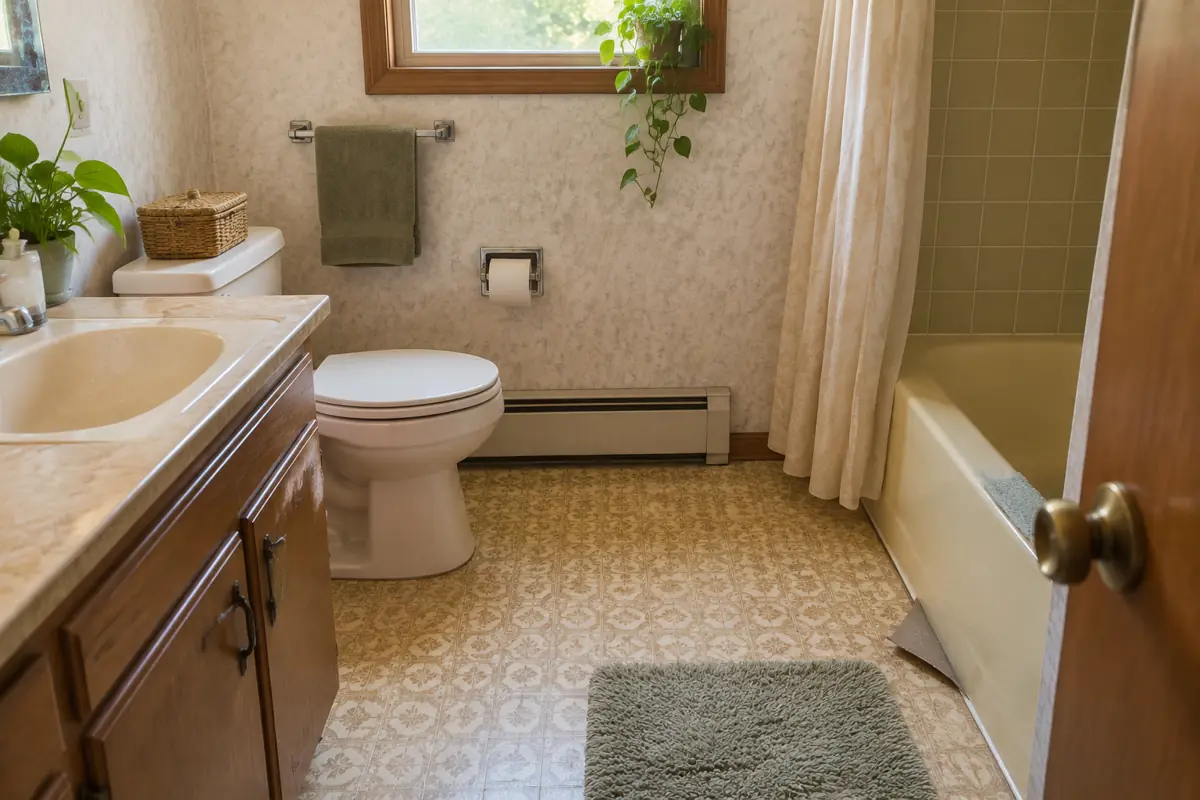
Two layers of the same old kitchen floor can sit on opposite sides of the ban line. The felt bonded to the underside of vinyl sheet flooring is defined as flooring felt in 40 CFR 763.163 and has been banned since 1990. Vinyl-asbestos floor tiles and the mastic under them were never banned. EPA and the CPSC both list vinyl floor tiles, sheet-flooring backing and flooring adhesives among materials that may contain asbestos.
Popcorn and other sprayed ceiling textures fall under the spraying limits of 1973 and 1978, now 40 CFR 61.146. The rule limits spraying of material over 1 percent asbestos and exempts sprays where a bituminous or resinous binder leaves the material non-friable after drying. Joint compound is covered by the 1977 CPSC ban.
Pipe insulation is the odd case. The 1975 limit, now 40 CFR 61.148, applies to 'facility' components, and the NESHAP definition of facility excludes residential buildings with four or fewer dwelling units (40 CFR 61.141). The 1989 ban on corrugated asbestos paper, which the CFR lists for pipe coverings, is not limited to facilities.
Nearly half of US homes were built before 1980, from 20.7% in Nevada to 73.2% in New York
The ACS 2024 count of homes by year built gives the size of the stock built while asbestos use was near its peak: 70.6 million units, 48.1% of the US total.
Housing units by decade built, millions, 2024
Source: US Census Bureau, ACS 2024 1-year, table B25034
Of 146.7 million US housing units in 2024, 16.8 million were built in 1939 or earlier, 6.2 million in the 1940s, 13.4 million in the 1950s, 14.1 million in the 1960s and 20.1 million in the 1970s. Another 18.5 million date from the 1980s, the decade that still used 1.9 million metric tons of asbestos.
Housing units built before 1980 as a percent of all housing units
Source: US Census Bureau, ACS 2024 1-year, table B25034; computed by Kitchen and Bath Renovators
New York has the oldest stock (73.2% pre-1980), followed by Rhode Island, Connecticut, DC and Pennsylvania. Nevada (20.7%), Arizona (27.9%) and Georgia (30.3%) have the youngest. In 23 of 51 jurisdictions most homes predate 1980; the median state share is 47.5%. California has the largest pre-1980 stock by count, 8.2 million units.
Show all 52 rows
| Geography | Code | Housing units | Built before 1980 | Share built before 1980 (%) | MOE (points) | Share built before 1950 (%) |
|---|---|---|---|---|---|---|
| United States | US | 146740964 | 70645087 | 48.1 | 0.1 | 15.7 |
| New York | NY | 8676911 | 6347574 | 73.2 | 0.5 | 37.5 |
| Rhode Island | RI | 488011 | 337192 | 69.1 | 2.1 | 33.3 |
| Connecticut | CT | 1554057 | 1045595 | 67.3 | 1.1 | 27.1 |
| District of Columbia | DC | 368700 | 244423 | 66.3 | 2.3 | 39.4 |
| Pennsylvania | PA | 5861320 | 3885241 | 66.3 | 0.5 | 31.7 |
| Massachusetts | MA | 3057853 | 2024578 | 66.2 | 0.8 | 35.2 |
| Illinois | IL | 5482133 | 3410687 | 62.2 | 0.5 | 25.3 |
| Ohio | OH | 5336168 | 3307668 | 62.0 | 0.5 | 24.0 |
| Michigan | MI | 4669109 | 2866185 | 61.4 | 0.5 | 21.4 |
| New Jersey | NJ | 3816432 | 2329832 | 61.0 | 0.6 | 23.3 |
| Iowa | IA | 1458471 | 868540 | 59.6 | 0.9 | 26.9 |
| Nebraska | NE | 880521 | 491576 | 55.8 | 1.2 | 22.1 |
| Wisconsin | WI | 2820538 | 1563207 | 55.4 | 0.6 | 22.4 |
| Vermont | VT | 343166 | 188392 | 54.9 | 1.8 | 24.9 |
| California | CA | 14877017 | 8153820 | 54.8 | 0.3 | 14.0 |
| Kansas | KS | 1310001 | 717533 | 54.8 | 1.0 | 20.7 |
| West Virginia | WV | 866433 | 473381 | 54.6 | 1.2 | 20.8 |
| Indiana | IN | 3026101 | 1614291 | 53.3 | 0.7 | 20.6 |
| Maine | ME | 764713 | 401678 | 52.5 | 1.3 | 26.4 |
| Missouri | MO | 2858527 | 1493514 | 52.2 | 0.7 | 17.4 |
| Minnesota | MN | 2597229 | 1333442 | 51.3 | 0.6 | 19.3 |
| New Hampshire | NH | 657198 | 332589 | 50.6 | 1.3 | 21.3 |
| Maryland | MD | 2588337 | 1304693 | 50.4 | 0.8 | 15.2 |
| Hawaii | HI | 572824 | 279811 | 48.8 | 1.4 | 5.7 |
| Oregon | OR | 1896851 | 910185 | 48.0 | 0.8 | 15.5 |
| Oklahoma | OK | 1800427 | 854327 | 47.5 | 0.6 | 11.3 |
| Wyoming | WY | 281789 | 133940 | 47.5 | 2.1 | 14.3 |
| Montana | MT | 539622 | 255912 | 47.4 | 1.4 | 15.8 |
| South Dakota | SD | 423705 | 198067 | 46.7 | 1.4 | 17.9 |
| Kentucky | KY | 2051004 | 944997 | 46.1 | 0.8 | 12.6 |
| Louisiana | LA | 2138882 | 972897 | 45.5 | 0.8 | 9.5 |
| North Dakota | ND | 380994 | 170036 | 44.6 | 1.6 | 14.1 |
| Virginia | VA | 3746211 | 1586577 | 42.4 | 0.6 | 11.1 |
| New Mexico | NM | 973944 | 404844 | 41.6 | 1.1 | 7.8 |
| Washington | WA | 3400980 | 1412930 | 41.5 | 0.5 | 13.2 |
| Alabama | AL | 2381771 | 977672 | 41.0 | 0.7 | 8.0 |
| Delaware | DE | 476415 | 194797 | 40.9 | 1.6 | 11.6 |
| Mississippi | MS | 1359223 | 544370 | 40.1 | 0.9 | 6.5 |
| Tennessee | TN | 3243954 | 1262991 | 38.9 | 0.6 | 9.3 |
| Arkansas | AR | 1421029 | 539558 | 38.0 | 0.8 | 6.5 |
| Colorado | CO | 2662111 | 1005736 | 37.8 | 0.7 | 8.9 |
| Alaska | AK | 329757 | 121049 | 36.7 | 1.6 | 3.1 |
| Idaho | ID | 832052 | 302581 | 36.4 | 1.0 | 10.3 |
| Utah | UT | 1283206 | 424607 | 33.1 | 0.8 | 8.4 |
| North Carolina | NC | 5073509 | 1646727 | 32.5 | 0.5 | 7.7 |
| Florida | FL | 10629845 | 3406698 | 32.0 | 0.3 | 3.4 |
| South Carolina | SC | 2531310 | 806646 | 31.9 | 0.5 | 5.9 |
| Texas | TX | 12616736 | 3931431 | 31.2 | 0.3 | 5.4 |
| Georgia | GA | 4668796 | 1415857 | 30.3 | 0.5 | 6.3 |
| Arizona | AZ | 3299178 | 921033 | 27.9 | 0.6 | 2.9 |
| Nevada | NV | 1365893 | 283180 | 20.7 | 0.7 | 1.9 |
ACS 2024 1-year estimates; MOE is the 90 percent margin of error for the share, approximated from component MOEs. Sorted by share.
Source: [22] US Census Bureau
The same housing stock carries lead risks, which this site covers separately in when lead paint was banned and the lead pipes map.
The 2024 chrysotile rule ends imports and the last industrial uses, not asbestos already in homes
EPA's TSCA Part 1 rule addresses the six chrysotile uses still active in 2024, none of them a home building product. Legacy asbestos in buildings is the subject of EPA's Part 2 risk evaluation, which has not yet produced a proposed rule.
| Use | Federal end date (40 CFR 751 Subpart F) | Scope |
|---|---|---|
| Chlor-alkali diaphragms (raw chrysotile import) | Banned after May 28, 2024 | Import |
| Chlor-alkali diaphragms (processing and use) | May 28, 2029; exceptions to May 25, 2032 and May 26, 2036 | Use |
| Sheet gaskets, chemical production | Banned after May 27, 2026 | All activities |
| Sheet gaskets, titanium dioxide and nuclear material | Use allowed until May 28, 2029 | Use |
| Sheet gaskets, Savannah River Site | Use allowed until December 31, 2037 | Use |
| Oilfield brake blocks | Banned after November 25, 2024 | All activities |
| Aftermarket automotive brakes and linings | Banned after November 25, 2024 | All activities |
| Other vehicle friction products and other gaskets | Banned after November 25, 2024 | All activities |
Dates as codified in the eCFR on 2026-10-22. The rule is under review in the Fifth Circuit.
Source: [15][14] US Environmental Protection Agency via eCFR; US Environmental Protection Agency via FederalRegister.gov
The rule, published March 28, 2024 and effective May 28, 2024 (89 FR 21970), ended imports of raw chrysotile for chlor-alkali diaphragms immediately. EPA said 8 chlor-alkali facilities still used asbestos. Brake and gasket uses ended after November 25, 2024, and sheet gaskets for chemical production after May 27, 2026. The final scheduled end date is December 31, 2037 for sheet gaskets at the Savannah River Site.
During the phase-outs the rule sets an interim workplace exposure limit of 0.005 fibers per cubic centimeter as an 8-hour average (40 CFR 751.511). USGS reports that US fiber imports were fully banned in May 2024 and that the last US mine closed in 2002.
For homeowners the more relevant document is EPA's Part 2 risk evaluation, announced December 3, 2024 (89 FR 95777). It found unreasonable risk from disturbing legacy asbestos such as floor and ceiling tiles, pipe wrap and insulation. EPA also states that undisturbed asbestos-containing insulation in an older building does not present a risk to people living or working there.
Court review of the 2024 rule: argued in June 2026, with no ruling in the docket we could see
Petitions for review of the 2024 rule were consolidated in the Fifth Circuit as No. 24-60193. The case was stayed for most of 2025, argued on June 1, 2026, and had no decision in the docket entries available to us.
| Date | Docket event | Case |
|---|---|---|
| 2024-04-19 | Petitions for review of the 2024 rule filed | No. 24-60193 |
| 2025-02-14 | Court grants EPA motion to stay further proceedings | No. 24-60193 |
| 2025-06-16 | EPA moves to extend the stay, stating it will conduct a rulemaking to reassess the rule | No. 24-60193 |
| 2025-07-09 | Court grants EPA motion to withdraw the stay-extension motion and extends the stay through August 8, 2025 | No. 24-60193 |
| 2025-11-24 | Court grants EPA unopposed motion to lift the stay of proceedings | No. 24-60193 |
| 2026-06-01 | Case argued; court directs supplemental briefing due June 10, 2026 | No. 24-60193 |
From docket entries mirrored by CourtListener; parties other than EPA are not named here. Latest entry available to us is dated 2026-06-22.
Source: [19] US Court of Appeals for the Fifth Circuit (docket mirrored by Free Law Project)
The court stayed proceedings at EPA's request on February 14, 2025. On June 16, 2025 EPA moved to extend the stay, stating it would conduct a rulemaking to reassess the rule. It then moved to withdraw that request, and on July 9, 2025 the court granted the withdrawal and extended the stay through August 8, 2025. After a further stay tied to a pause in Justice Department civil litigation, the court lifted the stay on November 24, 2025.
The case was argued on June 1, 2026, and the court asked for supplemental briefs due June 10, 2026. We read the docket through the CourtListener RECAP archive; its latest entry is dated June 22, 2026, and the court's own system may show later events. Until the court rules, the compliance dates in the CFR remain those listed above. USGS also notes that end dates may change because of the 2025 proceedings.
What federal rules require before a kitchen or bath demolition, and what they leave to states
Federal product bans do not reach materials already installed in a house, and the federal NESHAP and accreditation rules largely exclude single-family homes. State and local rules fill that gap and vary.
EPA's homeowner guidance says a home with undamaged materials that will not be disturbed does not need testing, and that testing makes sense before a remodel that will disturb building materials. It also says federal law does not require people who inspect, repair or remove asbestos materials in detached single-family homes to be trained and accredited, although some states and localities do (EPA).
Because the NESHAP 'facility' definition excludes residential buildings with four or fewer units, notification and work-practice rules for demolition and renovation in a typical single-family house generally come from state and local law rather than the federal NESHAP. Rules on testing, abatement and disposal differ by state; EPA keeps a list of state asbestos contacts.
If testing is needed, it fits at the planning stage, before demolition; see the kitchen remodel timeline and bathroom remodel timeline. When comparing bids, how to choose a remodeling contractor covers licensing and scope questions.
Counts and distributions
Share of all US asbestos used after the first federal limit
Formulasum(apparent consumption 1974..2025) / sum(apparent consumption 1900..2025) x 100
Inputs: USGS DS140 annual series 1900 to 2022 (fact rows 57 to 63), MCS 2026 for 2023 to 2025 (rows 47 to 49); cross-check row 64 (USGS Circular 1298); derived d1 to d4 (fact sheet rows)
Result: 19.0% after 1973 (5,985,074 of 31,511,974 metric tons); 81.0% before 1974
Roughly four of every five tons the US ever used were consumed before EPA's first limit on spray-on asbestos. The remaining 19.0% (about 6.0 million metric tons) was used while most products were still legal, including 1.9 million tons in the 1980s.
Limitations: Apparent consumption covers all uses (brakes, gaskets, cement pipe, building products) and excludes asbestos inside imported finished goods. It is not a building-products series.
Asbestos used in the 1980s
Formulasum(1980..1989) and sum(1980..1989) / d1 x 100
Inputs: DS140 annual series; fact rows 57 to 61 (fact sheet rows)
Result: 1,888,000 metric tons, 6.0% of the 1900 to 2025 total; 1989 use was 6.9% of the 1973 peak
A 1980s build date lowers the odds of asbestos materials but does not rule them out: the decade still used 1.9 million metric tons, and use first fell below 10% of the peak in 1988.
Limitations: National totals cannot say which homes received which products.
Kitchen and bath materials by federal status
Formulacount of 12 KBR material categories by status: banned, restricted to NESHAP facilities, never banned
Inputs: Table t1; registry entries; 40 CFR 763.165, 16 CFR 1304, 40 CFR 61.146 and 61.148, 40 CFR 721.11095 (fact sheet rows)
Result: 5 banned, 1 restricted, 6 never banned
Half of the material categories most likely to be found in an older kitchen or bath, including vinyl-asbestos floor tile and flooring mastic, never received a federal product ban. Since June 24, 2019 they cannot return to the market without a 90-day notice to EPA.
Limitations: Category list and mapping are KBR's. 'Never banned' means no federal product ban; it says nothing about whether a given installed product contains asbestos.
Pre-1980 housing as the exposure base
Formula(B25034_007 + _008 + _009 + _010 + _011) / B25034_001 x 100, by state
Inputs: ACS 2024 1-year B25034; fact rows 65 to 72; derived d16 to d22 (fact sheet rows)
Result: 70,645,087 units (48.1%) nationally; 23 of 51 jurisdictions above 50%; median 47.5%
Pre-1980 homes are the stock built while asbestos use was near its peak. New York (73.2%) and the Northeast and Midwest hold the oldest stock; Nevada (20.7%), Arizona and Georgia the youngest.
Limitations: Year built is reported by respondents and is less reliable for older homes. A pre-1980 build year does not mean a home contains asbestos, and many have been remodeled.
How long the federal phase-out has run
Formula2024 - 1973; 2037 - 1973
Inputs: Fact rows 1, 30 and 32 (fact sheet rows)
Result: 51 years from the first limit to the chrysotile rule; 64 years to the last scheduled end date
The federal approach has been product by product rather than one ban, which is why the honest answer to the search question is a list of dates.
Limitations: End dates depend on the outcome of the pending Fifth Circuit case.
Key findings
- The first federal limit on an asbestos building product took effect on April 6, 1973: spray-on insulation and fireproofing on US buildings had to contain less than 1 percent asbestos (38 FR 8820).[3]
- In the same 1973 rule, EPA said it considered banning the production, processing and use of asbestos and rejected that approach.[3]
- On December 15, 1977, the CPSC banned consumer patching compounds with asbestos, including tape joint compound; products made after January 16, 1978 were banned and all such products after June 11, 1978 (16 CFR 1304).[5]
- The CPSC estimated in 1977 that about half of the consumer patching compounds sold that year were made with asbestos, out of 30 to 50 million packages shipped a year.[5]
- A June 19, 1978 amendment extended the US spraying limit to all materials over 1 percent asbestos; spray-on decorative coatings were the main products affected (43 FR 26372).[7]
- The July 12, 1989 EPA rule (54 FR 29460) scheduled vinyl-asbestos floor tile, flooring felt, roofing felt and asbestos-cement sheet for Stage 1, from August 27, 1990.[8]
- On October 18, 1991 the Fifth Circuit vacated most of that rule (947 F.2d 1201). EPA's 1994 amendment kept six categories: flooring felt, commercial, corrugated and specialty paper, rollboard, and new uses.[9][10]
- Flooring felt, which the CFR defines to include felt bonded to the underside of vinyl sheet flooring, could not be made or imported in the US after August 27, 1990 or sold after August 25, 1992 (40 CFR 763.165).[11]
- Vinyl-asbestos floor tile was never banned at the federal level; since June 24, 2019 any new US manufacture or import requires a 90-day notice to EPA (84 FR 17345).[13][1]
- US asbestos consumption peaked at 803,000 metric tons in 1973 and was still 564,000 tons in 1979; it fell below 10 percent of the peak only in 1988 (USGS DS140).[21][20]
- Of the 31.5 million metric tons of asbestos the US used from 1900 to 2025, 19.0% came after 1973 and 7.0% in 1980 or later (KBR calculation from USGS data).[21][20]
- The 2024 chrysotile rule (89 FR 21970), effective May 28, 2024, banned brake and gasket uses after November 25, 2024, sheet gaskets after May 27, 2026, and chlor-alkali diaphragms by May 26, 2036 at the latest.[14][15]
- US asbestos fiber consumption was an estimated 50 metric tons in 2025, and the chlor-alkali industry has accounted for 100 percent of it since no later than 2015 (USGS MCS 2026).[20]
- 48.1% of US housing units (70.6 million) were built before 1980; in 23 of 51 jurisdictions (50 states plus DC) most homes predate 1980 (ACS 2024 1-year).[22]
- Federal law does not require people who inspect, repair or remove asbestos materials in detached single-family homes to be trained and accredited; some states and localities do, according to EPA.[24]
Executive summary
- The US never had a single asbestos ban date. This registry records 29 federal actions from April 6, 1973 to June 2026, each tied to a Federal Register page, CFR section or court record.
- Products banned today and found in homes: spray-on asbestos over 1 percent (1973 and 1978), consumer patching and joint compounds (1977), flooring felt including sheet-vinyl backing (1990), and asbestos paper products and rollboard (1996).
- EPA's 1989 rule would have phased out asbestos in almost all products, including vinyl floor tile, cement sheet and shingles. The Fifth Circuit vacated most of it on October 18, 1991.
- Our signature figure: 81.0% of the 31.5 million metric tons of asbestos the US consumed from 1900 to 2025 was used before 1974. The other 19.0% came after the first federal limit, including 1.9 million tons in the 1980s.
- Of 12 kitchen and bath material categories we mapped, 5 carry a federal product ban, 1 is restricted only for 'facilities', and 6 were never banned. Since 2019 those 6 need a 90-day notice to EPA before they could return.
- 70.6 million US homes (48.1%) were built before 1980, ranging from 20.7% of housing in Nevada to 73.2% in New York (ACS 2024).
- The 2024 chrysotile rule bans the last imported asbestos uses on dates running to December 31, 2037. It does not cover asbestos already in homes; EPA's 2024 Part 2 evaluation of those legacy uses has not yet led to a proposed rule.
Questions people ask
Is asbestos still legal in the US?
Partly. The 2024 chrysotile rule bans the last imported uses on dates running to December 31, 2037, and the 1989 rule still bans flooring felt, four paper products and new uses. But many discontinued products, including vinyl-asbestos floor tile and asbestos-cement products, were never banned outright; since June 24, 2019 they need a 90-day notice to EPA before anyone could make or import them again. Asbestos already installed in buildings is legal to leave in place.
Do houses built after 1980 have asbestos?
They can. The US still consumed 1.9 million metric tons of asbestos in the 1980s, 6.0% of all use from 1900 to 2025, and vinyl floor tile and cement products were never banned. Use fell below 10% of the 1973 peak only in 1988. A build year after 1980 lowers the odds; it does not rule asbestos out.
What did asbestos look like in old homes?
It looks like ordinary building material. The CPSC lists resilient floor tiles, the backing on vinyl sheet flooring, flooring adhesives, blanket or tape wrap on hot water and steam pipes, sprayed soundproofing or decorative ceiling material, patching and joint compounds, and cement sheet, millboard and paper around stoves. EPA and the CPSC both say you cannot tell whether a material contains asbestos by looking at it unless it is labeled; only lab analysis of a sample can confirm it.
Is popcorn ceiling asbestos?
Some is. Sprayed decorative ceiling coatings were the main products affected by EPA's June 19, 1978 spraying limit, which bars spraying material over 1 percent asbestos. Ceilings sprayed before that date may contain asbestos, and the rule exempts sprays in which a binder leaves the material non-friable after drying. Lab testing of a sample is the only way to know.
Does vinyl flooring contain asbestos?
Older vinyl flooring may. The felt backing on vinyl sheet flooring was banned for manufacture after August 27, 1990 and for sale after August 25, 1992. Vinyl-asbestos floor tile was scheduled for a 1990 ban that the Fifth Circuit vacated in 1991, so it was never federally banned. Since June 24, 2019, any new manufacture or import of it requires a 90-day notice to EPA.
Frequently asked questions
What year was asbestos banned in the US?
There is no single year. The main dates are 1973 and 1978 (spray-on asbestos), 1977 (patching compounds and fireplace embers), 1990 to 1997 (flooring felt and paper products under the 1989 rule) and 2024 to 2037 (the last chrysotile uses).
Did the 1989 asbestos ban get overturned?
Mostly. The Fifth Circuit vacated the 1989 rule on October 18, 1991. EPA's 1994 amendment kept six categories: flooring felt, commercial, corrugated and specialty paper, rollboard, and new uses.
When was asbestos removed from joint compound?
The CPSC banned consumer patching compounds with asbestos on December 15, 1977, including tape joint compound. Products made after January 16, 1978 were banned, and all such products after June 11, 1978. The CPSC estimated that about half of the patching compounds sold in 1977 contained asbestos.
How much asbestos did the US use?
About 31.5 million metric tons from 1900 to 2025, by our sum of USGS annual data. Use peaked at 803,000 tons in 1973 and was an estimated 50 tons in 2025.
How much of that was used after the first ban?
19.0%, about 6.0 million metric tons, was consumed from 1974 to 2025. 81.0% was used before 1974.
How many US homes were built before 1980?
70.6 million housing units, 48.1% of the 146.7 million US total, according to the ACS 2024 1-year estimates.
Which state has the most homes built before 1980?
By share, New York (73.2%). By count, California, with 8.2 million pre-1980 units. Nevada has the lowest share, 20.7%.
Does the 2024 EPA asbestos ban require removing asbestos from homes?
No. The 2024 rule covers six ongoing industrial uses of chrysotile. EPA's Part 2 risk evaluation of legacy uses, announced December 3, 2024, has not yet led to a proposed rule.
Is the 2024 asbestos rule still in effect?
Its compliance dates were in the eCFR as of October 22, 2026. Petitions for review (5th Cir. No. 24-60193) were argued on June 1, 2026; the docket entries available to us show no decision.
Do asbestos abatement workers need a license for single-family homes?
Not under federal law. EPA says federal law does not require training and accreditation for asbestos work in detached single-family homes, but some states and localities do.
Download the data
Every table in this report is available as a CSV under CC BY 4.0. The fact sheet lists each value with its source URL and access date.
For journalists and researchers
If you cite only a few, cite these
- 81.0% of US asbestos consumption from 1900 to 2025 came before 1974; 19.0% came after the first federal limit.[21][20]
- Vinyl-asbestos floor tile was never banned federally; the felt backing on vinyl sheet flooring has been banned since 1990.[11][13]
- 70.6 million US homes (48.1%) were built before 1980.[22]
Most quotable statistics
- 81.0% of all asbestos consumed in the United States from 1900 to 2025 was used before 1974, the year after the first federal limit (KBR analysis of USGS data).[21][20]
- The US still used 1.9 million metric tons of asbestos in the 1980s, 6.0% of its 1900 to 2025 total.[21]
- Of 12 asbestos material categories found in older kitchens and baths, 6 were never banned at the federal level (KBR mapping of the CFR).[11][13]
- US asbestos consumption fell from a record 803,000 metric tons in 1973 to an estimated 50 tons in 2025, a 99.99% decline.[20][21]
- 48.1% of US housing units, 70.6 million homes, were built before 1980 (ACS 2024).[22]
- The last scheduled end date for any asbestos use under the 2024 rule is December 31, 2037, 64 years after the first federal limit.[15][3]
Press summary
A new Kitchen and Bath Renovators registry of 29 federal asbestos actions shows the US never banned asbestos in one step. Spray-on asbestos was limited in 1973 and 1978, asbestos patching compounds were banned in 1977, and the felt backing on vinyl sheet flooring was banned in 1990. Most of EPA's 1989 ban, including vinyl-asbestos floor tile, was vacated by the Fifth Circuit in 1991, and the tile was never re-banned. Summing USGS data, 81.0% of the 31.5 million metric tons of asbestos used in the US from 1900 to 2025 was consumed before 1974; the 1980s still used 1.9 million tons. Of 12 kitchen and bath material categories, 6 never received a federal product ban. 70.6 million homes, 48.1% of US housing, were built before 1980. The 2024 chrysotile rule ends the last imported uses by 2037; a Fifth Circuit challenge argued on June 1, 2026 had no decision in the docket entries reviewed.
Suggested headlines
- When was asbestos banned? For vinyl floor tile, never
- 81.0% of US asbestos was used before the first federal limit
- The 1980s still used 1.9 million tons of asbestos
- 70.6 million US homes predate 1980, from 20.7% of Nevada's stock to 73.2% of New York's
- The last US asbestos use is scheduled to end in 2037, 64 years after the first limit
How to cite this report
Kitchen and Bath Renovators. (2026). When Was Asbestos Banned? Every Federal Action on Home Building Products. Retrieved from https://kitchenandbathrenovators.com/research/when-was-asbestos-banned/
Reuse license
Data and tables are licensed CC BY 4.0. Attribution: “Source: Kitchen and Bath Renovators, When Was Asbestos Banned? Every Federal Action on Home Building Products” with a link to this page.
Reproduce this analysis
Every figure comes from the files below. The scripts that pulled and computed them are kept with the report and can be re-run.
| Dataset | Publisher | Source | Query or filter | Rows used | Retrieved |
|---|---|---|---|---|---|
| Asbestos statistics (DS140) | USGS | File or endpoint | Column 'Apparent consumption', years 1900 to 2022 | 123 annual rows | 2026-10-27 |
| Mineral Commodity Summaries 2026, Asbestos | USGS | File or endpoint | Salient statistics, 'Consumption, estimated', 2023 to 2025 | 3 annual values (2021 and 2022 used only as a cross-check) | 2026-10-27 |
| ACS 2024 1-year table-based summary file, B25034 | US Census Bureau | File or endpoint | SUMLEVEL 010 and 040 with COMPONENT 00 (geography file Geos20241YR.txt); estimates E001 to E011 and MOEs | 53 geographies (US, 50 states, DC, Puerto Rico); 51 used for state ranking | 2026-10-27 |
| Federal Register documents API | Office of the Federal Register | File or endpoint | term=asbestos; EPA rules and notices 1994 on; all agencies since 2024-06-01 | 296 EPA rule hits screened; 8 documents used | 2026-10-27 |
| eCFR versioner API | Office of the Federal Register | File or endpoint | 16 CFR 1304, 1305 (issue 2026-10-19); 40 CFR 61 Subpart M, 763 Subpart I, 721.11095, 751 Subpart F (issue 2026-10-22) | 6 CFR units | 2026-10-27 |
| Federal Register historical issues (1973, 1975, 1977, 1978) | GovInfo | File or endpoint | Full-issue PDFs; asbestos rules located by text search | 4 issues | 2026-10-27 |
| Fifth Circuit docket No. 24-60193 (RECAP archive) | Free Law Project (CourtListener) | File or endpoint | Keyless search API, docket_id 68457472, entries sorted by date; rate limit respected | 225 indexed entries; 10 used | 2026-10-27 |
Data quality and exclusions
- ACS geography: the summary file holds 588 rows at the national and state summary levels, including urban, rural and other components; we kept the 53 rows with COMPONENT 00 (US, 50 states, DC, Puerto Rico) and excluded Puerto Rico (51.9% pre-1980) from state rankings, leaving 51.
- USGS series: 123 DS140 rows (1900 to 2022) plus 3 MCS 2026 values (2023 to 2025). Import values are 'NA' for 1900 to 1909, but apparent consumption is complete for all 126 years, and only apparent consumption is used.
- 1989 rule PDF: the EPA copy is a scan with OCR errors. Stage lists were read from the regulatory text and summary table and checked against the 1994 rewrite; no numbers were taken from garbled cells.
- Docket: 10 of 225 indexed docket entries were used. Duplicate index rows for the same entry were collapsed. Party names other than EPA were omitted.
- Pages to beat: one of the three top non-government search results (a real estate blog) refused our automated request and was replaced with the next result; nothing from those pages is used as data.
Methodology
Scope: federal actions that restrict making, importing, selling, spraying or installing asbestos products, plus the court rulings and rewrites that changed them. State and local bans, workplace exposure limits (except one OSHA entry for recency) and school rules (AHERA) are out of scope.
Selection: every registry entry rests on a primary record we opened on 2026-10-27: a Federal Register page (GovInfo issue PDFs for 1973 to 1978, EPA's posted copy of the 1989 rule, FederalRegister.gov for 1994 on), current CFR text from the eCFR API, the 1991 Fifth Circuit opinion, or Fifth Circuit docket entries from the CourtListener RECAP archive. EPA, CPSC and ATSDR web pages were used for summaries and homeowner guidance.
Conflicts: where the CPSC home guide (textured paint banned in 1977) differs from the codified ban text (patching compounds only), we follow the CFR and flag the difference. Where EPA describes 'five product types' banned under the 1989 rule and the 1994 amendment counts six categories, the difference is new uses, which EPA lists separately.
Derived metrics: cumulative consumption sums USGS apparent consumption for 1900 to 2022 (Data Series 140, last modified July 14, 2023) and 2023 to 2025 (Mineral Commodity Summaries 2026; 2025 estimated). The two sources agree for the overlap years 2021 and 2022, and the total matches the approximately 31.5 million metric tons for 1900 to 2003 published in USGS Circular 1298 (2006), because use after 2003 is small. The split of that total at 1973, 1980 and 1990 is our calculation; a search found no published version of it. Housing shares use ACS 2024 1-year table B25034, summing the five pre-1980 categories; margins of error use the Census root-sum-of-squares approximation. The kitchen and bath material map assigns each of 12 categories to the federal action that names it, or to the 2019 notice rule when no ban applies.
Recency: the ACS 2025 1-year summary file directory was not publicly available on 2026-10-27 (HTTP 401), so 2024 is the latest year used. The CourtListener docket mirror ends at an entry dated 2026-06-22. eCFR text is current to 2026-10-22 for Title 40 and 2026-10-19 for Title 16.
Registry upkeep: we check the registry quarterly and when the Fifth Circuit rules on No. 24-60193 or EPA proposes a Part 2 risk management rule. Last checked 2026-10-27.
This report presents published data with its limitations. It is not legal, financial or investment advice.
Sources, ranked by quality
Tier 1: primary and official sources (28)
- [1] US Environmental Protection Agency. EPA Actions to Protect the Public from Exposure to Asbestos (page last updated January 21, 2026). Regulatory history 1973 to 2024. Accessed 2026-10-27.
- [2] US Environmental Protection Agency. Asbestos Ban and Phase-Out Federal Register Notices (page last updated May 19, 2026). 1989 to 1994. Accessed 2026-10-27.
- [3] Office of the Federal Register via GovInfo. National Emission Standards for Hazardous Air Pollutants: Asbestos, Beryllium, and Mercury, 38 FR 8820 (April 6, 1973), Federal Register issue PDF. Rule published 1973-04-06. Accessed 2026-10-27.
- [4] Office of the Federal Register via GovInfo. Amendments to Standards for Asbestos and Mercury, 40 FR 48292 (October 14, 1975), Federal Register issue PDF. Rule published 1975-10-14. Accessed 2026-10-27.
- [5] Consumer Product Safety Commission via eCFR. 16 CFR Part 1304, Ban of consumer patching compounds containing respirable free-form asbestos (source 42 FR 63362, Dec. 15, 1977). eCFR current as of 2026-10-19. Accessed 2026-10-27.
- [6] Consumer Product Safety Commission via eCFR. 16 CFR Part 1305, Ban of artificial emberizing materials containing respirable free-form asbestos (source 42 FR 63364, Dec. 15, 1977). eCFR current as of 2026-10-19. Accessed 2026-10-27.
- [7] Office of the Federal Register via GovInfo. Asbestos Standard; Amendments, 43 FR 26372 (June 19, 1978), Federal Register issue PDF. Rule published and effective 1978-06-19. Accessed 2026-10-27.
- [8] US Environmental Protection Agency. Asbestos: Manufacture, Importation, Processing, and Distribution in Commerce Prohibitions; Final Rule, 54 FR 29460 (July 12, 1989). Rule published 1989-07-12. Accessed 2026-10-27.
- [9] US Court of Appeals for the Fifth Circuit (text via Public.Resource.Org). Corrosion Proof Fittings v. EPA, 947 F.2d 1201 (5th Cir. 1991), opinion and clarification. Decided 1991-10-18; clarification 1991-11-15. Accessed 2026-10-27.
- [10] US Environmental Protection Agency via FederalRegister.gov. Technical Amendment in Response to Court Decision on Asbestos, 59 FR 33208 (June 28, 1994). Effective 1994-06-28. Accessed 2026-10-27.
- [11] US Environmental Protection Agency via eCFR. 40 CFR Part 763 Subpart I, Prohibition of the manufacture, importation, processing, and distribution in commerce of certain asbestos-containing products. eCFR current as of 2026-10-22. Accessed 2026-10-27.
- [12] US Environmental Protection Agency via eCFR. 40 CFR Part 61 Subpart M, National Emission Standard for Asbestos. eCFR current as of 2026-10-22. Accessed 2026-10-27.
- [13] US Environmental Protection Agency via FederalRegister.gov and eCFR. Restrictions on Discontinued Uses of Asbestos; Significant New Use Rule, 84 FR 17345 (April 25, 2019), codified at 40 CFR 721.11095. Effective 2019-06-24. Accessed 2026-10-27.
- [14] US Environmental Protection Agency via FederalRegister.gov. Asbestos Part 1; Chrysotile Asbestos; Regulation of Certain Conditions of Use Under TSCA, 89 FR 21970 (March 28, 2024). Effective 2024-05-28. Accessed 2026-10-27.
- [15] US Environmental Protection Agency via eCFR. 40 CFR Part 751 Subpart F, Chrysotile Asbestos (compliance dates). eCFR current as of 2026-10-22. Accessed 2026-10-27.
- [16] US Environmental Protection Agency. Risk Management for Asbestos, Part 1: Chrysotile Asbestos (page last updated October 22, 2026). 2020 to 2026. Accessed 2026-10-27.
- [17] US Environmental Protection Agency via FederalRegister.gov. Asbestos Part 2 Supplemental Evaluation Including Legacy Uses and Associated Disposals; Final Risk Evaluation, 89 FR 95777 (December 3, 2024). Notice published 2024-12-03. Accessed 2026-10-27.
- [18] US Environmental Protection Agency. Risk Evaluation for Asbestos Part 2: Supplemental Evaluation Including Legacy Uses and Associated Disposals. 2022 to 2026. Accessed 2026-10-27.
- [19] US Court of Appeals for the Fifth Circuit (docket mirrored by Free Law Project). Docket No. 24-60193 (5th Cir.), consolidated petitions for review of the 2024 chrysotile asbestos rule, docket entries via the CourtListener RECAP archive. Entries 2024-04-19 to 2026-06-22. Accessed 2026-10-27.
- [20] US Geological Survey. Mineral Commodity Summaries 2026: Asbestos. 2021 to 2025 (2025 estimated); released February 2026. Accessed 2026-10-27.
- [21] US Geological Survey. Asbestos statistics, Historical Statistics for Mineral and Material Commodities (Data Series 140), last modified July 14, 2023. 1900 to 2022. Accessed 2026-10-27.
- [22] US Census Bureau. American Community Survey 2024 1-year, table B25034 Year Structure Built, table-based summary file. 2024 (released September 2025). Accessed 2026-10-27.
- [23] US Environmental Protection Agency. Learn About Asbestos (page last updated July 13, 2026). Current guidance. Accessed 2026-10-27.
- [24] US Environmental Protection Agency. Protect Your Family from Exposures to Asbestos (page last updated June 25, 2026). Current guidance. Accessed 2026-10-27.
- [25] US Consumer Product Safety Commission. Asbestos in the Home (safety guide). Undated guidance, opened 2026-10-27. Accessed 2026-10-27.
- [26] Agency for Toxic Substances and Disease Registry. Asbestos and Your Health (page dated August 26, 2026). Current guidance. Accessed 2026-10-27.
- [27] Occupational Safety and Health Administration via FederalRegister.gov. Asbestos; proposed rule on respirator requirements, 90 FR 28295 (July 1, 2025), and comment extension 90 FR 40542. Proposed 2025-07-01. Accessed 2026-10-27.
- [28] US Geological Survey. Worldwide Asbestos Supply and Consumption Trends from 1900 through 2003 (Circular 1298). 1900 to 2003; published 2006. Accessed 2026-10-27.