Heat Pump Water Heater: Operating Cost and Payback in Every State
- Primary data
- EIA-861M and EIA natural gas prices; ENERGY STAR certified heat pump water heaters; DOE 89 FR 37778
- Data period
- September 2025 to August 2026 (prices); models listed 2026-11-01
- Latest release used
- 2026-10-30
- Next release
- End of November 2026 (EIA-861M for September 2026); 2026-11-30 (gas prices)
- Geography
- 50 states and DC
- Sources
- 30 (25 Tier 1)
At prices for the 12 months to August 2026, a certified heat pump water heater (median UEF 3.55) costs about $165 a year to run on DOE's 55-gallon test day, against $636 for an electric resistance tank and $301 for a minimum gas tank. KBR's state model puts payback against resistance at 1.0 to 3.6 years.
The market in brief
- On DOE's 55-gallon test day a median certified heat pump unit uses 915 kWh a year; a resistance tank uses 3,528 kWh.
- At US average prices that is $165 against $636, a $471 yearly gap.
- Against DOE's $1,152 installed-cost premium, payback runs 1.0 years in Hawaii to 3.6 in North Dakota.
- Field hot water use is lower than the test day (77%), which stretches US payback to 3.2 years.
- At average prices the heat pump also costs less to run than a minimum gas tank in all 51 jurisdictions, by as little as $13.
- The 25C tax credit ended for installations after 2025-12-31; HEEHR rebates (up to $1,750) depend on state programs.
- Installation needs a 40 to 90 F room with ample air, a condensate drain and, in most cases, a 240 V circuit.
Heat pump water heater running costs: $165 a year against $636 for a resistance tank
On the federal test day a heat pump unit at the certified median uses 915 kWh a year, a resistance tank 3,528 kWh. That is 74.1% less electricity and, at the US average price of 18.04 cents per kWh, $471 a year.
Efficiency claims for heat pump water heaters are national; the bill is local. KBR priced the same job in every state: heating 55 gallons a day by 67 F, the medium-usage day in DOE's test procedure. That job takes 11,083,006 Btu a year. Dividing by each technology's Uniform Energy Factor (UEF) gives the energy bought.
Uniform Energy Factor (UEF): DOE's rating of delivered hot water energy divided by energy used over a simulated 24-hour test. A UEF of 3.55 means 3.55 units of heat delivered per unit of electricity.
The heat pump figure is the median of 282 medium-usage models on the ENERGY STAR list (UEF 3.55). The resistance tank is held at the federal minimum for a 50-gallon unit (UEF 0.9207) and the gas tank at the minimum for a 40-gallon unit (UEF 0.5803), both from 10 CFR 430.32(d). Prices are EIA's residential revenue divided by sales for September 2025 to August 2026 (EIA-861M) and volume-weighted residential gas prices (EIA).
| Input | Value | Source |
|---|---|---|
| Hot water drawn per day (medium-usage test) | 55 gallons | 10 CFR 430 app. E |
| Temperature rise | 67 F (58 F in, 125 F out) | 10 CFR 430 app. E |
| Heat delivered per year | 11,083,006 Btu | KBR calculation |
| Heat pump UEF | 3.55 (median of 282 medium-usage US listings) | ENERGY STAR list, 2026-11-01 |
| Electric resistance tank UEF | 0.9207 (federal minimum, 50 gal) | 10 CFR 430.32(d) |
| Gas tank UEF | 0.5803 (federal minimum, 40 gal) | 10 CFR 430.32(d) |
| Electricity price | 12-month revenue / sales, Sep 2025 to Aug 2026 | EIA-861M |
| Gas price | 12-month volume-weighted $/Mcf, converted with 2025 Btu/cf | EIA natural gas monthly |
| Heat pump premium (DOE basis) | $1,152 = ($1,903 – $902) x 1.1513 | DOE 2024 rule Table V.8; BLS CPI-U |
| Heat pump premium (high case) | $1,462 = $2,500 – $1,038 | ENERGY STAR cost article; DOE; BLS |
| Field-use factor | 0.771 (RECS 2020 mean / test-day resistance kWh) | EIA RECS 2020 |
Not included: fixed customer charges, time-of-use rates, the cooling effect of a heat pump on the room, gas-tank vent power, maintenance.
Source: [7][8][1][3][4][9][10][11][24] Office of the Federal Register / U.S. Department of Energy; Office of the Federal Register / U.S. Department of Energy; U.S. EPA ENERGY STAR; U.S. Energy Information Administration; U.S. Energy Information Administration; U.S. Department of Energy; U.S. Bureau of Labor Statistics; U.S. Energy Information Administration; U.S. EPA ENERGY STAR
DOE 55-gallon test day, prices for the 12 months to August 2026
Source: KBR model from EIA prices, ENERGY STAR list, 10 CFR 430
The formula reproduces ENERGY STAR's own label figures: for the 282 medium-usage listings the median gap between KBR's computed kWh and the listed kWh per year is 8.9 kWh. In Hawaii, with the highest electricity price, the heat pump costs $405 a year against $1,562 for resistance. For household-level bill context see average electric bill and average gas bill.
Payback against a resistance tank: 1.0 years in Hawaii, 3.6 in North Dakota
DOE's 2024 rule puts the installed price of a mid-level heat pump unit $1,152 above a resistance tank in September 2026 dollars. Divided by each state's saving, the premium is repaid in under 3 years in 33 of 51 jurisdictions.
DOE's May 2024 water heater rule lists an average installed cost of $902 for a baseline 20 to 55 gallon electric tank and $1,903 for efficiency level 2, a heat pump design (Table V.8, 2022 dollars). Level 2 is the nearest DOE level at or below the 3.55 median. KBR raised the $1,001 gap by the CPI-U change from the 2022 average to September 2026 (factor 1.1513), giving $1,152.
$1,152 premium, DOE test day, 12 months to August 2026
Source: KBR from DOE 89 FR 37778, BLS CPI, EIA-861M
The saving, and so the payback, follows the electricity price almost one for one. Hawaii saves $1,157 a year; North Dakota saves $323. California, Massachusetts, Maine, New York, Rhode Island, Connecticut and New Hampshire sit between 1.4 and 1.6 years; most of the South and Mountain West between 2.7 and 3.5. 18 jurisdictions need 3 years or more.
Show all 52 rows
| State | Electricity (cents/kWh) | Gas ($/therm) | Heat pump $/yr | Resistance tank $/yr | Gas tank $/yr | Saving vs resistance $/yr | Payback, test day (yrs) | Payback, field use (yrs) | Heat pump advantage over gas $/yr | Homes with electric water heater 2020 (%) | Rank (saving) |
|---|---|---|---|---|---|---|---|---|---|---|---|
| Hawaii | 44.27 | 6.523 | $405 | $1,562 | $1,246 | $1,157 | 1.0 | 1.3 | $841 | 66.3 | 1 |
| California | 32.34 | 2.159 | $296 | $1,141 | $412 | $845 | 1.4 | 1.8 | $116 | 18.8 | 2 |
| Massachusetts | 30.39 | 2.56 | $278 | $1,072 | $489 | $794 | 1.5 | 1.9 | $211 | 29.7 | 3 |
| Maine | 29.6 | 1.941 | $271 | $1,044 | $371 | $773 | 1.5 | 1.9 | $100 | 35.3 | 4 |
| Rhode Island | 29.44 | 2.011 | $269 | $1,039 | $384 | $769 | 1.5 | 1.9 | $115 | 26.1 | 5 |
| New York | 28.6 | 1.818 | $262 | $1,009 | $347 | $747 | 1.5 | 2.0 | $86 | 28.0 | 6 |
| Connecticut | 27.42 | 1.785 | $251 | $967 | $341 | $716 | 1.6 | 2.1 | $90 | 36.8 | 7 |
| Alaska | 26.94 | 1.381 | $247 | $950 | $264 | $704 | 1.6 | 2.1 | $17 | 28.4 | 8 |
| New Hampshire | 26.95 | 1.974 | $247 | $951 | $377 | $704 | 1.6 | 2.1 | $130 | 37.9 | 9 |
| District of Columbia | 24.48 | 1.725 | $224 | $864 | $329 | $640 | 1.8 | 2.3 | $105 | 52.4 | 10 |
| Vermont | 23.9 | 1.754 | $219 | $843 | $335 | $624 | 1.8 | 2.4 | $116 | 35.8 | 11 |
| New Jersey | 23.74 | 1.425 | $217 | $838 | $272 | $620 | 1.9 | 2.4 | $55 | 25.6 | 12 |
| Michigan | 21.28 | 1.086 | $195 | $751 | $207 | $556 | 2.1 | 2.7 | $13 | 27.3 | 13 |
| Maryland | 21.18 | 1.621 | $194 | $747 | $310 | $553 | 2.1 | 2.7 | $116 | 56.9 | 14 |
| Pennsylvania | 20.86 | 1.54 | $191 | $736 | $294 | $545 | 2.1 | 2.7 | $103 | 44.6 | 15 |
| Illinois | 18.91 | 1.135 | $173 | $667 | $217 | $494 | 2.3 | 3.0 | $44 | 28.1 | 16 |
| Wisconsin | 18.79 | 1.139 | $172 | $663 | $218 | $491 | 2.3 | 3.0 | $46 | 39.5 | 17 |
| Ohio | 18.41 | 1.443 | $168 | $650 | $276 | $481 | 2.4 | 3.1 | $107 | 37.6 | 18 |
| Delaware | 17.98 | 1.784 | $165 | $634 | $341 | $470 | 2.5 | 3.2 | $176 | 56.9 | 19 |
| Indiana | 16.9 | 1.152 | $155 | $596 | $220 | $442 | 2.6 | 3.4 | $65 | 43.3 | 20 |
| Virginia | 16.64 | 1.724 | $152 | $587 | $329 | $435 | 2.7 | 3.4 | $177 | 63.0 | 21 |
| Colorado | 16.61 | 1.088 | $152 | $586 | $208 | $434 | 2.7 | 3.4 | $56 | 22.0 | 22 |
| Alabama | 16.44 | 1.785 | $150 | $580 | $341 | $430 | 2.7 | 3.5 | $191 | 71.9 | 23 |
| Minnesota | 16.28 | 1.07 | $149 | $574 | $204 | $425 | 2.7 | 3.5 | $55 | 37.3 | 24 |
| Texas | 15.98 | 2.247 | $146 | $564 | $429 | $418 | 2.8 | 3.6 | $283 | 54.2 | 25 |
| South Carolina | 15.77 | 1.807 | $144 | $556 | $345 | $412 | 2.8 | 3.6 | $201 | 77.3 | 26 |
| Oregon | 15.53 | 1.622 | $142 | $548 | $310 | $406 | 2.8 | 3.7 | $168 | 64.8 | 27 |
| West Virginia | 15.53 | 1.399 | $142 | $548 | $267 | $406 | 2.8 | 3.7 | $125 | 71.2 | 28 |
| Florida | 15.41 | 2.485 | $141 | $544 | $475 | $403 | 2.9 | 3.7 | $334 | 87.9 | 29 |
| Arizona | 15.39 | 1.97 | $141 | $543 | $376 | $402 | 2.9 | 3.7 | $236 | 55.4 | 30 |
| New Mexico | 15.31 | 0.985 | $140 | $540 | $188 | $400 | 2.9 | 3.7 | $48 | 19.7 | 31 |
| Georgia | 15.17 | 2.149 | $139 | $535 | $410 | $396 | 2.9 | 3.8 | $272 | 59.4 | 32 |
| Kansas | 15.13 | 1.533 | $138 | $534 | $293 | $395 | 2.9 | 3.8 | $154 | 31.8 | 33 |
| Mississippi | 14.85 | 1.739 | $136 | $524 | $332 | $388 | 3.0 | 3.9 | $196 | 64.9 | 34 |
| North Carolina | 14.79 | 1.929 | $135 | $522 | $368 | $387 | 3.0 | 3.9 | $233 | 74.6 | 35 |
| South Dakota | 14.28 | 0.987 | $131 | $504 | $188 | $373 | 3.1 | 4.0 | $58 | 47.9 | 36 |
| Iowa | 14.2 | 1.095 | $130 | $501 | $209 | $371 | 3.1 | 4.0 | $79 | 32.6 | 37 |
| Washington | 14.2 | 1.647 | $130 | $501 | $315 | $371 | 3.1 | 4.0 | $185 | 62.5 | 38 |
| Wyoming | 14.01 | 1.237 | $128 | $494 | $236 | $366 | 3.1 | 4.1 | $108 | 33.3 | 39 |
| Missouri | 13.97 | 1.661 | $128 | $493 | $317 | $365 | 3.2 | 4.1 | $189 | 46.9 | 40 |
| Kentucky | 13.94 | 1.562 | $128 | $492 | $298 | $364 | 3.2 | 4.1 | $171 | 65.1 | 41 |
| Montana | 13.94 | 0.868 | $128 | $492 | $166 | $364 | 3.2 | 4.1 | $38 | 41.3 | 42 |
| Oklahoma | 13.81 | 1.588 | $126 | $487 | $303 | $361 | 3.2 | 4.1 | $177 | 45.4 | 43 |
| Tennessee | 13.61 | 1.305 | $125 | $480 | $249 | $356 | 3.2 | 4.2 | $125 | 74.2 | 44 |
| Arkansas | 13.57 | 2.218 | $124 | $479 | $424 | $355 | 3.3 | 4.2 | $299 | 59.4 | 45 |
| Nevada | 13.45 | 1.077 | $123 | $474 | $206 | $351 | 3.3 | 4.3 | $83 | 27.4 | 46 |
| Utah | 13.26 | 1.057 | $121 | $468 | $202 | $346 | 3.3 | 4.3 | $81 | 15.4 | 47 |
| Louisiana | 13.02 | 1.788 | $119 | $459 | $341 | $340 | 3.4 | 4.4 | $222 | 60.6 | 48 |
| Idaho | 12.77 | 0.773 | $117 | $451 | $148 | $334 | 3.5 | 4.5 | $31 | 46.7 | 49 |
| Nebraska | 12.74 | 1.217 | $117 | $449 | $232 | $333 | 3.5 | 4.5 | $116 | 33.3 | 50 |
| North Dakota | 12.35 | 0.974 | $113 | $436 | $186 | $323 | 3.6 | 4.6 | $73 | 58.2 | 51 |
| United States | 18.04 | 1.578 | $165 | $636 | $301 | $471 | 2.4 | 3.2 | $136 | 46.2 |
DOE medium-usage test day (55 gallons, 67 F rise). Heat pump UEF 3.55, resistance tank UEF 0.9207, gas tank UEF 0.5803. Payback uses a $1,152 premium (DOE 2024 rule, CPI-adjusted). Field use scales savings by 0.771. Sorted by saving.
Source: [1][3][4][5][6][7][8][9][10][11] U.S. EPA ENERGY STAR; U.S. Energy Information Administration; U.S. Energy Information Administration; U.S. Energy Information Administration; U.S. Energy Information Administration; Office of the Federal Register / U.S. Department of Energy; Office of the Federal Register / U.S. Department of Energy; U.S. Department of Energy; U.S. Bureau of Labor Statistics; U.S. Energy Information Administration
Against a minimum gas tank the heat pump costs less to run in all 51 jurisdictions, by as little as $13
At average prices, a minimum-efficiency gas tank costs $301 a year to run on the same test day, $136 more than the heat pump. The gap is widest in Hawaii and narrowest in Michigan.
The test-day gas tank burns 191.0 therms a year. Priced at each state's 12-month residential gas price, it costs more than the heat pump everywhere, but in Michigan ($13), Alaska and Idaho the margin is small enough that a different tariff could reverse it.
Gas tank cost minus heat pump cost, $ per year
Source: KBR from EIA electricity and natural gas prices
Two biases run in opposite directions. Average gas prices include fixed monthly charges that a household keeps paying if gas still serves the furnace or range, so the marginal cost of the water heater's therms is lower than modelled; that favors gas. A gas-to-heat-pump swap also needs a 240 V circuit and sometimes panel work, which this running-cost comparison leaves out. No payback is given for gas because DOE's rule does not publish a gas-to-heat-pump installed-cost premium.
Heat pump units also cool the room they sit in. ENERGY STAR cites a 2022 Slipstream study of 81 basement installations that measured an average drop of 2.3 F, and a Canadian test house study in which added heating load was offset by the water heater's savings (ENERGY STAR). KBR did not model this effect.
Why DOE's own payback is about five years: real homes use less hot water than the test day
RECS 2020 puts mean water heating electricity in homes with an electric water heater at 2,720 kWh, 77% of the test-day resistance figure. Scaling savings by that factor stretches the US payback from 2.4 to 3.2 years.
DOE's rule reports a 5.0-year simple payback for level 2, from a first-year saving of $201 (2022 dollars) computed on field energy use for a sample of RECS households. KBR's test-day saving is larger because the rating day assumes 55 gallons at a 67 F rise in every home. Using EIA RECS 2020 microdata, KBR estimated mean electric water heating at 2,720 kWh for the 57.04 million homes whose main water heater is electric (factor 0.771).
| Case | Annual saving vs resistance | Premium | Payback (years) |
|---|---|---|---|
| Medium test day (55 gal), DOE premium | $471 | $1,152 | 2.4 |
| Field use (RECS-scaled), DOE premium | $363 | $1,152 | 3.2 |
| Medium test day, high premium | $471 | $1,462 | 3.1 |
| Field use, high premium | $363 | $1,462 | 4.0 |
| High test day (84 gal), DOE premium | $729 | $1,152 | 1.6 |
| DOE 2024 rule, EL 2 (2022 prices, field use) | $201 (2022 dollars) | $1,001 (2022 dollars) | 5.0 |
US average electricity price 18.04 cents/kWh. Simple payback, no discounting, no incentives.
Source: [3][9][10][11][24] U.S. Energy Information Administration; U.S. Department of Energy; U.S. Bureau of Labor Statistics; U.S. Energy Information Administration; U.S. EPA ENERGY STAR
Simple payback vs a resistance tank, years
Source: KBR model; DOE, ENERGY STAR, EIA, BLS
With field use and the higher premium built from ENERGY STAR's cost ranges ($1,462), US payback reaches 4.0 years. State paybacks at field use run from 1.3 to 4.6 years. ENERGY STAR's own estimate is 3 to 6 years against a standard electric unit (ENERGY STAR). DOE uses a 15.1-year average life for electric storage units, heat pump models included; see the water heater lifespan report.
615 certified models: median UEF 3.7, four times the resistance-tank minimum
The ENERGY STAR list on 2026-11-01 held 719 heat pump water heater listings, 615 of them sold in the US. Their UEF runs from 2.52 to 4.5 with a median of 3.7.
615 US-market ENERGY STAR listings, 2026-11-01
Source: ENERGY STAR certified heat pump water heaters list
Half of US listings sit between UEF 3.48 and 3.88. The median of 3.7 is 4.0 times the 0.9207 minimum for a 50-gallon resistance tank. 90.4% of listings meet the UEF 3.3 floor used by Focus on Energy and NHSaves rebates. Every listing clears the 2.30 level that most 20 to 55 gallon electric tanks must reach from May 2029.
| Type | Listings | Median UEF | UEF range | Median compressor cut-off (F) | Lowest cut-off (F) | Listings with a sound rating | Median sound (dBA) | CO2 refrigerant listings |
|---|---|---|---|---|---|---|---|---|
| 240 V integrated | 447 | 3.75 | 3.3 to 4.5 | 37.0 | 23.0 | 113 | 49.0 | 0 |
| 120 V plug-in integrated | 68 | 3.0 | 2.8 to 3.5 | 37.0 | 35.0 | 22 | 45.0 | 0 |
| Split system | 100 | 3.55 | 2.52 to 4.23 | 1.0 | -26.0 | 13 | 37.0 | 94 |
615 US-market listings; 104 Canada-only listings excluded. Cut-off statistics exclude 26 values above 100 F and 7 blanks.
Source: [1] U.S. EPA ENERGY STAR
UEF also differs by draw pattern. Medium-usage listings have a median UEF of 3.55 and high-usage listings 3.84. The 68 plug-in 120 V models trade efficiency (median 3.0) for an easier swap: they run on a standard outlet circuit. Tank sizes by first-hour rating are covered in the water heater size report.
Integrated units switch to resistance near 37 F; split CO2 systems keep compressing to -26 F
The ENERGY STAR list records the lowest temperature at which each model's compressor runs. For 240 V integrated tanks the median is 37 F; for split systems, which put the compressor outdoors, it is 1 F.
An integrated unit draws heat from the room it sits in, so what matters is the room, not the outdoor climate. ENERGY STAR and DOE advise a space that stays between 40 and 90 F. Only 3.2% of 240 V integrated listings report a cut-off at or below 32 F. Below the cut-off the unit heats with its resistance elements, so a cold garage in winter erodes the savings modelled above.
Split systems are different. 94 of the 100 US-market split listings use CO2 (R-744) refrigerant, and their reported cut-offs run from -26 to 5 F. ENERGY STAR says split units work at outdoor temperatures as low as -25 F (ENERGY STAR). They also have the lowest median reported sound rating and can be the costliest: ENERGY STAR says split units can cost several times more than integrated models.
How loud: 49 dBA is the most common rating, and 467 of 615 listings give none
148 US-market listings report a sound pressure level, from 37 to 54 dBA with a median of 49. ENERGY STAR describes the range as 45 to 60 dB, about a refrigerator to a window air conditioner.
The field is optional, and 75.9% of listings leave it blank, so the ratings skew toward makers that publish them. Among those reported, 85 listings show 49 dBA. Split systems report the lowest median (37 dBA) because the compressor sits outside. Efficiency Maine advises that because of noise and the cooling effect, basements suit heat pump units better than living spaces.
46.2% of US homes heat water with electricity, where a heat pump is a same-fuel swap
No federal survey yet counts heat pump water heaters in homes. RECS 2020 shows 57.04 million homes with an electric main water heater; ENERGY STAR counted 190 thousand certified heat pump units shipped in 2023, about 4% of the market.
RECS 2020 records the fuel of the main water heater but not whether an electric unit is a heat pump, and the preliminary RECS 2024 public file has no water heating variables. KBR's weighted estimate is 46.2% of 123.53 million homes (standard error 0.1 points), against 48.0% with natural gas. For an electric home the switch keeps the same fuel and circuit, which is where the payback table applies directly.
KBR estimate from RECS 2020 microdata, weighted
Source: KBR from EIA RECS 2020 public microdata v7
The flow of new units is small: 190 thousand certified heat pump water heaters shipped in 2023, an estimated 4% market penetration, per ENERGY STAR's 2023 unit shipment report, the latest summary linked on its site.
The federal 25C credit ended with 2025; state rebates and utility discounts remain
P.L. 119-21, signed 2025-07-04, ended the 30% credit (up to $2,000 a year for heat pump water heaters) for property placed in service after 2025-12-31. The HEEHR rebate of up to $1,750 still stands in statute, but state programs open and close on their own schedule.
| Program or rule | Status or terms | Date of action | Evidence level | URL |
|---|---|---|---|---|
| Federal 25C credit (30%, up to $2,000 a year for heat pump water heaters) | Not allowed for property placed in service after 2025-12-31 | 2025-07-04 | Agency record (P.L. 119-21 sec. 70505; IRS) | https://www.irs.gov/newsroom/one-big-beautiful-bill-provisions |
| HEEHR (HEAR) rebate, up to $1,750 per heat pump water heater, income under 150% of AMI | Statute in force; text search of P.L. 119-21 finds no amendment | 2022-08-16 | Agency record (P.L. 117-169 sec. 50122) | https://www.govinfo.gov/content/pkg/PLAW-117publ169/html/PLAW-117publ169.htm |
| DOE Home Energy Rebates program | Rebates "available in select states"; no state list published | 2026-11-02 | Agency record (DOE page as accessed) | https://www.energy.gov/cmei/scep/home-energy-rebates-program |
| California HEEHRA (TECH Clean California for the CEC), single-family | Fully reserved statewide; new requests waitlisted | 2026-02-24 | Program administrator statement | https://techcleanca.com/heehrarebates/ |
| California HEEHRA, multifamily (covers heat pump water heaters) | Fully reserved statewide | 2026-09-01 | Program administrator statement | https://techcleanca.com/heehrarebates/ |
| Wisconsin HOMES and HEAR (Focus on Energy) | "Now available" to income-qualified households | 2026-11-02 | Program administrator statement | https://focusonenergy.com/home-energy-rebates |
| Efficiency Maine | $1,150 instant discount on a heat pump water heater | 2026-11-02 | Program administrator statement | https://www.efficiencymaine.com/at-home/heat-pump-water-heaters/ |
| NHSaves (New Hampshire utilities) | $900 rebate, UEF 3.30+ (2.80 for 120 V and split), purchases in 2026, claims by 2027-01-31 | 2026-01-01 | Utility program statement | https://nhsaves.com/residential/heat-pump-water-heater-2/ |
| Focus on Energy (Wisconsin utilities) | Instant discount of at least $300, UEF 3.3+ | 2026-11-02 | Utility program statement | https://www.focusonenergy.com/residential/water-heating |
| DOE water heater standard (10 CFR 430.32(d)(2)) | UEF 2.30 for most 20 to 55 gal electric tanks made from 2029-05-06 | 2024-05-06 | Agency record (89 FR 37778) | https://www.govinfo.gov/content/pkg/FR-2024-05-06/pdf/2024-09209.pdf |
Dates are the date of the action, or the access date where the program page gives none. Not tax advice. Checked at each report update.
Source: [12][13][14][15][16][17][18][19][20][21][22][9] Internal Revenue Service; Internal Revenue Service; U.S. Government Publishing Office; U.S. Government Publishing Office; U.S. Department of Energy; TECH Clean California / Energy Solutions; TECH Clean California / Energy Solutions; Focus on Energy; Focus on Energy; Efficiency Maine Trust; NHSaves (New Hampshire electric and gas utilities); U.S. Department of Energy
The IRS provisions page confirms that 25C is not allowed for property placed in service after 2025-12-31. HEEHR rebates are limited to households under 150% of area median income and are run by states; DOE's program page, accessed 2026-11-02, says only that rebates are available in select states. California's statewide HEEHRA funds were fully reserved for single-family homes on 2026-02-24 and for multifamily on 2026-09-01. Wisconsin's program lists HEAR as available.
Program discounts can cover much of the price gap: Efficiency Maine's $1,150 instant discount is close to the $1,152 DOE-basis premium used in this report. Not tax advice; confirm eligibility with the program.
What a remodel has to leave room for: air, a drain and often a 240 V circuit
A heat pump water heater needs space and air that a resistance tank does not, and a gas-to-heat-pump swap adds electrical work.
| Requirement | Detail | Source |
|---|---|---|
| Room temperature | Interior space that stays between 40 and 90 F year-round | ENERGY STAR; DOE Energy Saver |
| Air volume | About 1,000 cubic feet; at least 450 cubic feet per ENERGY STAR's install article, or a louvered door | ENERGY STAR |
| Condensate | A floor drain, sink, sump or pump for condensate | ENERGY STAR; Efficiency Maine |
| Electrical | 240 V supply at the location for most models when switching from gas; 72 of 615 listings run on 120 V | ENERGY STAR |
| Panel capacity | May need added capacity when replacing a gas or propane unit | ENERGY STAR |
| Tank size | Often one size up when replacing gas, for example 40 to 50 gallons | ENERGY STAR |
| Old vent | Seal the old flue penetration and cap the gas line | ENERGY STAR |
| Noise | 45 to 60 dB while running; median listed rating 49 dBA | ENERGY STAR; ENERGY STAR list |
| Maintenance | Rinse or change the air filter periodically | ENERGY STAR; Efficiency Maine |
Manufacturer instructions govern clearances for each model.
Source: [23][24][28][21][1] U.S. EPA ENERGY STAR; U.S. EPA ENERGY STAR; U.S. Department of Energy; Efficiency Maine Trust; U.S. EPA ENERGY STAR
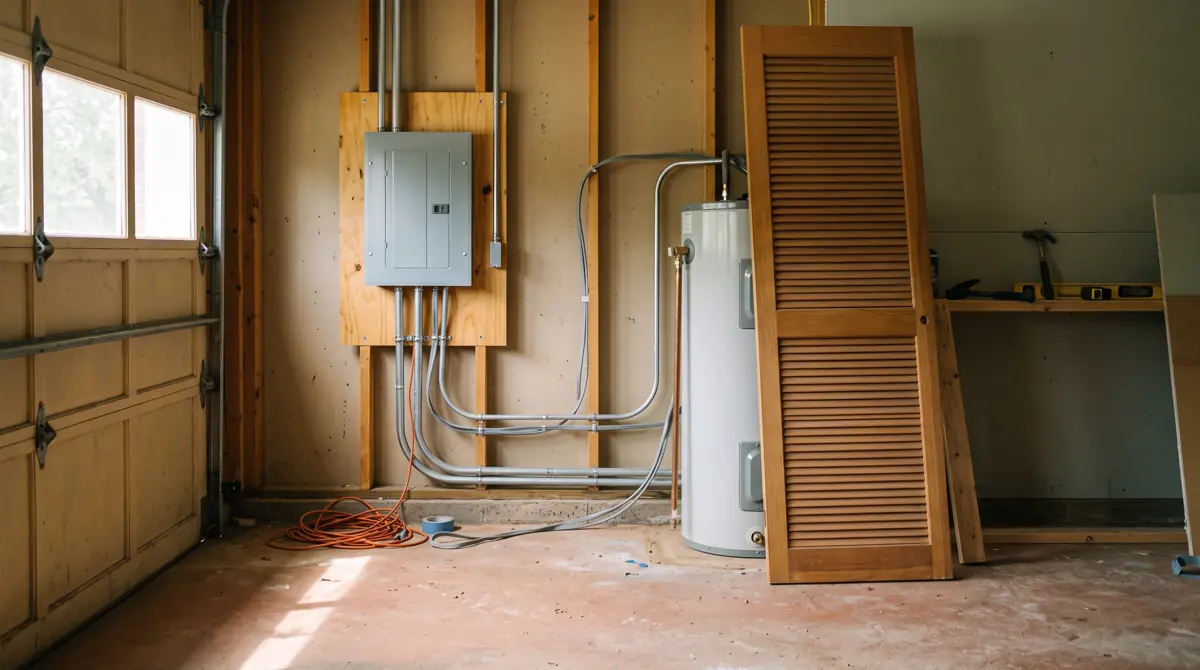
For bathroom and laundry projects, these needs show up as layout decisions: a closet sized for 450 cubic feet or fitted with a louvered door, a drain within reach, and a dedicated circuit. Including them in the plan is cheaper than retrofitting; see the bathroom remodel cost guide or the remodel cost calculator. Set-point choices are covered in the water heater temperature report.
Local benchmarks we calculated
Payback on the heat pump premium by state (signature)
Formulapayback = ((1,903 - 902) x 336.940 / 292.655) / ((Q / 0.9207 - Q / 3.55) / 3,412.14 x state cents/kWh / 100), Q = 365 x 55 x 8.24 x 67
Inputs: fact rows 14, 12, 24, 25, 1, 3, 5, 35, 7 and el_ rows by state (fact sheet rows)
Result: US 2.4 years; 1.0 (Hawaii) to 3.6 (North Dakota)
Where power is expensive the premium is recovered in under two years; the cheapest-power states need about three and a half.
Limitations: One national premium; average not marginal prices; test-day load; no incentives, no discounting.
Field-adjusted payback
Formulapayback_field = payback x (3,528 / 2,720)
Inputs: fact rows 118, 7 (fact sheet rows)
Result: US 3.2 years; states 1.3 to 4.6
Closer to DOE's 5.0-year rule estimate, which also uses field energy use.
Limitations: RECS 2020 mean includes secondary units and existing heat pump units; one national factor.
Heat pump versus gas tank running cost
Formulagas advantage = Q / 0.5803 / 100,000 x state $/therm - Q / 3.55 / 3,412.14 x state $/kWh
Inputs: fact rows 9, 35 and ng_, el_ rows by state (fact sheet rows)
Result: Heat pump cheaper in 51 of 51; $13 (Michigan) to $841 (Hawaii)
On running cost alone a heat pump beats a minimum gas tank everywhere, narrowly in low-gas-price northern states.
Limitations: Average gas prices include fixed charges; space-heating interaction and conversion costs not modelled.
UEF distribution of certified models
Formulamedian and quartiles of UEF over 615 US-market listings
Inputs: fact rows 29, 32, 33, 30, 31 (fact sheet rows)
Result: median 3.7; middle half 3.48 to 3.88; range 2.52 to 4.5
Listings, not sales: a model count does not weight popular models more.
Limitations: Model families with many listings weigh more than single models.
What the numbers show
- A heat pump water heater at the certified median UEF (3.55) costs $165 a year to run in the US on DOE's medium test day, at prices for the 12 months to August 2026.[1][3][4][7][8]
- An electric resistance tank at the federal minimum costs $636 a year on the same basis, so the heat pump saves $471 (US, 2025 to 2026 prices).[1][3][4][7][8]
- The annual saving versus resistance ranges from $1,157 in Hawaii to $323 in North Dakota (12 months to August 2026).[3][1][8]
- KBR's simple payback on DOE's $1,152 installed-cost premium is 2.4 years in the US and 1.0 to 3.6 years across states (test day, 2026 dollars).[9][10][3]
- Scaled to RECS 2020 field use (77% of the test day), US payback is 3.2 years; DOE's 2024 rule reported 5.0 years for the same efficiency level.[11][9]
- A minimum-efficiency gas tank costs $301 a year at US average gas prices; the heat pump is cheaper to run in all 51 jurisdictions, by $13 in Michigan up to $841 in Hawaii.[4][5][6][3]
- 615 heat pump water heater listings are certified by ENERGY STAR for the US market (2026-11-01), with UEF from 2.52 to 4.5 and a median of 3.7.[1]
- Integrated 240 V units have a median lower compressor cut-off of 37 F; split systems have a median of 1 F and go as low as -26 F (ENERGY STAR list, US).[1]
- Of 148 US listings with a sound rating, the median is 49 dBA; 467 of 615 listings report none (ENERGY STAR list, 2026).[1]
- 46.2% of US homes (57.04 million) heated water mainly with electricity in 2020 (RECS 2020).[11]
- ENERGY STAR counted 190 thousand certified heat pump water heaters shipped in 2023, an estimated 4% market penetration (US).[27]
- The 25C credit of 30% (up to $2,000 a year for a heat pump water heater) is not allowed for property placed in service after 2025-12-31 under P.L. 119-21 (US).[12][13][14]
- HEEHR rebates of up to $1,750 per heat pump water heater remain in statute; California's statewide funds were fully reserved by 2026-09-01.[15][17]
- Most 20 to 55 gallon electric tanks made from 2029-05-06 must reach UEF 2.30, a level DOE says only heat pump designs meet (US).[8][9]
Questions people ask
Are heat pump water heaters worth it?
Against an electric resistance tank, KBR's model recovers DOE's $1,152 premium in 2.4 years at the US average price on the test day and 3.2 years at field use, well inside DOE's 15.1-year average life. Against gas the running-cost gap is smaller ($136 a year on average) and the conversion costs more.
Do heat pump water heaters work in cold climates?
Integrated units depend on the room, not the outdoors: the median 240 V model stops compressing at 37 F and falls back to resistance. Split CO2 systems report cut-offs down to -26 F, and ENERGY STAR says they work outdoors to -25 F.
How loud is a heat pump water heater?
Listed ratings run from 37 to 54 dBA with a median of 49 among 148 US listings that report one. ENERGY STAR puts most models at 45 to 60 dB.
How long do heat pump water heaters last?
DOE applies the electric storage lifetime curve, a 15.1-year average, to heat pump units. Survival odds by age are in the water heater lifespan report.
Frequently asked questions
How much does a heat pump water heater cost to run per year?
$165 at the US average electricity price of 18.04 cents per kWh on DOE's 55-gallon test day, for the median certified medium-usage model (UEF 3.55).
How much electricity does a heat pump water heater use?
915 kWh a year on the medium test day at UEF 3.55, against 3,528 kWh for a minimum-efficiency resistance tank.
Which state saves the most with a heat pump water heater?
Hawaii, at $1,157 a year versus a resistance tank, because it has the highest residential electricity price (44.27 cents per kWh).
Which state saves the least?
North Dakota, at $323 a year, where electricity averaged 12.35 cents per kWh in the 12 months to August 2026.
Is a heat pump water heater cheaper to run than gas?
At 12-month average prices, yes in all 51 jurisdictions versus a minimum gas tank; the US gap is $136 a year, and only $13 in Michigan.
How much more does a heat pump water heater cost to install?
DOE's 2024 rule implies $1,152 more than a resistance tank in 2026 dollars; ENERGY STAR cites $1,500 to $3,000 for the unit plus $1,000 to $3,000 for labor and materials.
Is there still a federal tax credit for heat pump water heaters?
No. The 25C credit is not allowed for property placed in service after 2025-12-31 under P.L. 119-21. Not tax advice.
What is the HEEHR rebate for a heat pump water heater?
Up to $1,750 for households under 150% of area median income, through state programs; availability varies and California's funds were fully reserved by 2026-09-01.
What efficiency do certified heat pump water heaters reach?
The median UEF of 615 US listings is 3.7 (range 2.52 to 4.5); 90.4% are at 3.3 or higher.
Will heat pump water heaters be required?
For most 20 to 55 gallon electric tanks made from 2029-05-06, the federal minimum rises to UEF 2.30, which DOE says only heat pump designs meet.
For journalists and researchers
If you cite only a few, cite these
- US payback 2.4 years on the test day and 3.2 years at field use (KBR, 2026).[9][11][3]
- State payback 1.0 to 3.6 years (Hawaii to North Dakota).[9][3]
- Median certified UEF 3.7 across 615 US listings (ENERGY STAR, 2026-11-01).[1]
Most quotable statistics
- A certified heat pump water heater saves $471 a year over an electric resistance tank at 2025 to 2026 US average power prices (KBR model, DOE test day).[1][3][4][7][8]
- Payback on a heat pump water heater ranges from 1.0 years in Hawaii to 3.6 years in North Dakota (KBR, DOE cost basis).[9][3]
- At average prices a heat pump water heater costs less to run than a minimum gas tank in all 51 jurisdictions, by as little as $13 a year.[3][4]
- The median ENERGY STAR heat pump water heater rates UEF 3.7, four times the 0.9207 minimum for a 50-gallon resistance tank.[1][8]
- 467 of 615 certified heat pump water heater listings publish no sound rating (ENERGY STAR, 2026).[1]
- The 25C credit for heat pump water heaters ended for property placed in service after 2025-12-31.[13][14]
Press summary
Kitchen and Bath Renovators priced a heat pump water heater in all 50 states and DC using EIA's latest 12 months of residential electricity and gas prices, DOE's federal test day of hot water and the ENERGY STAR model list. A median certified heat pump unit (UEF 3.55) costs $165 a year to run at the US average price, against $636 for a minimum-efficiency electric resistance tank and $301 for a minimum gas tank. Against DOE's estimated $1,152 installed-cost premium, the switch from resistance pays back in 1.0 years in Hawaii and 3.6 years in North Dakota; scaling to field hot water use from EIA's household survey gives 3.2 years nationally. The 615 US-market certified models have a median UEF of 3.7. The 30% federal credit ended for installations after 2025-12-31, so remaining help comes from state HEEHR programs and utility rebates such as Efficiency Maine's $1,150 discount.
Suggested headlines
- Heat pump water heaters pay back in 1.0 to 3.6 years against electric tanks, state model finds
- A $471 a year gap: what a heat pump water heater saves at 2026 power prices
- Heat pump water heaters beat minimum gas tanks on running cost in all 51 jurisdictions, narrowly in Michigan
- With the federal credit gone, heat pump water heater buyers turn to state and utility rebates
- Three in four certified heat pump water heater listings give no noise rating
How to cite this report
Kitchen and Bath Renovators. (2026). Heat Pump Water Heater: Operating Cost and Payback in Every State. Retrieved from https://kitchenandbathrenovators.com/research/heat-pump-water-heater/
Reuse license
Data and tables are licensed CC BY 4.0. Attribution: “Source: Kitchen and Bath Renovators, Heat Pump Water Heater: Operating Cost and Payback in Every State” with a link to this page.
Download the data
Every table in this report is available as a CSV under CC BY 4.0. The fact sheet lists each value with its source URL and access date.
- derived_metrics.csv (CSV)
- fact_sheet.csv (CSV)
- Registry (CSV)
- t1_state_costs.csv (CSV)
- t2_assumptions.csv (CSV)
- t3_certified_by_type.csv (CSV)
- t5_installation_needs.csv (CSV)
- t6_payback_sensitivity.csv (CSV)
Reproduce this analysis
Every figure comes from the files below. The scripts that pulled and computed them are kept with the report and can be re-run.
| Dataset | Publisher | Source | Query or filter | Rows used | Retrieved |
|---|---|---|---|---|---|
| ENERGY STAR Certified Heat Pump Water Heaters | U.S. EPA | File or endpoint | Markets contains United States; all fields | 615 of 719 listings | 2026-11-02 |
| EIA-861M sales and revenue by state | U.S. Energy Information Administration | File or endpoint | Residential revenue and sales, 2025-09 to 2026-08, 50 states and DC | 612 state-months | 2026-11-02 |
| Natural gas residential price and volume, monthly | U.S. Energy Information Administration | File or endpoint | Data 1 sheet, state columns, 2024-09 to 2026-08; volumes from NG_CONS_SUM_A_EPG0_VRS_MMCF_M.xls | 12 calendar months per state | 2026-11-02 |
| Heat content of natural gas delivered to consumers | U.S. Energy Information Administration | File or endpoint | 2025 value by state | 51 states and DC plus US | 2026-11-02 |
| RECS 2020 public microdata v7 | U.S. Energy Information Administration | File or endpoint | FUELH2O, KWHWTH, BTUNGWTH, state_postal, NWEIGHT, NWEIGHT1 to NWEIGHT60 | 18,496 households; 8,310 with an electric main water heater | 2026-11-02 |
| Consumer water heaters final rule, Table V.8 | U.S. Department of Energy | File or endpoint | Electric storage 20 to 55 gal: installed cost EL 0 and EL 2 | 2 values | 2026-11-02 |
| CPI-U all items (CUUR0000SA0) | U.S. Bureau of Labor Statistics | File or endpoint | 2022 M13 and 2026 M09 | 2 values | 2026-11-02 |
Data quality and exclusions
- Dropped 104 Canada-only ENERGY STAR listings; 615 US-market listings remain.
- Excluded 26 lower compressor cut-off values above 100 F (210 and 220, treated as entry errors) and 7 blanks from cut-off statistics; UEF statistics use all 615.
- Sound pressure level is blank for 467 of 615 listings; noise statistics use the 148 that report it.
- Normalised refrigerant spellings (R1234YF to R-1234YF, R513A to R-513A) before counting.
- EIA withholds some state-month gas cells; for 20 jurisdictions at least one calendar month came from the prior year (Florida and New Mexico 8 each).
- August 2026 electricity data are preliminary in EIA-861M.
- Formula check: KBR's annual kWh formula matched ENERGY STAR's listed kWh per year within a median 8.9 kWh across 282 medium-usage listings.
Methodology
Selection: federal sources first (EIA, DOE, EPA ENERGY STAR, BLS, IRS, GovInfo), then state program administrators and utilities for incentives. Every source was opened on 2026-11-02 and saved in raw/.
Cost model: annual heat = 365 x 55 gallons x 8.24 lb/gallon x 1.00 Btu/lb F x 67 F = 11,083,006 Btu (10 CFR 430 appendix E, section 6.3.9). Energy = heat / UEF; electricity converted at 3,412.14 Btu per kWh, gas at 100,000 Btu per therm. Heat pump UEF 3.55 is the median of 282 US-market medium-usage ENERGY STAR listings; resistance and gas tanks use the federal minimums for 50 and 40 gallons.
Prices: electricity is the sum of residential revenue over the sum of residential sales by state for September 2025 to August 2026 (EIA-861M, August 2026 preliminary). Gas is the residential price weighted by residential volume for each calendar month, using the latest month in the 24 months to August 2026 where EIA publishes both, converted to dollars per therm with EIA's 2025 heat content by state.
Payback: DOE's 2024 rule average installed cost for efficiency level 2 ($1,903) minus the baseline ($902), in 2022 dollars, scaled by CPI-U (September 2026 / 2022 average = 1.1513). A high case uses the low end of ENERGY STAR's unit and installation ranges. Field use scales savings by the ratio of RECS 2020 mean water heating kWh in electric-water-heater homes to the test-day resistance kWh (0.771).
Conflicts: where ENERGY STAR guidance gives 1,000 cubic feet and its installation article 450 cubic feet, both are shown. DOE's 5.0-year payback and KBR's test-day figure differ by design (field versus rating load) and both are reported.
Model data: Canada-only listings (104) were dropped; lower cut-off values above 100 F (26) and blanks (7) were excluded from cut-off statistics only.
Last updated 2026-11-02. Next update after EIA's late-November 2026 releases.
This report presents published data with its limitations. It is not legal, financial or investment advice.
Sources, ranked by quality
Tier 1: primary and official sources (25)
- [1] U.S. EPA ENERGY STAR. ENERGY STAR Certified Heat Pump Water Heaters (dataset v7jr-74b4). Certified models listed on 2026-11-01. Accessed 2026-11-02.
- [2] U.S. EPA ENERGY STAR. ENERGY STAR Certified Gas (Storage and Tankless) Water Heaters (dataset 6sbi-yuk2). Certified models listed on 2026-11-01. Accessed 2026-11-02.
- [3] U.S. Energy Information Administration. Form EIA-861M monthly sales and revenue by state (sales_revenue.xlsx). September 2025 to August 2026 (August 2026 preliminary). Accessed 2026-11-02.
- [4] U.S. Energy Information Administration. Average Price of Natural Gas Delivered to Residential Consumers, monthly, by state. September 2024 to August 2026. Accessed 2026-11-02.
- [5] U.S. Energy Information Administration. Natural Gas Delivered to Residential Consumers (volumes), monthly, by state. September 2024 to August 2026. Accessed 2026-11-02.
- [6] U.S. Energy Information Administration. Heat Content of Natural Gas Delivered to Consumers, annual, by state. 2025. Accessed 2026-11-02.
- [7] Office of the Federal Register / U.S. Department of Energy. 10 CFR Part 430, Subpart B, Appendix E: Uniform Test Method for Measuring the Energy Consumption of Water Heaters (eCFR). eCFR current as of 2026-10-26. Accessed 2026-11-02.
- [8] Office of the Federal Register / U.S. Department of Energy. 10 CFR 430.32(d): Energy conservation standards for water heaters (eCFR). eCFR current as of 2026-10-26. Accessed 2026-11-02.
- [9] U.S. Department of Energy. Energy Conservation Program: Energy Conservation Standards for Consumer Water Heaters, final rule, 89 FR 37778 (GovInfo PDF), Tables I.2, IV.11, V.1, V.8, V.9. Costs in 2022 dollars; published 2024-05-06. Accessed 2026-11-02.
- [10] U.S. Bureau of Labor Statistics. Consumer Price Index for All Urban Consumers, U.S. city average, all items (CUUR0000SA0), flat file. 2022 annual average and September 2026. Accessed 2026-11-02.
- [11] U.S. Energy Information Administration. 2020 Residential Energy Consumption Survey (RECS) public use microdata, version 7. 2020. Accessed 2026-11-02.
- [12] Internal Revenue Service. Energy Efficient Home Improvement Credit. Property placed in service 2023 to 2025. Accessed 2026-11-02.
- [13] Internal Revenue Service. One, Big, Beautiful Bill provisions: home energy credit expirations. As of 2026-11-02. Accessed 2026-11-02.
- [14] U.S. Government Publishing Office. Public Law 119-21, section 70505 (Termination of energy efficient home improvement credit). Enacted 2025-07-04. Accessed 2026-11-02.
- [15] U.S. Government Publishing Office. Public Law 117-169, section 50122 (High-efficiency electric home rebate program). Enacted 2022-08-16. Accessed 2026-11-02.
- [16] U.S. Department of Energy. Home Energy Rebates Program. As of 2026-11-02. Accessed 2026-11-02.
- [21] Efficiency Maine Trust. Heat Pump Water Heaters. As of 2026-11-02 (calculator figures dated 2026-09-11). Accessed 2026-11-02.
- [23] U.S. EPA ENERGY STAR. Heat Pump Water Heaters: buying guidance. As of 2026-11-02. Accessed 2026-11-02.
- [24] U.S. EPA ENERGY STAR. What Goes into the Cost of Installing a Heat Pump Water Heater? (Ask the Experts, 2024-02-02). 2024. Accessed 2026-11-02.
- [25] U.S. EPA ENERGY STAR. Do Heat Pump Water Heaters Work in Cold Climates? (Ask the Experts). As of 2026-11-02. Accessed 2026-11-02.
- [26] U.S. EPA ENERGY STAR. Busting Myths About Heat Pump Water Heaters (Ask the Experts, 2024-08-16). 2024. Accessed 2026-11-02.
- [27] U.S. EPA ENERGY STAR. ENERGY STAR Unit Shipment and Market Penetration Report, Calendar Year 2023 Summary. 2023. Accessed 2026-11-02.
- [28] U.S. Department of Energy. Heat Pump Water Heaters, Energy Saver (Internet Archive capture of the energy.gov page, 2026-06-30). Captured 2026-06-30. Accessed 2026-11-02.
- [29] U.S. Energy Information Administration. Form EIA-861M detailed data page (release dates). Released 2026-10-23 for August 2026. Accessed 2026-11-02.
- [30] U.S. Energy Information Administration. Natural Gas Prices, monthly (release dates). Released 2026-10-30. Accessed 2026-11-02.
Tier 2: trade bodies, market research, company data (5)
- [17] TECH Clean California / Energy Solutions. HEEHRA Rebates (TECH Clean California, for the California Energy Commission). As of 2026-11-02. Accessed 2026-11-02.
- [18] TECH Clean California / Energy Solutions. HEEHRA Rebates for Single Family Homes in Northern California Fully Reserved as of February 24, 2026. 2026-02-24. Accessed 2026-11-02.
- [19] Focus on Energy. IRA Home Energy Rebates (Wisconsin HOMES and HEAR). As of 2026-11-02. Accessed 2026-11-02.
- [20] Focus on Energy. Residential Water Heating instant discounts. As of 2026-11-02. Accessed 2026-11-02.
- [22] NHSaves (New Hampshire electric and gas utilities). Heat Pump Water Heater rebate. Purchases 2026-01-01 to 2026-12-31. Accessed 2026-11-02.