How Long Do Appliances Last? The Federal Lifetime Index for 20 Home Appliances
- Primary data
- U.S. DOE energy conservation standards rulemakings (Federal Register, 2009 to 2024) and EIA RECS 2020 public microdata v7
- Data period
- DOE estimates published 2009 to 2024; household appliance ages for 2020, with a preliminary 2024 check
- Latest release used
- 2026-05-01
- Next release
- RECS 2024 heating, cooling and water heating data in spring 2027 (EIA)
- Geography
- United States
- Sources
- 40 (40 Tier 1)
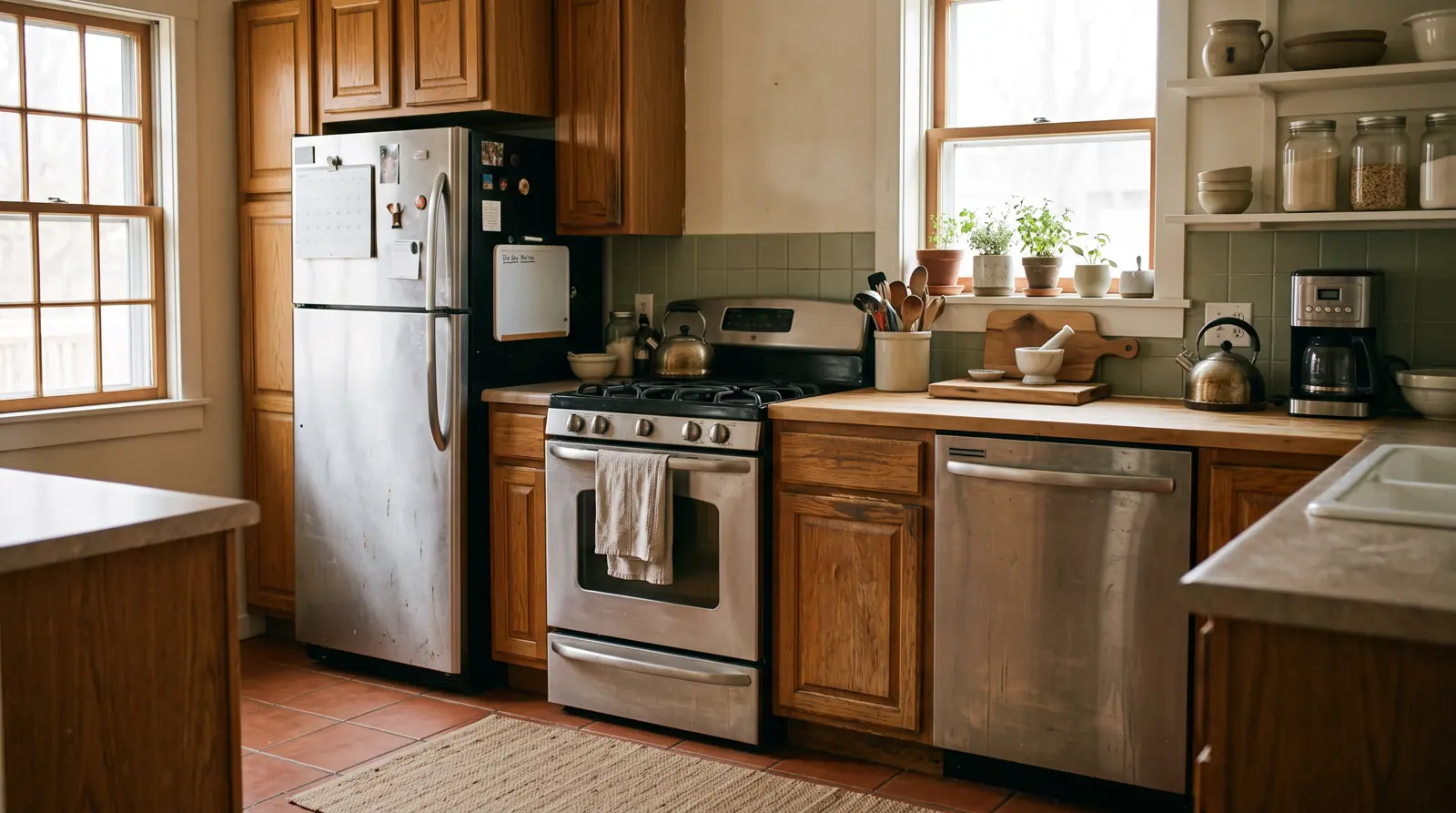
DOE's own rulemaking files show how long do appliances last: from 9.3 years for room air conditioners to 21.5 for gas furnaces, with refrigerators at 14.3 and dishwashers at 15.2. KBR's analysis of EIA's 2020 household survey finds 88.3 million appliances in US homes already at or past those federal averages.
How the index is built
Appliances at or past DOE's average lifetime, US, 2020
FormulaSum over 10 appliance rows of weighted units whose RECS age band starts at or above the band edge nearest DOE's average lifetime
Inputs: fact sheet RECS rows for 2020 and DOE lifetime rows (see derived_metrics.csv d1) (fact sheet rows)
Result: 88.28 million units (SE 1.02 million; bounds 61.24 to 164.49 million)
About 0.71 flagged appliances per US household. Gas furnaces and main refrigerators contribute most units.
Limitations: Band edges round each average to 10, 15 or 20 years. Only the most-used freezer and the main heating and cooling unit carry an age. Water heaters are excluded to avoid duplicating the water heater report.
Households with at least one appliance at or past DOE's average
FormulaWeighted households with any flagged appliance / all households
Inputs: RECS 2020 microdata v7 (fact sheet rows)
Result: 38.4% (47.48 million); strict-edge lower bound 29.8%
Roughly two in five homes held at least one appliance that had reached its federal average age.
Limitations: Survey estimate with jackknife SE; see fact sheet.
Direction of change in DOE lifetime estimates
Formulacount(newest - prior < 0) across 19 categories; median(newest - prior)
Inputs: Table 1 lifetime pairs (fact sheet rows)
Result: 14 shorter, 4 longer, 1 unchanged; median -1.0 years
Newer federal analyses assume shorter lives for most kitchen and laundry products and longer lives for central AC and storage water heaters.
Limitations: Unweighted; mixes final rules and one proposal; changes reflect data and method updates.
Kitchen lifetime spread
Formulamax - min of DOE averages for refrigerator, dishwasher, electric cooking, gas cooking, microwave
Inputs: rows for those five products (fact sheet rows)
Result: 6.02 years (16.8 – 10.78)
Appliances bought together are modelled to fail years apart.
Limitations: Cooking averages are by fuel, not by range vs wall oven vs cooktop.
Laundry vs kitchen age-band pairing
Formulashare(washer band = dryer band) - share(fridge band = dishwasher band)
Inputs: RECS 2020 AGECWASH, AGECDRYER, AGERFRI1, AGEDW (fact sheet rows)
Result: 26.0 percentage points
Laundry pairs are far more often the same age than kitchen pairs.
Limitations: Same band does not prove a joint purchase.
How long do appliances last in DOE's own files: 20 estimates from 8.8 to 26.6 years
Each time the Department of Energy writes an efficiency standard it estimates how long the product survives in American homes. Those estimates sit in the life-cycle cost section of each rule. Collected in one place, they form a federal lifetime index.
DOE average lifetime: The mean of a survival curve, usually a Weibull distribution, that DOE fits to shipment histories and the ages of appliances reported in EIA's RECS and the Census Bureau's American Housing Survey. It is an input to DOE's consumer cost model.
| Rank | Appliance | Group | DOE average lifetime (years) | Newest DOE document | Published | Federal Register | Docket | Prior estimate (years) | Prior document | Prior published | Change (years) |
|---|---|---|---|---|---|---|---|---|---|---|---|
| 1 | Gas-fired hot water boiler | Heating | 26.6 | Final rule | 2016-01-15 | 81 FR 2320 | EERE-2012-BT-STD-0047 | not available | |||
| 2 | Gas furnace (non-weatherized) | Heating | 21.5 | Final rule | 2023-12-18 | 88 FR 87502 | EERE-2014-BT-STD-0031 | 23.6 | 76 FR 37408 | 2011-06-27 | -2.10 |
| 3 | Central air conditioner | Cooling | 21.2 | Direct final rule | 2017-01-06 | 82 FR 1786 | EERE-2014-BT-STD-0048 | 19 | 76 FR 37408 | 2011-06-27 | +2.20 |
| 4 | Gas tankless (instantaneous) water heater | Water heating | 20 | Final rule (withdrawn 2025-05-20 under the Congressional Review Act) | 2024-12-26 | 89 FR 105188 | EERE-2017-BT-STD-0019 | 20 | 75 FR 20112 | 2010-04-16 | 0.00 |
| 5 | Freezer, standard-size | Kitchen | 18.4 | Direct final rule | 2024-01-17 | 89 FR 3026 | EERE-2017-BT-STD-0003 | 22.3 | 76 FR 57516 (via 88 FR 12452) | 2011-09-15 | -3.90 |
| 6 | Electric cooking products (cooktops, ovens, ranges) | Kitchen | 16.8 | Direct final rule | 2024-02-14 | 89 FR 11434 | EERE-2014-BT-STD-0005 | 19 | 74 FR 16040 | 2009-04-08 | -2.20 |
| 7 | Central heat pump | Heating | 15.3 | Direct final rule | 2017-01-06 | 82 FR 1786 | EERE-2014-BT-STD-0048 | 16.3 | 76 FR 37408 | 2011-06-27 | -1.00 |
| 8 | Dishwasher | Kitchen | 15.2 | Direct final rule | 2024-04-24 | 89 FR 31398 | EERE-2019-BT-STD-0039 | 15.4 | 81 FR 90072 | 2016-12-13 | -0.20 |
| 9 | Storage tank water heater | Water heating | 15 | Final rule | 2024-05-06 | 89 FR 37778 | EERE-2017-BT-STD-0019 | 13 | 75 FR 20112 | 2010-04-16 | +2.00 |
| 10 | Wine or beverage cooler, full-size | Kitchen | 14.6 | Direct final rule | 2024-05-07 | 89 FR 38762 | EERE-2020-BT-STD-0039 | 17.4 | 81 FR 75194 | 2016-10-28 | -2.80 |
| 11 | Gas cooking products (cooktops, ovens, ranges) | Kitchen | 14.5 | Direct final rule | 2024-02-14 | 89 FR 11434 | EERE-2014-BT-STD-0005 | 19 | 74 FR 16040 | 2009-04-08 | -4.50 |
| 12 | Refrigerator, standard-size | Kitchen | 14.3 | Direct final rule | 2024-01-17 | 89 FR 3026 | EERE-2017-BT-STD-0003 | 17.4 | 76 FR 57516 (via 88 FR 12452) | 2011-09-15 | -3.10 |
| 13 | Clothes dryer | Laundry | 14 | Direct final rule | 2024-03-12 | 89 FR 18164 | EERE-2014-BT-STD-0058 | 16 | 76 FR 22454 | 2011-04-21 | -2.00 |
| 14 | Clothes washer | Laundry | 13.4 | Direct final rule | 2024-03-15 | 89 FR 19026 | EERE-2017-BT-STD-0014 | 14.2 | 77 FR 32308 | 2012-05-31 | -0.80 |
| 15 | Whole-home dehumidifier | Cooling | 12 | Proposed rule (not finalized) | 2023-11-06 | 88 FR 76510 | EERE-2019-BT-STD-0043 | 19 | 81 FR 38338 | 2016-06-13 | -7.00 |
| 16 | Freezer, compact | Kitchen | 11.3 | Direct final rule | 2024-01-17 | 89 FR 3026 | EERE-2017-BT-STD-0003 | 7.5 | 76 FR 57516 (via 88 FR 12452) | 2011-09-15 | +3.80 |
| 17 | Microwave oven | Kitchen | 10.78 | Final rule | 2023-06-20 | 88 FR 39912 | EERE-2017-BT-STD-0023 | 10.9 | 78 FR 36316 | 2013-06-17 | -0.12 |
| 18 | Portable dehumidifier | Cooling | 10 | Proposed rule (not finalized) | 2023-11-06 | 88 FR 76510 | EERE-2019-BT-STD-0043 | 11 | 81 FR 38338 | 2016-06-13 | -1.00 |
| 19 | Room (window or wall) air conditioner | Cooling | 9.3 | Final rule | 2023-05-26 | 88 FR 34298 | EERE-2014-BT-STD-0059 | 10.5 | 76 FR 22454 | 2011-04-21 | -1.20 |
| 20 | Refrigerator, compact | Kitchen | 8.8 | Direct final rule | 2024-01-17 | 89 FR 3026 | EERE-2017-BT-STD-0003 | 5.6 | 76 FR 57516 (via 88 FR 12452) | 2011-09-15 | +3.20 |
Averages of DOE survival curves used for life-cycle cost modelling, not warranties. Dehumidifier values come from a November 2023 proposal that DOE did not finalize; the gas tankless figure comes from a December 2024 rule withdrawn in May 2025. The 2011 refrigerator and freezer values are as listed in Table IV.12 of the February 2023 proposal.
Source: [1][2][4][5][6][7][8][9][10][11][12][13][14][15][16][17][18][19][20][21][22][23][24][25] U.S. Department of Energy, Federal Register; U.S. Department of Energy, Federal Register; U.S. Department of Energy, Federal Register; U.S. Department of Energy, Federal Register; U.S. Department of Energy, Federal Register; U.S. Department of Energy, Federal Register; U.S. Department of Energy, Federal Register; U.S. Department of Energy, Federal Register; U.S. Department of Energy, Federal Register; U.S. Department of Energy, Federal Register; U.S. Department of Energy, Federal Register; U.S. Department of Energy, Federal Register; U.S. Department of Energy, Federal Register; U.S. Department of Energy, Federal Register; U.S. Department of Energy, Federal Register; U.S. Department of Energy, Federal Register; U.S. Department of Energy, Federal Register; U.S. Department of Energy, Federal Register; U.S. Department of Energy, Federal Register; U.S. Department of Energy, Federal Register; U.S. Department of Energy, Federal Register; U.S. Department of Energy, Federal Register; U.S. Department of Energy, Federal Register; U.S. Department of Energy, Federal Register
Years; averages for cost modelling, not guarantees
Source: U.S. Department of Energy standards rulemakings in the Federal Register, 2016 to 2024; KBR compilation.
The longest-lived products are heating and cooling systems: gas-fired hot water boilers at 26.6 years, gas furnaces at 21.5 years and central air conditioners at 21.2 years. The shortest are room air conditioners at 9.3 years and compact refrigerators at 8.8 years.
Kitchen appliances cluster in the middle. The 2024 refrigerator rule uses 14.3 years for a standard-size refrigerator, the 2024 dishwasher rule uses 15.2 years and the 2024 cooking rule uses 16.8 years for electric and 14.5 years for gas cooking products. For appliance-level detail, see our reports on refrigerators, dishwashers, ovens and water heaters.
88.3 million appliances in US homes had reached DOE's average age by 2020
Matching DOE's averages to the age bands in EIA's 2020 household survey shows 88.3 million appliance units at or past the band edge nearest their federal average, in 38.4% of homes.
| Appliance | DOE average lifetime (years) | RECS age band used | Units at or past (million) | SE (million) | Share of units (%) | SE (points) | Strict lower bound (million) | Upper bound (million) | Units with a reported age (million) | Survey records |
|---|---|---|---|---|---|---|---|---|---|---|
| Refrigerator (most-used) | 14.3 | 15+ | 14.31 | 0.34 | 11.6 | 0.28 | 14.31 | 35.12 | 122.86 | 18413 |
| Refrigerator (second) | 14.3 | 15+ | 9.72 | 0.23 | 22.9 | 0.56 | 9.72 | 20.40 | 42.53 | 6926 |
| Separate freezer (most-used) | 18.4 | 20+ | 4.61 | 0.17 | 11.2 | 0.37 | 4.61 | 8.81 | 41.14 | 6929 |
| Dishwasher | 15.2 | 15+ | 11.35 | 0.30 | 12.6 | 0.32 | 4.84 | 11.35 | 89.79 | 14108 |
| Clothes washer | 13.4 | 15+ | 9.63 | 0.25 | 9.3 | 0.25 | 9.63 | 25.79 | 103.96 | 16344 |
| Clothes dryer | 14 | 15+ | 11.92 | 0.28 | 11.7 | 0.28 | 11.92 | 29.60 | 102.32 | 16106 |
| Gas furnace (main heat) | 21.5 | 20+ | 10.50 | 0.26 | 18.3 | 0.44 | 0.00 | 10.50 | 57.29 | 8955 |
| Central heat pump (main heat) | 15.3 | 15+ | 3.21 | 0.18 | 19.9 | 1.06 | 1.55 | 3.21 | 16.13 | 2218 |
| Central air conditioner (main AC, excl. heat pump homes) | 21.2 | 20+ | 8.38 | 0.27 | 12.3 | 0.38 | 0.00 | 8.38 | 68.38 | 10224 |
| Window or wall AC (main AC) | 9.3 | 10+ | 4.65 | 0.24 | 21.7 | 0.89 | 4.65 | 11.33 | 21.43 | 3045 |
| Total, 10 rows | 88.28 | 1.02 | 61.24 | 164.49 |
RECS records age in bands (under 2, 2 to 4, 5 to 9, 10 to 14, 15 to 19, 20 or more). Each appliance is counted from the band edge nearest DOE's average. Strict lower bound uses the first edge above the average (zero for furnaces and central AC, whose averages fall inside the open 20+ band). Upper bound adds the band that contains the average. Water heaters are excluded; see /research/how-long-does-a-water-heater-last/.
Source: [38][1][4][6][8][10][20][22] U.S. Energy Information Administration; U.S. Department of Energy, Federal Register; U.S. Department of Energy, Federal Register; U.S. Department of Energy, Federal Register; U.S. Department of Energy, Federal Register; U.S. Department of Energy, Federal Register; U.S. Department of Energy, Federal Register; U.S. Department of Energy, Federal Register
Units in US primary residences, nearest RECS band edge
Source: KBR analysis of EIA 2020 RECS microdata v7.
RECS asks the age of each appliance in bands, not years. For each appliance we took the band edge nearest DOE's average: 15 years for refrigerators, dishwashers, washers, dryers and heat pumps, 20 years for freezers, gas furnaces and central AC, and 10 years for window or wall units. Because ages are reported in completed years, the 15+ edge is exact for refrigerators (14.3) and dryers (14), and the 10+ edge is exact for room AC (9.3).
The bounds are wide because the bands are wide. Counting only bands entirely above each average gives 61.2 million units; adding the band that contains the average gives 164.5 million. The central figure has a jackknife standard error of 1.02 million.
Percent of units with a reported age, nearest RECS band edge
Source: KBR analysis of EIA 2020 RECS microdata v7 and DOE lifetime estimates.
Share for share, second refrigerators (22.9%), window or wall AC units (21.7%), heat pumps (19.9%) and gas furnaces (18.3%) are the most likely to be at or past their federal average. Clothes washers are the least likely, at 9.3%.
14 of 19 lifetime estimates got shorter in DOE's latest rulemakings
Comparing each product's newest DOE estimate with the one from its previous rulemaking, most averages moved down, some by several years.
Average lifetime in years, prior rulemaking vs newest
Source: DOE final and direct final rules in the Federal Register (dockets in table 1); KBR compilation.
The largest drops are for whole-home dehumidifiers (19 to 12 years, in a 2023 proposal that was not finalized), gas cooking products (19 to 14.5), freezers (22.3 to 18.4) and refrigerators (17.4 to 14.3). Estimates rose for central air conditioners (19 to 21.2), storage water heaters (13 to 15), compact refrigerators (5.6 to 8.8) and compact freezers (7.5 to 11.3). The gas tankless estimate held at 20 years.
These changes mostly reflect new inputs, not proof that products wear out faster. The refrigerator curve was refit to RECS 2005 to 2020 ages; the 2024 cooking figures drew on AHAM's estimates of useful life, where the 2009 figure came from the literature; and the dehumidifier proposal adopted manufacturer figures. In the 2024 refrigerator rule, DOE said it had no data to corroborate a link between tighter standards and shorter lifetimes (89 FR 3026).
- Refrigerator, standard-size: 17.4 years (2011) to 14.3 years (2024).
- Clothes dryer: 16 years (2011) to 14 years (2024).
- Clothes washer: 14.2 years (2012) to 13.4 years (2024).
- Room air conditioner: 10.5 years (2011) to 9.3 years (2023).
- Gas furnace: 23.6 years (2011) to 21.5 years (2023).
- Microwave oven: 10.9 years (2013) to 10.78 years (2023).
Kitchen appliances: the microwave's average runs 6.02 years short of an electric range
Within one kitchen, DOE's averages differ by about six years, so appliances bought on the same day are not expected to fail together.
- Electric cooking products (range, cooktop, oven): 16.8 years (2024).
- Dishwasher: 15.2 years (2024).
- Gas cooking products: 14.5 years (2024).
- Refrigerator, standard-size: 14.3 years (2024).
- Wine or beverage cooler: 12.6 years weighted across sizes (2024).
- Microwave oven: 10.78 years (2023).
Refrigerators and dishwashers with both units 15 or older were present in 5.5% of homes that had both in 2020. Homeowners planning a remodel can compare these averages with the build schedule in our kitchen remodel timeline and the appliance line in our remodel cost calculator; garbage disposals are covered in a separate lifespan report.
Washers and dryers age in matched pairs; refrigerators and dishwashers only about half the time
In 2020, 78.3% of homes with both a washer and a dryer had them in the same age band, against 52.2% for a refrigerator and dishwasher.
| Appliances | Share of households with all of them (%) | SE (points) | Households with all of them (million) |
|---|---|---|---|
| Clothes washer and dryer | 78.3 | 0.35 | 101.60 |
| Most-used refrigerator and dishwasher | 52.2 | 0.53 | 89.50 |
| Refrigerator, dishwasher, washer and dryer | 23.1 | 0.38 | 81.28 |
| Refrigerator and dishwasher both 15 or older | 5.5 | 0.22 | 89.50 |
A shared band (for example both 5 to 9 years old) is consistent with buying together but does not prove it; bands are 3 to 5 years wide, so chance matches are common.
Source: [38] U.S. Energy Information Administration
Only 23.1% of homes with all four appliances had a refrigerator, dishwasher, washer and dryer in one age band. The 26.0-point gap between laundry pairs and kitchen pairs is consistent with laundry sets being bought together and kitchen appliances being replaced one at a time.
Preliminary 2024 survey: slightly smaller shares past the line, slightly more units
Using the same band edges on EIA's preliminary RECS 2024 file, the six kitchen and laundry rows total 62.85 million units at or past DOE's average, against 61.55 million in 2020.
| Appliance | Share 2020 (%) | Share 2024 (%) | Units 2020 (million) | Units 2024 (million) | SE 2024 share (points) |
|---|---|---|---|---|---|
| Refrigerator (most-used) | 11.6 | 10.7 | 14.31 | 14.15 | 0.26 |
| Refrigerator (second) | 22.9 | 22.4 | 9.72 | 10.21 | 0.63 |
| Separate freezer (most-used) | 11.2 | 9.9 | 4.61 | 4.79 | 0.45 |
| Dishwasher | 12.6 | 11.8 | 11.35 | 11.70 | 0.33 |
| Clothes washer | 9.3 | 8.7 | 9.63 | 9.79 | 0.27 |
| Clothes dryer | 11.7 | 11.0 | 11.92 | 12.20 | 0.30 |
| Total, six rows | 61.55 | 62.85 |
RECS 2024 v1 (May 2026) is preliminary and carries no heating, cooling or water heater ages yet; EIA lists those for spring 2027. Same band edges as table 3.
Source: [38][39] U.S. Energy Information Administration; U.S. Energy Information Administration
Percent of units with a reported age; 2024 is preliminary
Source: KBR analysis of EIA RECS 2020 v7 and RECS 2024 v1 microdata.
Every one of the six shares fell slightly from 2020 to 2024, while the household count rose from 123.53 million to 132.54 million, so the unit count edged up by 1.30 million. RECS 2024 is preliminary and does not yet include heating, cooling or water heater ages.
A DOE lifetime is an input to a cost model, not a promise about your unit
DOE builds each average from survey ages and shipment histories, then varies it by region or product class where the data allow.
For furnaces, DOE uses 22.5 years in the North and 20.2 years elsewhere, and its literature review ranged from 16 to 23.6 years (88 FR 87502). For central AC the regional averages run from 18.0 years in the hot-humid South to 24.9 years in the hot-dry West (82 FR 1786).
Repairs extend lives in DOE's models too: the 2024 washer rule assumes a repair adds about 5 years and that a used washer has 7 years left on average (89 FR 19026).
| Appliance | Under 2 | 2 to 4 | 5 to 9 | 10 to 14 | 15 to 19 | 20 or more |
|---|---|---|---|---|---|---|
| Refrigerator (most-used) | 15.2 | 23.8 | 32.4 | 16.9 | 7.2 | 4.5 |
| Refrigerator (second) | 11.3 | 14.7 | 26.0 | 25.1 | 12.1 | 10.8 |
| Separate freezer (most-used) | 13.8 | 16.0 | 28.3 | 20.5 | 10.2 | 11.2 |
| Dishwasher | 15.4 | 23.5 | 31.5 | 16.9 | 7.2 | 5.4 |
| Clothes washer | 16.7 | 25.1 | 33.4 | 15.5 | 5.6 | 3.7 |
| Clothes dryer | 14.7 | 22.9 | 33.5 | 17.3 | 6.9 | 4.8 |
| Gas furnace (main heat) | 10.5 | 14.4 | 23.4 | 20.1 | 13.3 | 18.3 |
| Central heat pump (main heat) | 15.3 | 17.9 | 28.1 | 18.8 | 10.3 | 9.6 |
| Central air conditioner (main AC, excl. heat pump homes) | 12.4 | 15.8 | 26.2 | 20.9 | 12.4 | 12.2 |
| Window or wall AC (main AC) | 16.1 | 31.0 | 31.2 | 13.5 | 4.6 | 3.6 |
Weighted with NWEIGHT. Rows sum to 100 within rounding.
Source: [38] U.S. Energy Information Administration
Which appliance rules DOE moved to roll back in 2025, and what is still pending
The lifetimes in this index were set under rules that DOE has since proposed to rescind for several kitchen products; the estimates themselves remain the newest published.
| Product | Newest standard with a lifetime estimate | Latest Federal Register action | Action date | Citation |
|---|---|---|---|---|
| Refrigerators and freezers | Direct final rule, 89 FR 3026 | No 2025 to 2026 action found; effective date confirmed 2024-06-13 (89 FR 50205) | 2024-06-13 | 89 FR 50205 |
| Dishwashers | Direct final rule, 89 FR 31398 | Proposal to rescind the amended water use standards | 2025-05-16 | 90 FR 20859 |
| Clothes washers | Direct final rule, 89 FR 19026 | Proposal to rescind the amended water use standards | 2025-05-16 | 90 FR 20890 |
| Clothes dryers | Direct final rule, 89 FR 18164 | No 2025 to 2026 action found | 2024-10-08 | 89 FR 81295 |
| Cooking tops | Direct final rule, 89 FR 11434 | Proposal to rescind the amended design requirements | 2025-05-16 | 90 FR 20881 |
| Conventional ovens | Direct final rule, 89 FR 11434 | Proposal to rescind the amended design requirements | 2025-05-16 | 90 FR 20885 |
| Microwave ovens | Final rule, 88 FR 39912 | Proposal to rescind the standards | 2025-05-16 | 90 FR 20895 |
| Wine and beverage coolers | Direct final rule, 89 FR 38762 | Proposal to withdraw coverage of the product category | 2025-05-16 | 90 FR 20840 |
| Dehumidifiers | Final rule, 81 FR 38338 (2023 proposal not finalized) | Proposal to rescind amended standards for non-whole-home units | 2025-05-16 | 90 FR 20864 |
| Room air conditioners | Final rule, 88 FR 34298 | No 2025 to 2026 action found | 2023-05-26 | 88 FR 34298 |
| Storage water heaters | Final rule, 89 FR 37778 | No 2025 to 2026 action found | 2024-05-06 | 89 FR 37778 |
| Gas tankless water heaters | Final rule, 89 FR 105188 | Rule withdrawn after Congressional disapproval | 2025-05-20 | 90 FR 21390 |
| Gas furnaces | Final rule, 88 FR 87502 | Gas industry petition to amend compliance dates; comments closed 2026-05-27 | 2026-04-27 | 91 FR 22477 |
| Central air conditioners and heat pumps | Direct final rule, 82 FR 1786 | No 2025 to 2026 action found | 2017-01-06 | 82 FR 1786 |
| Consumer boilers | Final rule, 81 FR 2320 | 2023 proposal withdrawn | 2025-01-17 | 90 FR 5746 |
| All covered products | Analytic methods | Request for comment on DOE's methods, including product lifetime modelling | 2026-07-07 | 91 FR 41578 |
Compiled from Federal Register API searches run on 2026-11-01. 'No action found' means no rule or proposal for the product in DOE documents published from 2025-01-20 to 2026-11-01.
Source: [1][4][6][8][10][11][13][15][17][18][20][22][23][26][27][28][29][30][31][32][33][34][35][37][40] U.S. Department of Energy, Federal Register; U.S. Department of Energy, Federal Register; U.S. Department of Energy, Federal Register; U.S. Department of Energy, Federal Register; U.S. Department of Energy, Federal Register; U.S. Department of Energy, Federal Register; U.S. Department of Energy, Federal Register; U.S. Department of Energy, Federal Register; U.S. Department of Energy, Federal Register; U.S. Department of Energy, Federal Register; U.S. Department of Energy, Federal Register; U.S. Department of Energy, Federal Register; U.S. Department of Energy, Federal Register; U.S. Department of Energy, Federal Register; U.S. Department of Energy, Federal Register; U.S. Department of Energy, Federal Register; U.S. Department of Energy, Federal Register; U.S. Department of Energy, Federal Register; U.S. Department of Energy, Federal Register; U.S. Department of Energy, Federal Register; U.S. Department of Energy, Federal Register; U.S. Department of Energy, Federal Register; U.S. Department of Energy, Federal Register; U.S. Department of Energy, Federal Register; Office of the Federal Register
On 2025-05-16 DOE published proposals covering microwave ovens, cooking tops, ovens, dishwasher and clothes washer water use, dehumidifiers and wine coolers. The July 2026 request for information cites a National Academies recommendation to prioritize data on product lifetime and asks whether DOE should replace its 30-year analysis horizon with product-life horizons.
Key findings
- DOE's 2023 furnace rule uses a 21.5-year average lifetime for non-weatherized gas furnaces, 22.5 years in the North and 20.2 elsewhere (US, published 2023-12-18).[20]
- DOE's 2017 central air conditioner rule uses a 21.2-year national average lifetime, 18.0 years in the hot-humid region and 24.9 years in the hot-dry region (US).[22]
- DOE's 2024 refrigerator rule uses 14.3 years for standard-size refrigerators and 18.4 years for standard-size freezers, down from 17.4 and 22.3 years in the 2011 rule (US).[1][2]
- DOE's 2024 dishwasher rule uses an average lifetime of 15.2 years and found no evidence that lifetime varies by efficiency level (US).[4]
- DOE's 2024 rules use 13.4 years for clothes washers and 14 years for clothes dryers, down from 14.2 and 16 years in the 2012 and 2011 rules (US).[6][7][8][9]
- DOE's 2024 cooking products rule uses 16.8 years for electric and 14.5 years for gas cooking products; its 2009 rule used 19 years for both (US).[11][12]
- DOE's 2023 microwave rule uses 10.78 years and its 2023 room air conditioner rule uses 9.3 years, the two shortest among full-size products in this index (US).[13][10]
- In 2020, 21.7% of main window or wall air conditioners in US homes were 10 or more years old, past DOE's 9.3-year average (KBR analysis of RECS 2020).[38][10]
- In 2020, 18.3% of gas furnaces heating US homes were 20 or more years old, the largest 20+ share of any appliance row (KBR analysis of RECS 2020).[38]
- In 2020, 22.9% of second refrigerators were 15 or older, nearly double the 11.6% share for main refrigerators (KBR analysis of RECS 2020).[38][1]
- 88.3 million appliances in US homes were at or past the band edge nearest DOE's average lifetime in 2020, 0.71 per household (KBR analysis).[38]
- In the preliminary 2024 RECS, the share of main refrigerators at or past 15 years was 10.7%, against 11.6% in 2020 (US).[39][38]
Summary for decision makers
- DOE's newest average lifetimes run from 8.8 years for compact refrigerators to 26.6 years for gas-fired hot water boilers; the main kitchen appliances sit between 10.78 years (microwave) and 16.8 years (electric range, cooktop or oven).
- In 14 of 19 appliance categories with two DOE estimates, the newest lifetime is shorter than the previous one; the median change is -1.0 years.
- The refrigerator average fell from 17.4 years in the 2011 rule to 14.3 years in the 2024 rule, and gas cooking products fell from 19 years in 2009 to 14.5 years in 2024.
- KBR's tabulation of EIA 2020 RECS microdata counts 88.3 million appliances, across 10 appliance types, at or past the band edge nearest DOE's average in 2020; strict and generous edges give 61.2 million to 164.5 million.
- 38.4% of US households, or 47.5 million, had at least one of those appliances at or past its federal average age in 2020.
- Washers and dryers share an age band in 78.3% of homes that have both; refrigerators and dishwashers do so in 52.2%.
- DOE's lifetimes are averages of survival curves used in cost modelling. They are not warranties and do not predict when a given unit will fail.
Questions people ask
Which appliance lasts the longest?
In DOE's estimates, gas-fired hot water boilers last longest at 26.6 years (2016 rule), followed by gas furnaces at 21.5 years (2023 rule) and central air conditioners at 21.2 years (2017 rule). Among kitchen products, electric cooking products lead at 16.8 years and standard-size freezers at 18.4 years.
How long do kitchen appliances last?
DOE's newest averages are 16.8 years for electric ranges, cooktops and ovens, 15.2 years for dishwashers, 14.5 years for gas cooking products, 14.3 years for standard-size refrigerators and 10.78 years for microwave ovens, all from rules published in 2023 or 2024.
Should I replace all my appliances at once?
The data cannot decide that for a given home, and this page is not advice. DOE's kitchen averages differ by 6.02 years from microwave to electric range, and in 2020 only 52.2% of homes with both had a refrigerator and dishwasher in the same age band, against 78.3% for washer and dryer pairs.
Do new appliances last as long as old ones?
DOE's newest estimates are shorter than the previous ones in 14 of 19 categories, for example 14.3 vs 17.4 years for refrigerators. DOE attributes the revisions to newer survey data and inputs, and said in 2024 it had no data linking tighter efficiency standards to shorter refrigerator lifetimes.
For journalists and researchers
If you cite only a few, cite these
- 88.3 million appliances in US homes were at or past the age band nearest DOE's average lifetime for their type in 2020 (KBR analysis of EIA RECS microdata).[38]
- 38.4% of US households had at least one major appliance at or past its federal average age in 2020.[38]
- DOE's newest lifetime estimate is shorter than its previous one for 14 of 19 appliance categories.[1][2][6][8]
Most quotable statistics
- 88.3 million appliances in US homes were at or past the age band nearest DOE's average lifetime for their type in 2020 (KBR analysis of EIA RECS microdata).[38]
- 38.4% of US households had at least one major appliance at or past its federal average age in 2020.[38]
- DOE's newest lifetime estimate is shorter than its previous one for 14 of 19 appliance categories.[1][2][6][8]
- DOE's refrigerator lifetime fell from 17.4 years in its 2011 rule to 14.3 years in its 2024 rule.[1][2]
- DOE's average lifetimes range from 9.3 years for room air conditioners to 21.5 years for gas furnaces.[10][20]
- In 2020, 18.3% of gas furnaces heating US homes were at least 20 years old.[38]
Press summary
A new index from Kitchen and Bath Renovators collects the average appliance lifetimes the U.S. Department of Energy uses in its efficiency rules, with the Federal Register citation and docket for each. The newest estimates range from 9.3 years for room air conditioners to 21.5 years for gas furnaces; standard refrigerators are at 14.3 years and dishwashers at 15.2. In 14 of 19 categories the newest estimate is shorter than the previous one, including refrigerators (17.4 to 14.3 years) and gas cooking products (19 to 14.5). Matching the averages to EIA's 2020 household survey microdata, KBR counts 88.3 million appliances already at or past their federal average age, in 38.4% of US homes. DOE's lifetimes are modelling averages, not guarantees, and several kitchen rules face 2025 rescission proposals that remain pending.
Suggested headlines
- 88.3 million US appliances have outlived the government's own average lifespan
- DOE quietly shortened its refrigerator lifespan from 17.4 to 14.3 years
- 14 of 19 federal appliance lifetimes got shorter in the latest rulemakings
- Two in five US homes hold an appliance past its federal average age
- Washers and dryers age together; kitchen appliances do not
How to cite this report
Kitchen and Bath Renovators. (2026). How Long Do Appliances Last? The Federal Lifetime Index for 20 Home Appliances. Retrieved from https://kitchenandbathrenovators.com/research/how-long-do-appliances-last/
Reuse license
Data and tables are licensed CC BY 4.0. Attribution: “Source: Kitchen and Bath Renovators, How Long Do Appliances Last? The Federal Lifetime Index for 20 Home Appliances” with a link to this page.
Download the data
Every table in this report is available as a CSV under CC BY 4.0. The fact sheet lists each value with its source URL and access date.
- derived_metrics.csv (CSV)
- fact_sheet.csv (CSV)
- The federal lifetime index: DOE average lifetime for 20 home appliance categories, newest estimate first by length (CSV)
- Where each appliance rule stood on 2026-11-01 (CSV)
- US appliances at or past DOE's average lifetime, 2020 (RECS microdata, KBR tabulation) (CSV)
- Kitchen and laundry appliances at or past DOE's average, 2020 vs preliminary 2024 (CSV)
- How often appliances in the same home share an age band, 2020 (CSV)
- Age profile of US household appliances, 2020 (percent of units with a reported age) (CSV)
Frequently asked questions
How long does a refrigerator last according to the Department of Energy?
DOE's January 2024 rule uses an average lifetime of 14.3 years for standard-size refrigerators and refrigerator-freezers, 18.4 years for standard-size freezers and 8.8 years for compact refrigerators.
How long does a dishwasher last?
DOE's April 2024 dishwasher rule uses an average lifetime of 15.2 years and found no evidence that lifetime varies by efficiency level or product class.
How long do washers and dryers last?
DOE's March 2024 rules use 13.4 years for residential clothes washers and 14 years for consumer clothes dryers.
How long does a microwave last?
DOE's June 2023 microwave oven rule uses an average lifetime of 10.78 years, close to the 10.9 years in its 2013 rule.
How long does a gas furnace last?
DOE's December 2023 furnace rule uses a national average of 21.5 years for non-weatherized gas furnaces: 22.5 years in the North and 20.2 years elsewhere.
How long does central air conditioning last?
DOE's January 2017 rule uses a national average of 21.2 years for central air conditioners and 15.3 years for heat pumps, with central AC ranging from 18.0 years in hot-humid areas to 24.9 years in hot-dry areas.
How long does a window air conditioner last?
DOE's May 2023 room air conditioner rule uses 9.3 years. In 2020, 21.7% of main window or wall units in US homes were 10 or more years old.
How long does a water heater last?
DOE's May 2024 rule uses around 15 years for storage water heaters, and its December 2024 rule (later withdrawn) used about 20 years for gas tankless units. See the water heater lifespan report for the household detail.
What share of US homes have an appliance past its average age?
In 2020, 38.4% of US households (47.5 million) had at least one of 10 tracked appliances at or past the RECS band edge nearest DOE's average lifetime (KBR analysis of RECS microdata).
Where do DOE's appliance lifetimes come from?
DOE fits a survival curve, usually a Weibull distribution, to appliance shipment histories and to the ages households report in EIA's RECS and the Census Bureau's American Housing Survey, sometimes adjusted with manufacturer input.
Reproduce this analysis
Every figure comes from the files below. The scripts that pulled and computed them are kept with the report and can be re-run.
| Dataset | Publisher | Source | Query or filter | Rows used | Retrieved |
|---|---|---|---|---|---|
| Federal Register documents (DOE energy conservation standards) | Office of the Federal Register / U.S. DOE | File or endpoint | conditions[agencies][]=energy-department, term = product standard titles, types RULE and PRORULE; full text from raw_text_url | 46 documents saved in raw/fr (36 cited) | 2026-11-01 |
| 2020 Residential Energy Consumption Survey public-use microdata v7 | U.S. Energy Information Administration | File or endpoint | AGERFRI1, AGERFRI2, AGEFRZR, AGEDW, AGECWASH, AGECDRYER, EQUIPAGE (EQUIPM 3 with FUELHEAT 1 or 2; EQUIPM 4), ACEQUIPAGE (ACEQUIPM_PUB 1 excluding EQUIPM 4; ACEQUIPM_PUB 4); NWEIGHT and NWEIGHT1 to 60 | 18,496 household records | 2026-11-01 |
| 2024 Residential Energy Consumption Survey public-use microdata v1 (preliminary) | U.S. Energy Information Administration | File or endpoint | AGERFRI1, AGERFRI2, AGEFRZR, AGEDW, AGECWASH, AGECDRYER; NWEIGHT and 60 replicate weights | 16676 household records | 2026-11-01 |
Data quality and exclusions
- RECS age variables use -2 for not applicable (no such appliance); those records were excluded from each appliance's base, which is why the units with a reported age in table 3 are below the household total.
- Gas furnace row keeps only records with EQUIPM 3 and natural gas or propane as main heating fuel; oil and electric furnaces were left out.
- Central AC row excludes homes whose main heating is a central heat pump, because RECS groups central heat pumps with central AC in ACEQUIPM_PUB; those units are counted in the heat pump row with EQUIPAGE.
- Water heaters were excluded from the RECS count to keep within this report's lane; ovens, cooktops, microwaves and dehumidifiers were excluded because RECS 2020 records no age for them.
- Lifetime values were checked against the saved Federal Register text by script; 4 table values (2011 refrigerator-era values in Table IV.12 and 2017 regional heat pump values) were checked by reading the tables directly.
Methodology
Source selection: for each residential product DOE regulates, we took the most recent Federal Register final rule, direct final rule or (for dehumidifiers) proposed rule that states an average lifetime, and the previous rulemaking that does. Documents were found through the keyless Federal Register API and read in full text; values were extracted with scripts and checked against the text (scripts/check_values.py).
Inclusion: products found in typical US homes, including kitchen, laundry, heating, cooling and water heating products. Exclusion: commercial equipment, lighting, and products without a stated lifetime. Where a rule states both a rounded and a precise value (for example approximately 9 and 9.3 years for room AC), the precise value is used.
Conflicts: the 2011 refrigerator and freezer values come from Table IV.12 of DOE's February 2023 proposal, which compares lifetimes by rulemaking phase. For dishwashers, the prior value is the 15.4 years DOE's 2016 final rule attributes to its 2014 proposal. Cooking products have an intermediate 2016 proposal (16 years electric, 13 gas) that was not finalized; the prior final rule is from 2009.
Derived metrics: EIA's RECS 2020 microdata v7 (released January 2024) records appliance ages in six bands. For each appliance we counted units in bands at or above the band edge nearest DOE's average, weighted with NWEIGHT, with jackknife standard errors from the 60 replicate weights (V = 59/60 times the sum of squared replicate deviations, per EIA). Strict and generous edges give bounds. Formulas and inputs are in derived_metrics.csv.
Limitations: DOE lifetimes are model inputs and change with data and method; RECS ages are self-reported in bands; only the most-used freezer and main heating and cooling equipment carry ages; RECS 2024 is preliminary. Last updated 2026-11-01.
This report presents published data with its limitations. It is not legal, financial or investment advice.
Sources, ranked by quality
Tier 1: primary and official sources (40)
- [1] U.S. Department of Energy, Federal Register. Refrigerators, refrigerator-freezers and freezers: Direct final rule (89 FR 3026, docket EERE-2017-BT-STD-0003). Published 2024-01-17. Accessed 2026-11-01.
- [2] U.S. Department of Energy, Federal Register. Refrigerators, refrigerator-freezers and freezers: Proposed rule (Table IV.12 lists 2011 lifetimes) (88 FR 12452, docket EERE-2017-BT-STD-0003). Published 2023-02-27. Accessed 2026-11-01.
- [3] U.S. Department of Energy, Federal Register. Residential refrigerators, refrigerator-freezers and freezers: Final rule (76 FR 57516, docket EE-2008-BT-STD-0012). Published 2011-09-15. Accessed 2026-11-01.
- [4] U.S. Department of Energy, Federal Register. Dishwashers: Direct final rule (89 FR 31398, docket EERE-2019-BT-STD-0039). Published 2024-04-24. Accessed 2026-11-01.
- [5] U.S. Department of Energy, Federal Register. Residential dishwashers: Final rule (no amended standards) (81 FR 90072, docket EERE-2014-BT-STD-0021). Published 2016-12-13. Accessed 2026-11-01.
- [6] U.S. Department of Energy, Federal Register. Residential clothes washers: Direct final rule (89 FR 19026, docket EERE-2017-BT-STD-0014). Published 2024-03-15. Accessed 2026-11-01.
- [7] U.S. Department of Energy, Federal Register. Residential clothes washers: Direct final rule (77 FR 32308, docket EERE-2008-BT-STD-0019). Published 2012-05-31. Accessed 2026-11-01.
- [8] U.S. Department of Energy, Federal Register. Consumer clothes dryers: Direct final rule (89 FR 18164, docket EERE-2014-BT-STD-0058). Published 2024-03-12. Accessed 2026-11-01.
- [9] U.S. Department of Energy, Federal Register. Residential clothes dryers and room air conditioners: Direct final rule (76 FR 22454, docket EERE-2007-BT-STD-0010). Published 2011-04-21. Accessed 2026-11-01.
- [10] U.S. Department of Energy, Federal Register. Room air conditioners: Final rule (88 FR 34298, docket EERE-2014-BT-STD-0059). Published 2023-05-26. Accessed 2026-11-01.
- [11] U.S. Department of Energy, Federal Register. Consumer conventional cooking products: Direct final rule (89 FR 11434, docket EERE-2014-BT-STD-0005). Published 2024-02-14. Accessed 2026-11-01.
- [12] U.S. Department of Energy, Federal Register. Dishwashers, dehumidifiers, microwave ovens, kitchen ranges and ovens: Final rule (74 FR 16040, docket EERE-2006-STD-0127). Published 2009-04-08. Accessed 2026-11-01.
- [13] U.S. Department of Energy, Federal Register. Microwave ovens: Final rule (88 FR 39912, docket EERE-2017-BT-STD-0023). Published 2023-06-20. Accessed 2026-11-01.
- [14] U.S. Department of Energy, Federal Register. Microwave ovens, standby and off mode: Final rule (78 FR 36316, docket EERE-2011-BT-STD-0048). Published 2013-06-17. Accessed 2026-11-01.
- [15] U.S. Department of Energy, Federal Register. Dehumidifiers: Final rule (81 FR 38338, docket EERE-2012-BT-STD-0027). Published 2016-06-13. Accessed 2026-11-01.
- [16] U.S. Department of Energy, Federal Register. Dehumidifiers: Proposed rule (not finalized) (88 FR 76510, docket EERE-2019-BT-STD-0043). Published 2023-11-06. Accessed 2026-11-01.
- [17] U.S. Department of Energy, Federal Register. Consumer water heaters: Final rule (89 FR 37778, docket EERE-2017-BT-STD-0019). Published 2024-05-06. Accessed 2026-11-01.
- [18] U.S. Department of Energy, Federal Register. Consumer gas-fired instantaneous water heaters: Final rule (withdrawn 2025-05-20 under the Congressional Review Act) (89 FR 105188, docket EERE-2017-BT-STD-0019). Published 2024-12-26. Accessed 2026-11-01.
- [19] U.S. Department of Energy, Federal Register. Residential water heaters, direct heating equipment and pool heaters: Final rule (75 FR 20112, docket EE-2006-BT-STD-0129). Published 2010-04-16. Accessed 2026-11-01.
- [20] U.S. Department of Energy, Federal Register. Consumer furnaces: Final rule (88 FR 87502, docket EERE-2014-BT-STD-0031). Published 2023-12-18. Accessed 2026-11-01.
- [21] U.S. Department of Energy, Federal Register. Residential furnaces, central air conditioners and heat pumps: Direct final rule (76 FR 37408, docket EERE-2011-BT-STD-0011). Published 2011-06-27. Accessed 2026-11-01.
- [22] U.S. Department of Energy, Federal Register. Residential central air conditioners and heat pumps: Direct final rule (82 FR 1786, docket EERE-2014-BT-STD-0048). Published 2017-01-06. Accessed 2026-11-01.
- [23] U.S. Department of Energy, Federal Register. Residential boilers: Final rule (81 FR 2320, docket EERE-2012-BT-STD-0047). Published 2016-01-15. Accessed 2026-11-01.
- [24] U.S. Department of Energy, Federal Register. Miscellaneous refrigeration products (wine and beverage coolers): Direct final rule (89 FR 38762, docket EERE-2020-BT-STD-0039). Published 2024-05-07. Accessed 2026-11-01.
- [25] U.S. Department of Energy, Federal Register. Miscellaneous refrigeration products: Direct final rule (81 FR 75194, docket EERE-2011-BT-STD-0043). Published 2016-10-28. Accessed 2026-11-01.
- [26] U.S. Department of Energy, Federal Register. Residential clothes washers (rescind water standards): Proposed rule (90 FR 20890, docket EERE-2025-BT-STD-002). Published 2025-05-16. Accessed 2026-11-01.
- [27] U.S. Department of Energy, Federal Register. Dehumidifiers (rescind amended standards in part): Proposed rule (90 FR 20864, docket EERE-2025-BT-STD-0013). Published 2025-05-16. Accessed 2026-11-01.
- [28] U.S. Department of Energy, Federal Register. Microwave ovens (rescind standards): Proposed rule (90 FR 20895, docket EERE-2025-BT-STD-0014). Published 2025-05-16. Accessed 2026-11-01.
- [29] U.S. Department of Energy, Federal Register. Conventional cooking tops (rescind design requirements): Proposed rule (90 FR 20881, docket EERE-2025-BT-STD-0011). Published 2025-05-16. Accessed 2026-11-01.
- [30] U.S. Department of Energy, Federal Register. Conventional ovens (rescind design requirements): Proposed rule (90 FR 20885, docket EERE-2025-BT-STD-0012). Published 2025-05-16. Accessed 2026-11-01.
- [31] U.S. Department of Energy, Federal Register. Residential dishwashers (rescind water standards): Proposed rule (90 FR 20859, docket EERE-2025-BT-STD-0023). Published 2025-05-16. Accessed 2026-11-01.
- [32] U.S. Department of Energy, Federal Register. Gas-fired instantaneous water heaters (withdrawal of disapproved rule): Final rule; withdrawal (90 FR 21390, docket EERE-2017-BT-STD-0019). Published 2025-05-20. Accessed 2026-11-01.
- [33] U.S. Department of Energy, Federal Register. Review of DOE's analytic methods for setting standards: Request for information (91 FR 41578, docket EERE-2022-BT-OT-0004). Published 2026-07-07. Accessed 2026-11-01.
- [34] U.S. Department of Energy, Federal Register. Petition to amend compliance dates (consumer furnaces, commercial water heaters): Notification of petition (91 FR 22477, docket EERE-2026-BT-STD-0001). Published 2026-04-27. Accessed 2026-11-01.
- [35] U.S. Department of Energy, Federal Register. Consumer boilers (withdrawal of 2023 proposal): Proposed rule; withdrawal (90 FR 5746, docket EERE-2019-BT-STD-0036). Published 2025-01-17. Accessed 2026-11-01.
- [36] U.S. Department of Energy, Federal Register. Residential conventional cooking products: Supplemental proposed rule (81 FR 60784, docket EERE-2014-BT-STD-0005). Published 2016-09-02. Accessed 2026-11-01.
- [37] U.S. Department of Energy, Federal Register. Miscellaneous refrigeration products (proposed withdrawal of coverage): Proposed withdrawal of determination (90 FR 20840, docket EERE-2025-BT-DET-0009). Published 2025-05-16. Accessed 2026-11-01.
- [38] U.S. Energy Information Administration. 2020 Residential Energy Consumption Survey (RECS) public-use microdata v7 and codebook. 2020 (file updated January 2024). Accessed 2026-11-01.
- [39] U.S. Energy Information Administration. 2024 Residential Energy Consumption Survey (RECS) public-use microdata v1, preliminary. 2024 (released May 2026). Accessed 2026-11-01.
- [40] Office of the Federal Register. Federal Register API: DOE energy conservation documents published 2025-01-20 to 2026-11-01. 2025 to 2026. Accessed 2026-11-01.