Bathroom tile
Can You Tile Over Existing Tile in a Bathroom? What the Mortar and Membrane Makers Allow
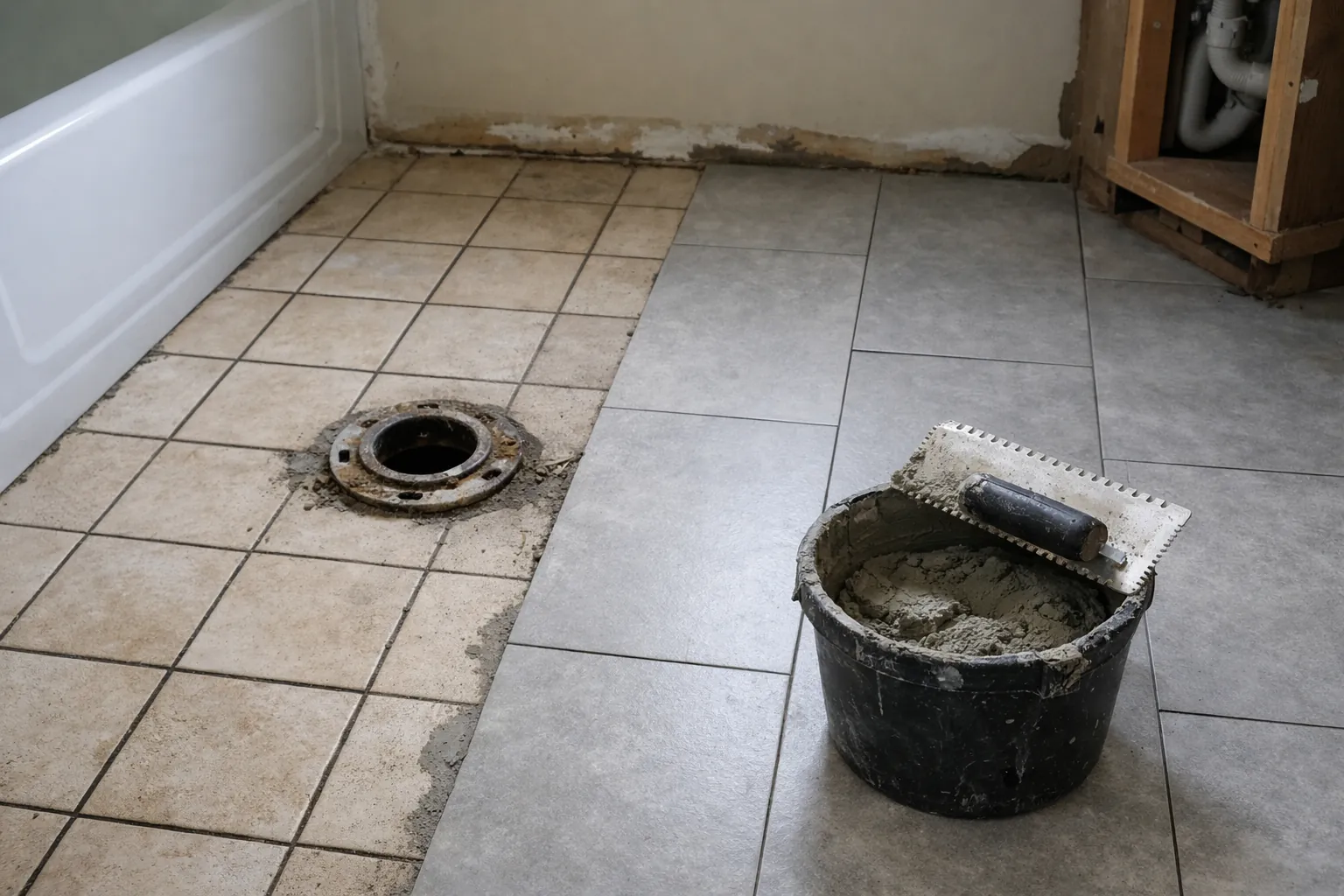
Yes, you can lay tile over existing tile in a bathroom, and the mortar makers publish the method, but only over old tile that is still fully bonded, clean and on a stiff floor. LATICRETE’s TDS 135 (July 2026) says existing ceramic tile “must be firmly bonded to a rigid substrate” that meets L/360 deflection, then calls for a degreasing scrub and a 1/16 inch skim coat of a polymer-modified mortar before the new tile goes down. Plan on the floor rising about 3/8 to 9/16 inch, which is what decides whether the toilet, the door and the vanity still fit. And no maker treats a second layer as a cure for a leaking shower.
The tap test decides it before any product does
Every document we read starts with the same condition, in different words. ARDEX Technical Bulletin TB117 (2020) says the old surface “must be sound with no loose or drummy tiles,” and adds the uncomfortable part: “the final installation is still reliant on satisfactory adhesion of the preceding one.” The new tile can only be as well stuck as the old tile was. Bostik uses the phrase “stable, clean, and dry” and “fully bonded to the substrate.”
In practice that means a short checklist you can run yourself before anyone quotes the job:
- Drag or tap every tile with a screwdriver handle or a coin. A hollow, papery sound is a drummy tile with no mortar behind it. A few can be cut out and refilled; a pattern of them means the bond failed and the floor should come up.
- Look for cracks that run across several tiles in a line. That is movement in the floor below, and a second layer will crack along the same line. Custom Building Products’ RedGard Uncoupling Mat TDS-357 says cracks wider than 1/8 inch must be treated under TCNA methods F125 or F125A first.
- Check for soft spots or bounce. LATICRETE’s 254 Platinum data sheet (DS-677) limits floor deflection to L/360 for ceramic tile and L/480 for stone. Old tile on a bouncy floor fails that test whether one layer or two sit on it.
- Look at the grout around the tub and shower. Black, crumbling or missing grout near water usually means water has been getting behind the tile. Find out where it went before covering it.
What nine maker documents require before new tile goes over old
This is the signature table for this page: we opened each manufacturer’s own technical sheet and recorded whether it names existing ceramic tile as a substrate, and what preparation it demands. Mortar and membrane warranties hinge on following these sheets, so the prep column is the one a contractor’s quote should match.
| Document | Over old tile? | Prep it requires | Limit worth knowing |
|---|---|---|---|
| LATICRETE TDS 135 (2026) | Yes, with 254 Platinum or MULTIMAX | TSP or dishwasher-detergent scrub, rinse, dry; 1/16 in skim coat | Firmly bonded to a rigid floor, L/360 |
| LATICRETE 254 Platinum (DS-677) | Lists “Existing Ceramic Tile and Stone” | Clean, sound surface | Deflection L/360 tile, L/480 stone |
| Custom TDS-193 (2023) | Yes, with admix | “Mechanically abrade” well-bonded tile; glazed tile “roughened or scarified” | Respirator when sanding |
| Custom MBP primer TDS-258 (2023) | Lists glazed porcelain and ceramic | Clean; “No shot blasting or abrasion required” | Must be followed by a modified mortar |
| Custom RedGard TDS-104 | Lists “Existing ceramic tile” | Well-bonded, clean surface | Isolates cracks to 1/8 in |
| Custom RedGard Uncoupling Mat TDS-357 | Lists “Existing ceramic tile” | Abrade with a carborundum stone, rinse, dry | Cracks over 1/8 in need TCNA F125 |
| LATICRETE HYDRO BAN (DS-663, 2021) | Lists “Ceramic Tile and Stone” | Clean, sound surface | Not over cracks wider than 1/8 in |
| ARDEX TB117 (2020, AU/NZ) | Yes, interior | Degrease; or grind 80 percent of glaze to CSP1 and prime | 100 percent mortar coverage; heavy tiles on walls not “safe” |
| MAPEI C03 (2018, AU) | Yes | Clean and degrease; diamond-grind if needed; ECO Prim Grip primer | Loose tiles and weak grout removed and filled |
Sources: manufacturer technical data sheets linked in each row, opened 2026-11-26. TDS-193 covers Custom’s PremiumPlus mortar (sold in Canada); its prep language is Custom’s standard “Bonding to Existing Surfacing Material” text. ARDEX and MAPEI documents are Australian editions; US product names differ.
The glaze is the problem, so every method attacks it
Read the table across and a pattern shows: the makers disagree on how to deal with the glaze, not on whether it matters. A glazed tile face is close to glass, and thinset grips by soaking into pores and locking into texture. The three routes are:
- Scuff it. Custom’s TDS-193 says glazed tile “should be roughened or scarified” and its mat sheet names a carborundum stone. ARDEX’s heavier option is grinding at least 80 percent of the glaze off with a diamond disc.
- Prime it. Custom’s MBP primer is sold on the line “No shot blasting or abrasion required,” and MAPEI’s system rolls on its ECO Prim Grip. A primer still needs a clean surface: soap scum and floor wax defeat it as surely as they defeat mortar.
- Use a mortar rated to grab it. LATICRETE’s route skips the grinding and leans on a premium polymer-modified mortar plus a skim coat pressed into the surface, with a primer “permitted and recommended.”
What none of them describe is a basic unmodified thinset, mixed with plain water, troweled onto glazed tile that was neither abraded nor primed. Even Custom’s non-modified PremiumPlus sheet calls for its admix when setting over existing tile. When a quote says “tile over tile” and names no primer, no abrading step and no modified mortar, ask which data sheet the installer is following. Sanding old tile throws silica dust, which is why Custom’s sheet tells installers to wear a respirator.
The new floor sits 3/8 to 9/16 inch higher, with nothing torn out
Tearing out tile lowers the floor before the new one raises it. Tiling over tile only adds, so the whole new assembly lands on top. The numbers come from the makers’ own stack:
- The Schluter-DITRA Installation Handbook (2023) calls 5/16 inch “typical” tile thickness and says DITRA-XL (5/16 inch) plus that tile meets 3/4 inch hardwood. That leaves 1/8 inch for the two thin-set layers in Schluter’s stack (our calculation: 3/4 minus 5/16 minus 5/16).
- Direct bond, no membrane: 5/16 inch tile plus one mortar layer of about 1/16 to 1/8 inch, starting from LATICRETE’s 1/16 inch skim coat in TDS 135, is about 3/8 to 7/16 inch (our calculation).
- Over standard DITRA: add the 1/8 inch membrane and its second mortar layer, about 9/16 inch (our calculation, using the handbook’s 1/8 inch DITRA).
- Thicker or larger tile: a 3/8 inch porcelain plank or a lumpy hand-made tile pushes each figure up by 1/16 inch or more. Read the thickness on your tile’s spec sheet and redo the sum.
Membranes are where people get surprised. If you want an uncoupling or waterproofing layer under the new tile (the RedGard and HYDRO BAN sheets above list existing tile as a substrate), liquid membranes cost almost nothing in height: LATICRETE says HYDRO BAN cures “only 0.020 to 0.030” inch thick. A sheet uncoupling mat adds its full thickness. The 2023 DITRA handbook, notably, gives methods over wood, concrete, gypsum and “Existing Vinyl” floors but no method over existing ceramic tile, so ask Schluter before planning DITRA over old tile.
Four places a half inch of new floor runs into trouble
| Where | The rule or limit | Usual fix |
|---|---|---|
| Doorway into the hall | 2010 ADA Standards 303: up to 1/4 in may be vertical; 1/4 to 1/2 in must be beveled 1:2 | Beveled threshold or reducer profile |
| Toilet flange | Oatey: flange “should sit on top of or even with the finished floor” | Flange extender or spacer ring |
| Door swing | Bottom clearance shrinks by the full rise (our calculation) | Trim the door bottom |
| Vanity toe kick | KCMA A161.1: 3 in minimum toe space height | Tile around it, or pull and reset the vanity |
Sources: U.S. Access Board, 2010 ADA Standards for Accessible Design (sections 303.2, 303.3, 404.2.5); Oatey, Five best practices when installing a toilet flange; KCMA A161.1 (2022). ADA rules bind public buildings, not private homes; we use them as a tested benchmark for a trip-safe edge.
Shower walls: a second skin over a leak keeps the leak
The most-asked version of this question is the shower, and it is where tile over tile goes wrong most often. ARDEX’s TB117 is blunt: “A new layer of tiles in a shower recess will not remedy waterproofing problems, unless the leak itself is addressed.” Old shower tile is rarely ugly by accident. Stained grout, a soft wall behind the soap dish or loose tiles near the valve point to water already in the wall, and the new layer seals it in.
If the old shower wall is solid and dry, three more limits apply:
- Weight adds up. ARDEX notes both layers “cumulatively load up the substrate” and says “heavy and large format tiles over existing tiles should not be considered a safe installation” on walls. Bostik puts the load ceiling for drywall at about 73 kg per square meter (about 15 lb per sq ft, our conversion) and allows only small-format tile over tile there. The mortar alone is real weight: LATICRETE rates 254 Platinum at 80 to 95 sq ft per 50 lb bag with a 1/4 inch notched trowel, about 0.5 to 0.6 lb of dry powder per sq ft per layer (our calculation).
- Waterproof the new face, not the old one. If the new tile needs a membrane, the sheets in the table put it on top of the old tile: RedGard lists existing ceramic tile as a substrate and is listed with IAPMO as a shower pan liner.
- Valve trim may not reach. The wall gets thicker by the same 3/8 inch or more, so the valve body sits deeper behind the finished face. Valve makers print a minimum and maximum finished-wall depth on the rough-in guard; if the new face falls outside it, you need an extension kit or a valve change, which means opening the wall anyway.
For the shower floor, tile over tile is the wrong tool. The pan, slope and drain are what fail, and a new layer raises the floor around a drain flange that stays put. That is a shower pan replacement, not a resurfacing job. If the tile is sound and only the joints look bad, a regrout fixes the look for far less.
Skipping the tear-out saves about $3 to $6 a square foot
The money case is narrower than the DIY videos suggest. Homewyse puts tile removal at $3.05 to $5.64 per sq ft (May 2026 national average, including haul-away), and installing bathroom floor tile at $16.58 to $20.60 per sq ft. On a 40 sq ft bathroom floor that is $122 to $226 of removal you avoid, against $663 to $824 for the new tile installed (our calculation: 40 times each rate). Removal is 18 to 27 percent on top of the install price (our calculation: 3.05 / 16.58 and 5.64 / 20.60).
Then take back what tile over tile adds: a primer or abrading step, a premium modified mortar instead of a basic bag, a flange extender, a beveled threshold, and possibly a trimmed door. On a small floor those extras can eat a good share of the removal savings. The stronger reason to skip demolition is time and mess: a tear-out is a loud, dusty extra day, and the calendar for a retiled floor is already set mostly by mortar and grout cure times. Tile over tile can also leave the vanity in place, which is the route our guide to replacing a bathroom floor without removing the vanity weighs in detail. For a full bathroom budget, the room-by-room numbers are in our bathroom remodel cost guide.
- Low
- $122 removal avoided, 40 sq ft floor
- Midpoint
- $174 removal avoided, 40 sq ft floor
- High
- $226 removal avoided, 40 sq ft floor
Pick a new tile that suits a second layer
- Floors: porcelain’s low absorption matters less here than its weight and thickness. A thin floor-rated tile keeps the rise down; our porcelain vs ceramic tile comparison shows how to read absorption and slip numbers on a spec sheet.
- Size versus old grout lines: ARDEX warns that large format tile “may require a smoothing cement coat” over the old tile, because old grout joints and lippage telegraph into a big flat tile. Do not line new joints up with old ones; offset them.
- Movement joints: ARDEX says joints in the old layer “must be continued through the new layer,” and Custom’s RedGard sheet says not to bridge expansion or control joints. Perimeter gaps at the tub and walls still need caulk, not grout.
- Walls: stay with light, small to medium tile unless the wall behind the old tile is cement board you can confirm.
Frequently Asked Questions
Can I install bathroom tile over existing tile?
Yes, if the old tile is firmly bonded, clean and on a floor or wall that meets the stiffness rule. LATICRETE TDS 135 requires a rigid substrate at L/360, a degreasing scrub, and a 1/16 inch skim coat of a premium modified mortar before the new tile.
Is it a good idea to tile over existing tiles?
It is a good idea when the old tile is sound and the extra height (about 3/8 to 9/16 inch, our calculation from Schluter and LATICRETE figures) fits at the door, toilet and vanity. It saves the $3.05 to $5.64 per sq ft that Homewyse puts on tile removal, plus a dusty day. It is a bad idea over hollow or cracked tile, because the new layer depends on the old bond.
Can I tile over existing shower tile?
On the walls, only if they are dry and solid, and with light tile. ARDEX says a new layer “will not remedy waterproofing problems,” and the valve trim may not reach the thicker wall. On the shower floor, the pan and drain set the limits, so replacing the pan is usually the honest fix.
What are the disadvantages of tiling over existing tiles?
Four: the floor rises about 3/8 to 9/16 inch (our calculation), which hits doors, toilet flanges and toe kicks; walls carry two layers of weight (Bostik caps drywall at about 73 kg per square meter); any hidden water damage stays hidden; and the new tile can never be better bonded than the old.
Do I have to sand or grind the old tile first?
Depends on the system. Custom says to abrade or scarify glazed tile; its MBP primer skips abrasion; LATICRETE relies on cleaning plus a skim coat of 254 Platinum. Follow one maker’s sheet start to finish rather than mixing methods.
Sources
- LATICRETE, TDS 135: Ceramic Tile and Stone Over Existing Wall and Floor Surfaces (2026)
- LATICRETE, 254 Platinum Data Sheet (DS-677) (2024)
- LATICRETE, HYDRO BAN Data Sheet (DS-663) (2021)
- Custom Building Products, PremiumPlus Non-Modified Thin-Set Mortar, TDS-193 (2023)
- Custom Building Products, MBP Multi-Surface Bonding Primer, TDS-258 (2023)
- Custom Building Products, RedGard Waterproofing and Crack Prevention Membrane, TDS-104 (n.d.)
- Custom Building Products, RedGard Uncoupling Mat, TDS-357 (n.d.)
- ARDEX, Technical Bulletin TB117: Applications of Tiles onto Pre-existing Tiles (2020)
- MAPEI Australia, C03 System for the Installation of Ceramic or Porcelain Tiles on Existing Tiles (2018)
- Bostik, Tiling Over Existing Tiles (n.d.)
- Schluter Systems, Schluter-DITRA Installation Handbook 2023 (2023)
- U.S. Access Board, 2010 ADA Standards for Accessible Design (2010)
- Oatey, Five best practices when installing a toilet flange (2022)
- Kitchen Cabinet Manufacturers Association, ANSI/KCMA A161.1 (2022) (2022)
- Homewyse, Cost to Remove Tile (2026)
- Homewyse, Cost to Install Bathroom Floor Tile (2026)