Bathroom comparisons
Porcelain vs Ceramic Tile for a Bathroom Floor: What 82 Spec Sheets Show
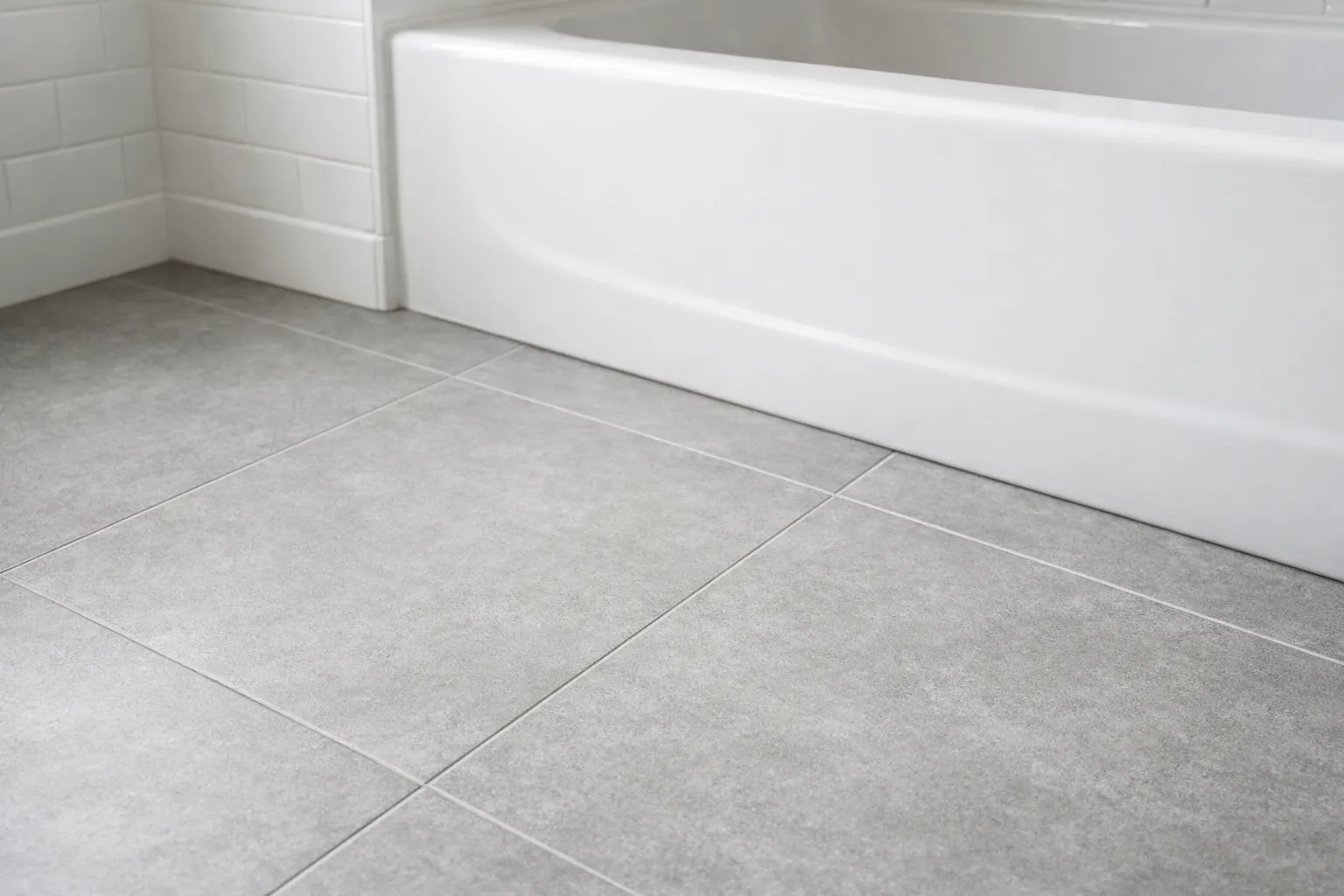
In the porcelain vs ceramic tile choice, the dividing line is a lab number, not a look: porcelain is ceramic tile that absorbs 0.5 percent of its weight in water or less under the ASTM C373 test, the threshold in ANSI A137.1 that the Tile Council of North America says decides whether a tile counts as porcelain at all. For a bathroom floor, that 0.5 percent matters less than a second number most comparisons skip: the wet slip rating. We opened the spec pages for 82 current Daltile floor series and found 73 of the 76 porcelain series rated for wet, level interior floors (DCOF 0.42 or higher), but only 24 ticked for shower floors, and the one semi-vitreous ceramic floor tile in the set passed both.
For a bathroom floor, porcelain wins on water and ties on slip
Porcelain is the safer default for a bathroom floor because water that sits in grout or around a toilet base has less body to soak into. Marazzi prints the four absorption classes that ANSI A137.1 is built on: impervious is 0.5 percent or less, vitreous is more than 0.5 up to 3.0 percent, semi-vitreous is more than 3.0 up to 7.0 percent, and non-vitreous is more than 7.0 percent. Porcelain is the impervious class. In the Daltile pages we read, the ceramic floor tiles sat in the vitreous or semi-vitreous bands, and the ceramic wall tiles listed absorption under 20 percent.
Slip resistance is a separate test. ANSI A137.1 asks for a wet dynamic coefficient of friction (DCOF) of 0.42 or more for level interior floors walked on wet, as Daltile explains on its DCOF page. A porcelain tile can fail that (a polished face) and a ceramic tile can pass it. So the honest answer to “which is better for a bathroom floor” is: porcelain, as long as the spec sheet also shows wet DCOF of 0.42 or more. A glazed ceramic floor tile that shows both a floor rating and 0.42 wet is a reasonable budget pick for a bathroom with no curbless shower.
Ten Daltile spec pages, porcelain and ceramic, side by side
Each row is one product page as published on daltile.com, read on 25 November 2026. Absorption is the ASTM C373 result for the floor tile (or the only tile listed); strength is the ASTM C648 breaking strength; the last column is whether Daltile ticks “Wet & Level Interior Floor” (DCOF 0.42 or more) and “Shower Floors”.
| Series | C373 water absorption | C648 breaking strength | Wet floor / shower floor |
|---|---|---|---|
| Volume 1.0 | < 0.5% (porcelain) | 275 lbf or more | Yes / Yes |
| Marble Attache | < 0.5% (porcelain) | 275 lbf or more | Yes / Yes |
| Emerson Wood | < 0.5% (porcelain) | 275 lbf or more | Yes / No |
| Calgary, polished 12x24 | < 0.5% (porcelain) | 275 lbf or more | No / No (dry floors only) |
| SlimLite Terra | < 0.5% (thin porcelain) | 85 lbf or more | No / No |
| Advantage | < 7.0% (semi-vitreous ceramic) | 250 lbf or more | Yes / Yes |
| Divinium 1x3 mosaic | < 3.0% (vitreous ceramic) | 250 lbf or more | Yes / Yes |
| Quarry Tile | < 3.0% (vitreous quarry) | 350 lbf or more | Wet box blank / Yes |
| Cove Creek wall tile | < 20.0% (ceramic wall body) | 125 lbf or more | Not a floor tile |
| Bryne | < 20.0% (ceramic wall body) | 125 lbf or more | No / No |
Source: Daltile product pages, Technical Specifications and Application charts, accessed 25 Nov 2026 (one color per series; linked in each row). Class names per Marazzi test results.
What 82 Daltile floor series publish, counted by absorption class
To see whether these examples are typical, we pulled every product URL in the concrete, fabric, marble, monochromatic, quarry, stone, terrazzo and wood looks from the Daltile sitemap (115 series), opened one color per series, and kept the 82 whose page lists a floor-tile C373 figure. We dropped 28 pages with no spec table (many were vinyl) and 5 tiles sold only for walls or counters. Our calculation, counted by hand-checked script:
| Absorption class | Floor series | Rated wet level floor | Rated shower floor |
|---|---|---|---|
| Impervious, porcelain (0.5% or less) | 76 | 73 | 24 |
| Vitreous (over 0.5% to 3.0%) | 5 (3 quarry, 2 mosaics) | 2 | 5 |
| Semi-vitreous (over 3.0% to 7.0%) | 1 | 1 | 1 |
| Non-vitreous (over 7.0%) | 0 sold for floors | n/a | n/a |
Our count of Daltile product pages, accessed 25 Nov 2026; class bands per Marazzi (ASTM C373). One manufacturer, one color per series: a snapshot, not a market share.
Porcelain is a water rating, not a slip rating
Three of the 76 porcelain series missed the wet-floor box. Calgary in its polished 12x24 finish is ticked for dry, level interior floors only, and Daltile’s page warns that tiles under 0.42 wet DCOF “are not recommended for use in areas with wet or slippery conditions.” The two SlimLite thin-porcelain series list a breaking strength of 85 lbf or more against 275 lbf or more for Daltile’s standard porcelain floors, and neither is ticked for wet floors. Both are porcelain by the 0.5 percent rule. Neither belongs on a bathroom floor that sees splash-out from a tub.
Going the other way, Advantage is a ceramic floor tile with absorption under 7.0 percent, which puts it in the semi-vitreous class, yet Daltile ticks it for wet level floors and shower floors. If your shortlist includes a ceramic, read its application chart before you rule it out.
The same series can be porcelain on the floor and ceramic on the wall
Several Daltile series sell a matching wall tile with a different body. Cove Creek, Articulo and Modern Hearth each list the floor tile at under 0.5 percent absorption and the wall tile at under 20.0 percent, with wall breaking strength of 125 lbf or more against 275 lbf or more for the floor piece. That is a 40-fold difference in the absorption ceiling (20.0 divided by 0.5, our calculation) inside one color story.
The practical risk is a substitution: a wall tile that looks identical ends up on the floor because it was in stock or cheaper. Check the size and SKU on the order against the floor column of the spec chart, not the series name. Ceramic wall tile is fine on shower walls and backsplashes, which is where most of it goes; see our backsplash installation cost guide for that use.
On a 40 sq ft floor the porcelain premium is small
This Old House (updated June 2026) puts installed porcelain at $13 to $48 per sq ft and installed ceramic at $11 to $39, and says either material alone usually costs $4 to $10 per sq ft at a home center. The Tile Shop prices ceramic at about $5 to $10 per sq ft and porcelain at about $8 to $15.
On a 40 sq ft bathroom floor, the gap between the two This Old House ranges is $80 at the low end ($2 x 40) and $360 at the high end ($9 x 40), our calculation. Using The Tile Shop material prices, the porcelain premium is $120 to $200 for the same 40 sq ft ($3 to $5 x 40), our calculation, before the 10 percent or so most installers add for cuts. We priced tile against vinyl for a 5 by 8 foot bath in tile vs luxury vinyl plank, so that math is not repeated here. Import duties also move tile prices; our tile tariffs tracker covers the rates, and the ASTM C373 test is also what the US International Trade Commission uses to sort ceramic tile in the tariff schedule.
Where porcelain costs you: cutting, setting and weight
The density that keeps water out also makes porcelain harder to cut and drill. The Tile Shop notes porcelain needs a more specialized thinset with a higher latex content, and This Old House says porcelain generally calls for professional installation while ceramic is the friendlier DIY tile. Large porcelain formats also add flatness demands on the subfloor that small ceramic squares hide.
- Cuts: porcelain needs a wet saw or a good scoring cutter; soft ceramic scores and snaps with a basic cutter.
- Mortar: ask what thinset is on the bid and confirm it is rated for porcelain on the bag or data sheet.
- Time: setting and curing time is the same for both; our guide to how long it takes to retile a bathroom floor shows the mortar and grout waits.
- Feel: both are hard and cold underfoot; a heated floor works under either.
Read a tile spec sheet in four checks before you buy
- Step 1
Water absorption, ASTM C373
0.5 percent or less means porcelain. Some sellers print “< 0.5”. The ANSI blog notes that only products with the Porcelain Tile Certification Agency mark are guaranteed to be porcelain; set up by TCNA and the Ceramic Tile Distributors Association, the agency certifies to ANSI A137.1:2022 and ASTM C373-18.
- Step 2
Wet DCOF, 0.42 or more
For a level bathroom floor look for 0.42 wet or a ticked “wet interior floor” box. Daltile lists 0.60 wet for exterior and pool decks and 0.65 for ramps.
- Step 3
Floor wear class
Daltile grades glazed floor tile 1 to 4: class 1 is residential bathrooms, 2 all residential areas, 3 residential and light commercial, 4 residential and commercial. Many retailers call this the PEI rating. Class 1 is the floor; anything 2 or higher is margin.
- Step 4
Which column you are reading
Charts often list floor, wall and mosaic tiles side by side. Read the column that matches your SKU and size.
Shower floors: think mosaic size and slope, then body
Only 24 of 76 Daltile porcelain series are ticked for shower floors, against 73 for wet level floors, in our count. A shower floor slopes to a drain, and small tiles follow the slope; in our count, 18 of the 24 shower-ticked porcelain series list a mosaic in their spec chart, against 1 of the 52 that are not ticked, and both vitreous ceramic mosaics we checked were ticked. For a shower floor, choose the mosaic first and confirm it is rated, and see shower pan replacement cost for what sits under it. The tile body matters less than the waterproofing below: a tiled shower lasts as long as its pan, as we cover in how long tile showers last.
Frequently Asked Questions
Which is better for bathroom floors, porcelain or ceramic?
Porcelain, provided the spec sheet also shows wet DCOF of 0.42 or more. Porcelain absorbs 0.5 percent or less by definition, per the Tile Council of North America, and 73 of the 76 porcelain Daltile floor series we checked are rated for wet level floors. A ceramic floor tile with the same wet rating is a fair budget pick for a bath without a curbless shower.
What are the disadvantages of porcelain floor tiles?
It is harder to cut and drill, it needs a thinset suited to dense tile, per The Tile Shop, and it costs more: $13 to $48 per sq ft installed against $11 to $39 for ceramic at This Old House rates. Polished porcelain can be slippery wet; Daltile rates its polished Calgary for dry floors only.
Which type of tile is better for a bathroom, ceramic or porcelain?
Use porcelain on the floor and either on the walls. Ceramic wall tile, listed at under 20 percent absorption on Daltile charts, is fine on shower walls and backsplashes because water runs off vertical surfaces, and it is lighter and easier to cut.
Is all porcelain tile certified?
No. The ANSI blog says products marked by the Porcelain Tile Certification Agency are guaranteed to be porcelain under ASTM C373-18; other tiles sold as porcelain rely on the maker’s own test data. Ask for the C373 result if the box carries no mark.
What is the new trend for bathroom floors?
We do not have survey data on trends. What is on offer is easier to count: in the Daltile sitemap, stone-look products had 491 URLs, concrete-look 242, marble-look 201, wood-look 158 and terrazzo-look 121 on 25 November 2026, our count. Nearly all of those floor series are porcelain.
Sources
- ASTM Standardization News / Tile Council of North America, Standards and the Ceramic Tile Industry (2024-01-02)
- ANSI Blog, The Eminence of Porcelain Tile (Internet Archive copy) (2025-05-29)
- Marazzi USA, Test Results: water absorption classifications (n.d.)
- Daltile, DCOF: industry trusted and tested (n.d.)
- Daltile, Sitemap of product pages (2026)
- Daltile, Volume 1.0 product page, technical specifications (2026)
- Daltile, Marble Attache product page, technical specifications (2026)
- Daltile, Emerson Wood product page, technical specifications (2026)
- Daltile, Calgary product page, technical specifications (2026)
- Daltile, SlimLite Terra product page, technical specifications (2026)
- Daltile, Advantage product page, technical specifications (2026)
- Daltile, Divinium product page, technical specifications (2026)
- Daltile, Quarry Tile product page, technical specifications (2026)
- Daltile, Cove Creek product page, technical specifications (2026)
- Daltile, Bryne product page, technical specifications (2026)
- Daltile, Articulo product page, technical specifications (2026)
- Daltile, Modern Hearth product page, technical specifications (2026)
- This Old House, Tile Floor Cost (2026-06-08)
- This Old House, Ceramic vs. Porcelain Tile: Which Is Better? (2026-05-25)
- The Tile Shop, Porcelain vs Ceramic Tile: Which is Better? (n.d.)