How Much Water Does a Shower Use? Shower vs Bath by the Gallon (2026)
- Primary data
- KBR compilation: 11 state showerhead rules, 160 manufacturer tub capacities, WRF REU2016 shower measurements
- Data period
- REU2016 end-use logging (published April 2016); rules in force on 2026-10-27; tub specifications opened 2026-10-27
- Latest release used
- 2026-10-27
- Next release
- Registry rechecked quarterly; REU2026 shower detail once publicly released
- Geography
- United States (state rules and Census population); REU sites in the US and Canada
- Sources
- 32 (26 Tier 1)
How much water does a shower use comes down to flow times minutes. At the measured average of 7.8 minutes, a shower uses 19.5 gallons at the federal 2.5 gpm limit, 15.6 at 2.0 gpm and 14.0 at the 1.8 gpm cap in five states. A median 60-inch alcove tub holds 52.0 gallons.
How much water does a shower use at 2.5, 2.0 and 1.8 gpm?
Shower water is flow rate times minutes. The legal flow ceiling depends on where the showerhead was sold, so the same 10-minute shower ranges from 18.0 to 25.0 gallons across the three limits in force in the US.
gpm (gallons per minute): The rated maximum flow of a showerhead, measured at a flowing pressure of 80 pounds per square inch under 10 CFR 430.32(p). Homes with lower water pressure usually get less than the rating.
| Flow basis | Flow (gpm) | 5 min (gal) | 7.8 min (gal) | 8 min (gal) | 10 min (gal) |
|---|---|---|---|---|---|
| Federal limit (10 CFR 430.32(p)) | 2.5 | 12.5 | 19.5 | 20.0 | 25.0 |
| Measured US average, REU2016 | 2.1 | 10.5 | 16.4 | 16.8 | 21.0 |
| WaterSense and 2.0 gpm states | 2.0 | 10.0 | 15.6 | 16.0 | 20.0 |
| California-type 1.8 gpm states | 1.8 | 9.0 | 14.0 | 14.4 | 18.0 |
Flow times minutes at rated maximum flow. 7.8 minutes is the REU2016 measured average duration.
Source: [1][6][15][7] eCFR, Office of the Federal Register; U.S. Environmental Protection Agency; California Energy Commission; Water Research Foundation
Rated maximum flow times minutes
Source: 10 CFR 430.32(p); EPA WaterSense spec v1.1; Cal. Code Regs. tit. 20; WRF REU2016. KBR calculation.
The federal ceiling is 2.5 gpm for any showerhead manufactured after January 1, 1994 (10 CFR 430.32(p)). EPA's WaterSense label requires 2.0 gpm or less (WaterSense specification 1.1). California's Title 20 sets 1.8 gpm for heads made on or after July 1, 2018 (CEC, Table H-5).
Moving from 2.5 to 1.8 gpm cuts the water in a shower of any length by 28.0%; moving from 2.5 to 2.0 gpm cuts it by 20.0%. A 10-minute shower drops from 25.0 gallons to 18.0 gallons, a saving of 7.0 gallons.
Metered homes averaged 15.8 gallons and 7.8 minutes a shower
The best public measurement of real showers is the Water Research Foundation's REU2016 study. Shower length did not change between 1999 and 2016; the volume fell slightly as average flow dropped.
| Metric | REU1999 | REU2016 | Source |
|---|---|---|---|
| Showers per household per day | 1.8 | 1.8 | WaterDM memo, Table 2 |
| Showers per person per day | 0.66 | 0.69 | WaterDM memo, Table 2 |
| Average shower volume (gallons) | 16.7 | 15.8 | WaterDM memo, Table 2 |
| Average shower duration (minutes) | 7.8 | 7.8 | WaterDM memo, Table 2 |
| Average shower flow rate (gpm) | 2.2 | 2.1 | WaterDM memo, Table 2 |
| Shower use per person (gallons per day) | 11.6 | 11.1 | WRF Executive Report, Figure 5 |
| Bath use per person (gallons per day) | 1.2 | 1.5 | WRF Executive Report |
| Homes meeting the under 2.5 gpm shower criterion (percent) | 75 | 80 | WRF Executive Report, Figure 6 |
REU1999: 1,187 homes (shower table). REU2016: 762 homes (shower table). Neither sample is nationally representative.
Source: [7][8] Water Research Foundation; WaterDM for the Alliance for Water Efficiency
Gallons per person per day in metered single-family homes
Source: Water Research Foundation, Residential End Uses of Water, Version 2: Executive Report (2016).
REU2016 logged 762 homes in its shower table: 1.8 showers per household per day, 0.69 per person, 15.8 gallons and 7.8 minutes per shower at 2.1 gpm (WaterDM memo, Table 2). REU1999 measured the same 7.8 minutes at 2.2 gpm and 16.7 gallons.
Multiplying the two REU2016 means, 2.1 gpm by 7.8 minutes, gives 16.38 gallons, slightly above the measured 15.8. The gap exists because the average of individual showers is not the product of two averages; long showers and high flows do not always occur together.
Eighty percent of REU2016 homes met the under 2.5 gpm shower criterion, up from 75% in REU1999 (WRF Executive Report, Figure 6). The remaining homes had average shower flows at or above 2.5 gpm, which is possible because the standard applies to new products, not installed ones.
A standard 60-inch alcove tub holds a median 52.0 gallons to overflow
Manufacturers publish how much water each tub holds. Across 160 unique tub models from three manufacturers, standard alcove tubs cluster near 52 gallons and freestanding soaking tubs near 70.
| Manufacturer | Tub class | Models (unique size and capacity) | Min (gal) | Median (gal) | Max (gal) |
|---|---|---|---|---|---|
| American Standard | Standard 60-inch alcove | 14 | 39.0 | 49.0 | 70.0 |
| American Standard | Freestanding soaking | 8 | 58.0 | 68.0 | 80.0 |
| Americh | Standard 60-inch alcove | 6 | 52.0 | 63.5 | 68.0 |
| Americh | Freestanding soaking | 25 | 60.0 | 78.0 | 112.0 |
| MAAX | Standard 60-inch alcove | 22 | 35.0 | 52.0 | 70.0 |
| MAAX | Freestanding soaking | 50 | 44.0 | 68.0 | 103.0 |
Capacity to overflow or maximum water capacity as stated by each manufacturer, no bather in the tub. Standard alcove: 59.5 to 60.5 inches long and 32.5 inches wide or less. Left and right drain twins counted once.
Source: [28][29][30] American Standard (American Bath Group); Americh; MAAX
Gallons to overflow, by brand and tub class
Source: American Standard, Americh and MAAX product specifications opened 2026-10-27. KBR compilation.
The 42 standard alcove models (59.5 to 60.5 inches long, 32.5 inches wide or less) range from 35.0 to 70.0 gallons, with a median of 52.0. The 83 freestanding models range from 44.0 to 112.0 gallons, with a median of 70.0. Deep-soak alcove models, such as American Standard's Evolution line at 70.0 gallons, overlap with freestanding tubs.
Each figure is the manufacturer's own stated capacity: American Standard's "Water Capacity", Americh's "Gallon to Overflow" and MAAX's "Maximum Water Capacity". The full model list with links is in the downloadable tub_models_used.csv. A tub is rarely filled to the overflow, and a bather displaces water, so a real bath uses less than these numbers.
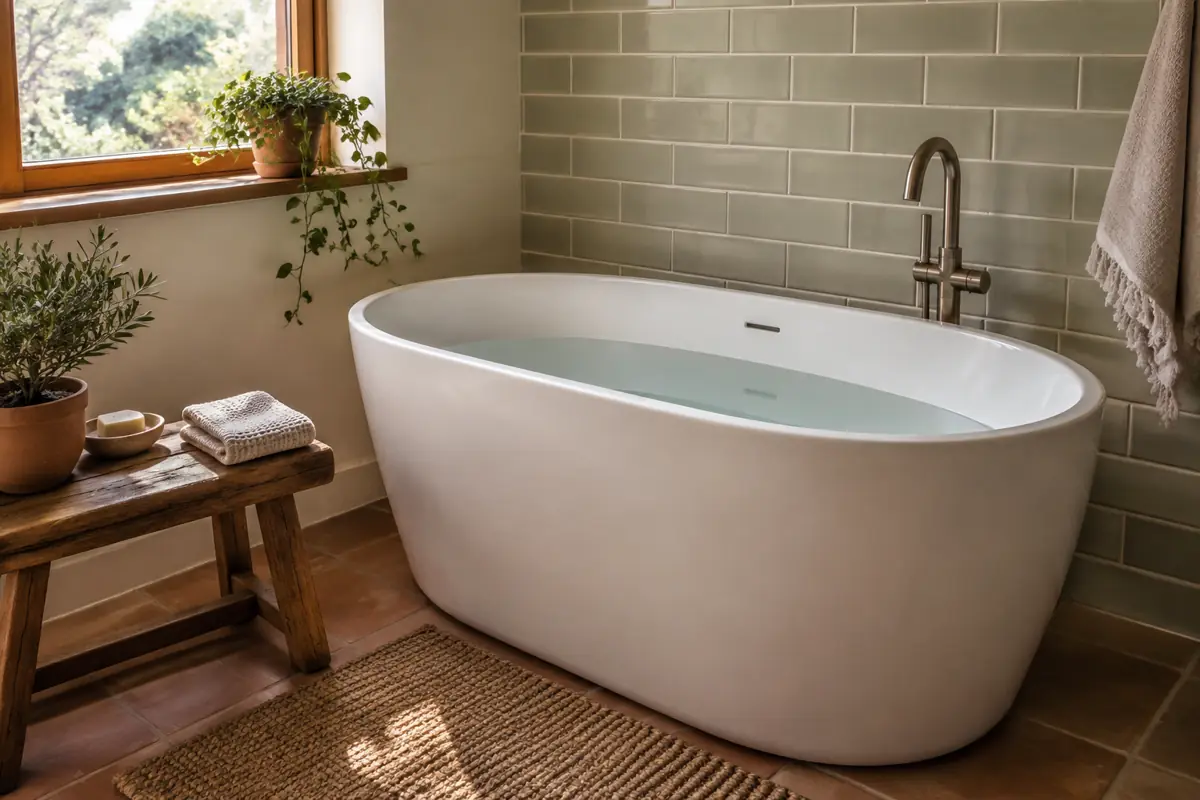
In gallons, the choice of tub moves bath water more than any flow limit moves shower water. The gap between the median alcove and median freestanding tub, 18.0 gallons, is larger than the whole volume of an average 15.8-gallon shower. Cost ranges for swapping a tub out are covered in our tub-to-shower conversion cost guide.
A shower has to run 20.8 minutes at 2.5 gpm to match that tub
Dividing tub capacity by flow gives the shower length at which a shower and a full bath use the same water. At every legal flow limit the break-even is far longer than the measured 7.8-minute average shower.
| Flow basis | Flow (gpm) | Minutes to match median 60-inch alcove tub | Minutes to match median freestanding soaking tub | Minutes to match 25th percentile alcove tub | Minutes to match 75th percentile soaking tub |
|---|---|---|---|---|---|
| Federal limit (10 CFR 430.32(p)) | 2.5 | 20.8 | 28.0 | 18.9 | 32.0 |
| Measured US average, REU2016 | 2.1 | 24.8 | 33.3 | 22.5 | 38.1 |
| WaterSense and 2.0 gpm states | 2.0 | 26.0 | 35.0 | 23.7 | 40.0 |
| California-type 1.8 gpm states | 1.8 | 28.9 | 38.9 | 26.3 | 44.4 |
Tub capacity divided by flow rate. Medians and percentiles from tables/tub_models_used.csv.
Source: [1][6][15][28][29][30] eCFR, Office of the Federal Register; U.S. Environmental Protection Agency; California Energy Commission; American Standard (American Bath Group); Americh; MAAX
Median 60-inch alcove tub (52.0 gal) and median freestanding tub (70.0 gal)
Source: KBR calculation from manufacturer specifications and federal, EPA and state flow limits.
At the federal 2.5 gpm limit the break-even against the median alcove tub is 20.8 minutes; at 1.8 gpm it stretches to 28.9 minutes, 8.1 minutes longer. Against the median freestanding tub the break-even is 28.0 minutes at 2.5 gpm and 38.9 minutes at 1.8 gpm.
The average REU2016 shower used 30% of the median alcove tub's capacity and 23% of the median freestanding tub's. Even the small end of the alcove range, the 25th percentile at 47.3 gallons, takes 18.9 minutes to match at 2.5 gpm.
Eleven jurisdictions cap new showerheads below the federal 2.5 gpm
Five states require 1.8 gpm and six jurisdictions require 2.0 gpm, each verified from statute or regulation text. Together they hold 94.9 million residents, 27.8% of the 2025 US population.
| State | Limit (gpm at 80 psi) | Applies to | Effective date | Legal source | Evidence | URL | Population 2025 (Census) |
|---|---|---|---|---|---|---|---|
| California | 1.8 | Showerheads manufactured on or after July 1, 2018 (2.0 gpm tier from July 1, 2016) | 2018-07-01 | Cal. Code Regs. tit. 20, sec. 1605.3(h), Table H-5, adopted by the California Energy Commission on August 12, 2015 | agency record | https://efiling.energy.ca.gov/GetDocument.aspx?tn=206010 | 39355309 |
| Washington | 1.8 | New showerheads manufactured on or after January 1, 2021 (must meet Cal. Title 20 sec. 1605.3 as in effect January 1, 2018) | 2021-01-01 | RCW 19.260.040(15) and RCW 19.260.050(3) | agency record | https://app.leg.wa.gov/RCW/default.aspx?cite=19.260.040 | 8001020 |
| Oregon | 1.8 | Showerheads manufactured on or after January 1, 2022 (must meet Cal. Title 20 sec. 1605.3(h) as in effect January 1, 2020) | 2022-01-01 | ORS 469.233(11) (Internet Archive capture of oregonlegislature.gov, 2026-08-15) | agency record | https://web.archive.org/web/20260815211532/https://www.oregonlegislature.gov/bills_laws/ors/ors469.html | 4273586 |
| Maine | 1.8 | Showerheads manufactured on or after January 1, 2023 (must meet 20 CCR sec. 1605.3 as in effect December 9, 2021) | 2023-01-01 | 38 M.R.S. sec. 1616 and Maine DEP rule 06-096 CMR ch. 180 | agency record | https://legislature.maine.gov/statutes/38/title38sec1616.html | 1414874 |
| New York | 1.8 | Showerheads manufactured on or after June 26, 2023 | 2023-06-26 | NYSERDA appliance standards regulation, Part 509, sec. 509.18 (Internet Archive capture of the NYSERDA compliance manual, 2025-03-22) | agency record | https://web.archive.org/web/20250322100229/https://www.nyserda.ny.gov/-/media/Project/Nyserda/Files/Programs/NYS-Appliance-and-Equipment-Efficiency-Standards/NYS-Product-and-Appliance-Standards-Compliance-Manual.pdf | 20002427 |
| Colorado | 2.0 | Showerheads sold must be WaterSense-listed (WaterSense maximum 2.0 gpm); current text effective August 7, 2023 | 2023-08-07 | C.R.S. 6-7.5-105(1) as amended by HB23-1161 | agency record | https://leg.colorado.gov/bills/hb23-1161 | 6012561 |
| Vermont | 2.0 | New showerheads sold, leased or rented on or after July 1, 2021 | 2021-07-01 | 9 V.S.A. sec. 2795(a)(14)(D) and sec. 2796(d)(3) | agency record | https://legislature.vermont.gov/statutes/section/09/074/02795 | 644663 |
| District of Columbia | 2.0 | Showerheads sold or installed; amendment applies as of October 1, 2022 | 2022-10-01 | D.C. Code sec. 8-1771.03(b)(3B), added by D.C. Law 23-195 | agency record | https://code.dccouncil.gov/us/dc/council/code/sections/8-1771.03 | 693645 |
| Massachusetts | 2.0 | New showerheads sold, leased or rented; statute paragraph effective January 1, 2022 | 2022-01-01 | M.G.L. c. 25B sec. 5(10)(a)(VI), as amended by St. 2021, c. 8, sec. 52 (Internet Archive capture of malegislature.gov, 2023-05-11) | agency record | https://web.archive.org/web/20230511092045/https://malegislature.gov/Laws/GeneralLaws/PartI/TitleII/Chapter25B/Section5 | 7154084 |
| Rhode Island | 2.0 | Showerheads manufactured on or after January 1, 2023 | 2023-01-01 | R.I. Gen. Laws sec. 39-27.1-4(11) and sec. 39-27.1-5(a) (Internet Archive captures, 2025-03-12 and 2026-07-14) | agency record | https://web.archive.org/web/20250312001729/https://webserver.rilegislature.gov/Statutes/TITLE39/39-27.1/39-27.1-4.htm | 1114521 |
| Maryland | 2.0 | New showerheads sold or offered for sale beginning January 1, 2024 | 2024-01-01 | Md. Code, State Gov't sec. 9-2006 | agency record | https://mgaleg.maryland.gov/mgawebsite/Laws/StatuteText?article=gsg§ion=9-2006&enactments=false | 6265347 |
Each row read from the statute or regulation text (several through labelled Internet Archive captures). New Jersey and Hawaii are excluded because their limit text was not confirmed. Population: Census Vintage 2025.
Source: [15][17][18][19][20][21][22][23][24][25][26][27] California Energy Commission; Washington State Legislature; Oregon Legislature; Maine Legislature; Maine Department of Environmental Protection; NYSERDA; Colorado General Assembly; Vermont General Assembly; Council of the District of Columbia; Massachusetts Legislature; Rhode Island General Assembly; Maryland General Assembly; U.S. Census Bureau
Gallons per minute at 80 psi; 2.5 is the federal limit. NJ and HI not verified.
Source: state statutes and regulations listed in the registry; 10 CFR 430.32(p).
Washington, Oregon and Maine do not print a number in their own codes; each requires showerheads to meet California's Title 20 section 1605.3, which sets 1.8 gpm (RCW 19.260.040; 38 M.R.S. sec. 1616). New York's Part 509 states 1.8 gpm directly. Colorado requires showerheads sold to be WaterSense-listed, which means 2.0 gpm or less (HB23-1161).
Population shares use Census Vintage 2025 estimates (NST-EST2025): 73.0 million people (21.4%) in 1.8 gpm states and 21.9 million (6.4%) in 2.0 gpm jurisdictions, out of 341.8 million.
These rules govern what can be sold, manufactured or installed after their effective dates. They do not require anyone to replace a working showerhead. New Jersey and Hawaii appear on trade and advocacy lists, but the limit text could not be confirmed from an official copy, so they are left out; see the methodology.
Per person water totals by state are covered in our separate report on average water usage per person, and what that water costs is in average water bill.
The multi-nozzle dispute changed the definition, not the 2.5 gpm number
Since 2020 the federal fight has been over whether a fixture with several nozzles counts as one showerhead. The 2.5 gpm figure in 10 CFR 430.32(p) has not moved.
- 2020-12-16: DOE adopted a definition under which each showerhead in a multi-head product is considered separately (85 FR 81341), effective 2021-01-15.
- 2021-12-20: DOE reinstated the 2013 definition and removed the body spray definition (86 FR 71797), effective 2022-01-19.
- 2025-04-09: An executive order directed DOE to rescind the 2021 rule and the definition in 10 CFR 430.2 without notice and comment (90 FR 15619).
- 2025-05-15: DOE's repeal took effect; the statutory definition in 42 U.S.C. 6291(31)(D) now controls (90 FR 15647).
- 2026-01-13: The House passed H.R. 4593, which would define showerhead by reference to ASME A112.18.1-2024 (engrossed text). No enrolled version was on GovInfo on 2026-10-27.
California's rule takes the opposite approach for multi-nozzle heads: total flow with any or all nozzles running must stay at or under the 1.8 gpm limit (Title 20, Table H-5, note 3).
Swapping a 2.5 gpm head for 1.8 gpm saves about 3,587 gallons a household a year
Because REU data show people do not shower longer with lower-flow heads, the saving scales directly with the flow difference. About 63.3% of shower water was hot in REU2016, so most of the saving is heated water.
| Swap | Gallons saved per 7.8-minute shower | Gallons saved per household per year | Of which hot water (gallons per year) |
|---|---|---|---|
| Federal 2.5 gpm head replaced by 1.8 gpm | 5.46 | 3587 | 2272 |
| Measured REU2016 average 2.1 gpm replaced by 1.8 gpm | 2.34 | 1537 | 974 |
| WaterSense 2.0 gpm head replaced by 1.8 gpm | 1.56 | 1025 | 649 |
Saving = (old flow minus 1.8) x 7.8 minutes x 1.8 showers a day x 365. Hot share = 17.8 / 28.1 from REU2016.
Source: [7][8][15] Water Research Foundation; WaterDM for the Alliance for Water Efficiency; California Energy Commission
At REU2016 habits, a household showering 1.8 times a day for 7.8 minutes uses 12,812 gallons a year at 2.5 gpm and 9,224 gallons at 1.8 gpm. The measured REU2016 figure, 28.1 gallons a day, works out to 10,256 gallons a year.
Hot water share: showers used 17.8 gallons of hot water per household per day in the 94-home sub-sample, against 28.1 gallons of total shower water in the main sample, or 63.3%. Applied to the 3,587-gallon saving, that is about 2,272 gallons of water the household no longer heats. EPA's own estimate for WaterSense heads is 2,700 gallons a year per family (EPA WaterSense).
Replacing a head that already flows at the measured 2.1 gpm average saves less, about 1,537 gallons a year. Dishwasher water is covered in how much water does a dishwasher use; remodel budgets that include new fixtures are in our bathroom remodel cost guide and walk-in shower cost guide.
Ratios behind the comparison
Gallons per shower at each legal limit
Formulagallons = flow (gpm) x minutes
Inputs: fact rows 1, 5, 25, 36, 57 (fact sheet rows)
Result: At 7.8 minutes: 19.5 gallons at 2.5 gpm, 16.4 at 2.1, 15.6 at 2.0 and 14.0 at 1.8 gpm. At 10 minutes: 25.0, 21.0, 20.0 and 18.0 gallons.
Where a showerhead was sold sets a 5.5-gallon spread for the same 7.8-minute shower.
Limitations: Assumes the head runs at its rated maximum; actual flow depends on household pressure.
Break-even shower length vs a full tub (signature finding)
Formulaminutes = manufacturer tub capacity (gallons) / flow (gpm)
Inputs: tables/tub_models_used.csv (160 unique models); fact rows 1, 5, 36, 57 (fact sheet rows)
Result: Median alcove tub 52.0 gallons: 20.8 minutes at 2.5 gpm, 24.8 at 2.1, 26.0 at 2.0, 28.9 at 1.8. Median freestanding tub 70.0 gallons: 28.0, 33.3, 35.0 and 38.9 minutes.
The measured average shower (7.8 minutes) is well under every break-even, so a full median alcove bath uses about 3.3 times the water of the average shower.
Limitations: Capacities are to overflow with no bather; three manufacturers only; Kohler's site did not respond to automated requests, and brands such as Delta and Jacuzzi were not compiled.
Population living under below-federal showerhead limits
Formulasum of 2025 populations of verified jurisdictions / US population x 100
Inputs: registry rows 60 to 70; fact row 72 (fact sheet rows)
Result: 1.8 gpm: 73.0 million (21.4%). 2.0 gpm: 21.9 million (6.4%). Combined: 94.9 million (27.8%).
More than a quarter of US residents buy new showerheads under a cap tighter than the federal 2.5 gpm.
Limitations: Excludes New Jersey and Hawaii (not verified); rules cover new products, not installed heads.
Annual household saving from a 1.8 gpm head and its hot water share
Formula(old gpm - 1.8) x 7.8 x 1.8 x 365; hot = saving x 17.8 / 28.1
Inputs: fact rows 16, 21, 25, 33, 57 (fact sheet rows)
Result: 2.5 to 1.8 gpm: 3,587 gallons a year, about 2,272 of them hot. 2.1 to 1.8: 1,537 gallons (974 hot). 2.0 to 1.8: 1,025 gallons (649 hot).
The saving is driven by the flow gap; going from a WaterSense head to 1.8 gpm saves under a third of what replacing a 2.5 gpm head does.
Limitations: Hot water share mixes two REU2016 samples; real households vary in shower count and length.
Product of means vs measured shower volume
Formula2.1 x 7.8 vs measured 15.8
Inputs: fact rows 25, 35, 36 (fact sheet rows)
Result: 16.38 gallons computed vs 15.8 gallons measured.
Simple flow times minutes slightly overstates the average shower; per-shower data are needed for exact averages.
Limitations: Both inputs are sample means with confidence intervals.
Where the numbers diverge
- Federal law caps showerheads manufactured after January 1, 1994 at 2.5 gallons per minute at 80 psi (10 CFR 430.32(p), in force 2026-10-23).[1][2]
- EPA WaterSense labels only showerheads rated at 2.0 gpm or less (specification version 1.1, effective 2018-07-26).[6]
- California has capped showerheads manufactured on or after July 1, 2018 at 1.8 gpm at 80 psi (Cal. Code Regs. tit. 20, Table H-5).[15][16]
- REU2016 metered homes averaged 15.8 gallons per shower, 7.8 minutes and 2.1 gpm (US and Canada study sites).[7][8]
- Average shower duration was 7.8 minutes in both REU1999 and REU2016, while average flow fell from 2.2 to 2.1 gpm.[7][8]
- Showers took 28.1 gallons per household per day in REU2016, 20% of indoor use; baths took 3.6 gallons, 3%.[7]
- In the REU2016 hot water sub-sample of 94 homes, showers used 17.8 gallons of hot water per household per day, 39.1% of all hot water.[7]
- The median standard 60-inch alcove tub across 42 manufacturer models holds 52.0 gallons to overflow; the middle half runs from 47.3 to 59.0 gallons (specifications opened 2026-10-27).[28][29][30]
- The median freestanding soaking tub across 83 models holds 70.0 gallons, 18.0 gallons more than the median alcove tub.[28][29][30]
- At 2.5 gpm a shower needs 20.8 minutes to match the median alcove tub and 28.0 minutes to match the median freestanding tub; at 1.8 gpm it needs 28.9 and 38.9 minutes.[1][15][28][29][30]
- Eleven jurisdictions set limits below 2.5 gpm in statute or regulation text verified for this report; their 94.9 million residents are 27.8% of the 2025 US population.[17][18][19][20][21][22][23][24][25][26][27]
- The five 1.8 gpm states hold 73.0 million residents, 21.4% of the US population in 2025.[15][17][18][19][20][27]
- DOE repealed the regulatory showerhead definition effective May 15, 2025 without changing the 2.5 gpm standard.[12][13][4]
- Replacing a 2.5 gpm head with 1.8 gpm saves 5.46 gallons per average shower and about 3,587 gallons per household per year at REU2016 frequency.[7][8]
Summary
- A 7.8-minute shower, the REU2016 measured average, uses 19.5 gallons at the federal 2.5 gpm limit and 14.0 gallons at 1.8 gpm (10 CFR 430.32(p); Cal. Code Regs. tit. 20).
- Metered homes in REU2016 averaged 15.8 gallons per shower at 2.1 gpm, with 1.8 showers per household per day.
- Across 42 standard 60-inch alcove tub models from American Standard, Americh and MAAX, the median stated capacity is 52.0 gallons; 83 freestanding models have a median of 70.0 gallons.
- A shower has to run 20.8 minutes at 2.5 gpm, or 28.9 minutes at 1.8 gpm, before it uses as much water as the median alcove tub filled to overflow.
- Five states (California, Washington, Oregon, Maine, New York) cap new showerheads at 1.8 gpm and six jurisdictions (Colorado, Vermont, DC, Massachusetts, Rhode Island, Maryland) at 2.0 gpm; together they hold 27.8% of the 2025 US population.
- The 2025 federal repeal of the regulatory showerhead definition left the 2.5 gpm number untouched; it removed the regulatory definition that governed how multi-nozzle products are counted.
- Replacing a 2.5 gpm head with a 1.8 gpm head saves about 3,587 gallons a year per household, of which about 2,272 gallons is heated water.
Questions people ask
Does a bath use more water than a shower?
Usually yes. The median standard 60-inch alcove tub holds 52.0 gallons to overflow, while the average metered shower in REU2016 used 15.8 gallons. A shower has to run 20.8 minutes at 2.5 gpm before it matches that full tub.
How much water does a 10 minute shower use?
A 10-minute shower uses 25.0 gallons at the federal 2.5 gpm limit, 20.0 gallons with a 2.0 gpm WaterSense head and 18.0 gallons at the 1.8 gpm limit in California, Washington, Oregon, Maine and New York.
What is the flow rate of a shower head?
New showerheads may not exceed 2.5 gpm at 80 psi under federal law, 2.0 gpm to earn the WaterSense label, and 1.8 or 2.0 gpm in 11 jurisdictions with stricter rules. REU2016 metered homes averaged 2.1 gpm.
Are low-flow shower heads required?
For new sales, yes in 11 jurisdictions: 1.8 gpm in five states and 2.0 gpm in Colorado, Vermont, DC, Massachusetts, Rhode Island and Maryland. Elsewhere the federal 2.5 gpm limit applies. None of these rules requires replacing an installed head.
How much water does a bath use?
Filled to overflow, standard 60-inch alcove tubs from three manufacturers hold 35.0 to 70.0 gallons (median 52.0) and freestanding tubs hold 44.0 to 112.0 gallons (median 70.0). Partial fills and the bather's own volume reduce the water used.
For journalists and researchers
If you cite only a few, cite these
- Shower break-even vs a full median alcove tub: 20.8 minutes at 2.5 gpm, 28.9 minutes at 1.8 gpm (KBR, 2026).[1][15][28][29][30]
- Average measured shower: 15.8 gallons, 7.8 minutes, 2.1 gpm (REU2016).[7][8]
- 27.8% of the 2025 US population lives under a showerhead cap of 2.0 gpm or less (KBR registry of 11 jurisdictions).[27][26]
Most quotable statistics
- A shower must run 20.8 minutes at the federal 2.5 gpm limit to use as much water as the median 60-inch alcove tub filled to overflow (52.0 gallons, 42 models, 2026).[1][28][29][30]
- Metered US and Canadian homes averaged 15.8 gallons and 7.8 minutes per shower in REU2016.[7][8]
- 27.8% of US residents in 2025 lived in a jurisdiction that caps new showerheads at 2.0 gpm or less.[17][20][26][27]
- Five states cap new showerheads at 1.8 gpm: California, Washington, Oregon, Maine and New York.[15][17][18][19][20]
- The median freestanding soaking tub holds 70.0 gallons, 18.0 gallons more than the median alcove tub (manufacturer specifications, 2026).[28][29][30]
- Replacing a 2.5 gpm showerhead with a 1.8 gpm head saves about 3,587 gallons per household per year at REU2016 shower habits.[7][8]
Press summary
A new Kitchen and Bath Renovators analysis puts numbers on the shower vs bath question. A 7.8-minute shower, the average measured by the Water Research Foundation's REU2016 study, uses 19.5 gallons at the federal 2.5 gpm limit and 14.0 gallons at the 1.8 gpm limit now set in five states. Across 42 standard 60-inch alcove tubs from American Standard, Americh and MAAX, the median stated capacity is 52.0 gallons, so a shower would have to run 20.8 minutes at 2.5 gpm to match a full tub. Freestanding soaking tubs hold a median 70.0 gallons. The report also compiles 11 jurisdictions with showerhead limits below the federal level, verified from statute and regulation text; together they hold 27.8% of the US population. Replacing a 2.5 gpm head with a 1.8 gpm head saves about 3,587 gallons a year per household. Data and tables are free to reuse under CC BY 4.0.
Suggested headlines
- A full bath equals a 20.8-minute shower at the federal flow limit
- Average shower uses 15.8 gallons; a standard tub holds 52.0
- More than a quarter of Americans now buy showerheads under a 2.0 gpm cap
- Five states cap showerheads at 1.8 gpm as federal definition fight continues
- A 1.8 gpm showerhead saves a household about 3,587 gallons a year
How to cite this report
Kitchen and Bath Renovators. (2026). How Much Water Does a Shower Use? Shower vs Bath by the Gallon (2026). Retrieved from https://kitchenandbathrenovators.com/research/how-much-water-does-a-shower-use/
Reuse license
Data and tables are licensed CC BY 4.0. Attribution: “Source: Kitchen and Bath Renovators, How Much Water Does a Shower Use? Shower vs Bath by the Gallon (2026)” with a link to this page.
Download the data
Every table in this report is available as a CSV under CC BY 4.0. The fact sheet lists each value with its source URL and access date.
- derived_metrics.csv (CSV)
- fact_sheet.csv (CSV)
- Registry (CSV)
- t1_gallons_per_shower.csv (CSV)
- t2_break_even_minutes.csv (CSV)
- t3_tub_capacity_by_brand.csv (CSV)
- t4_annual_savings.csv (CSV)
- t5_reu_shower_metrics.csv (CSV)
Frequently asked questions
How many gallons does an average shower use?
REU2016 metered homes averaged 15.8 gallons per shower, from a 7.8-minute average at 2.1 gpm.
How long is the average shower?
7.8 minutes in both REU1999 and REU2016, so lower-flow heads did not lengthen showers.
What is the federal showerhead limit?
2.5 gallons per minute at 80 psi for showerheads manufactured after January 1, 1994, under 10 CFR 430.32(p).
Which states require 1.8 gpm showerheads?
California (from July 1, 2018), Washington (2021), Oregon (2022), Maine (2023) and New York (June 26, 2023), based on the statute and regulation texts opened for this report.
What does WaterSense require for showerheads?
A rated flow of 2.0 gpm or less, plus minimum flows of 60% of rated flow at 20 psi and 75% at 45 and 80 psi (specification 1.1, 2018).
Did the 2025 federal change raise the 2.5 gpm limit?
No. DOE repealed the regulatory definition of showerhead effective May 15, 2025; the 2.5 gpm standard in 10 CFR 430.32(p) is unchanged.
How much water does a freestanding soaking tub hold?
Across 83 freestanding models from three manufacturers, stated capacity runs from 44.0 to 112.0 gallons, with a median of 70.0 gallons.
How much of shower water is hot?
About 63.3% in REU2016: 17.8 gallons of hot shower water per household per day against 28.1 gallons of total shower water.
How much water do showers use per person per day?
11.1 gallons per person per day in REU2016, down from 11.6 in REU1999, with 0.69 showers per person per day.
How much does a 1.8 gpm head save compared with 2.5 gpm?
5.46 gallons per 7.8-minute shower and about 3,587 gallons per household per year at 1.8 showers a day.
Reproduce this analysis
Every figure comes from the files below. The scripts that pulled and computed them are kept with the report and can be re-run.
| Dataset | Publisher | Source | Query or filter | Rows used | Retrieved |
|---|---|---|---|---|---|
| 10 CFR 430.32 and 430.2 (XML) | eCFR, Office of the Federal Register | File or endpoint | part=430, section=430.32 and 430.2, date 2026-10-23 | paragraph (p) Showerheads; definitions list | 2026-10-27 |
| Federal Register documents on showerhead definition | Office of the Federal Register API | File or endpoint | term 'definition of showerhead', newest first | 4 documents used (2020-27280, 2021-27462, 2025-06459, 2025-06476) | 2026-10-27 |
| REU2016 Executive Report (4309A.pdf, Internet Archive capture 2016-10-19) | Water Research Foundation | File or endpoint | Figure 1, Table 1, Figures 5 and 6, shower text | shower, bath and hot water rows | 2026-10-27 |
| WaterDM memo, Table 2 (Internet Archive capture 2024-12-04) | WaterDM / Alliance for Water Efficiency | File or endpoint | Table 2 shower summary | 7 metrics x 2 studies | 2026-10-27 |
| American Standard alcove and freestanding bathtubs | American Standard Bathing | File or endpoint | collections bathtubs-alcove and bathtubs-freestanding; product pages parsed for 'Water Capacity' | 52 listings, 49 with capacity | 2026-10-27 |
| Americh bathtub catalog and spec sheets | Americh | File or endpoint | product_type Skirted with tag l-60, plus Freestanding and 2pc Freestanding; spec PDF 'Gallon to Overflow' | 41 listings, 41 with capacity | 2026-10-27 |
| MAAX product sitemap and product pages | MAAX | File or endpoint | URLs containing alcove or freestanding and bathtub, one variant per model id; field max_us_gallons | 163 models, 163 with capacity | 2026-10-27 |
| NST-EST2025-ALLDATA | U.S. Census Bureau | File or endpoint | POPESTIMATE2025 for United States and 11 jurisdictions | 12 rows | 2026-10-27 |
Data quality and exclusions
- 256 manufacturer tub listings opened; 3 had no stated capacity and were dropped (two American Standard Ovation Curve listings and the Studio S freestanding tub).
- Duplicates with identical brand, class, length, width and capacity (mostly left and right drain twins) were collapsed: 253 listings with capacity became 160 unique models.
- American Standard lists the Aspirations 60 x 30 left-drain tub at 64.37 gallons and the right-drain twin at 53.6 gallons; both are kept as published, which slightly widens the alcove range.
- Americh catalog tags (gto values) matched the spec-sheet 'Gallon to Overflow' for 40 of 41 tubs; the Maude 6636 tag says 70 and the spec sheet says 65, and the spec sheet value is used.
- Of 14 jurisdictions on the ASAP state table, 11 were verified from official text; New Jersey and Hawaii were excluded, and PMI lists Nevada's 2.0 gpm rule for new construction only, so it is not counted.
- REU2016 hot water figures come from a 94-home sub-sample; the 63.3% hot share divides that sub-sample's shower hot water by the main sample's shower total.
Methodology
Selection: federal flow limits were read from the current eCFR and U.S. Code; the WaterSense requirement from EPA's specification; shower behavior from the Water Research Foundation's REU2016 executive report and the 2020 memo by its lead author; state limits only from statute or regulation text; tub capacities only from manufacturer product specifications or spec sheets.
State registry: candidate states came from the Appliance Standards Awareness Project state table and the Plumbing Manufacturers International summary. Each was kept only if the limit could be read in an official text. Washington, Oregon, Maine, Massachusetts, Rhode Island and New York texts were read on the legislature or agency site or, where the site blocked automated access, in a labelled Internet Archive capture of the same official page. New Jersey (legislature site unreachable, no archived statute found) and Hawaii (statute points to California section 1605.1 'as amended', figure not confirmed) were excluded. Nevada and Utah appear on trade lists only for new construction codes and are not counted.
Tub capacities: all alcove and freestanding listings in American Standard's bathing store, Americh's catalog and the MAAX product sitemap were opened (256 listings). Three listings without a stated capacity were dropped. Left and right drain versions and other duplicates with identical brand, class, length, width and capacity were counted once, leaving 160 models. Standard alcove means 59.5 to 60.5 inches long and 32.5 inches wide or less (42 models); soaking means freestanding (83 models). Medians and quartiles use the inclusive method.
Conflicting numbers: EPA's statements (showers nearly 17% of indoor use, nearly 40 gallons a day per family) differ from REU2016 measurements (20%, 28.1 gallons per household per day). REU2016 figures are used for calculations because they are measured; EPA figures are quoted only as EPA's estimates. The REU2016 executive report gives 11.1 gallons per person per day for showers and the 2020 memo gives 11.2; the executive report figure is used in text.
Derived metrics: every formula, input row and result is in derived_metrics.csv; scripts/04_compute.py and scripts/05_fact_sheet.py rebuild the tables and CSVs from raw files.
Last updated 2026-10-27. The registry will be rechecked quarterly and when REU2026 shower data become public.
This report presents published data with its limitations. It is not legal, financial or investment advice.
Sources, ranked by quality
Tier 1: primary and official sources (26)
- [1] eCFR, Office of the Federal Register. 10 CFR 430.32(p), Showerheads. in force 2026-10-23. Accessed 2026-10-27.
- [2] U.S. Code via GovInfo. 42 U.S.C. 6295(j), Standards for showerheads and faucets. 2023 edition. Accessed 2026-10-27.
- [3] U.S. Code via GovInfo. 42 U.S.C. 6291(31)(D), definition of showerhead. 2023 edition. Accessed 2026-10-27.
- [4] eCFR, Office of the Federal Register. 10 CFR 430.2, Definitions. in force 2026-10-23. Accessed 2026-10-27.
- [5] U.S. Environmental Protection Agency. WaterSense: Showerheads. page updated 2026-03-03. Accessed 2026-10-27.
- [6] U.S. Environmental Protection Agency. WaterSense Specification for Showerheads, Version 1.1. effective 2018-07-26. Accessed 2026-10-27.
- [7] Water Research Foundation. Residential End Uses of Water, Version 2: Executive Report (Internet Archive capture of waterrf.org). published April 2016. Accessed 2026-10-27.
- [9] Water Research Foundation. The Water Research Foundation Releases Landmark Update to Residential End Use Study (Internet Archive capture). 2026-06-15. Accessed 2026-10-27.
- [10] U.S. Department of Energy. Energy Conservation Program: Definition of Showerhead (85 FR 81341). 2020-12-16. Accessed 2026-10-27.
- [11] U.S. Department of Energy. Energy Conservation Program: Definition of Showerhead (86 FR 71797). 2021-12-20. Accessed 2026-10-27.
- [12] Executive Office of the President. Maintaining Acceptable Water Pressure in Showerheads (90 FR 15619). 2025-04-09. Accessed 2026-10-27.
- [13] U.S. Department of Energy. Repeal of the Definition of Showerhead (90 FR 15647). 2025-04-15. Accessed 2026-10-27.
- [14] U.S. House of Representatives via GovInfo. H.R. 4593, SHOWER Act (introduced, reported and engrossed texts). 2025-07-22 to 2026-01-13. Accessed 2026-10-27.
- [15] California Energy Commission. Appliance Efficiency Regulations, Title 20, Toilet, Urinal, Faucet and Showerhead Regulations 2015 (docket 15-AAER-05, TN 206010). adopted 2015-08-12. Accessed 2026-10-27.
- [16] California Energy Commission. Resolution Adopting Amendments to the Appliance Efficiency Regulations (TN 205704). 2015-08-12. Accessed 2026-10-27.
- [17] Washington State Legislature. RCW 19.260.040 and 19.260.050. current. Accessed 2026-10-27.
- [18] Oregon Legislature. ORS 469.233 (Internet Archive capture of oregonlegislature.gov). capture 2026-08-15. Accessed 2026-10-27.
- [19] Maine Legislature; Maine Department of Environmental Protection. 38 M.R.S. sec. 1616 and DEP rule 06-096 CMR ch. 180. current. Accessed 2026-10-27.
- [20] NYSERDA. NYS Product and Appliance Standards Compliance Manual, Part 509 (Internet Archive capture). capture 2025-03-22. Accessed 2026-10-27.
- [21] Colorado General Assembly. HB23-1161, Environmental Standards for Appliances (signed act). effective 2023-08-07. Accessed 2026-10-27.
- [22] Vermont General Assembly. 9 V.S.A. sec. 2795 and sec. 2796. current. Accessed 2026-10-27.
- [23] Council of the District of Columbia. D.C. Code sec. 8-1771.03. current. Accessed 2026-10-27.
- [24] Massachusetts Legislature. M.G.L. c. 25B sec. 5 (Internet Archive capture of malegislature.gov). capture 2023-05-11. Accessed 2026-10-27.
- [25] Rhode Island General Assembly. R.I. Gen. Laws sec. 39-27.1-4 and 39-27.1-5 (Internet Archive captures). captures 2025-03-12 and 2026-07-14. Accessed 2026-10-27.
- [26] Maryland General Assembly. Md. Code, State Government sec. 9-2006. current. Accessed 2026-10-27.
- [27] U.S. Census Bureau. Annual Estimates of the Resident Population, Vintage 2025 (NST-EST2025-ALLDATA). July 1, 2025. Accessed 2026-10-27.
Tier 2: trade bodies, market research, company data (6)
- [8] WaterDM for the Alliance for Water Efficiency. Results from 1999 and 2016 Residential End Uses of Water Studies (memo, Internet Archive capture). 2020-04-29. Accessed 2026-10-27.
- [28] American Standard (American Bath Group). Alcove and freestanding bathtub product specifications. opened 2026-10-27. Accessed 2026-10-27.
- [29] Americh. Bathtub specification sheets (Gallon to Overflow). opened 2026-10-27. Accessed 2026-10-27.
- [30] MAAX. Alcove and freestanding bathtub product pages (Maximum Water Capacity). opened 2026-10-27. Accessed 2026-10-27.
- [31] Appliance Standards Awareness Project. Efficiency Standards for Showerheads (June 2024) and Bill to Redefine Showerhead (January 2026) fact sheets. 2024 to 2026. Accessed 2026-10-27.
- [32] Plumbing Manufacturers International. PMI Summary of Current Plumbing Provisions. table dated 2023-09-06. Accessed 2026-10-27.