Compare
Undermount vs drop in sink: the countertop decides, then the cost
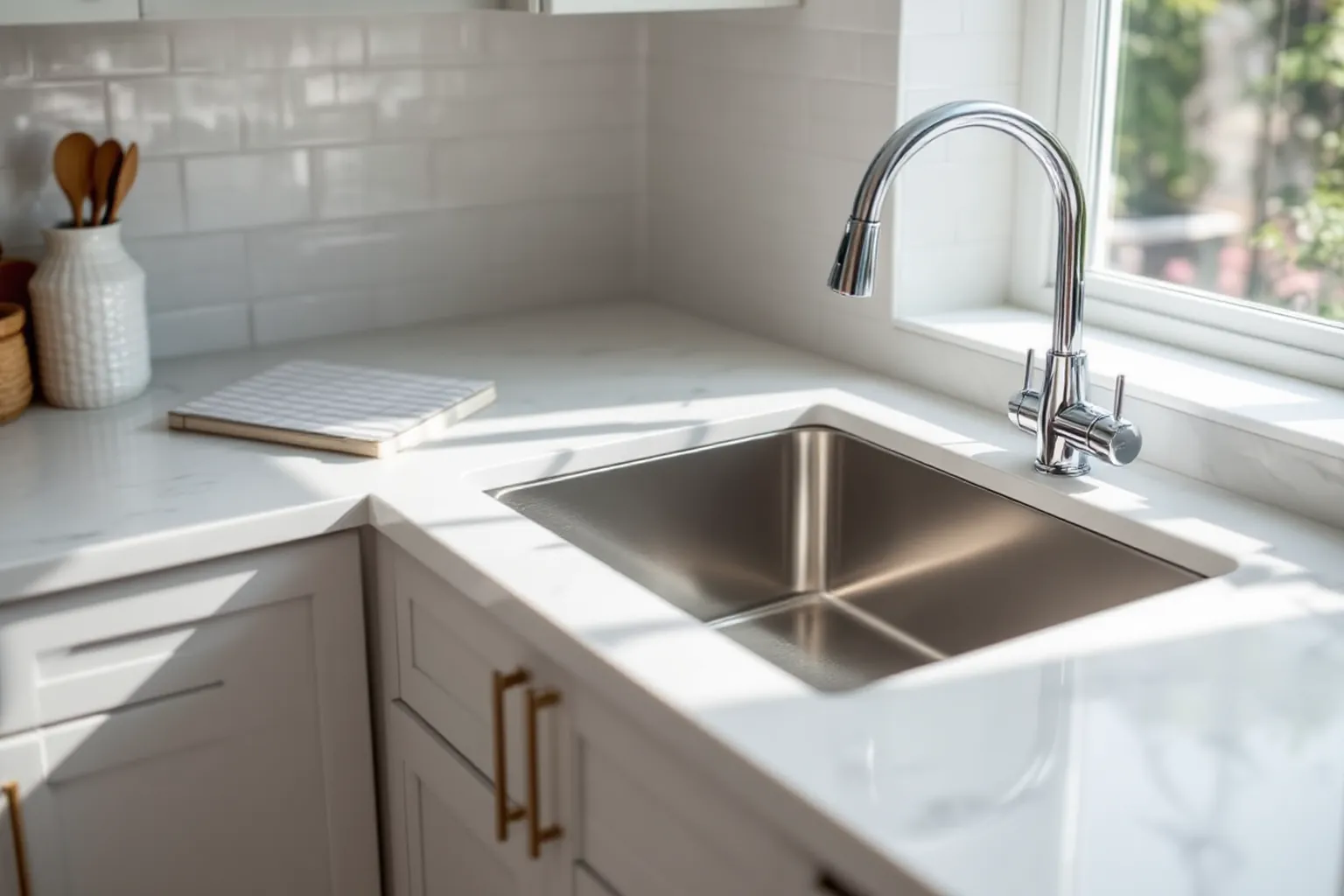
In the undermount vs drop in sink choice, the countertop decides first and taste second. None of the eight sink makers’ undermount instruction sheets we read lists laminate as an approved top, and four of them say outright the sink should only be fastened to solid surface or stone. If your counter is stone, quartz or solid surface, undermount costs a fabricator roughly $25 to $40 more for the cutout alone, per SlabWise‘s trade price ranges, and the trade-off is a cleaner counter now against a harder swap later. If your counter is standard laminate, a drop-in is the realistic choice unless the top itself is being replaced.
The rim decides where the sink hangs and who carries the load
A drop-in (also called top-mount or self-rimming) sink is lowered into a hole from above. Its rim rests on the counter and hides the cut edge, so the hole can be rough. Elkay’s drop-in instructions for its quartz sinks tell the installer to trace the upturned sink, draw a cut line 5/16 inch inside that outline and cut it with a jig saw, and note that its clips fit counters up to 1-3/4 inch thick (Elkay document 1000005238).
An undermount sink hangs below the counter. The hole is the finished edge you see every day, so it has to be cut to a template and polished, and the sink is held up by clips, brackets or a frame plus silicone. Kohler’s under-mount kitchen sink instructions go further: the installer builds a 2x4 support frame inside the cabinet, sets the sink on it so its rim sits at or slightly below the cabinet top, and only then installs the countertop over it (Kohler 1634499-2-B). A sink set that way cannot come out without lifting the countertop. A 2000 Journal of Light Construction article quoted an Eljer requirement that the support structure carry at least 350 pounds and warned that lifting a stone top after the silicone cures can damage the stone.
That one difference explains nearly every line in the comparison below: who cuts the hole, how much it costs, which counters can take it, and how hard a future swap is.
Eight undermount instruction sheets, zero that approve laminate
We opened the installation sheets packed with eight undermount sinks from six sellers and recorded what each says about the countertop, the attachment and who should install it. Method: a document counts as restricting the top only if it says so in words; we searched each one for the word laminate (0 hits in 8). The registry below is our calculation from those documents; each name links to the PDF.
| Document | Countertop allowed | How it attaches | Installer |
|---|---|---|---|
| Kohler under-mount kitchen sink (1634499-2-B) | Not named | 2x4 frame in cabinet, sink set before the top; positive reveal | Required: “qualified professional only” |
| Kohler undermount sheet (1644835-2-A) | Not named; fabricator must use the undermount cut line | Silicone; sink supported from below | Countertop maker cuts to template |
| Elkay CS45 undermount (2021) | Solid surface only (“granite / Corian”) | Brackets in pre-drilled holes, silicone; 1/2 in reveal | Recommended; fabricator cuts holes |
| Elkay quartz sinks (2019) | Solid surface only (“granite / Corian”) | Clips, silicone; 1/8 in reveal | Recommended |
| 1858 Brand stainless undermount (2022) | Solid surface only; top at least 1/2 in thick | Clips, silicone; 1 in build-up preferred | Licensed professional suggested |
| Franke commercial undermount vanities | Named solid surface brands, granite, polymer | Two methods by material | No liability for top damage |
| Abey / Schock undermount | Written for solid surface routing | Timber border at least 25 mm under the top | Recommended; warranty void if sink is glued |
| WebstaurantStore undermount guide | Not named | Mounting holes drilled under the top, silicone | Qualified installer recommended |
Sources: maker installation PDFs linked in each row, opened 2026-11-24. Tally and wording: our reading of each document.
Four of eight sheets say solid surface or stone only
From the table: 0 of 8 sheets mention laminate at all. Four restrict the top in plain words: both Elkay sheets say undermount sinks “should only be fastened to a solid surface countertop (i.e. granite / Corian)”, the 1858 Brand sheet is “for … a solid surface countertop only” with a minimum top thickness of 1/2 inch, and the Franke sheet gives one method for named solid surface brands and another for granite and other polymer tops. Seven of eight either require or recommend a professional or the countertop fabricator. Two put the risk on you in writing: Elkay says it “is not responsible for the sink or countertop if damaged during installation”, and Abey says its warranty is void if epoxy or adhesive is used to secure the sink.
Laminate is not impossible, it is just a different product category. Wilsonart’s own sinks fabrication guide describes a “Direct To Laminate” and a “Ledge” method, both “developed to install a Wilsonart HD sink in a postform or pre-bonded laminate top”, using its adhesive, a two-part routing template and a router (Wilsonart Sinks Fabrication Guide, rev. 2011). That is a shop process done when the top is built, with a solid surface bowl bonded to the substrate, not a stainless sink clipped under a top you already own. Our laminate vs solid surface comparison covers why the particleboard core is the weak point once water reaches it.
Match the mount to the counter you have
- Granite, quartz, marble: undermount is the normal pairing and every sheet above allows it. Caesarstone’s own how-to for quartz recommends 4 to 6 epoxy sink clips and says to avoid drill-in clips because “it’s best to avoid unnecessary drilling into quartz” (Caesarstone). The stone choice itself is covered in quartz vs granite.
- Solid surface (Corian and similar): undermount, or an integrated bowl of the same material. SlabWise lists an integrated solid surface sink at $400 to $800 added to the top.
- Butcher block: either works, but an undermount leaves end grain exposed at the cut, which has to be sealed and kept dry. Fixr adds $100 to $150 per sink cutout on a wood top; the care side is in butcher block vs quartz.
- Standard laminate: drop-in. the rim covers the cut particleboard edge, and no undermount sheet in the registry lists laminate. The 1858 Brand sheet also asks for at least 1/2 inch of actual countertop material (1858 Brand), and a laminate skin is a thin sheet over a wood-product core.
- Tile counters: drop-in is simpler; an undermount needs the tile edge finished around the opening, which none of the eight sheets above addresses.
What the price gap really is: $25 at the saw, more at the set
The sink itself can be the same product either way; Elkay’s quartz sink sheet, for example, covers an undermount model and a top-mount version of the same design. The gap is labor at the fabricator, where the undermount opening gets a polished interior edge and the sink is set from below. Ranges are each publisher’s own; the difference column is our calculation (undermount minus drop-in, low end to low end and high end to high end).
| Line item | Drop-in | Undermount | Difference |
|---|---|---|---|
| Cutout only, stone (SlabWise) | $50 to $85 | $75 to $125 (rectangle) | +$25 to $40 |
| Cutout plus set, stone (SlabWise) | $100 to $200 | $200 to $400 | +$100 to $200 |
| Installed sink, all-in (Fixr, 2025) | $90 to $1,000 | $200 to $2,000 | +$110 to $1,000 |
| Undermount, basic grade (Homewyse, Jan 2026) | n/a | $368 to $520 | n/a |
Sources: SlabWise (updated July 2026), SlabWise (updated July 2026), Fixr (updated Aug 2025), Homewyse (Jan 2026). SlabWise sells fabrication software; its ranges are trade-observed, not a survey.
A 33 inch stainless sink on new quartz, priced both ways
Take one rectangular kitchen sink going into a new quartz top. At the cutout line, SlabWise puts drop-in at $50 to $85 and undermount rectangle at $75 to $125, so the polish costs about $25 to $40. If the shop also sets the sink, SlabWise‘s cutout-and-set ranges ($100 to $200 vs $200 to $400) put the gap at $100 to $200. The plumber’s reconnection is the same either way; SlabWise lists $100 to $400 for a standard kitchen sink.
So on a new stone top, undermount adds at most about $200 at the fabricator by our calculation from the SlabWise ranges, which is small next to the slab itself. The cost that does change the answer is the one where the top is not new. Keeping laminate and wanting undermount means a new countertop, which is why the replace cabinets but keep the countertops route almost always keeps a drop-in.
Swapping a sink in five years: drop-in wins by a mile
A drop-in comes out from above: cut the caulk, release the clips, lift. Any new sink whose rim covers the old opening can go in, and a slightly larger hole can be cut on laminate with a jig saw.
An undermount is tied to its opening. The new sink has to fit the existing polished cutout and reveal, and a frame-set sink like the Kohler example above needs the top lifted (Kohler 1634499-2-B), which JLC warns can damage stone once the silicone has cured. Enlarging a stone opening is a fabricator job with silica dust rules attached; what can and cannot be cut in place is in cutting a quartz countertop after installation.
Plan the sink before the template visit. Kohler asks for the actual sink and faucet to be given to the countertop supplier for the cutout (Kohler), and fabricators will not template without it, which feeds into how long countertop fabrication takes. If you are still choosing bowl layout, settle single vs double bowl first, since the template follows the sink.
Crumbs, caulk lines and the reveal nobody asks about
The cleaning argument is real but smaller than it sounds. With an undermount you can wipe crumbs straight off the counter into the bowl; with a drop-in, the rim stops them and the caulk line around it collects grime. The undermount has its own caulk line, just under the lip where you cannot see it. Ruvati suggests recaulking an undermount every 3 to 5 years.
The reveal is how much sink rim shows inside the counter opening, and it is set at the template stage:
- Elkay’s CS45 sheet requires a 1/2 inch reveal “for all accessories to work as shown” (Elkay).
- Elkay’s quartz sinks are templated at about 1/8 inch (Elkay).
- Kohler says the cutout “should provide a positive reveal” so accessories move freely (Kohler).
A workstation sink with a sliding cutting board or colander needs that ledge exposed; a negative reveal (counter overhanging the bowl) hides the rim but traps gunk underneath. Tell the fabricator which you want before cutting.
Undermount and drop-in, trade by trade
Undermount
Pros
- Counter wipes straight into the bowl
- No rim on the counter surface
- Expected on stone and quartz tops
Cons
- Needs stone, quartz or solid surface
- Fabricator cut, polish and set
- Hard to swap without the same size sink
Drop-in
Pros
- Works on laminate, tile, wood and stone
- Rim hides a rough cut edge
- Simple to replace later
Cons
- Rim and caulk line collect grime
- Cannot sweep crumbs into the bowl
- Rim sits proud of the counter
Frequently Asked Questions
Is it better to have an undermount or drop-in sink?
Undermount is better on stone, quartz or solid surface: the counter wipes into the bowl and the extra fabricator cost is small, about $25 to $40 for the polished cutout per SlabWise. Drop-in is better on laminate or tile and when you want an easy sink swap later.
Are drop-in sinks outdated?
They read as more traditional, and pages like Badeloft call them less popular and seen as dated, but on laminate or tile they remain the practical fit, since no undermount sheet we read approves laminate. Function matters more than fashion here.
What are the disadvantages of a drop-in sink?
The rim sits above the counter, so you cannot sweep crumbs straight in, and the caulk joint around the rim collects grime and needs recaulking. It also takes a little counter space. On the plus side, it is the easiest sink to replace.
Can you use an undermount sink as a drop-in sink?
Only if it is sold as dual mount. A true undermount has a thin flat flange that is not made to show or carry load from the top. Elkay’s quartz sink sheet, for example, covers an undermount model and a separate top-mount version, with clips rated for counters up to 1-3/4 inch thick (Elkay). Check the model’s spec sheet for both templates.
Can you put an undermount sink in a laminate countertop?
Not with an ordinary undermount sink: none of the eight undermount sheets we read lists laminate, and Elkay says solid surface only. Wilsonart documents a shop method for bonding its own solid surface sinks into postform laminate (Wilsonart), which is done when the top is made.
Sources
- Kohler, Installation Instructions: Under-mount Kitchen Sink (1634499-2-B) (n.d.)
- Kohler, Undermount kitchen sink installation sheet (1644835-2-A), copy hosted by Lowe's (n.d.)
- Elkay, Installation Instructions: Undermount Sinks (CS45, 2000000328) (2021)
- Elkay, Installation Instructions: Quartz Undermount and Drop-in Sinks (1000005238) (2019)
- 1858 Brand, Installation Instructions: Undermount Stainless Steel Sinks, copy hosted by Lowe's (Revised 2022-08-19)
- Franke Kindred Canada, Installation of Commercial Undermount Vanities (OV1317U) (n.d.)
- Abey, Schock Undermount Sink Installation Instructions (n.d.)
- WebstaurantStore, Undermount Sink Instruction Guide (n.d.)
- Wilsonart, Wilsonart Sinks Fabrication Guide (BR 0410) (Revision 2011-03-03)
- Caesarstone, How to Install an Undermount Sink to Quartz (2021-09-01)
- Journal of Light Construction, Undermount Sinks (Martin Holladay) (2000-07-01)
- SlabWise, How to price specialty cutouts in stone countertops (Updated 2026-07-11)
- SlabWise, Cost to install countertop and sink (Updated 2026-07-09)
- Fixr, Sink Installation Cost (Updated 2025-08-29)
- Homewyse, Fair Cost Estimate: Undermount Sink (January 2026)
- Fixr, How much does it cost to install butcher block countertops? (Updated 2022-08-18)
- Ruvati, Undermount vs Drop in Sinks: Pros and Cons (2024-01-22)
- Badeloft, Undermount vs Drop In Sink (2024)