Kitchen comparisons
Double Sink vs Single Sink: What Fits Your Cabinet and Your Pans
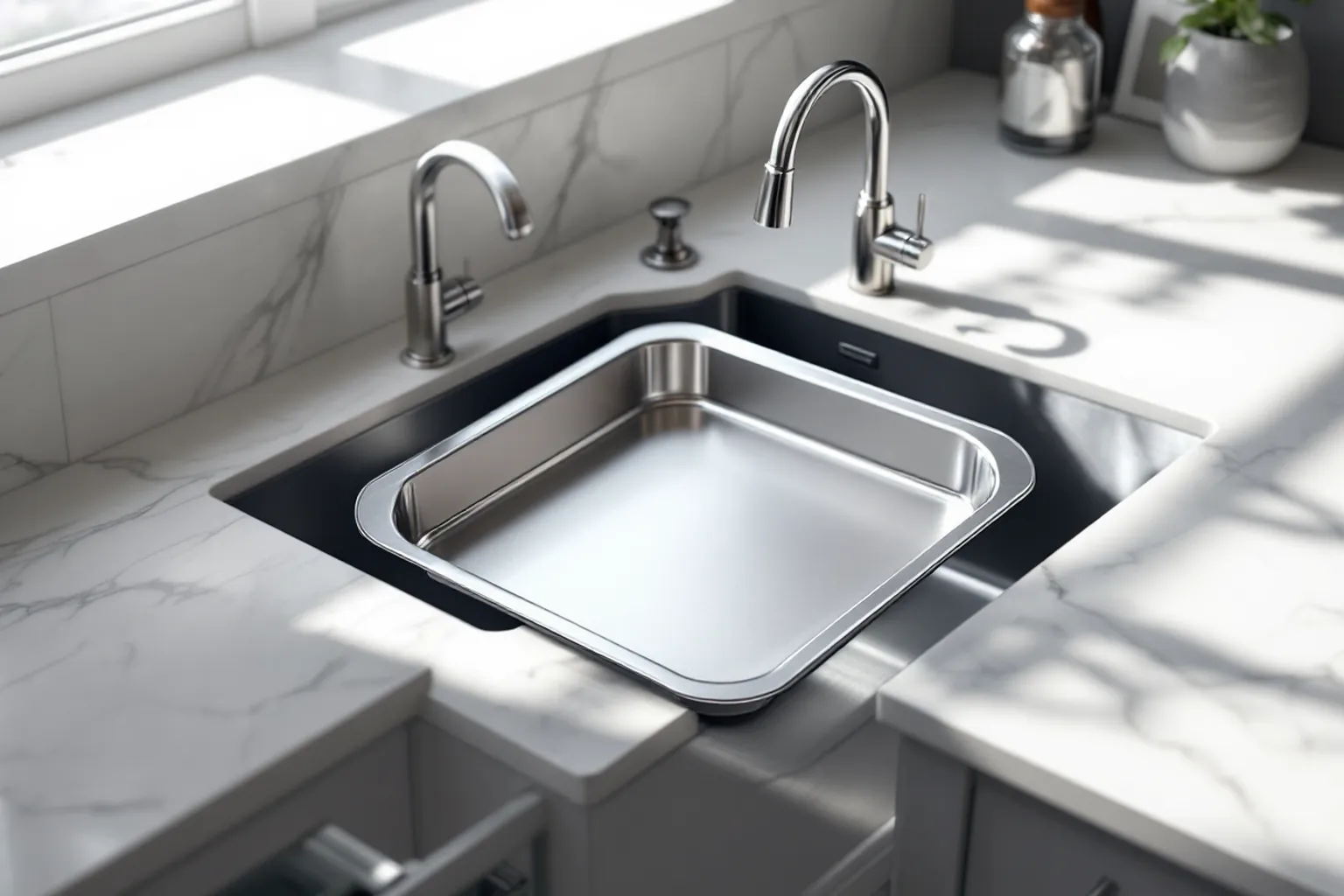
Double sink vs single sink is mostly a question of cabinet width and pan size. In the 18 undermount spec sheets we compiled from Kohler, Kraus, Elkay, Blanco and Ruvati, every double-bowl sink asks for a 36-inch base cabinet, and none of the nine 50/50 or 60/40 models has a bowl wide enough for an 18 x 13 inch half-sheet pan to lie flat, while all seven single bowls do. In the same 36-inch cabinet, the Kraus KHU100-32 single gives one 30 x 17 inch bowl; the Kraus KHU102-33 50/50 splits nearly the same footprint into two 14 7/8 x 17 inch bowls, so the biggest thing you can wash shrinks by half (our calculation from the sheets). Choose a double only if you hand-wash a lot or need a second basin free while the first is full.
18 spec sheets: which bowls take a half-sheet pan flat
We read each maker’s specification sheet (or, for Ruvati, the product page) and recorded the minimum base cabinet and the top-of-bowl size of the largest bowl, left to right by front to back, in inches. Total bowl area is the sum of every bowl’s length times width. The pan test is our calculation, using the nominal 18 x 13 inch half-sheet size as the test footprint: the largest bowl must measure at least 18 inches one way and 13 inches the other. Bowls have rounded corners and slightly sloped sides, so the floor is a little smaller than the top; treat a marginal Yes as a maybe.
| Model (layout) | Min cabinet | Largest bowl (in) | Total sq in | Half-sheet flat? |
|---|---|---|---|---|
| Kohler K-5286 (Single) | 27 in | 22 1/4 x 16 1/2 | 367 | Yes |
| Ruvati RVH7300 (Single) | 33 in | 28 x 16 | 448 | Yes |
| Blanco Precis 30 (Single) | 33 in | 28 x 16 | 448 | Yes |
| Kraus KHU100-32 (Single) | 36 in | 30 x 17 | 510 | Yes |
| Kohler K-5285 (Single) | 36 in | 30 1/4 x 16 9/16 | 501 | Yes |
| Kohler K-5290 (Single) | 36 in | 29 3/16 x 15 1/16 | 440 | Yes |
| Kohler K-5283 (Single) | 39 in* | 33 1/4 x 16 9/16 | 551 | Yes |
| Kraus KHU102-33 (50/50) | 36 in | 14 7/8 x 17 | 506 | No |
| Kohler K-5281 (50/50) | 36 in | 14 9/16 x 16 9/16 | 482 | No |
| Elkay ELUH3118 (50/50) | 36 in | 13 1/2 x 16 | 432 | No |
| Elkay ELUH311810PD (50/50) | 36 in | 13 1/2 x 16 | 432 | No |
| Kraus KHU103-33 (60/40) | 36 in | 16 7/8 x 17 | 506 | No |
| Elkay ECTRU32179RT (60/40) | 36 in | 17 x 17 | 493 | No |
| Elkay ELUH3119LPD (40/60) | 36 in | 16 x 17 1/2 | 452 | No |
| Blanco Precis 1 3/4 (Large/small) | 36 in | 17 x 16 | 480 | No |
| Kohler K-5284 (Large/medium) | 36 in | 17 1/2 x 16 9/16 | 482 | No |
| Kohler K-5282 (XL/medium) | 36 in | 20 3/4 x 18 1/2 | 576 | Yes |
| Elkay ELUH3219 (Large/prep) | 36 in | 21 x 15 3/4 | 449 | Yes |
Sources: Kohler, Kraus, Elkay and Blanco specification sheets linked in each row; Ruvati RVH7300 product page. *Kohler lists 36 to 39 in for K-5283 and says 36 in may need cabinet modifications. Areas and pan test are our calculation.
Same 36-inch cabinet, same bowl area, half the biggest basin
The usual pitch for a double bowl is that you get more sink. The spec sheets say otherwise. The Kraus KHU100-32 single and the Kraus KHU102-33 50/50 both need a 36-inch cabinet and both have 17-inch-deep (front to back) bowls that are 10 inches deep. The single’s bowl is 30 x 17 inches, or 510 square inches. The double’s two 14 7/8 x 17 inch bowls add up to 506 square inches. By our calculation the divider costs you about 4 square inches of total area, but it cuts the largest open basin from 510 to 253 square inches.
That matters for the things that actually fill a sink: a sheet pan, a roasting rack, a stockpot lid, a grill grate. The Kohler K-5282 sheet states the design rule plainly: its 20 3/4 x 18 1/2 inch left bowl “is sized to fit a half cookie sheet flat in the bottom of the basin.” None of the 50/50 or 60/40 bowls in our table reaches 18 inches in either direction; the largest, on the Elkay ECTRU32179RT, is 17 x 17.
A 60/40 split helps round items more than flat ones. By our calculation every 60/40 or large/medium big bowl in the table is at least 16 inches each way, so a pan body up to 15 inches across fits, while the 13 1/2 x 16 inch bowls of the Elkay ELUH3118 do not.
A 30- or 33-inch sink base rules out most double bowls
If you are keeping your cabinets, the sink base width settles much of this. In our sample:
- 30-inch base: only the Kohler K-5286, a 24-inch single with a 22 1/4 x 16 1/2 inch bowl and a 27-inch minimum cabinet, fits. No double we found lists a 30-inch minimum.
- 33-inch base: 30-inch singles such as the Ruvati RVH7300 and Blanco Precis 30 fit, each with a 28 x 16 inch bowl.
- 36-inch base: everything else, including all nine split-bowl models. Even the 30 3/4-inch Elkay ELUH3118 double asks for 36 inches.
- 39-inch base: the 35-inch Kohler K-5283 single, whose sheet says a 36-inch cabinet may need modification.
Some smaller doubles sold online list 33-inch minimums on retailer pages; we left those out because we could not open a maker’s sheet for them. The lesson holds: check the sheet’s minimum cabinet line before you fall for a sink, because cutting into a sink base to make room is cabinet work, not plumbing. If you are replacing cabinets anyway, our guide to replacing cabinets without replacing countertops covers what happens to the top.
The second bowl was built for hand-washing, and dishwashers took most of that job
The classic double-bowl routine is wash on one side, rinse on the other. A dishwasher does that work on far less water: in a measured UK lab trial, 150 people washing a full load by hand used an average of 49 liters, against 13 liters for a then-current dishwasher (Berkholz and others, International Journal of Consumer Studies). Today’s ENERGY STAR limit for a standard model is 3.2 gallons per cycle. Our report on how much water a dishwasher uses has the full federal history.
Where a second bowl still earns its keep: households without a dishwasher, people who hand-wash knives, wood and cast iron daily, and kitchens where two people work the sink at once. Architect Jerome Buttrick told Remodelista his firm no longer installs double bowls, while a sink seller quoted in the same piece wanted a main bowl of 21 inches or more and a second of at least 15 inches. By that yardstick, only the two unequal sinks at the bottom of our table come close, and both need 36 inches of cabinet.
If you want one big basin plus an occasional second one, a plastic tub or a workstation sink’s grid gives you the split on demand. A faucet with a strong spray matters more in a single bowl; our kitchen faucet GPM data shows what the flow limits allow.
Under the sink: one drain or two, and where the disposal goes
A single bowl has one drain, one strainer and one trap connection, which leaves the most room in the cabinet for a disposal, the dishwasher hose and a pull-out bin. A double has two drain openings joined by a waste tee before the trap, and the disposal hangs under one of them. The Elkay ELUH3119LPD sheet notes that select disposers can go on either bowl; on most doubles you pick a side, and the other bowl drains through the tee.
That choice is not minor: about 60.1 million of 115.9 million occupied US homes had a kitchen-sink disposal in the 2013 American Housing Survey. On a 50/50 sink the disposal bowl is the one that stays clear for scraping, so the other bowl does the soaking. Our report on how long a garbage disposal lasts covers warranties and local bans before you buy one for the new sink.
Rear-set drains, which all the Kraus and Elkay sheets above list, push the plumbing toward the wall and free up the front of the cabinet in either layout. Drain hole size is close to standard: the Kraus sheets list 3 1/2 inches and the Kohler K-5281 lists 3 3/4 inches.
Swapping a double for a single: the countertop decides the price
Setting a new sink on an existing drain line is a modest job: Homewyse puts basic kitchen sink installation at $472 to $569 per sink (May 2026 national estimate), covering leveling, securing, the drain assembly and the P-trap hookup, but not plumbing changes, old-sink removal or contractor markup.
The catch is the hole in the counter. An undermount single must cover or exceed the old cutout, and stone can be cut bigger in place but never smaller. A drop-in single needs a rim wide enough to hide the old opening. Run the numbers in our undermount vs drop-in sink comparison before you order. Moving the sink to a new spot is a different job entirely; see the cost to move a kitchen sink to an island for the drain and vent math.
What each layout does better, by the spec sheets
Single bowl
Pros
- Takes a half-sheet pan flat in all 7 models we checked
- Fits 30- and 33-inch sink bases
- One drain, more cabinet room
Cons
- Nothing to soak in while you rinse
- Disposal scraping and washing share one basin
Double bowl
Pros
- Wash and rinse side by side without a dishwasher
- Disposal side stays clear
- Unequal splits keep one large bowl
Cons
- All 9 split models we checked need a 36-inch base
- No 50/50 or 60/40 bowl fits a half-sheet flat
- Two drains and a tee under the sink
Frequently Asked Questions
Is a single or double kitchen sink better?
Neither in general, but in the same 36-inch cabinet a single gives you one basin about twice as wide as either half of a 50/50. In our 18-sheet comparison, all seven singles fit an 18 x 13 inch half-sheet pan flat and none of the nine 50/50 or 60/40 doubles did (our calculation from the maker sheets, such as Kraus KHU102-33). Doubles win for hand-washing and two-person use.
Are double kitchen sinks still in style?
We found no sales data on this. What exists is anecdote: an architect quoted by Remodelista said his firm no longer installs double bowls. Makers still sell many split designs, including lower dividers such as the Kohler K-5284 Smart Divide, which tries to give you both.
Does a double sink vanity increase home value?
That question is about bathrooms, and we found no reliable data tying a second vanity sink to sale price. What a double vanity does need is wall length; our double vanity vs single vanity guide works through the spacing rules.
Can I replace my double kitchen sink with a single sink?
Usually yes, if the single covers the old countertop cutout and fits your cabinet. Most 33-inch doubles need a 36-inch base, and singles in the 30 to 32 inch range need 33 to 36 inches per the Blanco and Kohler sheets, so the cabinet rarely blocks the swap. Basic installation runs $472 to $569 per sink per Homewyse, before any countertop work.
Sources
- Kraus, KHU100-32, KHU102-33 and KHU103-33 specification sheets (2019)
- Kohler, Strive K-5281, K-5282, K-5283, K-5284, K-5285, K-5286 and Undertone K-5290 specification sheets (2025)
- Elkay, ELUH3118, ELUH311810PD, ELUH3119LPD and ELUH3219 submittal sheets (n.d.)
- Elkay, Crosstown ECTRU32179RT specification sheet (n.d.)
- Blanco, PRECIS 30 and PRECIS 1 3/4 specification sheets (n.d.)
- Ruvati, RVH7300 30-inch undermount single bowl (n.d.)
- Homewyse, Cost to Install Kitchen Sink, 2026 (2026)
- Remodelista, Single-Bowl vs Double-Bowl Sinks in the Kitchen (2025)
- U.S. EPA ENERGY STAR, Dishwashers Key Product Criteria (2023)
- Wiley, International Journal of Consumer Studies, Manual dishwashing habits: an empirical analysis of UK consumers (2010)
- U.S. Census Bureau and HUD, American Housing Survey 2013 national tables (2015)