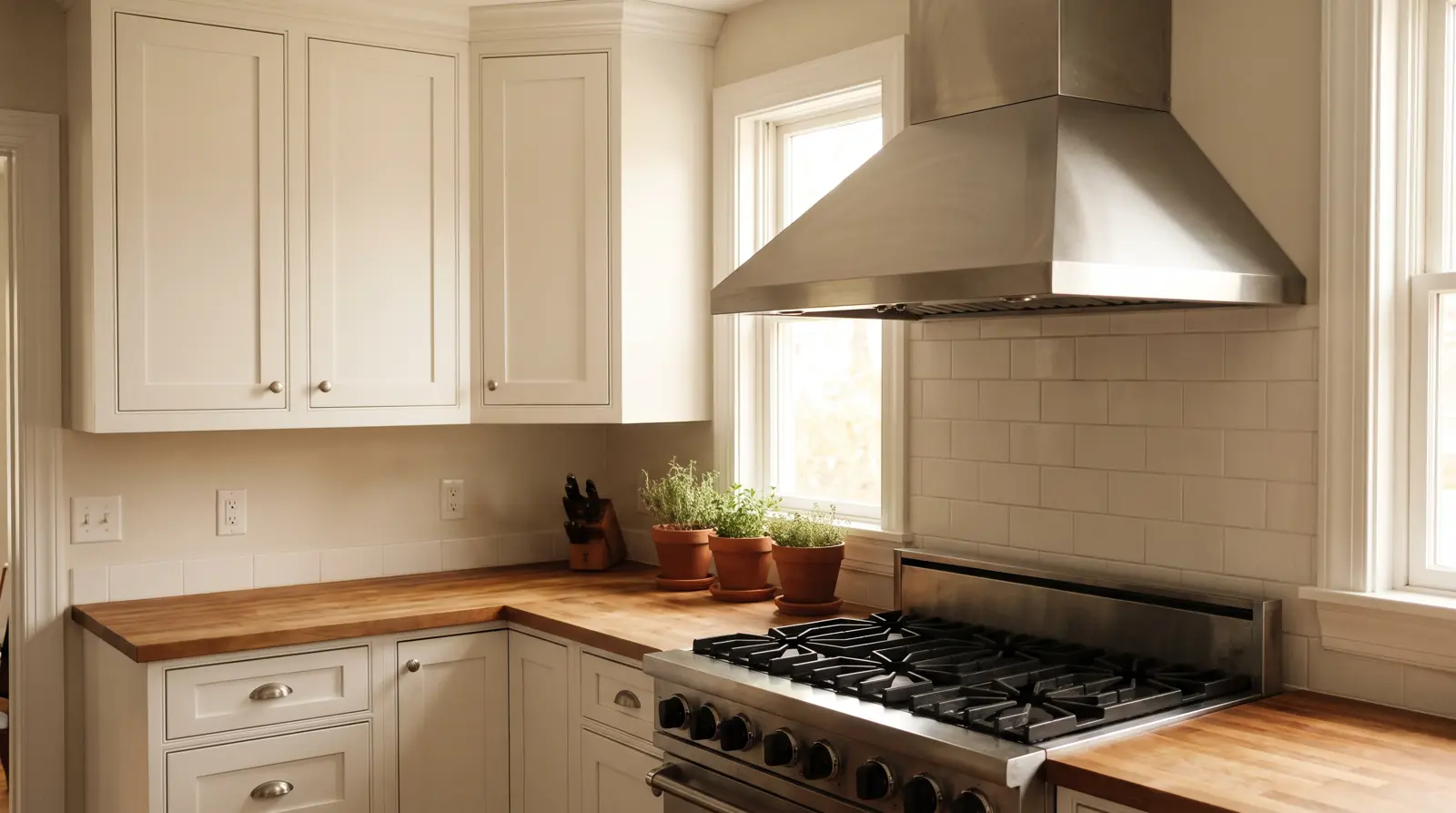
Range Hood CFM: How Much Airflow a Gas or Electric Range Needs
- Primary data
- ENERGY STAR Certified Ventilating Fans (range hoods)
- Data period
- Listings as of 2026-11-13
- Latest release used
- 2026-11-13
- Next release
- Updated continuously by EPA
- Geography
- United States (with California and Washington code tables)
- Sources
- 16 (12 Tier 1)
None of the 92 ENERGY STAR range hoods listed on 2026-11-15 exceeds 210 CFM, so no certified model reaches the 400 CFM make-up air trigger. Range hood CFM rules split by fuel: California asks 110 to 160 CFM over electric and 180 to 280 over gas, while HVI advises 100 CFM per foot of wall range.
No ENERGY STAR range hood is rated above 210 CFM, and none reaches 400
The brief planned three airflow classes for certified hoods. The data fills only the first one: all 92 listings sit between 120 and 210 CFM.
We pulled every range hood row from the ENERGY STAR Certified Ventilating Fans dataset on 2026-11-15. EPA last updated the list on 2026-11-13. There are 92 range hood listings among 1,145 certified ventilating fans.
The highest working-speed airflow on the list is 210 CFM. The median is 150 CFM and the lowest is 120 CFM. 0 listings fall in the 301 to 400 CFM class and 0 in the over-400 class, so the share of certified hoods above the IRC make-up air trigger is 0.0%.
ENERGY STAR listings, 2026-11-15
Source: U.S. EPA ENERGY STAR Certified Ventilating Fans dataset, range hoods, pulled 2026-11-15
The ceiling is built into the label. The ENERGY STAR key product criteria define the range hood category as hoods of 75 W or less, with at least 2.8 CFM per watt. At exactly 75 W and 2.8 CFM per watt a hood moves 210 CFM, the same figure as the top listing. A more efficient hood could move more air inside 75 W, but none on the list does.
| Airflow class | Listings | Share of listings (%) | Median CFM | Median sones | Median CFM per watt |
|---|---|---|---|---|---|
| Up to 300 CFM | 92 | 100.0 | 150.0 | 1.5 | 4.6 |
| 301 to 400 CFM | 0 | 0.0 | None listed | None listed | None listed |
| Over 400 CFM | 0 | 0.0 | None listed | None listed | None listed |
Airflow is the working-speed rating ENERGY STAR publishes for range hoods. 92 listings; 5 have no sone value.
Source: [1] U.S. EPA ENERGY STAR
Listings repeat. The 92 rows reduce to 30 distinct performance configurations from 6 partners and 8 brands, likely because one design is listed separately for each finish or width. 41 of the 92 listings were first certified in 2025.
ENERGY STAR, 2026 through 2026-11-13
Source: ENERGY STAR Certified Ventilating Fans dataset, date_qualified field
Seven range hood CFM rules, side by side, for gas and electric
For one 36-inch range, the rules in circulation ask for anything from 110 CFM to 600 CFM. Only the state codes are binding, and they sit at the low end.
| Rule | Who sets it | Status | Hood over electric range | Hood over gas range |
|---|---|---|---|---|
| 100 CFM per 10,000 BTU | Retailer guidance (Proline) | Rule of thumb | Width in inches x 10 | 100 CFM per 10,000 BTU |
| 100 CFM per linear foot (wall), 150 (island) | Home Ventilating Institute | Trade guidance | 100 CFM per foot; minimum 40 | Same; manufacturer advice for pro-style |
| Title 24 Table 150.0-G, homes over 1,500 sq ft | California Energy Commission | State code, new homes | 110 CFM or 50% CE | 180 CFM or 70% CE |
| Title 24 Table 150.0-G, homes under 750 sq ft | California Energy Commission | State code, new homes | 160 CFM or 65% CE | 280 CFM or 85% CE |
| WAC Table M1505.4.4.3 | Washington State | State code | 160 CFM or 65% CE | 250 CFM or 80% CE |
| IRC 2021 make-up air trigger | International Code Council | Model code, where adopted | Above 400 CFM, only with a vented fuel appliance | Above 400 CFM, only with a vented fuel appliance |
| ENERGY STAR range hood category | U.S. EPA | Voluntary label | 75 W or less, 2.8 CFM per watt, 2.0 sones | 75 W or less, 2.8 CFM per watt, 2.0 sones |
CE = capture efficiency rated to ASTM E3087. Title 24 and Washington accept either the airflow or the CE rating. The 100 CFM per 10,000 BTU rule has no code or standards-body source that we could open.
Source: [16][13][4][6][14][2] Proline Range Hoods (retailer); Home Ventilating Institute (HVI); California Energy Commission; Washington State Legislature; Energy Vanguard; U.S. EPA ENERGY STAR
The 100 CFM per 10,000 BTU rule for gas is the one most buying guides repeat. We found it published by a hood retailer, Proline Range Hoods, which also recommends at least 600 CFM for most kitchens. We could not find it in any code or standards document we opened, so it is shown as a rule of thumb.
The Home Ventilating Institute sizes by width instead: 100 CFM per linear foot for a range against a wall and 150 CFM per foot over an island. Its table gives 250 CFM for a 30-inch wall hood, 300 CFM for 36 inches and 400 CFM for 48 inches, with minimums of 100, 120 and 160 CFM.
Single values; code rows use the airflow path
Sources: CEC Table 150.0-G; WAC 51-51-1505; HVI; ENERGY STAR; Proline. BTU rule row is our calculation.
The gap between advice and code is wide. HVI's 36-inch wall recommendation of 300 CFM is 120 CFM above California's 180 CFM gas minimum for a home over 1,500 sq ft. ASHRAE's residential ventilation standard is the base for both state tables, but its text is sold, not free, so we cite the state versions that adopt it with amendments.
The 400 CFM make-up air trigger depends on what else burns in the house
The IRC make-up air rule is not a plain 400 CFM cap. Since the 2018 edition it applies only when an atmospherically vented fuel appliance shares the home's air.
As quoted by Energy Vanguard, the 2021 IRC requires make-up air for each exhaust system capable of more than 400 CFM where a gas, liquid or solid fuel-burning appliance that is neither direct-vent nor mechanical draft is inside the dwelling's air barrier. The make-up air must roughly equal the exhaust rate.
Fine Homebuilding traces the 400 CFM rule to the 2009 IRC, where it applied to every large hood. The 2018 edition narrowed it to homes with naturally drafted appliances, and the 2021 edition kept that wording. The ICC's own code page blocks automated access, so we did not open it directly; both secondary sources agree on the wording.
| Rule | Crossing point | Basis |
|---|---|---|
| 100 CFM per 10,000 BTU (gas) | 40,000 BTU per hour total | 400 / 100 x 10,000 |
| HVI wall rate, 100 CFM per foot | 48-inch hood (400 CFM) | HVI width table |
| HVI island rate, 150 CFM per foot | About 32 inches wide | 400 / 150 = 2.67 ft |
| Retailer recommendation, 600 CFM | Above the trigger | 600 > 400 |
| Highest ENERGY STAR hood, 210 CFM | Below the trigger | 210 < 400 |
The trigger applies only where a fuel-burning appliance that is neither direct-vent nor mechanical draft sits inside the air barrier (2021 IRC as quoted by Energy Vanguard).
Source: [16][13][14][1] Proline Range Hoods (retailer); Home Ventilating Institute (HVI); Energy Vanguard; U.S. EPA ENERGY STAR
Each sizing rule crosses the trigger at a different point. Under the BTU rule, a cooktop totaling more than 40,000 BTU per hour calls for a hood above 400 CFM. Under HVI's island rate, any island hood wider than about 32 inches does. No ENERGY STAR certified hood comes close.
Certified hoods run at a median 1.5 sones and 4.6 CFM per watt
Within the narrow certified band, quieter and more efficient hoods are concentrated in a small set of configurations.
Across listings with a sound rating, the median certified hood is rated 1.5 sones and the loudest 2.0 sones, the ENERGY STAR limit. 55.2% are 1.5 sones or quieter. 5 listings report no sone value.
Median efficacy is 4.6 CFM per watt, 1.64 times the 2.8 CFM per watt floor. Dividing listed airflow by efficacy gives a median fan power of 32.6 W, and no listing tops 58.3 W.
| Working-speed band | Listings | Median CFM | Median sones | Median CFM per watt | Median fan watts |
|---|---|---|---|---|---|
| 100 to 130 CFM | 20 | 120.0 | 1.5 | 4.2 | 31.0 |
| 131 to 160 CFM | 56 | 150.0 | 2.0 | 4.6 | 32.6 |
| 161 to 210 CFM | 16 | 200.0 | 0.1 | 15.4 | 12.3 |
Fan watts = airflow / efficacy. 11 of the 16 listings in the top band report 0.0 or 0.1 sones and 14.2 to 16.6 CFM per watt, all from one partner.
Source: [1] U.S. EPA ENERGY STAR
ENERGY STAR data cannot answer how loud a 600 CFM hood is, because no certified hood is that large. Washington caps intermittent kitchen exhaust at 3 sones at an airflow setting of 100 CFM or more. That limit applies at the rated setting, not at boost speed.
California and Washington ask more CFM over gas, or a capture efficiency score
Both state codes set fuel-specific minimums and let a hood comply by tested capture efficiency instead of airflow.
California's 2025 single-family compliance form reproduces Table 150.0-G. A hood over an electric range needs 110 CFM in homes over 1,000 sq ft, 130 CFM at 750 to 1,000 sq ft and 160 CFM below 750 sq ft. Over a gas range it needs 180, 250 or 280 CFM by the same size bands.
| Home floor area | Electric range minimum (CFM) | Certified hoods meeting it (%) | Gas range minimum (CFM) | Certified hoods meeting it (%) |
|---|---|---|---|---|
| Over 1,500 sq ft | 110 | 100.0 | 180 | 16.3 |
| Over 1,000 to 1,500 sq ft | 110 | 100.0 | 250 | 0.0 |
| 750 to 1,000 sq ft | 130 | 84.8 | 280 | 0.0 |
| Under 750 sq ft | 160 | 30.4 | 280 | 0.0 |
Minimums from Table 150.0-G (2025 Standards). Share = ENERGY STAR range hood listings whose working-speed airflow is at or above the minimum. Hoods can also comply by capture efficiency, which ENERGY STAR does not list.
Source: [4][1] California Energy Commission; U.S. EPA ENERGY STAR
Share of 92 ENERGY STAR range hood listings
Source: ENERGY STAR range hood listings 2026-11-15; minimums from Title 24 Table 150.0-G and WAC 51-51-1505
Matched against those minimums, 100.0% of certified hoods meet the 110 CFM electric figure, 16.3% meet the 180 CFM gas figure for the largest homes and 0.0% meet 250 or 280 CFM. A certified hood can still comply in a small California home by its capture efficiency rating, which ENERGY STAR does not publish.
Washington's amendments use one row for all home sizes: 160 CFM or 65% capture efficiency over electric, 250 CFM or 80% over combustion ranges, and 300 CFM for downdraft and other kitchen fans. California sets the same 300 CFM for downdraft and a continuous option of 5 air changes per hour for an enclosed kitchen. 30.4% of certified hoods meet Washington's electric figure by airflow.
Field studies find the hood switched on in about one cooking event in four
Airflow on paper matters less if the fan stays off. New LBNL field data put hood use at 23.8% of cooking events.
The CEVICA study, led with Lawrence Berkeley National Laboratory, logged 4,184 cooking events and 1,038 hood use events in 40 San Joaquin Valley homes. In the Phase 1 sample, hoods ran for 3 minutes or more in 23.8% of cooking events: 26.9% with gas and 20.4% with induction.
CEVICA homes, share of events with hood on 3+ min
Source: Fang et al. 2026, LBNL, IAQVEC 2026 paper 514, Table 1
| Cooking events | Gas stove (%) | Induction stove (%) | All stoves (%) |
|---|---|---|---|
| With particle emissions | 35.0 | 38.1 | 35.2 |
| Without particle emissions | 23.6 | 13.1 | 18.1 |
| All cooking | 26.9 | 20.4 | 23.8 |
Phase 1, cohort 1, 1,543 cooking events in San Joaquin Valley homes. Use = hood on for 3 minutes or more.
Source: [7] Lawrence Berkeley National Laboratory via OSTI
Use rose when cooking produced particles: 35.0% of those gas events and 38.1% of induction events. With gas cooking, NO2 added per minute of cooking was 30% lower when the hood ran, and integrated NO2 was about 45% higher in events without hood use. The same team measured time-integrated NO2 14.2 ppb lower with electric cooking; the stove comparison is covered in our induction vs gas stove report.
An earlier simulation by Logue and colleagues estimated that 62%, 9% and 53% of occupants in Southern California homes cooking with gas and no hood use exceed acute standards for NO2, CO and formaldehyde. It modeled hood use with the 55% mean capture efficiency measured in California homes. The EPA lists an exhaust fan vented outdoors over gas stoves among its steps to reduce NO2 exposure.
Federal surveys do not record whether homes have a vented hood
No national count of vented range hoods exists in the main federal housing energy survey.
We searched the EIA RECS 2020 and RECS 2024 codebooks for hood, exhaust and vent variables. Neither has a range hood or kitchen exhaust question; the only exhaust item is an attic fan. That means no federal figure shows how many U.S. kitchens have a hood or whether it vents outside.
For bathroom fans, see our bathroom exhaust fan CFM report. State and local rules on gas appliances are tracked in the gas stove ban tracker. Hood installation usually falls late in a remodel; our kitchen remodel timeline shows where.
Ratios behind the comparison
Share of ENERGY STAR range hood listings above the 400 CFM make-up air trigger
Formulalistings above 400 CFM / all listings x 100
Inputs: rows 17, 1 (fact sheet rows)
Result: 0.0% (0 of 92 listings)
No ENERGY STAR certified hood can trigger IRC make-up air at its rated working speed. Buyers sizing above 400 CFM are choosing outside the certified pool.
Limitations: Working-speed airflow; a hood can have a higher boost speed
Airflow at the ENERGY STAR range hood ceiling of 75 W and the 2.8 CFM per watt floor
Formula75 x 2.8
Inputs: rows 22, 23 (fact sheet rows)
Result: 210 CFM
The 75 W category limit and 2.8 CFM per watt floor together point to 210 CFM, matching the highest listing.
Limitations: A more efficient hood can move more air within 75 W
Gas burner input matched by the highest-airflow certified hood under the 100 CFM per 10,000 BTU rule
Formula210 CFM / 100 x 10,000
Inputs: rows 7, 53 (fact sheet rows)
Result: 21,000 BTU per hour
By the BTU rule, the largest certified hood suits a cooktop with total burner input of 21,000 BTU per hour; the median suits 15,000.
Limitations: Rule of thumb from a retailer, not a code
Total cooktop input at which the BTU rule crosses the 400 CFM trigger
Formula400 / 100 x 10,000
Inputs: rows 51, 53 (fact sheet rows)
Result: 40,000 BTU per hour
Above this total cooktop input, the BTU rule asks for more than 400 CFM.
Limitations: Trigger also needs an atmospherically vented appliance
Island hood width at which the HVI recommended rate crosses 400 CFM
Formula400 / 150 CFM per foot = 2.67 ft x 12
Inputs: rows 51, 45 (fact sheet rows)
Result: 32 inches
Island hoods wider than about 32 inches at HVI's recommended rate pass 400 CFM.
Limitations: Rounded to the inch; 2.67 ft
Share of certified hoods meeting Title 24 airflow for gas, homes over 1,500 sq ft (180 CFM)
Formulalistings >= 180 CFM / 92 x 100
Inputs: rows 27, 1 (fact sheet rows)
Result: 16.3%
Most certified hoods fall short of California's gas airflow minimum even for the largest homes, unless they comply by capture efficiency.
Limitations: Working-speed rating vs code rating point may differ
Median fan power of certified range hoods
Formulamedian of (airflow / efficacy) per listing
Inputs: rows 8, 12 (fact sheet rows)
Result: 32.6 W
Certified hoods draw well under half the 75 W category limit at listed airflow.
Limitations: Computed from listed fields, not measured
Share of CEVICA cooking events without range hood use
Formula100 - 23.8
Inputs: row 58 (fact sheet rows)
Result: 76.2%
In the CEVICA homes, about three in four cooking events happened with the hood off or on for under 3 minutes.
Limitations: One California cohort
Where the numbers diverge
- ENERGY STAR listed 92 certified range hoods as of its 2026-11-13 update, out of 1,145 certified ventilating fans of all types (8.0%).[1]
- Working-speed airflow of certified range hoods ranges from 120 to 210 CFM, with a median of 150 CFM (United States and Canada listings, 2026).[1]
- 0 of 92 certified range hoods (0.0%) is rated above 400 CFM, and 0 is rated between 301 and 400 CFM.[1]
- The 92 listings collapse to 30 distinct performance configurations from 6 ENERGY STAR partners and 8 brands.[1]
- ENERGY STAR range hood criteria cover hoods of 75 W or less and require at least 2.8 CFM per watt and no more than 2.0 sones (Version 4.1).[2]
- The median certified hood uses 32.6 W of fan power at its listed airflow and the highest uses 58.3 W (our calculation from listed airflow and efficacy).[1]
- 55.2% of certified hoods with a sound rating are rated 1.5 sones or quieter; the loudest is 2.0 sones.[1]
- California's 2025 Title 24 Table 150.0-G sets 110 to 160 CFM over electric ranges and 180 to 280 CFM over gas ranges, scaled up as homes get smaller.[4]
- Washington requires 160 CFM over electric and 250 CFM over combustion ranges, or 65% and 80% capture efficiency (effective 2024-03-16).[6]
- HVI recommends 100 CFM per linear foot for wall ranges and 150 CFM for islands, with minimums of 40 and 50 CFM per foot.[13]
- Under the 2021 IRC, exhaust above 400 CFM needs make-up air only where a fuel-burning appliance that is neither direct-vent nor mechanical draft is inside the air barrier.[14][15]
- In the CEVICA study, range hoods ran during 26.9% of gas cooking events and 20.4% of induction cooking events (California, 2026 publication).[7]
- A 2014 simulation estimated that 62% of Southern California occupants in homes cooking with gas and no hood use exceed acute NO2 standards.[9]
Summary
- ENERGY STAR lists 92 certified range hoods (2026-11-15); every one is rated at or below 210 CFM at working speed, and 0.0% exceed the 400 CFM make-up air trigger.
- The ENERGY STAR range hood category only covers hoods of 75 W or less, and 75 W at the 2.8 CFM per watt floor works out to 210 CFM, the same as the top listing.
- Certified hoods run at a median 150 CFM, 1.5 sones and 4.6 CFM per watt; no range hood is on the 2026 Most Efficient list.
- Code minimums are far below rule-of-thumb sizes: California asks 180 CFM over a gas range in homes over 1,500 sq ft, HVI recommends 300 CFM for a 36-inch wall hood and a retailer recommends 600.
- Only 16.3% of certified hoods meet California's 180 CFM gas minimum by airflow, and 0.0% meet the 250 to 280 CFM gas minimums for smaller homes.
- The 2021 IRC make-up air rule applies above 400 CFM only when a fuel-burning appliance that is neither direct-vent nor mechanical draft sits inside the air barrier.
- In 40 California homes studied by LBNL, hoods ran in 23.8% of cooking events, and NO2 added per minute of gas cooking was 30% lower when they did.
Questions people ask
Is 300 CFM enough for a gas range?
300 CFM exceeds every state code minimum we found: California asks 180 to 280 CFM over gas and Washington 250 CFM. It matches HVI's recommendation for a 36-inch wall hood. Under the 100 CFM per 10,000 BTU rule of thumb, 300 CFM fits a cooktop up to 30,000 BTU per hour.
Do I need make-up air for a range hood?
Under the 2021 IRC, only if the hood can exhaust more than 400 CFM and a fuel-burning appliance that is neither direct-vent nor mechanical draft is inside the air barrier. An all-electric home with a large hood does not trigger it. Local amendments can differ.
Do recirculating hoods work?
HVI states that nonducted, recirculating hoods provide no actual ventilation. Washington allows listed ductless hoods only where an enclosed kitchen also has continuous exhaust to code rates.
How loud is a 600 CFM hood?
Certified data cannot say: no ENERGY STAR hood is above 210 CFM. Certified hoods are rated at a median 1.5 sones. Washington limits intermittent kitchen exhaust to 3 sones at a setting of 100 CFM or more, which says nothing about boost speeds.
For journalists and researchers
If you cite only a few, cite these
- 0 of 92 ENERGY STAR range hoods exceed 400 CFM; the highest is 210 CFM (2026-11-15).[1]
- California Title 24 Table 150.0-G: 110 to 160 CFM over electric, 180 to 280 CFM over gas.[4]
- Hoods ran in 23.8% of cooking events in CEVICA homes (LBNL, 2026).[7]
Most quotable statistics
- None of the 92 ENERGY STAR certified range hoods listed on 2026-11-15 is rated above 210 CFM; 0.0% exceed the 400 CFM IRC make-up air trigger.[1][14]
- Only 16.3% of ENERGY STAR range hoods meet California's 180 CFM gas minimum for homes over 1,500 sq ft by airflow alone.[1][4]
- California's 2025 Title 24 asks 110 to 160 CFM over electric ranges and 180 to 280 CFM over gas ranges.[4]
- Range hoods ran in 23.8% of cooking events across 40 California homes in a 2026 LBNL field study.[7]
- HVI recommends 300 CFM for a 36-inch wall hood, 120 CFM above California's gas minimum for large homes.[13][4]
- Under the 100 CFM per 10,000 BTU rule of thumb, any cooktop above 40,000 BTU per hour needs a hood above 400 CFM.[16][14]
Press summary
Kitchen and Bath Renovators compared the main range hood sizing rules with federal certification data. Of 92 ENERGY STAR certified range hoods listed on 2026-11-15, none is rated above 210 CFM at working speed, and none reaches the 400 CFM level at which the 2021 International Residential Code can require make-up air. The ENERGY STAR range hood category is limited to hoods of 75 W or less, which caps airflow near 210 CFM at the minimum efficacy. State codes ask for far less than common buying advice: California's 2025 Title 24 sets 110 to 160 CFM over electric ranges and 180 to 280 CFM over gas, while Washington sets 160 and 250. HVI recommends 300 CFM for a 36-inch wall hood and a retailer suggests 600. Only 16.3% of certified hoods meet California's 180 CFM gas minimum by airflow. A 2026 LBNL field study found hoods ran in 23.8% of cooking events.
Suggested headlines
- No ENERGY STAR range hood tops 210 CFM, far below the 400 CFM make-up air line
- Range hood CFM rules run from 110 to 600 CFM for the same 36-inch range
- California asks 180 to 280 CFM over gas; only 16.3% of certified hoods qualify by airflow
- Hoods ran in fewer than one in four cooking events in an LBNL field study
- The 400 CFM make-up air rule only bites in homes with naturally vented gas appliances
How to cite this report
Kitchen and Bath Renovators. (2026). Range Hood CFM: How Much Airflow a Gas or Electric Range Needs. Retrieved from https://kitchenandbathrenovators.com/research/range-hood-cfm/
Reuse license
Data and tables are licensed CC BY 4.0. Attribution: “Source: Kitchen and Bath Renovators, Range Hood CFM: How Much Airflow a Gas or Electric Range Needs” with a link to this page.
Download the data
Every table in this report is available as a CSV under CC BY 4.0. The fact sheet lists each value with its source URL and access date.
- derived_metrics.csv (CSV)
- fact_sheet.csv (CSV)
- Range hood CFM rules side by side (CSV)
- ENERGY STAR range hoods by airflow class, 2026-11-15 (CSV)
- Certified range hoods within the 120 to 210 CFM band (CSV)
- Title 24 airflow minimums and how many certified hoods meet them (CSV)
- Where each sizing rule crosses the 400 CFM make-up air trigger (CSV)
- How often range hoods were switched on during cooking, CEVICA study (CSV)
Frequently asked questions
How many CFM does a range hood need for an electric range?
California's Title 24 asks 110 CFM in homes over 1,000 sq ft, rising to 160 CFM under 750 sq ft. Washington asks 160 CFM. HVI recommends 100 CFM per linear foot against a wall.
How many CFM does a range hood need for a gas range?
California asks 180 CFM in homes over 1,500 sq ft and 250 to 280 CFM in smaller homes; Washington asks 250 CFM. A retailer rule of thumb is 100 CFM per 10,000 BTU.
Does induction need less range hood CFM than gas?
Both state codes treat induction as electric, so the minimum is lower: 110 to 160 CFM in California versus 180 to 280 CFM for gas. Cooking itself still makes particles; in CEVICA, hood use was 38.1% for particle-producing induction events.
What is the most CFM an ENERGY STAR range hood has?
210 CFM at working speed, from the list updated 2026-11-13. The median is 150 CFM across 92 listings.
Why are ENERGY STAR range hoods so small?
The ENERGY STAR range hood category covers hoods of 75 W or less with at least 2.8 CFM per watt. At those limits a hood moves 210 CFM.
What is capture efficiency?
Capture efficiency is the share of cooking pollutants a hood removes directly, rated under ASTM E3087. California and Washington accept it in place of airflow, for example 70% CE instead of 180 CFM over gas in large California homes.
When did the 400 CFM make-up air rule start?
Fine Homebuilding dates it to the 2009 IRC. The 2018 edition limited it to homes with naturally drafted fuel appliances inside the envelope, and the 2021 edition kept that.
How often do people actually use their range hood?
In 40 California homes, hoods ran for 3 minutes or more in 23.8% of cooking events, per a 2026 LBNL study.
Does using the hood reduce NO2 from a gas stove?
In CEVICA, NO2 added per minute of gas cooking was 30% lower with the hood on. A 2014 simulation assumed 55% capture efficiency for hoods in California homes.
What sone rating is quiet for a range hood?
ENERGY STAR caps certified hoods at 2.0 sones; 55.2% of certified hoods are rated 1.5 sones or quieter. Washington allows up to 3 sones for intermittent kitchen exhaust.
Reproduce this analysis
Every figure comes from the files below. The scripts that pulled and computed them are kept with the report and can be re-run.
| Dataset | Publisher | Source | Query or filter | Rows used | Retrieved |
|---|---|---|---|---|---|
| ENERGY STAR Certified Ventilating Fans | U.S. EPA ENERGY STAR | File or endpoint | $where=unit_type='Range Hood'&$limit=5000; full table also pulled for the 1,145 total | 92 range hood rows of 1,145 | 2026-11-15 |
| ENERGY STAR Most Efficient Ventilating Fans | U.S. EPA ENERGY STAR | File or endpoint | $select=unit_type,count(*)&$group=unit_type | 2 groups, 0 range hoods | 2026-11-15 |
| CF2R-MCH-32-H, 2025 Single-Family, Tables 150.0-E to 150.0-G | California Energy Commission | File or endpoint | Table 150.0-G read from PDF | 4 floor-area rows x 2 fuels | 2026-11-15 |
| WAC 51-51-1505 | Washington State Legislature | File or endpoint | Tables M1505.4.4.1 and M1505.4.4.3, M1505.4.4.2 sound limits | 2 fuel rows | 2026-11-15 |
| RECS 2020 and 2024 codebooks (shared copies) | U.S. Energy Information Administration | File or endpoint | Keyword search hood, exhaust, vent in build/kitchenandbathrenovators.com/research_shared/recs2020/ and recs2024/ codebooks | 0 matching variables | 2026-11-15 |
Data quality and exclusions
- 92 range hood rows kept; 0 dropped. 1,053 non-hood rows (bath, utility and in-line fans) excluded by the unit_type filter.
- 5 listings have no sone value; they are excluded from sone medians and from the 1.5-sone share (base 87).
- 11 listings from one partner report 0.0 or 0.1 sones with 14.2 to 16.6 CFM per watt; kept as published and flagged.
- Multi-speed listings report up to three airflows; we used the highest, which is the listed working-speed rating.
- The 92 listings contain 30 distinct performance configurations; counts and shares are by listing, as ENERGY STAR publishes them.
Methodology
Source selection: we used the ENERGY STAR Certified Ventilating Fans dataset as the primary data, code tables published by the California Energy Commission and the Washington State Legislature, peer-reviewed or laboratory research from LBNL and Environmental Health Perspectives, and HVI guidance. Retailer and trade-press pages are used only to show who publishes a rule or to quote code text we could not open at the ICC.
Inclusion: every row with unit_type equal to Range Hood on 2026-11-15 (92 rows). Airflow per listing is the highest of the up to three listed working-speed airflows; efficacy is the value paired with that airflow; sones is the upper end of the listed range.
Conflicts: where rules disagree we show them side by side rather than choosing one. The 100 CFM per 10,000 BTU rule is labeled a rule of thumb because no code or standards text we opened contains it.
Derived metrics: shares are listing counts over 92; fan watts are airflow divided by efficacy; BTU and width crossing points are arithmetic on the published rules. Formulas and input rows are in derived_metrics.csv; the pull and computation scripts are in scripts/.
Limitations: ENERGY STAR airflow is a working-speed rating; code compliance points and boost speeds can differ. CEVICA covers 40 homes in one California region. Last updated 2026-11-15.
This report presents published data with its limitations. It is not legal, financial or investment advice.
Sources, ranked by quality
Tier 1: primary and official sources (12)
- [1] U.S. EPA ENERGY STAR. ENERGY STAR Certified Ventilating Fans (dataset 8dv7-nngq). Listings as of data update 2026-11-13, pulled 2026-11-15. Accessed 2026-11-15.
- [2] U.S. EPA ENERGY STAR. Ventilation Fans Key Product Criteria. Version 4.1 requirements, effective 2018-07-24. Accessed 2026-11-15.
- [3] U.S. EPA ENERGY STAR. ENERGY STAR Most Efficient Ventilating Fans (dataset ga9m-7gtz). As of 2026-11-15. Accessed 2026-11-15.
- [4] California Energy Commission. CF2R-MCH-32-H Local Mechanical Exhaust, Certificate of Installation (Tables 150.0-E, 150.0-F, 150.0-G). 2025 Building Energy Efficiency Standards, single-family, effective 2026-01-01. Accessed 2026-11-15.
- [5] Washington State Legislature. WAC 51-51-1503, Domestic cooking exhaust equipment (Washington amendments to the IRC). Effective 2024-03-15. Accessed 2026-11-15.
- [6] Washington State Legislature. WAC 51-51-1505, Mechanical ventilation (Tables M1505.4.4.1 and M1505.4.4.3). Effective 2024-03-16. Accessed 2026-11-15.
- [7] Lawrence Berkeley National Laboratory via OSTI. Range Hood Use and Effectiveness in Reducing Indoor Air Pollution During Gas and Induction Cooking (Fang et al., IAQVEC 2026 paper 514). CEVICA study, San Joaquin Valley, California; published May 2026. Accessed 2026-11-15.
- [8] Lawrence Berkeley National Laboratory via OSTI. Measured Indoor Nitrogen Oxides in Homes with a Child with Asthma and Gas or Induction Electric Cooking (Fang et al., 2026). CEVICA study, first 40 homes; published 2026. Accessed 2026-11-15.
- [9] NIEHS, Environmental Health Perspectives (PMC3888569). Pollutant Exposures from Natural Gas Cooking Burners: A Simulation-Based Assessment for Southern California (Logue et al., Environ Health Perspect 122:43-50). Simulation of Southern California homes; published 2014. Accessed 2026-11-15.
- [10] U.S. Environmental Protection Agency. Nitrogen Dioxide's Impact on Indoor Air Quality. Page accessed 2026-11-15. Accessed 2026-11-15.
- [11] U.S. Energy Information Administration. 2020 RECS public-use file codebook, version 7. 2020 survey year. Accessed 2026-11-15.
- [12] U.S. Energy Information Administration. 2024 RECS public-use file codebook, version 1. 2024 survey year; released 2026. Accessed 2026-11-15.
Tier 2: trade bodies, market research, company data (1)
- [13] Home Ventilating Institute (HVI). How Much Ventilation Do I Need?. Undated guidance page, accessed 2026-11-15. Accessed 2026-11-15.
Tier 3: journalism and expert commentary (3)
- [14] Energy Vanguard. Range Hood Makeup Air: The Basics (Allison A. Bailes III, Energy Vanguard). Published 2023-10-05; quotes the 2021 IRC. Accessed 2026-11-15.
- [15] Fine Homebuilding (Taunton Press). The Basics of Makeup Air (Glenn Mathewson, Fine Homebuilding #287). Covers 1971 CABO to 2021 IRC. Accessed 2026-11-15.
- [16] Proline Range Hoods (retailer). How Many CFM Do I Need For My Range Hood?. Updated 2026-09-24. Accessed 2026-11-15.