How Long Does a Water Heater Last? Lifespan Data by Type (2026)
- Primary data
- U.S. DOE consumer water heater technical support documents (appendix 8G) and EIA RECS 2020 microdata v7
- Data period
- Lifetime fits use survey data from 1974 to 2021 (latest DOE TSD December 2024); household water heater ages are for 2020 (RECS microdata v7, January 2024)
- Latest release used
- 2024-12-26
- Next release
- RECS 2024 water heating tables, spring 2027 (EIA)
- Geography
- United States
- Sources
- 24 (16 Tier 1)
How long does a water heater last? The U.S. Department of Energy's survival model puts the average at 14.5 years for gas tank heaters, 15.1 years for electric tanks and 20.0 years for gas tankless units. KBR's analysis of EIA's 2020 household survey finds 15.6% of homes already had a heater past its type's average.
How long does a water heater last by type? DOE's survival curves
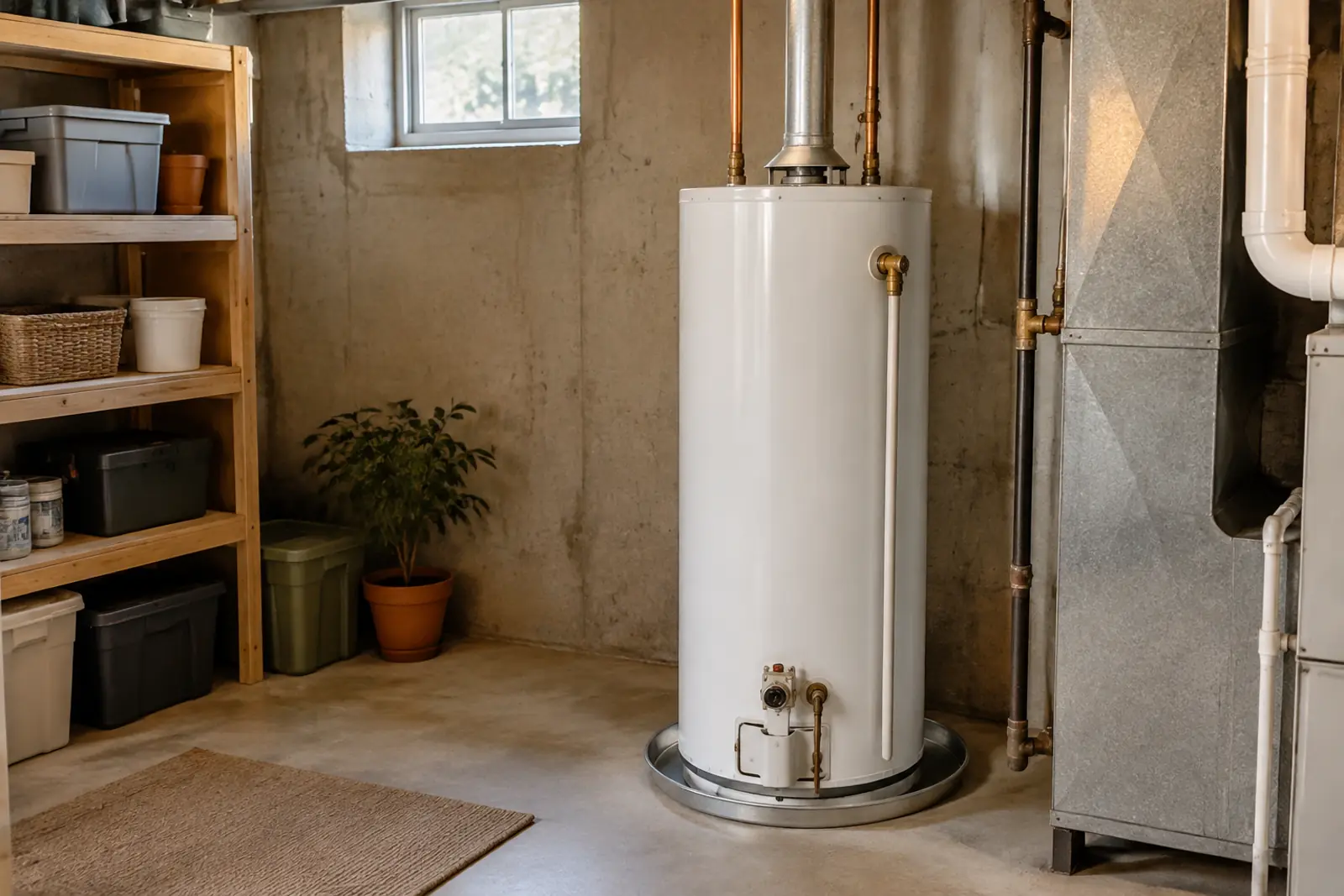
DOE does not publish a single lifespan. It fits a survival curve to each product class, and the means come out at 14.5 years for gas tanks, 15.1 for electric tanks, 15.5 for oil tanks and 20.0 for gas tankless units.
The U.S. Department of Energy builds its lifetime estimates for appliance standards from national survey data rather than from manufacturer claims. For consumer water heaters it combined the age bins reported in EIA's Residential Energy Consumption Survey (waves from 1990 to 2020), total installed stock from the Census Bureau's American Housing Survey (1974 to 2021) and historical shipments, then fitted a Weibull distribution to each product class (DOE TSD, appendix 8G; 89 FR 37778).
| Product class | Scale alpha (years) | Shape beta | Delay (years) | Mean life (years) | Median life (years) | DOE basis |
|---|---|---|---|---|---|---|
| Gas-fired storage (tank) | 15.1 | 1.76 | 1.0 | 14.5 | 13.3 | Fitted to RECS age bins, AHS stock and shipments |
| Electric storage (tank, incl. heat pump) | 15.7 | 1.57 | 1.0 | 15.1 | 13.4 | Fitted; applied to heat pump models |
| Oil-fired storage (tank) | 16.2 | 1.70 | 1.0 | 15.5 | 14.1 | Fitted |
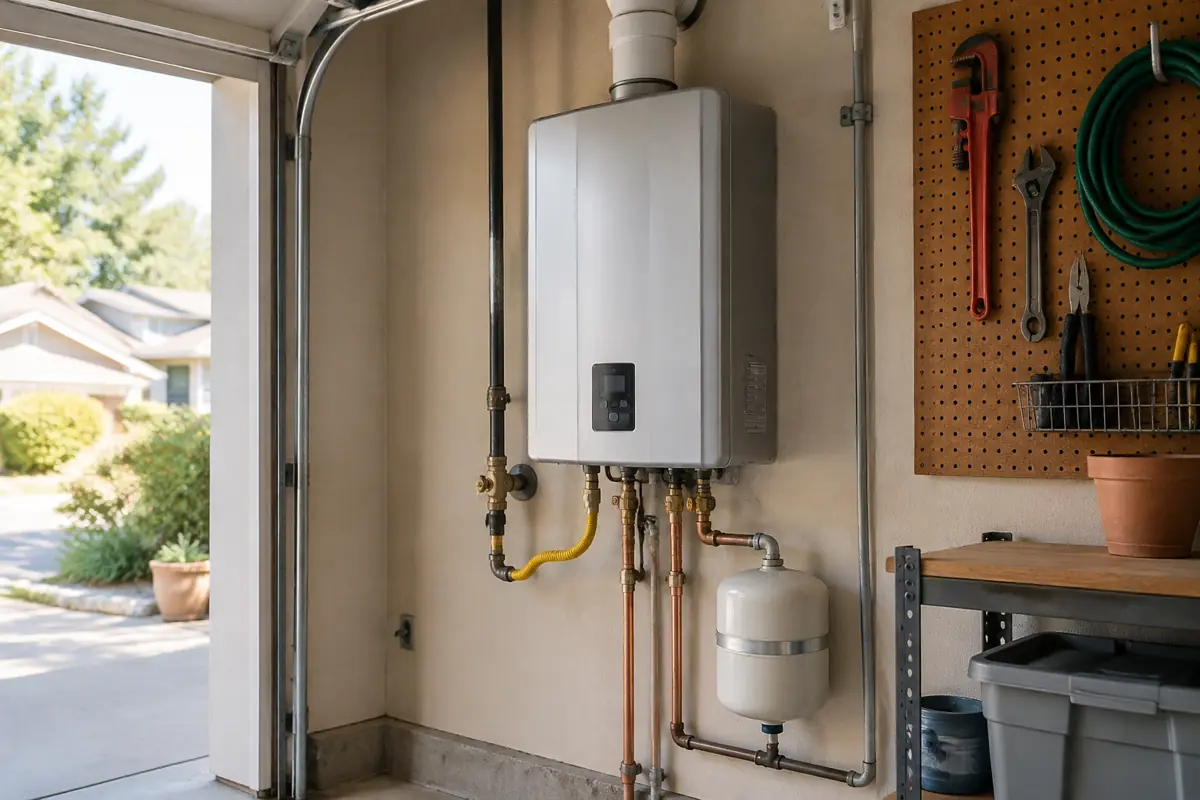
| Gas-fired instantaneous (tankless) | 21.3 | 1.76 | 1.0 | 20.0 | 18.3 | Assumed 20-year mean, gas storage shape |
Table 8G.4.1 of DOE's July 2023 consumer water heater TSD (appendix 8G); the tankless row is repeated unchanged in the December 2024 gas-fired instantaneous TSD. The May 2024 final rule states an average of about 15 years for storage water heaters.
Source: [1][2][3] U.S. Department of Energy; U.S. Department of Energy; U.S. Department of Energy via Federal Register
The median sits below the mean in every class: half of gas tank units are out of service by 13.3 years and half of electric tanks by 13.4 years. The gap comes from the long right tail, the minority of tanks that run 20 years or more. DOE told commenters that the inflection point of its curve shows the age most water heaters reach, while the average also counts units that fail unusually early or late (final rule, section IV.F.6).
Lifetime (DOE): The age at which a water heater is retired from service. Retirement includes failure and early replacement, for example during a remodel or a fuel switch.
Two choices in DOE's model matter for readers. First, DOE applies the electric storage curve to heat pump water heaters because its research did not show different lifetimes. Second, the tankless figure is an assumption: DOE states that gas-fired instantaneous units have limited data, so it set a 20.0-year mean with the gas tank shape, and tested 18 and 22 year alternatives in a sensitivity run (DOE GIWH TSD, Table 8G.5.1).
Cumulative percent retired, by product class
Source: KBR calculation from U.S. DOE consumer water heater TSD, Table 8G.4.1 (2023, 2024)
Why many pages say 8 to 12 years while DOE's curves say about 15
The short figure is real but comes from older or narrower sources. DOE's own literature table spans 9 to 13 years for storage averages, and its 2010 rule used 13 years.
DOE's literature review lists home inspector charts (InterNACHI: 6 to 12 years), a proprietary industry survey (Clear Seas Research 2020: an average of 11.5 years), a 2011 Weibull study (13.9 years gas, 12.5 years electric), and ASHRAE's 2022 data (15 years for replaced gas units, 11.8 for replaced electric units). Across these, storage averages run from 9 to 13 years (DOE TSD Table 8G.2.1).
| Estimate | Fuel | Average life (years) | Original source (as cited in DOE Table 8G.2.1) |
|---|---|---|---|
| Industry survey average | Storage, any fuel | 11.5 | Clear Seas Research (2020) |
| Weibull fit, national surveys | Gas | 13.9 | Lutz et al. (2011) |
| Weibull fit, national surveys | Electric | 12.5 | Lutz et al. (2011) |
| DOE 2010 rule (triangular) | Gas, oil, electric | 13 | DOE (2010) |
| Replaced units | Gas | 15 | ASHRAE (2022) |
| In-service units | Gas | 13.1 | ASHRAE (2022) |
| Replaced units | Electric | 11.8 | ASHRAE (2022) |
| In-service units | Electric | 15.5 | ASHRAE (2022) |
| DOE 2023 to 2024 rule (Weibull) | Gas | 14.5 | DOE TSD Table 8G.4.1 |
| DOE 2023 to 2024 rule (Weibull) | Electric | 15.1 | DOE TSD Table 8G.4.1 |
KBR did not open the original studies; values are as listed by DOE in appendix 8G of the July 2023 TSD.
Source: [1] U.S. Department of Energy
In the rulemaking record, apartment industry commenters told DOE that AHRI assumes 10 to 13 years, and Bradford White noted that DOE's own 2010 rule used 13 years. DOE answered that it had gathered more evidence and moved to a curve that starts retirements from year two and allows a longer tail (final rule, section IV.F.6). The result is a mean near 15 years with a median near 13.
Estimates compiled in DOE's 2023 technical support document
Source: U.S. DOE consumer water heater TSD, Table 8G.2.1 and Table 8G.4.1 (July 2023)
The odds a water heater is retired by year 5, 10 and 15
Run DOE's parameters through the survival formula and a gas tank has a 9.2% chance of retirement by year 5, 33.1% by year 10 and 58.3% by year 15.
The table below is KBR's calculation from DOE's published Weibull parameters. It answers the planning question a homeowner actually faces: given a unit of this type, how likely is it to have been replaced by a given age? Retirement in DOE's model includes both failure and early replacement.
| Type | By year 5 (%) | By year 10 (%) | By year 15 (%) | By year 20 (%) | By year 25 (%) | By year 30 (%) | Reached 10, retired before 15 (%) | Annual rate at age 10 (%) | Annual rate at age 15 (%) |
|---|---|---|---|---|---|---|---|---|---|
| Gas tank | 9.2 | 33.1 | 58.3 | 77.6 | 89.6 | 95.7 | 37.7 | 7.9 | 10.7 |
| Electric tank (incl. heat pump) | 11.0 | 34.1 | 56.6 | 74.1 | 85.7 | 92.7 | 34.2 | 7.2 | 9.1 |
| Oil tank | 8.9 | 30.8 | 54.2 | 73.1 | 85.8 | 93.2 | 33.8 | 7.0 | 9.3 |
| Gas tankless | 5.1 | 19.7 | 38.0 | 55.9 | 70.9 | 82.1 | 22.8 | 4.4 | 6.0 |
KBR calculation: F(x) = 1 – exp(-((x – delay)/alpha)^beta) with DOE Table 8G.4.1 parameters. Retirement includes failure and early replacement.
Source: [1][2] U.S. Department of Energy; U.S. Department of Energy
The annual rate rises with age. For gas tanks it climbs from 4.5% a year at age 5 to 7.9% at age 10 and 10.7% at age 15. Electric tanks follow a flatter curve (7.2% at age 10, 9.1% at age 15), which is why their median is close to the gas median while their mean is higher.
Gas tankless units, on DOE's assumed curve, reach a 38.0% retirement share at year 15, close to the point where the electric tank curve passes half.
15.6% of US homes already had a water heater past DOE's average life
KBR matched every household in EIA's 2020 survey to the DOE curve for its water heater type. 18.73 million homes had a unit at or beyond the DOE mean for that type.
RECS 2020 asks each household the age of its main water heater in six bins and records the fuel and whether it is tankless. KBR weighted the 18,496 records with EIA's final weights (NWEIGHT) and computed standard errors with the 60 jackknife replicate weights, following EIA's microdata guide. Weighted totals match EIA's published Table HC8.1: 123.53 million homes, of which 8.98 million had a main water heater aged 20 or more.
| Main water heater | Households (million) | Sample records | Under 2 yrs (%) | 2 to 4 yrs (%) | 5 to 9 yrs (%) | 10 to 14 yrs (%) | 15 to 19 yrs (%) | 20+ yrs (%) | 15+ yrs (%) (SE) |
|---|---|---|---|---|---|---|---|---|---|
| Gas tank (natural gas or propane) | 58.59 | 8667 | 13.8 | 17.6 | 31.7 | 20.6 | 8.8 | 7.5 | 16.3 (0.5) |
| Electric tank (resistance or heat pump) | 54.63 | 7944 | 13.4 | 18.4 | 32.1 | 20.8 | 8.4 | 6.9 | 15.3 (0.4) |
| Fuel oil tank | 1.87 | 430 | 6.4 | 10.4 | 22.8 | 22.2 | 15.7 | 22.4 | 38.1 (2.9) |
| Gas tankless | 4.87 | 807 | 26.0 | 25.9 | 29.2 | 13.8 | 3.3 | 1.8 | 5.1 (0.9) |
| Electric tankless | 2.41 | 366 | 31.7 | 22.9 | 24.6 | 15.3 | 2.8 | 2.7 | 5.5 (1.2) |
| All households | 123.53 | 18496 | 14.3 | 18.2 | 31.5 | 20.3 | 8.4 | 7.3 | 15.6 (0.3) |
KBR analysis of EIA RECS 2020 microdata v7, weighted with NWEIGHT; standard errors from 60 jackknife replicate weights. Type from WHEATSIZ (4 = tankless) and FUELH2O. Totals match EIA Table HC8.1.
Source: [6][7][8][9] U.S. Energy Information Administration; U.S. Energy Information Administration; U.S. Energy Information Administration; U.S. Energy Information Administration
For tank heaters the DOE means (14.5 to 15.5 years) sit within half a year of the 15-year bin boundary, so the count uses units aged 15 or more; for gas tankless units it uses the 20+ bin. On that rule 15.6% of the 119.96 million homes with one of these four types (standard error 0.3 points) were at or past the average in 2020.
Share of households by age of main water heater
Source: KBR analysis of EIA RECS 2020 microdata v7 (NWEIGHT)
The field data also test DOE's curves. If shipments had been constant, DOE's gas tank curve implies 20.1% of installed units would be 15 or older; RECS shows 16.3%. For electric tanks the figures are 24.3% and 15.3%. For gas and electric tanks the real stock is younger than the steady-state model, which fits growing shipments and early replacement. Oil tanks show the reverse (38.1% observed against 23.9% expected), a pattern consistent with a shrinking pool of oil-heated homes buying fewer new units; KBR did not test that explanation. For gas tankless units the gap is wide (1.8% observed against 22.2% expected at 20+), because most tankless units were installed recently. The survey cannot yet confirm or refute a 20.0-year tankless mean.
Share of installed units at or beyond the age bin that contains the DOE mean
Source: KBR analysis of EIA RECS 2020 microdata; KBR calculation from DOE TSD Table 8G.4.1
Warranties cover 6 to 15 years, short of DOE's average lifetimes
Across eight manufacturers, tank warranties are mostly 6 or 10 years, heat pump warranties mostly 10, and tankless heat exchanger warranties 15. The most common gas tank term equals about 41.4% of DOE's mean life.
KBR read the warranty documents and product pages of A. O. Smith, State, Bradford White, American Standard, Navien, Rinnai, Rheem and Takagi. Retailer listings were not used. Warranty length is a manufacturer's commercial promise about defects, not a lifetime forecast; it does show where makers draw the line.
| Manufacturer | Type | Model or series | Tank or heat exchanger (years) | Parts (years) | Labor (years) | Conditions noted | Source id |
|---|---|---|---|---|---|---|---|
| A. O. Smith | Gas tank | ProLine XCG-50 | 10 | 10 | not stated | Anode rods excluded as consumables | s17 |
| A. O. Smith | Electric tank | ProLine ENS-50 | 6 | 6 | not stated | Warranty codes give 6, 8 or 10 years | s17 |
| A. O. Smith | Gas tankless | ATI-540H | 15 | 5 | not stated | s17 | |
| A. O. Smith | Heat pump | Voltex HPTU and FPTU lines | 10 (HPTU) or 6 (FPTU) | same | not stated | 28 of 36 listed models at 10 years | s17 |
| State | Gas tank | Residential gas tank listing | 6 for 338 of 524 listed models | Terms of 3, 8 and 10 years also listed | s18 | ||
| State | Gas tankless | 199,000 BTU model on homepage | 15 | s18 | |||
| Bradford White | Gas and electric tank | Standard 6-year models | 6 | 6 | Extended plans add 2 or 4 years | s19 | |
| Bradford White | Gas and electric tank | 10-year models | 10 | 6 | Extended plan raises to 12 and 10 | s19 | |
| American Standard | Gas and electric tank | Residential glass-lined | 6 (12 on 12-year models) | 6 | Hardness below 12 grains (200 mg/L) required | s20 | |
| American Standard | Heat pump | Residential heat pump | 10 | 10 | Scale build-up failures excluded | s20 | |
| Navien | Gas tankless | NPE-A2 and NPN-U residential | 15 | 5 | 1 | Shorter with uncontrolled recirculation | s21 |
| Navien | Heat pump | NWP500 | 10 | 10 | 1 | s21 | |
| Rinnai | Gas tankless | SENSEI residential | 15 or 12,000 operation hours | 5 | 5 if registered, else 1 | 8 years if set above 160 F | s22 |
| Rinnai | Gas tankless | Value HE series | 10 (12 with isolation valve kit) | 5 | s22 | ||
| Rheem | Gas tankless | RTG and RTGH series | 15 | 5 | 1 | s23 | |
| Takagi | Gas tankless | Residential models | 15 | 5 | 1 | Excludes hard water above 7 grains per gallon (120 ppm); 3,000 or 9,000 hour caps | s24 |
Terms copied from manufacturer warranty documents and product pages opened on 2026-10-27. Terms change; the model's own warranty document governs. Retailer listings were not used.
Source: [17][18][19][20][21][22][23][24] A. O. Smith; State Water Heaters; Bradford White Corporation; American Standard Water Heaters (Ariston USA); Navien; Rinnai America; Rheem Manufacturing; Takagi
Model counts on two brands' sites show how common each term is. Of 819 gas tank models listed by A. O. Smith and State, 64.2% carried 6 years. Electric tanks split more evenly (48.6% at 6 years, 44.8% at 10). Heat pump models leaned long: 72.9% of 70 listed models carried 10 years.
| Type | Typical warranty (years) | DOE mean life (years) | Warranty as % of mean life | DOE chance retired within warranty term (%) | Listed A. O. Smith and State models at that term |
|---|---|---|---|---|---|
| Gas tank | 6 | 14.5 | 41.4 | 13.3 | 64.2% (526 of 819) |
| Electric tank (resistance) | 6 | 15.1 | 39.7 | 15.3 | 48.6% (256 of 527) |
| Heat pump water heater | 10 | 15.1 | 66.2 | 34.1 | 72.9% (51 of 70) |
| Gas tankless (heat exchanger) | 15 | 20.0 | 75.0 | 38.0 | n/a |
Heat pump units use DOE's electric storage curve, as DOE does. Tankless term is the heat exchanger warranty in the A. O. Smith, Navien, Rinnai SENSEI, Rheem and Takagi documents in table t5 (State lists 15 years without naming the component).
Source: [1][2][17][18][21][22][23][24] U.S. Department of Energy; U.S. Department of Energy; A. O. Smith; State Water Heaters; Navien; Rinnai America; Rheem Manufacturing; Takagi
DOE survival curve evaluated at the most common warranty term
Source: KBR calculation from DOE TSD Table 8G.4.1 and manufacturer warranty documents (2026)
Set against DOE's curves, the chance a unit is retired inside its typical warranty is 13.3% for a gas tank on a 6-year term and 38.0% for a gas tankless unit within a 15-year heat exchanger term. Retirement in DOE's model includes early replacement and failures outside warranty coverage, so these shares are not claim rates. ENERGY STAR sets the floor: at least 6 years on certified heat pump and gas tank models and 6 years on gas tankless heat exchangers (ENERGY STAR criteria).
Heat pump water heaters: DOE's tank curve, longer warranties
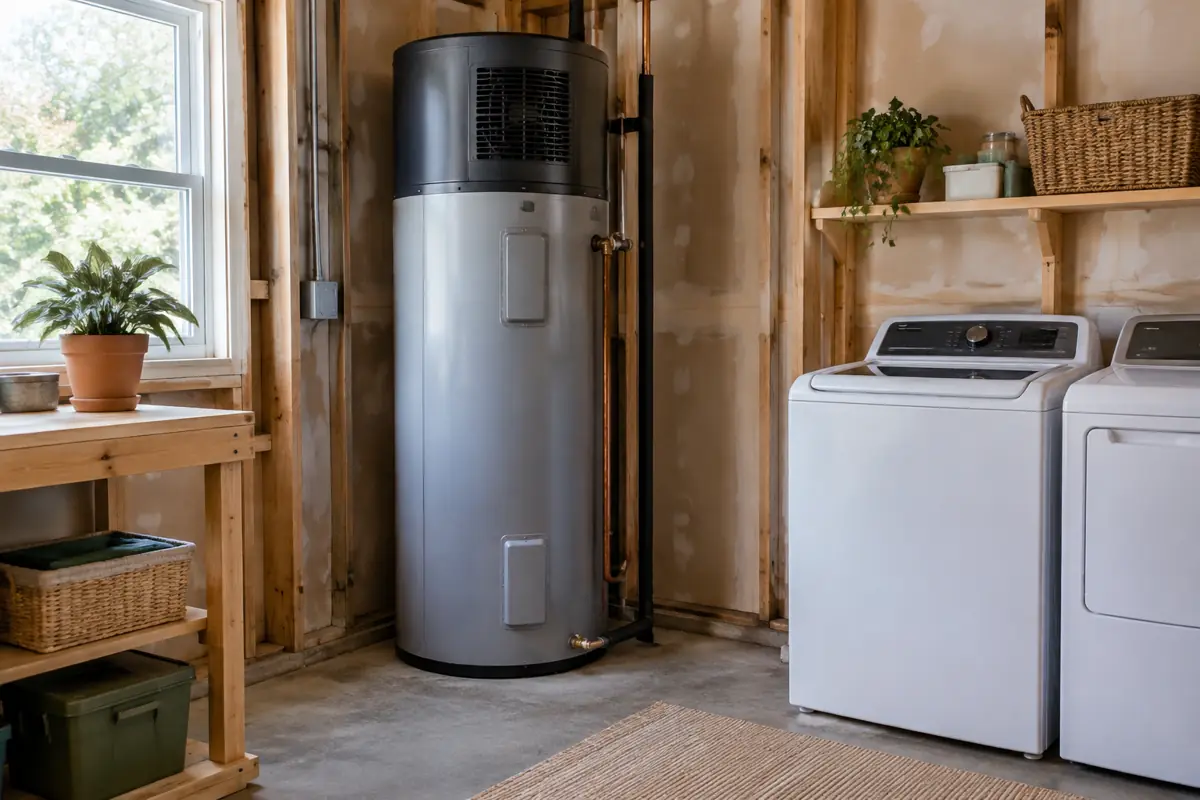
DOE treats heat pump units as electric storage water heaters for lifetime, a 15.1-year mean. Makers back most heat pump models with 10-year warranties, and shipments are small but growing.
In its 2024 rule DOE said its research had not shown that heat pump water heaters have different lifetimes than electric resistance tanks, and it added repair costs for parts such as compressors and fans to its cost analysis instead (89 FR 37778, section IV.F.5). Manufacturer pages make similar claims: A. O. Smith states typical hybrid lifespans of 12 to 15 years and Rheem says heat pump water heaters usually last 10 to 15 years.
ENERGY STAR counted 190 thousand certified heat pump water heaters shipped in 2023, an estimated 4% market penetration, against 528 thousand certified gas tankless units (ENERGY STAR 2023 shipment report). ENERGY STAR advises siting heat pump units in spaces that stay between 40 and 90 F with about 1,000 cubic feet of air around them.
Does hard water shorten water heater life? PNNL's answer is mostly about efficiency
Hard water builds scale that cuts tankless and gas tank efficiency and can block tankless units; softened water raises corrosion risk for tanks. Two warranties set explicit hardness limits.
A 2013 Pacific Northwest National Laboratory review for DOE found that hard water's effect on tank lifetime is minimal until sediment covers the bottom element, which it rates as rare. The larger effects were on efficiency and on tankless units. In a 2010 Battelle accelerated test with water at 444 mg/L hardness, gas tankless efficiency fell from 80 to 72 percent and the units failed after 1.6 equivalent years with a clogged pressure sensor; deliming restored efficiency to 77 percent. Gas tank efficiency fell from 70.4 to 67.4 percent over 2 equivalent years (PNNL-22921).
Temperature matters as much as hardness in PNNL's example: at 170 mg/L and 140 F, about 0.06 inches of scale could form in 4 years in a 50-gallon tank drawing 66 gallons a day, while at 120 F the same layer takes almost 30 years. PNNL notes that softening is often recommended above 140 mg/L, and that softened water can cut a glass-lined electric tank's expected life by up to 50 to 60 percent if the anode is not maintained.
Warranties reflect this. Takagi's residential tankless warranty excludes damage from water harder than 7 grains per gallon (120 ppm), and American Standard's tank warranty requires hardness below 12 grains (200 mg/L). City-level hardness is mapped in the KBR hard water map.
What failure looks like in the records, and the upkeep DOE lists
Insurance and laboratory records point to tank leaks for storage units and scale-related lockouts for tankless units. DOE's consumer guidance lists three routine checks.
An Insurance Institute for Business and Home Safety review of 700 water heater insurance claims (2007 data, reported by PNNL) found 69 percent came from a leaking or burst tank, at an average cost of $4,444 after the deductible and an average failure age of 10.7 years, with failures from 1 to 30 years. PNNL ties many tank leaks to a used-up sacrificial anode rod followed by tank corrosion.
- Energy Saver (DOE): flush a quart of water from the tank every 3 months.
- Energy Saver (DOE): check the temperature and pressure relief valve every 6 months.
- Energy Saver (DOE): inspect the anode rod every 3 to 4 years; PNNL cites guidance to replace it when 6 inches of bare core wire shows.
For whole-home planning, water heater replacement often coincides with bathroom work; see the bathroom remodel cost guide and how to choose a remodeling contractor. Water damage figures are covered in KBR's water damage statistics.
What the 2024 standard and the withdrawn tankless rule change
Water heaters made from 2029-05-06 must meet DOE's amended standards. A separate tankless rule from December 2024 no longer has force.
DOE's final rule of 2024-05-06 took effect on 2024-07-05 and requires compliance from 2029-05-06. DOE states that for certain electric storage classes the adopted levels can currently be met only with heat pump technology (89 FR 37778). A Federal Register search on 2026-10-27 found no document withdrawing that rule.
The December 2024 gas-fired instantaneous rule would have applied from 2029-12-26. A joint resolution of disapproval was signed on 2025-05-09 and DOE withdrew the rule on 2025-05-20 (90 FR 21390). Its technical support document still holds DOE's tankless lifetime assumption used in this report.
The numbers in one list
- DOE estimates a mean lifetime of 14.5 years and a median of 13.3 years for US gas-fired tank water heaters (Weibull fit, survey data 1990 to 2020).[1]
- DOE estimates a mean lifetime of 15.1 years and a median of 13.4 years for US electric tank water heaters, and applies the same curve to heat pump models.[1][3]
- DOE assumes a 20.0-year mean (18.3-year median) for US gas tankless water heaters and states that it has limited data for this class.[2]
- Under DOE's curve, 33.1% of gas tank heaters are retired by age 10 and 58.3% by age 15 (US, KBR calculation).[1]
- A gas tank heater that has reached age 10 has a 37.7% chance of retirement before age 15 under DOE's curve.[1]
- In 2020, 15.6% of US households with a gas, electric or oil tank or a gas tankless main water heater (18.73 million) had one at or past DOE's mean life for its type (KBR, RECS 2020).[6][1]
- In 2020, 16.3% of US gas tank and 15.3% of electric tank main water heaters were 15 or older; 38.1% of oil tanks were (RECS 2020).[6]
- 26.0% of US gas tankless main water heaters were under 2 years old in 2020, against 13.8% of gas tanks, a sign of a young and growing installed base.[6]
- 64.2% of the 819 gas tank models listed by A. O. Smith and State on 2026-10-27 carried a 6-year warranty, about 41.4% of DOE's 14.5-year mean.[17][18][1]
- Navien, Rinnai (SENSEI), Rheem, Takagi and A. O. Smith list 15-year heat exchanger warranties on residential gas tankless units, with parts covered for 5 years; State lists a 15-year limited warranty on its featured tankless model.[17][18][21][22][23][24]
- ENERGY STAR Version 5.0 requires at least a 6-year warranty on certified heat pump water heaters (sealed system) and gas tank models.[14]
- In a 2010 Battelle accelerated test at 444 mg/L hardness, gas tankless efficiency fell from 80 to 72 percent and the units failed after 1.6 equivalent years until delimed (as summarized by PNNL in 2013).[11]
- PNNL (2013) reports that softened water can cut the expected life of glass-lined electric tank heaters by up to 50 to 60 percent if anodes are not maintained.[11]
- An IBHS review of 700 water heater insurance claims found 69 percent stemmed from tank leaks or bursts, with an average failure age of 10.7 years (2007 data, reported by PNNL).[11]
Calculations
Share of homes past DOE's mean life for their water heater type (signature)
Formulaweighted households with (tank type and WHEATAGE 15+) or (gas tankless and WHEATAGE 20+) divided by weighted households with those four types; weights NWEIGHT
Inputs: fact rows 55, 61, 67, 73, 1, 14 (fact sheet rows)
Result: 15.6% (18.73 million of 119.96 million homes; SE 0.3 points)
About one home in six runs a water heater older than the DOE average for its type. Most of these are gas and electric tanks.
Limitations: Age bins do not align exactly with DOE means (14.5 to 15.5 years for tanks); 20.9% of ages are imputed by EIA; 2020 is the latest year with water heater age.
Retirement probability table from DOE survival curves
FormulaF(x) = 1 - exp(-((x - 1)/alpha)^beta); conditional = (S(10) - S(15)) / S(10); annual rate = (S(x) - S(x+1)) / S(x)
Inputs: fact rows 3, 4, 13, 7, 8, 13, 16, 17, 13 (fact sheet rows)
Result: Gas tank: 9.2% by 5, 33.1% by 10, 58.3% by 15; gas tankless: 38.0% by 15
Most tank heaters that reach 10 years still have years left, but the yearly retirement rate roughly doubles between ages 5 and 15.
Limitations: National averages; DOE's curve assumes the survival function has not changed over time and does not vary by region or water quality.
Warranty length against DOE mean lifetime
Formulatypical warranty term / DOE mean; chance retired within term = F(term)
Inputs: table t5 and t6; fact rows for A. O. Smith and State listing counts and DOE means (fact sheet rows)
Result: Gas tank 6 years = 41.4% of mean; heat pump 10 years = 66.2%; tankless heat exchanger 15 years = 75.0%
Tankless and heat pump warranties cover a larger share of expected life than tank warranties.
Limitations: Model counts come from two brands' websites; warranty length is not a lifetime forecast.
Field ages against DOE's steady-state curve
FormulaRECS share in age bin minus integral of S(x) above the bin divided by integral of S(x) (constant shipments)
Inputs: fact rows for RECS 15+ and 20+ shares; 3, 4, 13 (fact sheet rows)
Result: Gas tank -3.8 points, electric tank -9.0 points, oil tank 14.2 points, gas tankless -20.4 points
Gas, electric and tankless stocks are younger than a steady-state reading of DOE's curves, most of all tankless; oil tanks are older.
Limitations: DOE's own fit accounts for shipment history; the steady-state check is a simplification for readers, not a test of DOE's fit.
Questions people ask
How long do tankless water heaters last?
DOE assumes a 20.0-year mean and 18.3-year median for gas tankless units, and DOE's Energy Saver page says most tankless units last more than 20 years. DOE notes its tankless data are limited, and in 2020 only 1.8% of US gas tankless heaters were 20 or older, so field proof is thin.
What are signs a water heater is failing?
In insurer data reported by PNNL, 69 percent of water heater claims came from a leaking or burst tank, often after the anode rod was used up. In tankless units, scale can clog sensors: in Battelle's test the units failed after 1.6 equivalent years on very hard water until delimed. Age itself is a signal: DOE's curve puts a gas tank's yearly retirement rate at 10.7% by age 15.
Does hard water shorten water heater life?
PNNL found hard water mainly lowers efficiency and can block tankless units, while its effect on tank life is small until sediment buries the bottom element. Softened water is the bigger tank risk: up to a 50 to 60 percent cut in expected life for glass-lined electric tanks without anode care. See the KBR hard water map.
How long do gas water heaters last vs electric?
DOE's curves give gas tanks a 14.5-year mean and 13.3-year median and electric tanks a 15.1-year mean and 13.4-year median. By age 15, 58.3% of gas tanks and 56.6% of electric tanks are retired. The difference is small; electric tanks have a longer tail.
How old is too old for a water heater?
There is no official cutoff. Under DOE's curve a gas tank that reaches 10 has a 37.7% chance of retirement before 15, and the annual rate rises from 7.9% at age 10 to 10.7% at 15. In 2020, 7.3% of US homes had a water heater 20 or older.
Summary
- DOE's lifetime model, fitted to national survey and shipment data, gives a mean of 14.5 years for gas tank water heaters, 15.1 years for electric tanks and 15.5 years for oil tanks.
- Half of gas tank units are retired by 13.3 years and half of electric tanks by 13.4 years, so the typical unit goes before the average one.
- For gas tankless units DOE assumed a 20.0-year mean because field data are limited; in the 2020 survey only 1.8% of gas tankless heaters were 20 or older.
- In 2020, 15.6% of US households with a modelled water heater type (18.73 million homes) had one at or beyond DOE's mean life for that type, by KBR's count of RECS microdata.
- Typical warranties stop well short of those averages: 6 years on most listed gas tank models, 10 years on most heat pump models and 15 years on tankless heat exchangers.
- PNNL found hard water mainly cuts tankless and gas tank efficiency, while softened water can shorten a glass-lined electric tank's life by up to 50 to 60 percent without anode care.
- DOE's May 2024 standard takes effect for units made from 2029-05-06; the separate December 2024 tankless rule was withdrawn on 2025-05-20 after Congress disapproved it.
Frequently asked questions
What is the average lifespan of a water heater according to the Department of Energy?
DOE's 2023 to 2024 rulemaking estimates 14.5 years for gas tanks, 15.1 for electric tanks, 15.5 for oil tanks and an assumed 20.0 for gas tankless units. The final rule summarizes storage units as about 15 years.
Do heat pump water heaters last as long as standard electric tanks?
DOE found no evidence of a different lifetime and uses the electric tank curve (15.1-year mean) for both. Most heat pump models listed by A. O. Smith and State (72.9%) carry 10-year warranties.
How long is a typical water heater warranty?
Among 819 gas tank models listed by A. O. Smith and State, 64.2% carried 6 years. Gas tankless heat exchangers commonly carry 15 years with 5 years on parts. ENERGY STAR requires at least 6 years on certified tank and heat pump models.
What share of US water heaters are over 20 years old?
In 2020, 7.3% of US homes (8.98 million) had a main water heater aged 20 or more, per EIA's RECS. For oil-fired tanks the share was 22.4%.
Why do many websites say water heaters last 8 to 12 years?
That range matches home inspector charts and older surveys in DOE's literature review, where storage averages span 9 to 13 years. DOE's newer survival curve, fitted to decades of survey and shipment data, gives a mean near 15 years and a median near 13.
Does a water softener affect water heater life?
PNNL reports that softened water raises corrosion risk and can cut a glass-lined electric tank's expected life by up to 50 to 60 percent if the anode rod is not checked and replaced.
How often should a water heater be flushed?
DOE's Energy Saver guidance lists flushing a quart of water from a storage tank every 3 months and checking the temperature and pressure relief valve every 6 months.
When should the anode rod be checked?
DOE's Energy Saver page says every 3 to 4 years. PNNL cites guidance to inspect after 3 to 4 years and then yearly, more often with softened water. A. O. Smith's warranty treats anode rods as consumable parts outside warranty coverage.
What will replace an old water heater after 2029?
Units made from 2029-05-06 must meet DOE's amended standards; DOE states that some electric storage classes can currently meet them only with heat pump technology. The December 2024 tankless rule was withdrawn on 2025-05-20.
Are older water heaters more likely to fail each year?
Yes, in DOE's model. A gas tank's annual retirement rate is 4.5% at age 5, 7.9% at age 10 and 10.7% at age 15.
Download the data
Every table in this report is available as a CSV under CC BY 4.0. The fact sheet lists each value with its source URL and access date.
For journalists and researchers
If you cite only a few, cite these
- DOE mean water heater life: 14.5 years gas tank, 15.1 years electric tank, 20.0 years gas tankless (assumed).[1][2]
- 15.6% of US homes (18.73 million) had a water heater at or past DOE's mean life for its type in 2020 (KBR, RECS 2020).[6]
- 58.3% of gas tank water heaters are retired by age 15 under DOE's curve.[1]
Most quotable statistics
- The U.S. Department of Energy's survival curves put the mean life of a gas tank water heater at 14.5 years and an electric tank at 15.1 years.[1]
- In 2020, 15.6% of US homes with a common water heater type (18.73 million) had one at or past DOE's average life for that type (KBR analysis of EIA RECS 2020).[6][1]
- Under DOE's curve, 58.3% of US gas tank water heaters are retired by age 15.[1]
- Only 1.8% of US gas tankless water heaters were 20 or older in 2020, so DOE's 20.0-year tankless mean rests on assumption, not field data.[6][2]
- 64.2% of gas tank models listed by A. O. Smith and State carry a 6-year warranty, about 41.4% of DOE's mean life.[17][18][1]
- In a Battelle test on very hard water, gas tankless units lost efficiency from 80 to 72 percent and failed after 1.6 equivalent years until delimed.[11]
Press summary
How long does a water heater last? Federal data give a firmer answer than the 8 to 12 years repeated online. The U.S. Department of Energy's survival curves, fitted to decades of national survey and shipment data, put the mean life of a gas tank water heater at 14.5 years and an electric tank at 15.1 years, with medians of 13.3 and 13.4 years. DOE assumes 20.0 years for gas tankless units but says its data are limited. Kitchen and Bath Renovators matched every household in EIA's 2020 Residential Energy Consumption Survey to those curves and found 15.6% of homes with a common water heater type, 18.73 million, had one at or past the DOE average. Warranties stop short of those lifetimes: 64.2% of gas tank models listed by two major brands carry 6 years, while tankless heat exchangers commonly carry 15. Laboratory evidence summarized by PNNL links hard water mostly to efficiency loss and tankless scaling, and softened water to faster tank corrosion.
Suggested headlines
- Water heaters last 14.5 to 15.1 years on average, DOE curves show
- 15.6% of US homes run a water heater past its expected life
- 18.73 million US homes have a water heater older than DOE's average
- Most gas tank water heaters carry a 6-year warranty, under half their 14.5-year average life
- Tankless water heaters are assumed to last 20.0 years, but few in US homes are that old yet
How to cite this report
Kitchen and Bath Renovators. (2026). How Long Does a Water Heater Last? Lifespan Data by Type (2026). Retrieved from https://kitchenandbathrenovators.com/research/how-long-does-a-water-heater-last/
Reuse license
Data and tables are licensed CC BY 4.0. Attribution: “Source: Kitchen and Bath Renovators, How Long Does a Water Heater Last? Lifespan Data by Type (2026)” with a link to this page.
Reproduce this analysis
Every figure comes from the files below. The scripts that pulled and computed them are kept with the report and can be re-run.
| Dataset | Publisher | Source | Query or filter | Rows used | Retrieved |
|---|---|---|---|---|---|
| RECS 2020 public use microdata v7 | U.S. Energy Information Administration | File or endpoint | All 18,496 records; variables WHEATAGE, WHEATSIZ, FUELH2O, ZWHEATAGE, NWEIGHT, NWEIGHT1 to NWEIGHT60 | 18,496 households; 17,848 in the four DOE-modelled types after excluding electric tankless, other-fuel tankless and other-fuel storage | 2026-10-27 |
| DOE consumer water heater TSD, July 2023 (appendix 8G) | U.S. Department of Energy | File or endpoint | Table 8G.4.1 Weibull parameters; Table 8G.2.1 literature estimates | 4 product classes; 10 literature estimates used | 2026-10-27 |
| DOE gas-fired instantaneous water heater TSD, December 2024 (appendix 8G) | U.S. Department of Energy | File or endpoint | Table 8G.4.1 and Table 8G.5.1 | 1 product class | 2026-10-27 |
| Manufacturer warranty documents and listings | Eight manufacturers (see sources s17 to s24) | File or endpoint | Residential gas tank, electric tank, heat pump and gas tankless warranty terms; site filter counts for A. O. Smith and State | 16 registry rows; 1,416 listed tank and heat pump models in filter counts | 2026-10-27 |
Data quality and exclusions
- RECS: 3,254 of 18,496 records (20.9% of weighted households) have an imputed water heater age (ZWHEATAGE = 1); they are kept, as EIA does in its tables.
- RECS: 108 records with solar, wood or other-fuel tank units and 174 records with other-fuel tankless units were excluded from the type-level analysis because DOE publishes no curve for them; the other-fuel tankless group shows 21.4% aged 20 or more, which may reflect boiler-based systems reported as tankless.
- RECS: 366 electric tankless records are reported but excluded from the past-mean count because DOE publishes no curve for electric instantaneous units.
- Manufacturer counts: site filter totals (819 gas tank, 527 electric tank, 70 heat pump models) count listed SKUs, including size and fuel variants and possibly discontinued models; one State gas tank SKU with a 3-year term is kept in the denominator.
- DOE parameters: the July 2023 TSD table was used because the May 2024 final TSD could not be retrieved; the final rule's stated average of about 15 years for storage units was checked for consistency.
Methodology
Source selection: lifetime figures come only from DOE's consumer water heater technical support documents (Tier 1), read at appendix 8G, Table 8G.4.1 and Table 8G.2.1, and from the May 2024 final rule text. Household ages come from EIA's RECS 2020 public microdata (version 7, January 2024). Warranty terms come only from manufacturer warranty documents and product pages. Hard water evidence comes from PNNL-22921, a national laboratory report for DOE.
Access: regulations.gov returned HTTP 403 to automated requests, so the July 2023 TSD and the December 2024 tankless TSD were read from Internet Archive captures of the official regulations.gov files, labelled as such. The May 2024 final rule TSD was not captured and was not used; the final rule text states DOE kept its lifetime method and an average of about 15 years for storage units, consistent with the July 2023 table. DOE Energy Saver pages now redirect, so archived copies from 2026 were used.
RECS method: water heater type was set from WHEATSIZ (4 = tankless) and FUELH2O (natural gas and propane = gas; electricity; fuel oil). Estimates use NWEIGHT; standard errors use the 60 replicate weights with EIA's jackknife formula, variance = (59/60) times the sum of squared replicate deviations. Weighted totals were checked against EIA Table HC8.1 (123.53 million homes; 8.98 million with a unit aged 20 or more).
Derived metrics: survival and retirement shares use F(x) = 1 – exp(-((x – delay)/alpha)^beta) with DOE parameters; means were recomputed as delay + alpha times Gamma(1 + 1/beta) to confirm the table (gas storage recomputes to 14.4 against 14.5 published, a rounding effect). Steady-state stock shares integrate the survival function numerically at 0.001-year steps. All calculations are in scripts/ and derived_metrics.csv.
Conflicts: where DOE's literature table and its fitted curve differ, the fitted curve is reported as DOE's estimate and the literature values are shown as context. Commenter statements in the rulemaking (for example the AHRI 10 to 13 year figure) are reported as comments, not as facts.
Last updated 2026-10-27. RECS 2024 water heating data are due in spring 2027; this report will be revised then.
This report presents published data with its limitations. It is not legal, financial or investment advice.
Sources, ranked by quality
Tier 1: primary and official sources (16)
- [1] U.S. Department of Energy. Technical Support Document: Consumer Water Heaters, July 2023 NOPR (EERE-2017-BT-STD-0019-0058), appendix 8G, Table 8G.4.1 and Table 8G.2.1 (Internet Archive capture of the regulations.gov file, 2025-09-24). RECS 1990 to 2020, AHS 1974 to 2021, shipments 1954 to 2022. Accessed 2026-10-27.
- [2] U.S. Department of Energy. Technical Support Document: Gas-Fired Instantaneous Water Heaters final rule, December 2024 (EERE-2017-BT-STD-0019-1454), appendix 8G (Internet Archive capture of the regulations.gov file, 2025-08-22). 2024. Accessed 2026-10-27.
- [3] U.S. Department of Energy via Federal Register. Energy Conservation Program: Energy Conservation Standards for Consumer Water Heaters, final rule, 89 FR 37778. Published 2024-05-06. Accessed 2026-10-27.
- [4] U.S. Department of Energy via Federal Register. Energy Conservation Standards for Consumer Gas-Fired Instantaneous Water Heaters, final rule; withdrawal, 90 FR 21390. Published 2025-05-20. Accessed 2026-10-27.
- [5] U.S. Department of Energy. Consumer Water Heaters (Appliance and Equipment Standards product page). Rulemaking history 2020 to 2025. Accessed 2026-10-27.
- [6] U.S. Energy Information Administration. 2020 Residential Energy Consumption Survey (RECS) public use microdata, version 7 (released January 2024). 2020. Accessed 2026-10-27.
- [7] U.S. Energy Information Administration. RECS 2020 Codebook for Public File, v7 (WHEATAGE, WHEATSIZ, FUELH2O, ZWHEATAGE, NWEIGHT). 2020. Accessed 2026-10-27.
- [8] U.S. Energy Information Administration. Using the 2020 RECS microdata file to compute estimates and standard errors (RSEs). 2020. Accessed 2026-10-27.
- [9] U.S. Energy Information Administration. RECS 2020 Table HC8.1, Water heating in U.S. homes by housing unit type. 2020. Accessed 2026-10-27.
- [10] U.S. Energy Information Administration. 2024 RECS microdata page and 2024 RECS Codebook for Public File v1. 2024 (preliminary). Accessed 2026-10-27.
- [11] Pacific Northwest National Laboratory for U.S. DOE. Impacts of Water Quality on Residential Water Heating Equipment (PNNL-22921), Widder and Baechler. Published November 2013. Accessed 2026-10-27.
- [12] U.S. Department of Energy. Energy Saver: Tankless or Demand-Type Water Heaters (Internet Archive capture 2026-06-30; live page now redirects). Captured 2026-06-30. Accessed 2026-10-27.
- [13] U.S. Department of Energy. Energy Saver: Storage Water Heaters (Internet Archive capture 2026-05-01; live page now redirects). Captured 2026-05-01. Accessed 2026-10-27.
- [14] U.S. EPA ENERGY STAR. ENERGY STAR Residential Water Heaters Key Product Criteria (Version 5.0). Version 5.0, effective 2023-04-18. Accessed 2026-10-27.
- [15] U.S. EPA ENERGY STAR. ENERGY STAR Unit Shipment and Market Penetration Report, Calendar Year 2023 Summary (revised 2024-11-12). Calendar year 2023. Accessed 2026-10-27.
- [16] U.S. EPA ENERGY STAR. ENERGY STAR Heat Pump Water Heaters product page. Accessed 2026-10-27. Accessed 2026-10-27.
Tier 2: trade bodies, market research, company data (8)
- [17] A. O. Smith. A. O. Smith product pages (ProLine XCG-50, ProLine ENS-50, ATI-540H tankless, hybrid heat pump listing) and Residential Warranty Sheet 100293072. Accessed 2026-10-27. Accessed 2026-10-27.
- [18] State Water Heaters. State Water Heaters residential product listings (gas tank, electric tank, hybrid heat pump) and homepage. Accessed 2026-10-27. Accessed 2026-10-27.
- [19] Bradford White Corporation. BUILTBEST Extended Warranty homeowner sell sheet (US). Accessed 2026-10-27. Accessed 2026-10-27.
- [20] American Standard Water Heaters (Ariston USA). Residential Glass Lined Gas or Electric Water Heaters Limited Warranty (rev. 01.26) and Residential Heat Pump Water Heater Limited Warranty. Effective 2026. Accessed 2026-10-27.
- [21] Navien. Navien warranty pages: NPE-A2 tankless, NPN-U tankless, NWP500 heat pump water heater. Accessed 2026-10-27. Accessed 2026-10-27.
- [22] Rinnai America. Rinnai SENSEI Residential Limited Warranty 100000655(04) and Value (HE Series) Warranty 100000656. Accessed 2026-10-27. Accessed 2026-10-27.
- [23] Rheem Manufacturing. Rheem tankless water heaters product page. Accessed 2026-10-27. Accessed 2026-10-27.
- [24] Takagi. Takagi Limited Gas Tankless Water Heater Warranty (residential, 100287499). Accessed 2026-10-27. Accessed 2026-10-27.