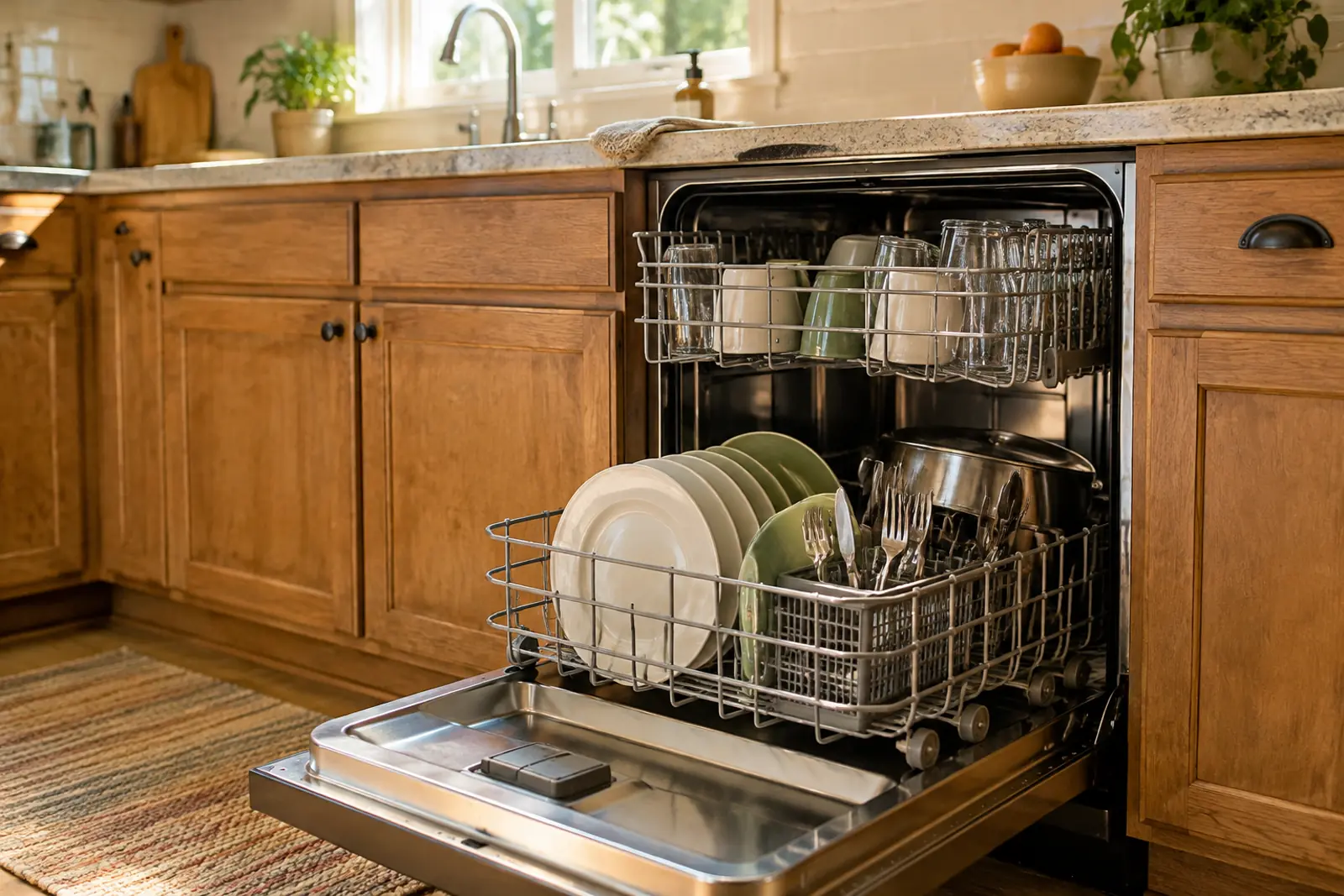
How Much Water Does a Dishwasher Use? Gallons per Cycle, 1988 to 2027
- Primary data
- ENERGY STAR Certified Residential Dishwashers (EPA) and 10 CFR 430.32(f)
- Data period
- 1988 to 2027 (rules); October 2026 (models); 2020 and 2024 (household use)
- Latest release used
- 2026-10-27
- Next release
- ENERGY STAR list updates daily; RECS 2024 full data spring 2027; DOE action on the 2025 rescission proposal pending
- Geography
- United States
- Sources
- 29 (28 Tier 1)
The answer to how much water does a dishwasher use is 3.2 gallons per cycle for the median ENERGY STAR standard-size model listed for the US; the median compact, 2.0 (October 2026). The federal maximum is 5.0 gallons (compact 3.5), scheduled to fall to 3.3 (3.1) on April 23, 2027, from 6.5 when the first cap began in 2010.
This month in brief
- The median ENERGY STAR standard-size dishwasher listed for the US is rated at 3.2 gallons per cycle; the 10th percentile is 2.88 gallons and only 17.6 percent of 670 listings are rated under 3.0 gallons (EPA data, October 2026).
- 59.9 percent of those listings sit at exactly 3.2 gallons, the ENERGY STAR v7.0 ceiling, and 18 of 41 brands with five or more listings rate every model at 3.2.
- The federal standard-size cap has been 5.0 gallons since May 30 2013 and is scheduled to fall to 3.3 gallons on April 23 2027, a 49.2 percent cut from the first 6.5 gallon cap of 2010.
- On May 16 2025 DOE proposed rescinding every DOE dishwasher water limit, which would return the cap to the 6.5 gallon statutory level; no final rule had been published by October 27 2026.
- Metered homes in the Water Research Foundation REU2016 study averaged 6.1 gallons per load in 2010 to 2013, 1.91 times today's median certified rating.
- In 2024, 19.3 percent of US homes with a dishwasher did not use it in a typical week, and 65.7 percent ran it three or fewer times a week (EIA RECS, preliminary).
- In measured lab trials, washing a full load by hand used 49 liters (12.9 gallons) in the UK against 13 liters (3.4 gallons) for a dishwasher; country averages ranged from 9.2 to 42.3 gallons.
How much water does a dishwasher use? 3.2 gallons for the median certified model, 2.0 for compacts
Today's answer comes from the ratings of the 670 standard-size and 31 compact ENERGY STAR dishwashers listed for the US market. Ratings come from the DOE normal-cycle test, not from a kitchen.
The ENERGY STAR certified dishwasher list downloaded on 2026-10-27 holds 762 listings. After dropping 40 Canada-only listings and 21 duplicate brand-model rows, 670 standard-size and 31 compact listings remain for the US market.
The median standard-size listing is rated at 3.2 gallons per cycle. The 10th percentile is 2.88 gallons and the 90th percentile is 3.2 gallons. The mean is 3.07 gallons.
The median compact listing is rated at 2.0 gallons per cycle, and the compact range runs from 1.0 to 2.0 gallons. Compact means a capacity under eight place settings plus six serving pieces, per 10 CFR 430.32(f).
Gallons per cycle: Water used in one run of the normal cycle on the DOE test procedure, the figure printed on the EnergyGuide label and reported to ENERGY STAR. Heavy, sanitize and express cycles can use more.
| Measure | Standard-size | Compact |
|---|---|---|
| Listings used (US market, de-duplicated) | 670 | 31 |
| Median (gal/cycle) | 3.2 | 2.0 |
| Mean (gal/cycle) | 3.07 | 1.92 |
| 10th percentile (gal/cycle) | 2.88 | 1.9 |
| 90th percentile (gal/cycle) | 3.2 | 2.0 |
| Lowest rating (gal/cycle) | 2.3 | 1.0 |
| Highest rating (gal/cycle) | 3.2 | 2.0 |
| Share rated under 3.0 gal (%) | 17.6 | 100.0 |
| Share rated exactly at the ENERGY STAR ceiling (%) | 59.9 | 71.0 |
| ENERGY STAR ceiling (gal/cycle) | 3.2 | 2.0 |
| Federal limit today (gal/cycle) | 5.0 | 3.5 |
| Federal limit from Apr 23 2027 (gal/cycle) | 3.3 | 3.1 |
762 listings downloaded; 40 Canada-only and 21 duplicate brand-model rows removed. Counts are listings, not sales.
Source: [16][17][1] U.S. EPA ENERGY STAR; U.S. EPA ENERGY STAR; Office of the Federal Register, eCFR
These are ENERGY STAR models only. Non-certified models may legally use up to 5.0 gallons. The DOE Compliance Certification Database, which lists every model sold, refused automated access during this research, so the full market distribution could not be computed (see methodology).
Fitting a dishwasher into existing cabinets is a layout question covered in cabinet refacing vs replacing; the remodel cost calculator estimates the wider kitchen project.
From no limit in 1988 to 3.3 gallons in 2027: every federal and ENERGY STAR cap
No federal rule capped dishwasher water before 2010. Congress set 6.5 gallons, DOE cut it to 5.0 in 2013 and to 3.3 for 2027, while ENERGY STAR moved ahead of each federal step.
The first federal dishwasher rule, from January 1 1988, only required an option to dry without heat. The 1994 standard set an energy factor of 0.46 cycles per kWh for standard models and 0.62 for compacts, with no water term, per the 2009 CFR edition.
The Energy Independence and Security Act of 2007 wrote the first water cap into law: 6.5 gallons for standard-size and 4.5 gallons for compact dishwashers made from January 1 2010. A 2012 DOE direct final rule cut those to 5.0 and 3.5 gallons from May 30 2013.
The 2024 direct final rule set 3.3 gallons (standard-size) and 3.1 gallons (compact) for units made on or after April 23 2027. DOE confirmed that compliance date in October 2024.
| Date | Instrument | Standard-size water limit | Compact water limit | What changed | Source |
|---|---|---|---|---|---|
| 1988-01-01 | NAECA 1987, 42 U.S.C. 6295(g)(1) | none | none | Must offer a no-heat dry option; no water limit | s15 |
| 1994-05-14 | DOE final rule, 56 FR 22250 | none | none | Energy factor minimums 0.46 (standard) and 0.62 (compact) cycles per kWh; still no water limit | s13 |
| 2010-01-01 | EISA 2007, 42 U.S.C. 6295(g)(10) | 6.5 gal | 4.5 gal | First federal water cap, with 355 and 260 kWh per year | s15, s12 |
| 2013-05-30 | DOE direct final rule, 77 FR 31918 | 5.0 gal | 3.5 gal | Caps cut; energy 307 and 222 kWh per year | s5, s6 |
| 2016-01-29 | ENERGY STAR v6.0 (voluntary) | 3.5 gal | 3.1 gal | Label tightened | s18 |
| 2017-01-12 | DOE final determination, 81 FR 90072 | 5.0 gal | 3.5 gal | DOE declined to tighten federal standards | s7 |
| 2020-11-30 | DOE final rule, 85 FR 68723 | 5.0 gal | 3.5 gal | New class for standard models with a normal cycle of 60 minutes or less, limits left to a later rule | s8 |
| 2022-02-18 | DOE final rule, 87 FR 2673 | 5.0 gal | 3.5 gal | Short-cycle class revoked | s9 |
| 2023-07-19 | ENERGY STAR v7.0 (voluntary) | 3.2 gal | 2.0 gal | Current label criteria | s17 |
| 2024-08-22 | DOE direct final rule, 89 FR 31398 (effective date) | 3.3 gal from 2027 | 3.1 gal from 2027 | New standards adopted; compliance April 23 2027 | s3, s4 |
| 2024-12-27 | DOE final rule, 89 FR 105408 | 5.0 gal | 3.5 gal | Short-cycle withdrawal confirmed after Fifth Circuit remand | s10 |
| 2025-05-16 | DOE proposed rule, 90 FR 20859 | 6.5 gal (proposed) | 4.5 gal (proposed) | Proposal to rescind all DOE water limits; comments closed July 15 2025; no final rule found | s2, s27 |
| 2027-04-23 | 10 CFR 430.32(f)(2) | 3.3 gal | 3.1 gal | Scheduled compliance date (does not apply to standard models with a normal cycle of 60 minutes or less) | s1 |
Federal limits apply by date of manufacture. ENERGY STAR rows are voluntary label criteria. Limits are ceilings measured on the DOE normal-cycle test.
Source: [1][2][3][4][5][7][8][9][10][12][13][15][17][18] Office of the Federal Register, eCFR; U.S. Department of Energy; U.S. Department of Energy; U.S. Department of Energy; U.S. Department of Energy; U.S. Department of Energy; U.S. Department of Energy; U.S. Department of Energy; U.S. Department of Energy; U.S. Department of Energy; U.S. Government Publishing Office; U.S. Government Publishing Office; U.S. EPA ENERGY STAR; U.S. EPA ENERGY STAR
Standard-size and compact dishwashers
Source: 42 U.S.C. 6295; 10 CFR 430.32(f); ENERGY STAR program criteria. Kitchen and Bath Renovators analysis.
| Standard or specification | Standard-size max (gal/cycle) | Cut from 6.5 gal (%) | Compact max (gal/cycle) | Cut from 4.5 gal (%) |
|---|---|---|---|---|
| Federal, Jan 1 2010 (EISA 2007) | 6.5 | 0.0 | 4.5 | 0.0 |
| ENERGY STAR v5.0 | 4.25 | 34.6 | 3.5 | 22.2 |
| Federal, May 30 2013 (2012 DFR) | 5.0 | 23.1 | 3.5 | 22.2 |
| ENERGY STAR v6.0, Jan 29 2016 | 3.5 | 46.2 | 3.1 | 31.1 |
| ENERGY STAR v7.0, Jul 19 2023 | 3.2 | 50.8 | 2.0 | 55.6 |
| Federal, Apr 23 2027 (2024 DFR) | 3.3 | 49.2 | 3.1 | 31.1 |
Cut = (first limit minus this limit) divided by first limit. First limits: 6.5 gallons standard-size, 4.5 compact (January 1 2010).
Source: [1][15][17][18] Office of the Federal Register, eCFR; U.S. Government Publishing Office; U.S. EPA ENERGY STAR; U.S. EPA ENERGY STAR
Six in ten certified models sit exactly on the 3.2 gallon ENERGY STAR ceiling
The certified market is not spread evenly below the limit. It piles up on it.
Of 670 US standard-size ENERGY STAR listings, 401 are rated at exactly 3.2 gallons, which is 59.9 percent. ENERGY STAR v7.0 allows at most 3.2 gallons, per the ENERGY STAR key product criteria.
Among the 41 brands with five or more US standard-size listings, 18 rate every listing at 3.2 gallons. Listings that also meet ENERGY STAR Most Efficient 2025 have a median of 2.9 gallons across 102 listings.
Number of listings by rating band, 670 listings, October 2026
Source: U.S. EPA ENERGY STAR Certified Residential Dishwashers dataset, retrieved 2026-10-27. Kitchen and Bath Renovators analysis.
Every ENERGY STAR standard-size listing is already at or under the 3.3 gallon federal limit due in 2027. DOE's own 2024 analysis found 16 of 19 manufacturers of standard-size models already offered products at the adopted level.
The 2027 limit is on the books, but DOE has proposed scrapping water caps altogether
Two federal tracks point in opposite directions: a finalized 3.3 gallon limit for 2027 and a pending proposal to return to 6.5 gallons.
On May 16 2025 DOE proposed to rescind the dishwasher water limits in 10 CFR 430.32(f), which would restore the 6.5 gallon (standard) and 4.5 gallon (compact) levels in the statute. DOE gave three reasons: doubt about its authority to regulate dishwasher water, a tentative finding that the limits are not economically justified, and a policy of cutting regulation not required by statute.
The proposal cites the Fifth Circuit's 2024 decision in Louisiana v. DOE. Comments closed July 15 2025. A Federal Register search through October 27 2026 found no final rule, and the eCFR text as of October 23 2026 still lists the 2027 limits.
If the proposal is finalized, the legal ceiling for a standard-size dishwasher would rise from 5.0 to 6.5 gallons. The certified models above already rate far below both. Whether any non-certified models would be designed to use more water cannot be seen in the ENERGY STAR data used here.
Meters in real homes logged 6.1 gallons a load, nearly twice today's ratings
Ratings and field use are different numbers. The only large US metered study predates most current models.
The Water Research Foundation REU2016 executive report logged water use in homes served by 23 utilities between 2010 and 2013. Dishwashers averaged 6.1 gallons per load, down 39 percent from 10.0 gallons in the 1999 study.
Dishwashers were the smallest indoor end use at 1.6 gallons per household per day, about 1 percent of indoor use. An automatic dishwasher was present in 84 percent of the study homes.
The metered 6.1 gallons is 1.91 times the current median certified rating. The gap mixes two effects: many study homes had machines built before the 2013 cap, and real loads include heavier cycles than the test's normal cycle. An open-access 2024 Australian study found that the express modifier alone added 25 percent to water per cycle.
For whole-house and per-person totals, see the average water usage per person report; showers and faucets are covered in how much water a shower uses.
Most owners run fewer loads than the 184 a year that the test assumes
Annual ratings multiply per-cycle results by a fixed cycle count. Survey data show most households run fewer loads, and one in five run none.
The DOE test procedure assumed 322 cycles a year until 2001, then 264, then 215 from 2003. The current appendix C2 uses 184, matching the AHAM DW-1-2020 industry value.
Cycles per year used to turn per-cycle results into annual ratings
Source: 77 FR 31918 (history of test procedure); 88 FR 3234. Kitchen and Bath Renovators analysis.
In the EIA 2024 RECS, 99.47 million of 132.54 million US homes had a dishwasher, or 75.0 percent. Of those owners, 19.3 percent used it zero times a week and 65.7 percent ran it three or fewer times a week, which is fewer than 184 loads a year.
Share of homes that have a dishwasher, 2020 and 2024
Source: EIA Residential Energy Consumption Survey 2020 microdata and 2024 Table HC3.1. Kitchen and Bath Renovators analysis.
The 2020 microdata allow a finer cut. Across all owners the weighted mean was 3.06 loads a week, or 159 a year. Owners who used the machine at all averaged 197 a year, the same figure DOE derived from RECS 2020 in its 2023 proposal.
| Loads per week | Share of owners, 2020 (RECS microdata, % ) | Share of owners, 2024 (RECS preliminary table HC3.1, %) |
|---|---|---|
| 0 | 19.1 | 19.3 |
| 1 | 15.4 | 15.0 |
| 2 to 3 | 29.3 | 31.5 |
| 4 to 6 | 21.5 | 20.5 |
| 7 or more | 14.7 | 13.7 |
2020 regrouped from microdata; 2024 from the preliminary published table. Shares of homes that have a dishwasher.
Source: [20][29] U.S. Energy Information Administration; U.S. Energy Information Administration
| Household members | RECS sample households with a dishwasher | Mean loads per week | Loads per year (x52) | Gallons per year at 3.2 gal/load |
|---|---|---|---|---|
| 1 | 3110 | 1.74 | 90.0 | 290.0 |
| 2 | 5644 | 2.99 | 155.0 | 497.0 |
| 3 | 2171 | 3.5 | 182.0 | 582.0 |
| 4 | 1942 | 4.2 | 219.0 | 699.0 |
| 5 | 763 | 4.29 | 223.0 | 713.0 |
| 6 | 284 | 4.72 | 246.0 | 786.0 |
| 7 or more | 194 | 4.28 | 222.0 | 711.0 |
Weighted with RECS final weights. Gallons column applies the median certified rating of 3.2 gallons to every load, which overstates use for older and understates it for heavy cycles.
Source: [20][16] U.S. Energy Information Administration; U.S. EPA ENERGY STAR
Household size drives frequency: single-person homes reported 1.74 loads a week and four-person homes 4.2 loads a week in 2020.
A year of dishwashing takes 589 to 1,196 gallons depending on which cap the machine was built to
Multiplying each per-cycle limit by the test's 184 loads gives the annual water each rule allows.
At 184 loads, the median certified model uses 588.8 gallons a year. A machine at the 2013 cap uses 920 gallons, and one at the 2010 cap 1,196 gallons. The difference between the 2010 cap and today's median model is 607.2 gallons a year.
184 loads is the DOE test-procedure assumption
Source: 10 CFR 430.32; 88 FR 3234; Water Research Foundation REU2016; ENERGY STAR dataset. Kitchen and Bath Renovators analysis.
| Per-cycle water | Gallons per cycle | Gallons per year at 184 cycles (DOE test) | Gallons per year at 159 cycles (RECS 2020 owner mean) | Gallons over a 15.2-year life at 184 cycles |
|---|---|---|---|---|
| No federal water cap (before 2010) | ||||
| Federal max from 2010: 6.5 gal | 6.5 | 1196.0 | 1033.5 | 18179.0 |
| Federal max from 2013: 5.0 gal | 5.0 | 920.0 | 795.0 | 13984.0 |
| Federal max from 2027: 3.3 gal | 3.3 | 607.2 | 524.7 | 9229.0 |
| Median ENERGY STAR standard model: 3.2 gal | 3.2 | 588.8 | 508.8 | 8950.0 |
| REU2016 metered average load: 6.1 gal | 6.1 | 1122.4 | 969.9 | 17060.0 |
184 cycles is the DOE appendix C2 test value; 159 is the RECS 2020 mean across all owners; 15.2 years is DOE's average lifetime. Blank row: no federal cap applied before 2010.
Source: [1][3][11][20][22] Office of the Federal Register, eCFR; U.S. Department of Energy; U.S. Department of Energy; U.S. Energy Information Administration; Water Research Foundation
Over DOE's 15.2-year average life, a median certified model uses about 8,950 gallons at 184 loads a year. In 2024, 11.8 percent of US dishwashers were 15 or more years old, old enough that most were built before the first federal cap took effect in 2010.
What that water costs depends on local rates; see the average water bill report. Hardness also affects detergent and spotting; see the hard water map.
Hand washing used 3.8 times more water than a dishwasher in a measured UK trial
Two peer-reviewed lab studies measured hand washing directly. Both found more water by hand, with wide spread between people.
In a UK study of 150 participants, washing a full standard load by hand used an average 49 liters of water and 1.7 kWh. The best-selling UK dishwasher of 2007 used 13 liters and 1.3 kWh for the same dishes. Hand washing took 60 minutes against 9 minutes to load and unload.
A 29-country study of 289 participants found country averages from 34.7 to 160.1 liters per 12 place-setting load, and individual results from 18.3 to 472.8 liters.
Lab and field studies, converted to US gallons
Source: Berkholz et al. 2010 and 2011; Alt and Stamminger 2024; WRF REU2016; ENERGY STAR. Kitchen and Bath Renovators analysis.
| Measurement | Liters | US gallons |
|---|---|---|
| UK lab study, 150 consumers, full 12-place load by hand (Berkholz et al. 2010) | 49 | 12.9 |
| Same UK study, best-selling UK dishwasher 2007, same load | 13 | 3.4 |
| 29-country lab study, lowest country average by hand (Berkholz et al. 2011) | 34.7 | 9.2 |
| 29-country lab study, highest country average by hand | 160.1 | 42.3 |
| 29-country lab study, lowest individual by hand | 18.3 | 4.8 |
| 29-country lab study, highest individual by hand | 472.8 | 124.9 |
| Australian homes, modelled average dishwasher cycle in real use (Stamminger et al. 2024) | 13.0 | 3.4 |
| US ENERGY STAR standard model, median rating (this report) | 12.1 | 3.2 |
Lab studies used European 12 place-setting test loads. Liters converted at 3.785412 liters per US gallon (NIST).
Source: [23][24][25][26][16] Wiley; Wiley; Springer; National Institute of Standards and Technology; U.S. EPA ENERGY STAR
Even the lowest country average, 9.2 gallons, is 2.9 times the median US certified rating. These were European test loads in a lab, not US kitchens. No US measured study of hand washing was found.
Momentum and share analysis
Ceiling clustering in certified models (signature finding)
Formulacount(US standard-size listings rated 3.2 gal) / count(US standard-size listings) x 100
Inputs: fact sheet rows 13, 16; derived_metrics d5 (fact sheet rows)
Result: 401 / 670 = 59.9 percent
Most certified dishwashers are engineered to the ENERGY STAR ceiling rather than below it, so the median sits on the limit.
Limitations: Listings, not sales; a 3.2 rating can be rounded; ENERGY STAR models only.
Distribution of rated water use
Formulamedian, 10th and 90th percentile, share under 3.0 gal of US standard-size listings
Inputs: fact sheet row 16; d1 to d4 (fact sheet rows)
Result: median 3.2 gal; p10 2.88 gal; p90 3.2 gal; 17.6 percent under 3.0 gal
The spread is narrow: 90 percent of listings fall between 2.88 and 3.2 gallons.
Limitations: No sales weights; DOE certification database not accessible.
Cut from the first federal cap by standard version
Formula(6.5 minus limit) / 6.5 x 100; compact (4.5 minus limit) / 4.5 x 100
Inputs: fact sheet rows 3 to 8, 13 to 15 (fact sheet rows)
Result: 2013 cap: 23.1 percent; 2027 cap: 49.2 percent; ENERGY STAR v7.0: 50.8 percent; compact 2027: 31.1 percent
The 2027 federal cap nearly halves the 2010 ceiling, and ENERGY STAR is already slightly below it.
Limitations: Caps are ceilings on the test cycle.
Annual water per household at 184 cycles
Formulagallons per cycle x 184
Inputs: fact sheet rows 3, 5, 7, 10; d1 (fact sheet rows)
Result: median model 588.8 gal; 2013 cap 920 gal; 2010 cap 1,196 gal; difference 607.2 gal
A machine built to today's median rating uses about half the annual water allowed in 2010.
Limitations: 184 is a test assumption; the RECS 2020 owner mean is 159.
Owners below the test-procedure cycle count
Formula(owners using 0 + 1 + 2 to 3 times a week) / all owners x 100
Inputs: fact sheet rows 10, 39; d19 (fact sheet rows)
Result: 65.7 percent in 2024; 63.8 percent in 2020
Annual ratings overstate water for about two in three owning households.
Limitations: Self-reported weekly frequency; 2024 is preliminary.
Field use vs rating
Formula6.1 / 3.2
Inputs: fact sheet row 23; d1 (fact sheet rows)
Result: 1.91
Metered loads in 2010 to 2013 used close to twice today's median rating.
Limitations: Different eras and machines; no newer US metered study found.
Hand washing vs dishwasher, measured
Formula49 L / 13 L; 34.7 L / 3.785412 / 3.2
Inputs: fact sheet rows 24 to 26 (fact sheet rows)
Result: 3.8 times in the UK trial; lowest country average 2.9 times the US median rating
Measured hand washing used more water in every study found.
Limitations: Lab conditions and European loads.
Findings to track
- The median ENERGY STAR standard-size dishwasher listed for the US market is rated at 3.2 gallons per cycle, with a mean of 3.07 gallons across 670 listings (October 2026).[16]
- 59.9 percent of US standard-size ENERGY STAR listings (401 of 670) are rated at exactly 3.2 gallons, the program ceiling (October 2026).[16][17]
- Only 17.6 percent of US standard-size ENERGY STAR listings (118) are rated under 3.0 gallons per cycle; the lowest rating is 2.3 gallons (October 2026).[16]
- The median US-listed compact ENERGY STAR dishwasher is rated at 2.0 gallons per cycle, 31 listings, October 2026.[16]
- Federal law set the first US dishwasher water cap at 6.5 gallons per cycle (standard-size) and 4.5 gallons (compact) for units made from January 1 2010.[15][12]
- Since May 30 2013 the US federal cap has been 5.0 gallons per cycle for standard-size and 3.5 gallons for compact dishwashers.[1][5]
- US dishwashers made on or after April 23 2027 may use at most 3.3 gallons (standard-size) or 3.1 gallons (compact) per cycle under the 2024 rule.[1][3][4]
- DOE proposed on May 16 2025 to rescind its dishwasher water limits, returning the US cap to 6.5 gallons (standard) and 4.5 gallons (compact).[2]
- US homes metered in 2010 to 2013 used an average 6.1 gallons per dishwasher load, down 39 percent from 10.0 gallons in the 1999 study.[22]
- Dishwashers accounted for 1.6 gallons per household per day, about 1 percent of indoor use, in the 23-utility REU2016 sample.[22]
- In 2024, 75.0 percent of US homes had a dishwasher, and 19.3 percent of those homes used it zero times in a typical week (EIA, preliminary).[29]
- US dishwasher owners who used the machine at all ran a mean 197 loads a year in 2020, matching DOE's own RECS-based estimate.[20][3]
- UK consumers in a 150-person lab trial used 49 liters to wash a full load by hand, against 13 liters for a dishwasher (published 2010).[23]
- DOE estimates the average US dishwasher lasts 15.2 years.[3]
Questions people ask
Does a dishwasher use less water than hand washing?
In measured studies, yes. A 150-person UK lab trial found 49 liters (12.9 gallons) by hand vs 13 liters (3.4 gallons) for a dishwasher on the same load, and country averages in a 29-country trial ran from 9.2 to 42.3 gallons. The median US certified rating is 3.2 gallons.
How much water does a dishwasher use per load?
The median US-listed ENERGY STAR standard model is rated at 3.2 gallons per normal cycle (October 2026). Homes metered in 2010 to 2013 averaged 6.1 gallons per load, on an older mix of machines and cycles.
How much water does a compact dishwasher use?
The median US-listed ENERGY STAR compact is rated at 2.0 gallons per cycle across 31 listings. The federal compact cap is 3.5 gallons, scheduled to fall to 3.1 gallons in April 2027.
How long does a dishwasher last?
DOE's 2024 analysis estimates an average lifetime of 15.2 years. In 2024, 11.8 percent of US dishwashers were 15 or more years old, per EIA's preliminary RECS table.
How much does it cost to run a dishwasher?
In electricity, a model at the 240 kWh ENERGY STAR cap costs about $43.30 a year at the US average residential price of 18.04 cents per kWh (12 months to August 2026), or about $0.20 per cycle at 215 cycles. ENERGY STAR's own page says about $50. Water and sewer charges are extra and depend on local rates.
Download the data
Every table in this report is available as a CSV under CC BY 4.0. The fact sheet lists each value with its source URL and access date.
For journalists and researchers
If you cite only a few, cite these
- Median rated water use of US-listed ENERGY STAR standard-size dishwashers: 3.2 gallons per cycle, October 2026.[16]
- 59.9 percent of those listings sit at exactly the 3.2 gallon ENERGY STAR ceiling.[16][17]
- Federal cap: 5.0 gallons today, 3.3 gallons from April 23 2027, unless the May 2025 rescission proposal is finalized.[1][2]
Most quotable statistics
- 59.9 percent of US-listed ENERGY STAR standard-size dishwashers are rated at exactly 3.2 gallons per cycle, the program ceiling (October 2026).[16][17]
- The median US ENERGY STAR standard-size dishwasher is rated at 3.2 gallons per cycle, 36.0 percent below the 5.0 gallon federal cap (October 2026).[16][1]
- The US federal dishwasher water cap is scheduled to fall from 5.0 to 3.3 gallons per cycle on April 23 2027.[1][4]
- DOE proposed in May 2025 to rescind dishwasher water limits, which would restore the 6.5 gallon statutory cap.[2]
- In 2024, 65.7 percent of US dishwasher owners ran it three or fewer times a week (EIA RECS, preliminary).[29]
- US homes metered in 2010 to 2013 averaged 6.1 gallons per dishwasher load, 1.91 times today's median certified rating.[22][16]
Press summary
A new Kitchen and Bath Renovators tracker answers how much water a dishwasher uses with dated, sourced figures. The median ENERGY STAR standard-size dishwasher listed for the US is rated at 3.2 gallons per cycle, and 59.9 percent of 670 listings sit at exactly that ceiling; only 17.6 percent are rated under 3.0 gallons. The federal cap has been 5.0 gallons since 2013 and is set to drop to 3.3 gallons on April 23 2027, nearly half the 6.5 gallon cap of 2010. DOE proposed in May 2025 to rescind its water limits, which would restore 6.5 gallons; no final rule had appeared by late October 2026. Field data tell a different story from ratings: homes metered in 2010 to 2013 used 6.1 gallons per load, and EIA's 2024 survey shows 65.7 percent of owners run the machine three or fewer times a week. All figures link to EPA, DOE, EIA and peer-reviewed sources, with CSV downloads.
Suggested headlines
- Six in ten certified dishwashers are built to the 3.2 gallon ceiling
- Dishwasher water cap set to fall to 3.3 gallons in 2027 as DOE weighs scrapping it
- Most US dishwasher owners run fewer loads than the federal test assumes
- Metered dishwashers used 6.1 gallons a load, nearly twice today's ratings
- Hand washing used 3.8 times more water than a dishwasher in a UK trial
How to cite this report
Kitchen and Bath Renovators. (2026). How Much Water Does a Dishwasher Use? Gallons per Cycle, 1988 to 2027. Retrieved from https://kitchenandbathrenovators.com/research/how-much-water-does-a-dishwasher-use/
Reuse license
Data and tables are licensed CC BY 4.0. Attribution: “Source: Kitchen and Bath Renovators, How Much Water Does a Dishwasher Use? Gallons per Cycle, 1988 to 2027” with a link to this page.
Frequently asked questions
What is the legal maximum water use for a dishwasher in the US?
5.0 gallons per cycle for standard-size and 3.5 gallons for compact models made on or after May 30 2013, under 10 CFR 430.32(f).
Will the limit change in 2027?
The rule on the books cuts the limits to 3.3 gallons (standard-size) and 3.1 gallons (compact) for units made on or after April 23 2027. DOE proposed in May 2025 to rescind its water limits; no final rule had been published by October 27 2026.
What would happen if DOE rescinds the water standards?
The cap would return to the statutory 6.5 gallons for standard-size and 4.5 gallons for compact dishwashers, per the May 2025 proposal.
When did dishwashers first get a water limit?
January 1 2010, when the Energy Independence and Security Act of 2007 capped standard-size models at 6.5 gallons and compacts at 4.5 gallons per cycle.
What is the ENERGY STAR water limit for dishwashers?
Version 7.0, effective July 19 2023, allows 3.2 gallons per cycle for standard-size and 2.0 gallons for compact models.
Do most efficient dishwashers use well under 3.2 gallons?
No. 59.9 percent of US standard-size ENERGY STAR listings are rated at exactly 3.2 gallons and 17.6 percent are under 3.0 gallons (October 2026).
How many loads does the average household run?
Owners who used a dishwasher at all averaged 197 loads a year in 2020; across all owners, including non-users, the mean was 159. In 2024, 19.3 percent of owners used it zero times a week.
How much water did older dishwashers use?
Metered homes averaged 10.0 gallons per load in the 1999 REU study and 6.1 gallons in the 2010 to 2013 REU2016 study.
Why do ratings differ from real use?
Ratings use the normal cycle on a standard test load. Heavy, sanitize and express options can use more; in Australian homes the express modifier added 25 percent water.
How many US homes have a dishwasher?
75.0 percent in 2024, or 99.47 million of 132.54 million homes, per EIA's preliminary RECS table.
Reproduce this analysis
Every figure comes from the files below. The scripts that pulled and computed them are kept with the report and can be re-run.
| Dataset | Publisher | Source | Query or filter | Rows used | Retrieved |
|---|---|---|---|---|---|
| ENERGY STAR Certified Residential Dishwashers (q8py-6w3f) | U.S. EPA ENERGY STAR | File or endpoint | Markets contains 'United States'; drop duplicate Brand Name + Model Number; split by Type | 762 raw; 670 standard-size and 31 compact used | 2026-10-27 |
| 10 CFR 430.32(f) point-in-time XML | Office of the Federal Register (eCFR) | File or endpoint | paragraph (f) Dishwashers | 1 section | 2026-10-27 |
| Federal Register documents API | Office of the Federal Register | File or endpoint | term dishwasher(s), agency energy-department; 12 documents saved as raw text | 12 rules and proposals | 2026-10-27 |
| RECS 2020 public microdata v7 | U.S. Energy Information Administration | File or endpoint | DISHWASH = 1; DWASHUSE, AGEDW, NHSLDMEM; NWEIGHT and NWEIGHT1 to NWEIGHT60 | 18,496 households; 14,108 with a dishwasher | 2026-10-27 |
| RECS 2024 Table HC3.1 (preliminary) | U.S. Energy Information Administration | File or endpoint | rows 'Dishwashers and usage' and 'Dishwasher age', Total U.S. column | 12 rows | 2026-10-27 |
| Electric Power Monthly Table 5.3 | U.S. Energy Information Administration | File or endpoint | Residential, rolling 12 months ending August 2026 | 1 value | 2026-10-27 |
Data quality and exclusions
- Removed 40 ENERGY STAR listings sold only in Canada (762 to 722).
- Removed 21 duplicate brand-model rows that repeated identical listings (722 to 701); this moved the 10th percentile from 2.66 to 2.88 gallons.
- RECS 2020: 114 of 14,108 dishwasher households had an imputed weekly-use value; they were kept, as EIA's weights assume.
- RECS 2024 frequency bands (0, 1, 2 to 3, 4 to 6, 7 or more) were matched by regrouping the 2020 microdata into the same bands.
- REU2016 executive report text was taken from a copy filed with the California State Water Resources Control Board because waterrf.org refused automated access.
Methodology
Selection: federal limits come only from statute (42 U.S.C. 6295), the Code of Federal Regulations (current eCFR and annual GPO editions) and DOE rules in the Federal Register. ENERGY STAR limits come from EPA program documents. Model ratings come from the EPA ENERGY STAR certified dishwasher dataset. Household use comes from EIA RECS 2020 microdata and the preliminary RECS 2024 table HC3.1. Field water use comes from the Water Research Foundation REU2016 executive report. Hand washing figures come only from peer-reviewed measured studies.
Inclusion and exclusion: of 762 ENERGY STAR listings, 40 Canada-only listings and 21 duplicate brand-model rows were removed, leaving 670 standard-size and 31 compact US listings. Retailer and manufacturer blogs, and hand washing estimates without a measured basis, were excluded.
Conflicts: where a rating and a metered figure differ, both are shown with their period and basis. ENERGY STAR's consumer page claims about 5,800 gallons saved over a lifetime and 8,400 gallons a year vs hand washing; these agency estimates do not show their assumptions on the page and are not used in calculations.
Derived metrics: all formulas and inputs are in derived_metrics.csv and scripts/analyze.py. RECS 2020 estimates use the final weight NWEIGHT with standard errors from the 60 replicate weights (Fay's method, factor 4/60). Liters are converted at 3.785412 per US gallon (NIST).
Limitations: the DOE Compliance Certification Database refused automated access (HTTP 403) and an Internet Archive copy was unavailable at the time, so the distribution covers ENERGY STAR models only. REU2016 covers 23 utilities, not a national sample, and predates most current models.
Last update: 2026-10-27. The ENERGY STAR list, Federal Register and eCFR will be rechecked when DOE acts on the 2025 proposal or when EIA releases full 2024 RECS data.
This report presents published data with its limitations. It is not legal, financial or investment advice.
Sources, ranked by quality
Tier 1: primary and official sources (28)
- [1] Office of the Federal Register, eCFR. 10 CFR 430.32(f), Energy and water conservation standards: dishwashers (eCFR, up to date as of 2026-10-23). current. Accessed 2026-10-27.
- [2] U.S. Department of Energy. Rescinding the Amended Water Use Standards for Residential Dishwashers (proposed rule, 90 FR 20859). 2025-05-16. Accessed 2026-10-27.
- [3] U.S. Department of Energy. Energy Conservation Standards for Dishwashers (direct final rule, 89 FR 31398). 2024-04-24. Accessed 2026-10-27.
- [4] U.S. Department of Energy. Energy Conservation Standards for Dishwashers: confirmation of effective and compliance dates (89 FR 83611). 2024-10-17. Accessed 2026-10-27.
- [5] U.S. Department of Energy. Energy Conservation Standards for Residential Dishwashers (direct final rule, 77 FR 31918). 2012-05-30. Accessed 2026-10-27.
- [6] U.S. Department of Energy. Energy Conservation Standards for Dishwashers: confirmation of effective date (77 FR 59712). 2012-10-01. Accessed 2026-10-27.
- [7] U.S. Department of Energy. Energy Conservation Standards for Residential Dishwashers: final determination (81 FR 90072). 2016-12-13. Accessed 2026-10-27.
- [8] U.S. Department of Energy. Establishment of a New Product Class for Residential Dishwashers (85 FR 68723). 2020-10-30. Accessed 2026-10-27.
- [9] U.S. Department of Energy. Product Classes for Residential Dishwashers, Residential Clothes Washers, and Consumer Clothes Dryers (87 FR 2673). 2022-01-19. Accessed 2026-10-27.
- [10] U.S. Department of Energy. Energy Conservation Standards for Dishwashers, Residential Clothes Washers, and Consumer Clothes Dryers (89 FR 105408). 2024-12-27. Accessed 2026-10-27.
- [11] U.S. Department of Energy. Test Procedure for Dishwashers (final rule, 88 FR 3234). 2023-01-18. Accessed 2026-10-27.
- [12] U.S. Department of Energy. Energy Conservation Standards for Certain Consumer Products (Dishwashers, Dehumidifiers, …), 74 FR 16040. 2009-04-08. Accessed 2026-10-27.
- [13] U.S. Government Publishing Office. 10 CFR 430.32, 2009 annual edition. edition of 2009-01-01. Accessed 2026-10-27.
- [14] U.S. Government Publishing Office. 10 CFR 430.32, 2011 annual edition. edition of 2011-01-01. Accessed 2026-10-27.
- [15] U.S. Government Publishing Office. 42 U.S.C. 6295, Energy conservation standards (U.S. Code 2023 edition). 2023 edition. Accessed 2026-10-27.
- [16] U.S. EPA ENERGY STAR. ENERGY STAR Certified Residential Dishwashers (dataset q8py-6w3f). snapshot 2026-10-27. Accessed 2026-10-27.
- [17] U.S. EPA ENERGY STAR. Dishwashers Key Product Criteria. Version 7.0, effective 2023-07-19. Accessed 2026-10-27.
- [18] U.S. EPA ENERGY STAR. ENERGY STAR Program Requirements for Residential Dishwashers, Version 6.0. effective 2016-01-29. Accessed 2026-10-27.
- [19] U.S. EPA ENERGY STAR. ENERGY STAR Dishwashers (consumer page). page as of 2026-10-27. Accessed 2026-10-27.
- [20] U.S. Energy Information Administration. Residential Energy Consumption Survey 2020, public microdata v7. 2020 (released January 2024). Accessed 2026-10-27.
- [21] U.S. Energy Information Administration. Electric Power Monthly, Table 5.3: average price of electricity by sector. through August 2026. Accessed 2026-10-27.
- [23] Wiley. Manual dishwashing habits: an empirical analysis of UK consumers (Berkholz et al., International Journal of Consumer Studies). published 2010. Accessed 2026-10-27.
- [24] Wiley. Comparative analysis of global consumer behaviour in the context of different manual dishwashing methods (Berkholz, Kobersky, Stamminger). published 2011. Accessed 2026-10-27.
- [25] Springer. Understanding consumers' behaviour … automatic dishwashing: an Australian household investigation (Alt and Stamminger, Energy Efficiency 17:104). published December 2024. Accessed 2026-10-27.
- [26] National Institute of Standards and Technology. NIST Guide to the SI, Appendix B.9: conversion factors. current. Accessed 2026-10-27.
- [27] Office of the Federal Register. Federal Register document search: dishwasher, 2025-01-01 to 2026-10-27. searched 2026-10-27. Accessed 2026-10-27.
- [28] De Gruyter. What science knows about our daily dishwashing routine (Schencking and Stamminger, Tenside Surfactants Detergents). published 2022-03-14. Accessed 2026-10-27.
- [29] U.S. Energy Information Administration. RECS 2024 Table HC3.1, Appliances in U.S. homes by housing unit type (preliminary). released March 2026. Accessed 2026-10-27.
Tier 2: trade bodies, market research, company data (1)
- [22] Water Research Foundation. Residential End Uses of Water, Version 2: Executive Report (copy filed as exhibit NRDC-10 with the California State Water Resources Control Board). 2010 to 2013 data, published April 2016. Accessed 2026-10-27.