Bathroom costs
Is a bathroom remodel tax deductible? The four cases where the IRS says yes
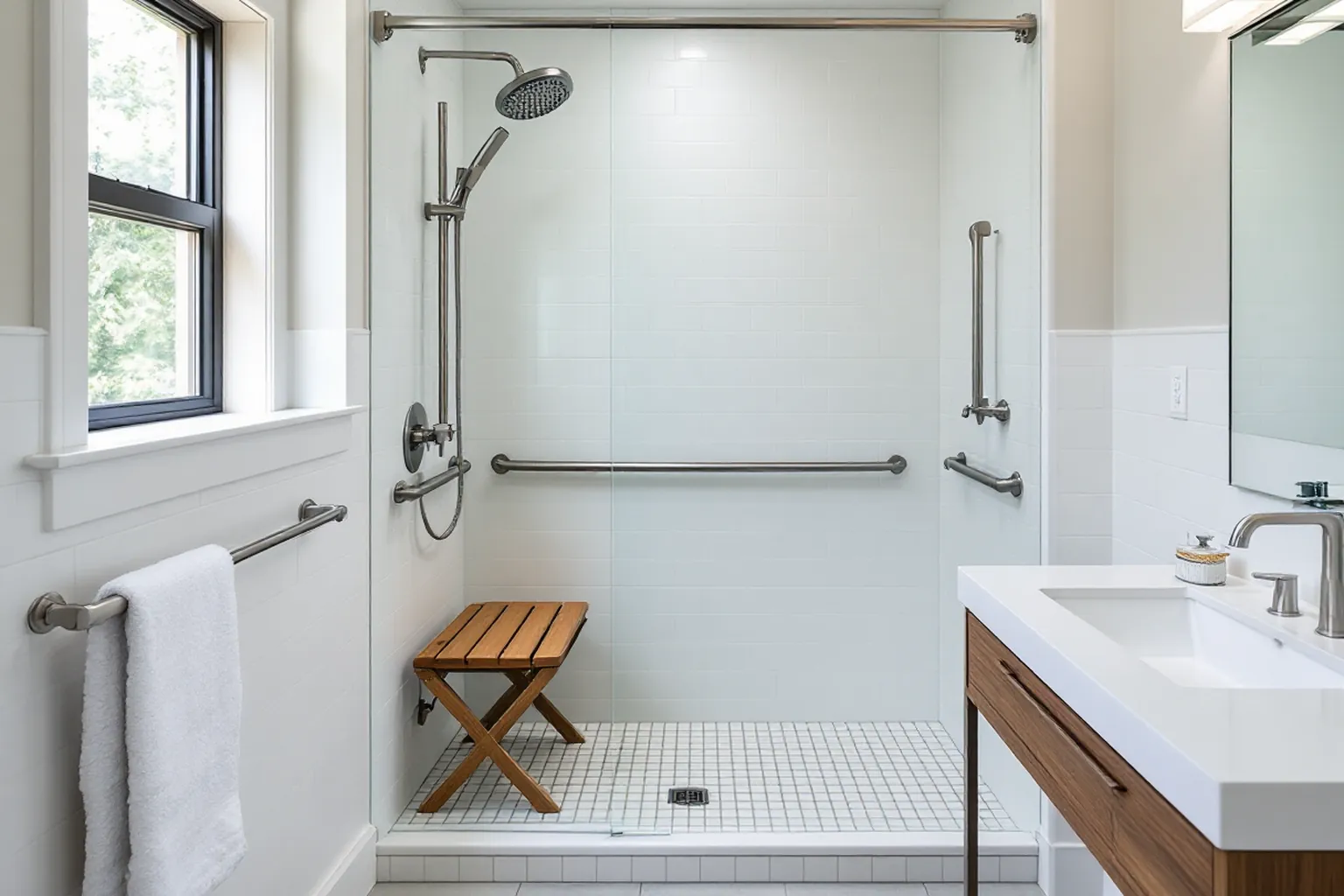
Is a bathroom remodel tax deductible? For a home you live in, usually not: under IRS Publication 523 a remodel is a capital improvement that raises your home’s cost basis and cuts taxable gain when you sell, not an expense you write off this year. There are four exceptions. Medically needed changes such as grab bars, a curbless shower or a widened door count as medical expenses, minus any rise in home value, but only the part of your total medical bills above 7.5% of AGI, and only if you itemize (IRS Publication 502). A bathroom in a rental is depreciated over 27.5 years (Publication 527), a home office can claim a share of whole-house repairs, and home equity interest is deductible when the loan pays for the remodel. Our worked 2026 example below shows a $40,000 accessibility bathroom saving a retired couple about $1,110 in federal tax, and a $20,000 one saving nothing.
Your own house, a rental, an office, a medical need: four different answers
The same new shower is treated four ways depending on who uses the room and why. This table compiles the rule from each IRS publication for tax year 2025, the latest editions posted as of November 2026.
| Situation | Deductible now? | How it works | IRS source |
|---|---|---|---|
| Personal home, cosmetic or upgrade | No | Adds to basis; lowers gain at sale | Pub 523 |
| Medical need (you, spouse, dependent) | Partly | Cost minus value increase, above 7.5% of AGI, itemizers only | Pub 502 |
| Rental property | Over time | Improvement depreciated over 27.5 years; repairs deducted | Pub 527 |
| Home office (self-employed) | Rarely | Business share of whole-home repairs; a bath used only personally does not count | Pub 587 |
| Paid with a home equity loan | Interest only | Interest deductible if the loan pays for a substantial improvement | Pub 936 |
Sources: IRS Publications 502, 523, 527, 587, 936 (2025 editions).
The medical route: what Publication 502 actually lets you count
Publication 502 treats a home improvement as a medical expense when its main purpose is medical care for you, your spouse or a dependent who lives with you. The rule has three parts, and all three matter for a bathroom:
- Cost minus value increase. Worksheet A in Publication 502 has you enter what you paid, then the home’s value right after and right before the work. Only the cost above the value increase counts. If the value rises by as much as you spent, nothing counts.
- Accessibility items usually count in full. The IRS list in Publication 502 names entrance ramps, widened doorways, railings and support bars, other modifications to bathrooms, lowered cabinets and grab bars as changes that generally do not raise a home’s value, so their whole cost can be included.
- Only reasonable cost. Publication 502 says extra spending for architectural or aesthetic reasons is not a medical expense. The marble wall you chose because you liked it stays out of the number.
Upkeep counts too: Publication 502 lets you include operating and maintenance costs of a medical capital asset, such as repairing a shower lift, when the main reason is medical care. In practice, keep a letter or chart note from a doctor tying the change to a diagnosis, separate invoices for the accessibility work and the cosmetic work, and an appraisal or broker opinion if the project could plausibly add value. For what the shower itself tends to cost, see our tub to shower conversion cost guide and the price ranges for a walk-in shower.
Worked 2026 example: a $40,000 accessible bath saves about $1,110
Our calculation for a married couple filing jointly, both over 65, with $90,000 of AGI in 2026. One spouse has a mobility diagnosis and the doctor recommends a curbless shower, grab bars and a wider door. Assumptions we chose for illustration: $3,000 of other medical bills, $12,500 of other itemized deductions (state and local tax, mortgage interest, gifts), a $4,000 appraised rise in home value, and cosmetic upgrades already removed from the cost. Standard deduction figures come from IRS Publication 505 (2026): $32,200 base plus $1,650 for each spouse 65 or older, so $35,500.
| Step | $20,000 project | $40,000 project |
|---|---|---|
| 1. Medical cost of the work (Worksheet A line 1) | $20,000 | $40,000 |
| 2. Less appraised value increase (line 4) | $4,000 | $4,000 |
| 3. Medical expense from the remodel (line 5) | $16,000 | $36,000 |
| 4. Plus other medical bills | $3,000 | $3,000 |
| 5. Less 7.5% of $90,000 AGI | $6,750 | $6,750 |
| 6. Deductible medical (Schedule A) | $12,250 | $32,250 |
| 7. Plus other itemized deductions | $12,500 | $12,500 |
| 8. Total itemized | $24,750 | $44,750 |
| 9. 2026 standard deduction, both 65+ | $35,500 | $35,500 |
| 10. Extra deduction from itemizing | $0 (take standard) | $9,250 |
| 11. Tax saved at the 12% bracket | $0 | about $1,110 |
Our calculation using IRS Pub 502 Worksheet A and the 7.5% floor, IRS Pub 505 (2026) standard deduction amounts, and 2026 brackets from the IRS. Inputs other than the IRS figures are illustrative.
Why a modest medical remodel often saves nothing
The 7.5% floor gets the attention, but the standard deduction is the bigger wall. In the table above the $20,000 project produces $12,250 of deductible medical expense, yet total itemized deductions of $24,750 still fall short of the $35,500 standard deduction, so the couple is better off ignoring the remodel entirely. That is our calculation from the IRS 2026 standard deduction amounts.
Turned around, the remodel only starts paying when its medical cost, net of any value increase, clears this hurdle: standard deduction minus other itemized deductions minus other medical bills, plus 7.5% of AGI. Our calculation for the same couple (other itemized $12,500, other medical $3,000):
- AGI $50,000: break-even about $23,750 of qualifying remodel cost (our calculation).
- AGI $90,000: about $26,750 (our calculation).
- AGI $150,000: about $31,250 (our calculation).
- AGI $250,000: about $38,750 (our calculation).
For a single filer 65 or older the base is smaller: the 2026 standard deduction is $16,100 plus $2,050 (IRS Publication 505), or $18,150. With $8,000 of other itemized deductions and $2,000 of other medical bills, our calculation puts break-even at about $12,650 of qualifying cost at $60,000 of AGI. Every dollar above the break-even saves only your marginal rate, which is 12% for joint 2026 taxable income between $24,800 and $100,800 per the IRS 2026 bracket table. Because Publication 502 counts expenses in the year you pay them, paying a large accessibility job and other big medical bills in the same calendar year can matter; ask a preparer before you schedule the final invoice.
No deduction today still means less tax when you sell
For an ordinary remodel the tax value shows up at sale. Publication 523 adds the cost of improvements, with bathrooms and kitchen modernization named as examples, to your home’s basis, and excludes up to $250,000 of gain ($500,000 for a married couple filing jointly) if you owned and lived in the home for 2 of the last 5 years. Repairs that only keep the home in good condition, such as fixing a leak or repainting, do not add to basis, and the cost of an improvement you later tore out (the 1998 bathroom you just gutted) no longer counts.
That makes basis records worth keeping for owners who have lived in a home a long time or in high-price markets where gain can pass the exclusion. A $35,000 bath remodel that is still in place at sale reduces taxable gain by $35,000 once you are above the exclusion; at a 15% long-term capital gains rate that is about $5,250 (our calculation, assuming the 15% rate applies to you). Keep the contract, change orders and proof of payment in the same folder as your closing papers. Our bathroom remodel cost breakdown shows which line items are typical in a full remodel.
Landlords and home offices: where a bathroom bill becomes a business cost
Rentals. Publication 527 lets landlords deduct repairs in the year paid but requires improvements to be capitalized; a bathroom is listed as an improvement, and residential rental buildings are depreciated over 27.5 years. A $27,500 bath remodel in a rental therefore yields roughly $1,000 a year of depreciation (our calculation, straight line, ignoring the mid-month convention in the first year). If you rent part of the house or use a vacation home personally, the same publication requires you to divide expenses between rental and personal use.
Small items. The $2,500 figure people ask about is the de minimis safe harbor: a business or landlord that elects it can deduct items costing up to $2,500 per invoice or item instead of depreciating them, per the IRS tangible property regulations page. It is written for property used in a trade or business, so it does not apply to your own bathroom. Splitting one remodel into many small invoices to fit under it is the sort of thing an examiner looks at.
Home office. Publication 587 allows a deduction only for space used regularly and exclusively for business. Expenses that benefit the whole home, like a furnace repair, are deductible at your business-use percentage (its example: 10% of the house, 10% of the repair). Work on a room you do not use for business, which describes nearly every bathroom, is not deductible. The simplified method pays $5 per square foot up to 300 square feet, per Publication 587, and ignores repairs altogether.
Financing the remodel: the interest can count even when the work does not
Publication 936 lets you deduct interest on a loan secured by your home only to the extent the money buys, builds or substantially improves that home, on up to $750,000 of total mortgage debt ($375,000 married filing separately). A substantial improvement adds value, prolongs the home’s life or adapts it to new uses, so a full bathroom remodel qualifies; a repair such as repainting does not on its own. You still have to itemize to benefit.
For scale: the median 2025 rate on subordinate-lien home improvement loans was 7.75% in FFIEC HMDA data, so a $55,000 home equity loan costs about $4,260 of interest in its first year (our calculation, before principal paydown). An unsecured personal loan or a credit card used for the same remodel produces no deductible interest at all. We compare loan types and current rate bands in our home improvement loan rates report.
The energy credit that used to cover a bathroom water heater has ended
Until 2025, the closest thing to a write-off for bathroom-adjacent work was the energy efficient home improvement credit, a credit rather than a deduction, which paid up to $2,000 a year toward a heat pump water heater according to the IRS credit page. That credit was cut off by Public Law 119-21 for property placed in service after December 31, 2025; the IRS page says it covers improvements made through that date. A heat pump water heater installed during a 2026 bathroom remodel earns no federal credit. Our report on the energy efficient home improvement credit has the claim data by state and the final rules, and our heat pump water heater guide covers whether the unit still pays back on energy savings alone. State and utility rebates may still exist; check your state energy office.
Frequently Asked Questions
Can you write off a bathroom renovation on your taxes?
Not for a home you live in, unless the work is medically needed. Then the cost minus any increase in home value counts as a medical expense, deductible only above 7.5% of AGI and only if you itemize, per IRS Publication 502. Rentals depreciate the cost over 27.5 years under Publication 527.
Do grab bars and a walk-in shower count as medical expenses?
They can. Publication 502 lists railings, support bars and other bathroom modifications among changes that generally do not raise home value, so their full reasonable cost can be included when the main purpose is medical care. Extra spending for looks does not count. See the walk-in tub cost guide for another common medical fixture.
What is the $2,500 expense rule?
It is the de minimis safe harbor that lets a business or landlord deduct items up to $2,500 per invoice or item instead of capitalizing them, per the IRS tangible property regulations page. It does not apply to your personal home.
What is the new $6,000 tax break for seniors?
An extra deduction of $6,000 per person 65 or older for 2025 through 2028, $12,000 for a qualifying couple filing jointly, reduced above $75,000 of modified AGI ($150,000 joint), per the IRS. You get it whether or not you itemize, so it does not depend on remodel spending.
What is the most overlooked tax break for remodelers?
Basis. Every improvement still in the house when you sell adds to its cost basis under Publication 523, which reduces gain above the $250,000 or $500,000 exclusion. Without receipts you cannot prove it, so keep them for as long as you own the home.
Sources
- IRS, Publication 502 (2025), Medical and Dental Expenses (2025)
- IRS, Publication 523 (2025), Selling Your Home (2025)
- IRS, Publication 527 (2025), Residential Rental Property (2025)
- IRS, Publication 587 (2025), Business Use of Your Home (2025)
- IRS, Publication 936 (2025), Home Mortgage Interest Deduction (2025)
- IRS, Publication 505 (2026), Tax Withholding and Estimated Tax (2026)
- IRS, Working Families Tax Cuts: individuals and workers (2026)
- IRS, Energy efficient home improvement credit (2026)
- IRS, Tangible property final regulations (2025)
- FFIEC / CFPB, HMDA 2025 snapshot, home improvement loans (loan purpose 2) (2026)