Countertop comparisons
Quartz vs Quartzite: What the Standards and Spec Sheets Actually Show
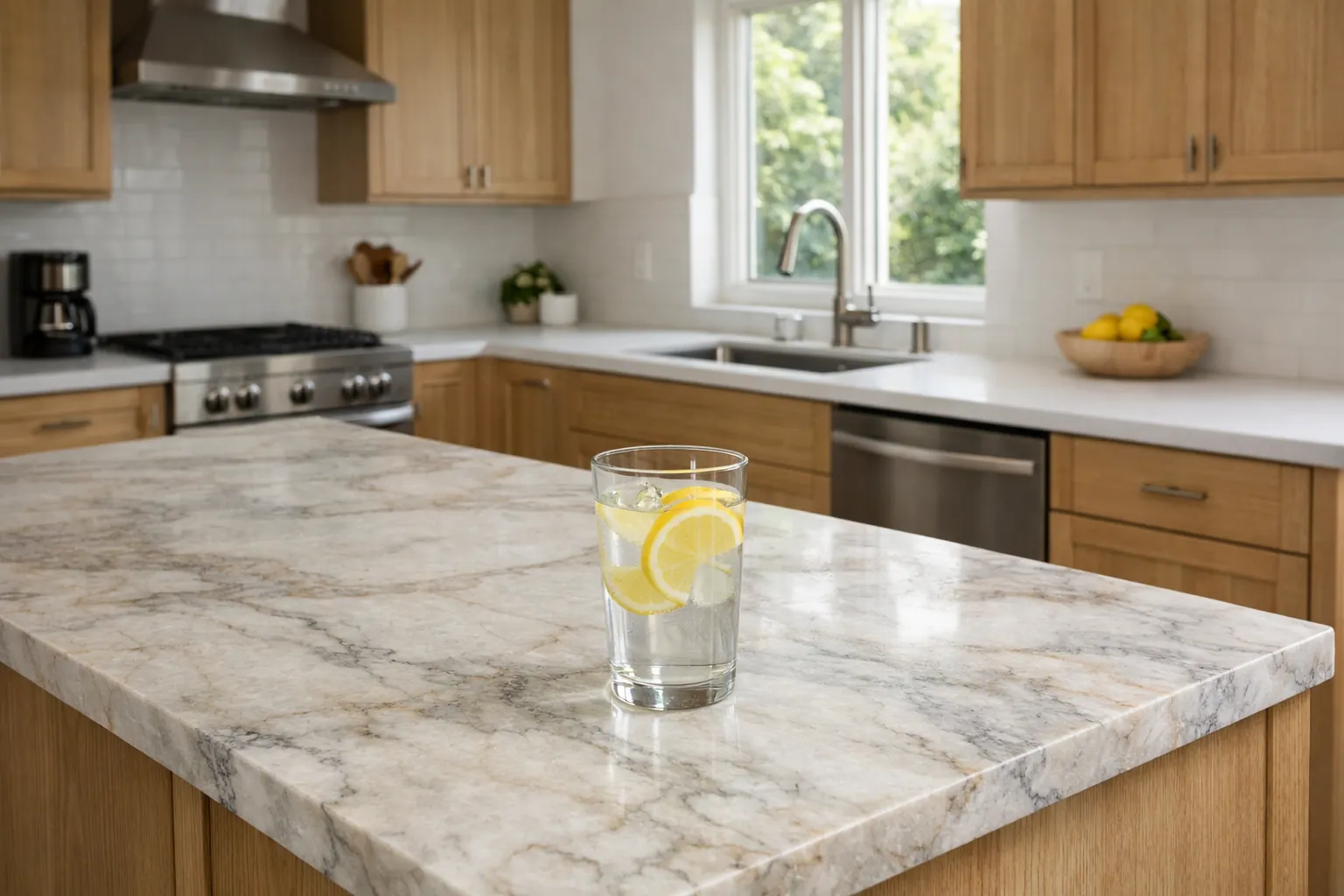
Quartz vs quartzite comes down to this: quartz is a factory slab of ground quartz and resin that needs no sealing, while quartzite is a natural rock that the stone standard lets absorb up to 1.0 percent water by weight, so it can stain unless sealed. That 1.0 percent ceiling comes from ASTM C616, as reproduced in the Natural Stone Institute design manual (2022), and it is 25 times the 0.04 percent that MSI publishes for its Q+ quartz (our calculation: 1.0 divided by 0.04). Installed, Fixr prices quartzite at $80 to $210 per sq ft, against $50 to $200 for quartz from HomeAdvisor. The bigger risk is not the choice between them: it is paying quartzite prices for a slab that is really marble.
One is a rock, the other is a recipe
Quartzite is a natural stone: sandstone whose quartz grains are cemented so tightly by silica that the rock breaks across the grains instead of around them. The Natural Stone Institute manual describes it as “very hard (H=7)” on the Mohs scale and not a soluble stone. ASTM C616 only calls a quartz-based stone “quartzite” (Type III) when it holds at least 95 percent free silica, a threshold repeated in the 2026 OSHA and NIOSH hazard alert on countertop silica.
Engineered quartz is made in a plant. Wilsonart‘s 2025 technical data says its quartz is “up to 93 percent” natural quartz crystals plus polyester binders and coloring agents. That resin is what makes quartz nonporous, and it is also why quartz makers warn about heat: Cambria‘s 2026 spec sheet says its product “may not withstand the direct transfer of heat” from pots and pans and recommends a trivet.
So the names sound alike, but you are comparing a quarried rock with variable properties slab to slab against a manufactured sheet with published test results. That difference drives everything below, from sealing to how much you should trust the label on the slab.
Quartzite is allowed to soak up 25 times more water than quartz makers report
We put the ASTM minimums for natural stone next to the typical results three quartz makers publish. Read the columns carefully: the stone rows are the minimum (or maximum) a stone must meet to comply with its ASTM spec, as reproduced in the Natural Stone Institute manual; the quartz rows are each maker’s own typical test results. A real quartzite slab can test much better than its minimum, so this compares floors, not averages.
| Material and document | Water absorption, by weight | Compressive strength (psi) | Modulus of rupture (psi) | Source |
|---|---|---|---|---|
| Quartzite, ASTM C616 Type III (limit) | 1.0% max | 20,000 min | 2,000 min | NSI manual 2022, p. 8-11 |
| Granite, ASTM C615 (limit) | 0.40% max | 19,000 min | 1,500 min | NSI manual 2022, p. 5-11 |
| Marble, ASTM C503 (limit) | 0.20% max | 7,500 min | 1,000 min | NSI manual 2022, p. 7-16 to 7-17 |
| Cambria quartz (typical) | Negligible (ASTM C97) | 24,750 | 6,800 | Cambria spec sheet, 2026 |
| Wilsonart quartz (typical) | Under 0.03 (ASTM C97) | Over 20,000 | Not listed | Wilsonart tech data, 08/2025 |
| MSI Q+ quartz (typical) | 0.04% (ASTM C97/C373) | 46,680 | 13,635 | MSI Q+ spec, Rev. 1, 3/2024 |
Sources: Natural Stone Institute, Dimension Stone Design Manual (2022), technical data for quartz-based stone, granite and marble; Cambria product specification sheet (2026); Wilsonart Quartz technical data (08/2025); MSI Q+ technical specifications (3/2024). Compiled 2026-11-25.
Harder is not the same as stain-proof
Three things stand out in the table, and they cut against the usual sales pitch.
- Quartzite’s water allowance is the loosest of the three natural countertop stones. Its 1.0 percent ceiling is 2.5 times granite’s 0.40 percent and 5 times marble’s 0.20 percent (our calculation from the NSI figures). The manual says the absorption test is used to predict staining: stone that absorbs more water “will also tend to absorb liquid stains more readily.”
- Quartz is not softer in scratch terms. Cambria lists a Mohs hardness of 7 under ASTM C1895, the same H=7 the NSI gives true quartzite. Both will dull a knife edge; neither should be used as a cutting board.
- Quartz wins on bending strength by a wide margin on paper. Cambria’s 6,800 psi and MSI’s 13,635 psi modulus of rupture are 3.4 and 6.8 times the 2,000 psi quartzite minimum (our calculation). That matters for overhangs and thin sink rails, where a natural slab can crack along a vein.
None of this makes quartzite a poor countertop. It means a quartzite slab needs to be tested and probably sealed, while quartz needs to be kept away from hot pans. If you want the longer view on how quartz tops hold up and what voids their warranties, our page on how long quartz countertops last reads eight warranties line by line.
"Soft quartzite" is usually marble with a better name
The most expensive mistake in this comparison is buying a slab labeled quartzite that is actually marble or dolomite. Marble has a 0.20 percent absorption limit, so it is not more porous, but it is a carbonate stone: lemon juice, vinegar and wine dissolve the surface and leave dull etch marks that sealing does not stop. The Natural Stone Institute’s Use Natural Stone guide (Karin Kirk, 2020) is blunt: “There is really no such thing as soft quartzite, and in most cases that term means the stone is marble.” The same guide notes that Super White “is made of dolomite.”
Trade names are not regulated, and price lists blur them. Fixr‘s quartzite cost table prices Super White at $50 to $80 per sq ft as a quartzite variety, next to Taj Mahal at $90 to $110 and Macaubas Fantasy at $85 to $95. A slab name tells you the look; only a test tells you the rock. Do the tests below on the actual slab you are buying, at the yard, before you sign the fabrication order.
Three tests to run on a slab before you pay a deposit
- Step 1
Glass scratch test
1 minute
Press a sharp edge or corner of a sample (or an offcut the yard will give you) into a glass tile. The NSI guide says granite, sandstone and quartzite “will all scratch glass,” while marble, dolomitic marble and limestone will not. Wipe the glass: a real scratch stays, powdered stone rubs off.
- Step 2
Lemon or vinegar etch test
5 to 10 minutes
Put several large drops of lemon juice or vinegar on the polished face and leave them 5 to 10 minutes, per the NSI guide. Wipe and look at the spot at an angle against a light. A dull ring means calcite or dolomite is present, which is the guide’s test to “distinguish a potentially mislabeled quartzite from marble.” Ask first, and test on the back or an edge if the yard prefers.
- Step 3
Water darkening test
10 to 15 minutes
Dribble water on the surface and leave it 10 to 15 minutes, then dry it. A darkened patch means the stone absorbed water and is more likely to stain, according to the NSI guide, which used a porous quartzite (Lamberti Bianco) as its example. Fixr recommends an impregnating sealer about once a year only if this kind of test shows the stone can stain.
A 30 sq ft kitchen run costs $900 more at the low end in quartzite
Thirty square feet is the size Fixr uses for its quartzite national average, so we priced the same area from each published per-square-foot range (our calculation: range times 30).
| Material | Installed per sq ft | 30 sq ft (our calculation) | Source |
|---|---|---|---|
| Quartz | $50 to $200 | $1,500 to $6,000 | HomeAdvisor, 2026 |
| Quartz (Fixr’s comparison figure) | $40 to $100 | $1,200 to $3,000 | Fixr, 2025 |
| Quartzite | $80 to $210 | $2,400 to $6,300 | Fixr, 2025 |
| Quartzite, Fixr national average job | Not per sq ft | $4,200 (range $3,600 to $4,950) | Fixr, 2025 |
Sources: HomeAdvisor, Quartz Countertops Cost (2026); Fixr, Quartzite Countertop Installation Cost (updated August 29, 2025). Fixr’s $4,200 average assumes about 30 sq ft of Fantasy Macaubas with a bullnose edge and undermount sink.
The slab name moves the price more than the material class
The overlap in the table is wide: a premium quartz design and an entry quartzite can land within a few hundred dollars of each other. What spreads quartzite prices is the variety and the fabrication. Fixr splits its $80 to $210 installed range into $50 to $120 per sq ft for material and $30 to $90 per sq ft for fabrication and install, and its high example, $6,300, is 30 sq ft of Taj Mahal with an ogee edge and two undermount sinks. Its low example, $960, is a 12 sq ft Super White vanity top.
For what happens between templating and install day, see how long countertop fabrication takes. Quartz has its own price pressure: most slabs are imported and subject to the duties covered in our quartz countertop tariffs tracker, so get a written quote with the slab line itemized and an expiry date.
If you are still weighing a third stone, our quartz vs granite comparison covers the granite side, including when granite actually needs sealing.
Both slabs are silica-heavy when they are cut
Engineered quartz gets the headlines on silicosis, but quartzite is just as high in silica. The 2026 OSHA and NIOSH hazard alert lists typical crystalline silica content of at least 95 percent for quartzite, less than 0.2 up to 95 percent for engineered stone depending on the product, 10 to 50 percent for granite and under 5 percent for marble and limestone. It says “the highest crystalline silica levels are associated with quartzite and with certain engineered stones.”
The exposure is to the people cutting and grinding the slab, not to you using a finished counter. In practice that gives you one rule for either choice: on-site cuts, such as a cooktop cutout or trimming a seam, should be done wet or with a shroud and vacuum, never dry-cut in your kitchen. Our engineered stone silicosis report covers the case counts and the state rules, and the steps for a cut after install are in cutting a quartz countertop after installation. This is not medical or legal advice.
Where each one fits in a working kitchen
Quartz
Pros
- Nonporous: no sealing schedule
- Published test data for every product line
- Consistent color for long runs and matched seams
- Higher bending strength on paper for overhangs
Cons
- Resin can scorch or discolor under a hot pan
- Most makers exclude outdoor and heat damage
- Patterns imitate stone; repeats show on big islands
Quartzite
Pros
- No resin, so no resin to scorch
- Each slab is one of a kind
- True quartzite resists kitchen acids
Cons
- Looser absorption limit than granite (ASTM C616): test and likely seal
- Mislabeled marble is common in the trade
- Fewer color choices, mostly whites, grays and tans
- Higher fabrication cost
Frequently Asked Questions
Which is nicer, quartz or quartzite?
It depends on what you mean by nicer. Quartzite is a natural stone with real crystal depth and no two slabs alike, while quartz offers consistent, designed patterns. On upkeep, quartz is easier: makers such as Wilsonart report moisture absorption under 0.03, while ASTM C616 allows quartzite up to 1.0 percent, per the Natural Stone Institute manual.
What is the best stone for kitchen countertops?
There is no single best stone; the right one matches how you cook. The Natural Stone Institute manual names granite, quartzite and highly compact marble as the stones of maximum resistance for heavy-use surfaces, and says that on kitchen counters of any stone, spills should be wiped up immediately. If you want zero sealing, engineered quartz is the usual pick; compare it with granite in our quartz vs granite guide.
Why is quartz in decline?
Mostly because of worker health and trade rules. Engineered stone can be up to 95 percent crystalline silica, according to the OSHA and NIOSH hazard alert (2026), and Safe Work Australia banned engineered stone from July 1, 2024. In the US, imported slabs also face the duties in our quartz tariffs tracker. Quartzite is just as high in silica (at least 95 percent), so the cutting hazard does not disappear by switching.
Is Taj Mahal quartzite or quartz?
Taj Mahal is a natural stone sold as a quartzite, not an engineered quartz; Fixr lists it among quartzite varieties at $90 to $110 per sq ft for material. If a showroom sample has the Taj Mahal look but comes with a quartz maker’s spec sheet, it is an engineered design, not the stone. As with any natural slab, run the glass and lemon tests from the NSI guide on the slab you are buying.
Does quartzite need to be sealed?
Sources
- Natural Stone Institute, Dimension Stone Design Manual (2022), technical data for quartz-based stone, granite and marble (distributor-hosted copy) (2022)
- Natural Stone Institute (Use Natural Stone), How to Be Your Own Stone Sleuth, by Karin Kirk (2020)
- OSHA and NIOSH, Hazard Alert: Worker Exposure to Silica during Countertop Manufacturing, Finishing, and Installation (HA-3768-2026), Internet Archive copy (2026)
- Cambria, Product Specification Sheet (version 26A) (2026)
- Wilsonart, Wilsonart Quartz Technical Data (Rev. 08/2025) (2025)
- MSI, Technical Specifications for Q+ from MSI (Rev. 1, 3/2024) (2024)
- Fixr, Quartzite Countertop Installation Cost (2025)
- HomeAdvisor, Quartz Countertops Cost (2026)
- Safe Work Australia, Engineered stone ban (2024)