Kitchen costs
Under cabinet lighting cost: what a 10x10 kitchen really pays
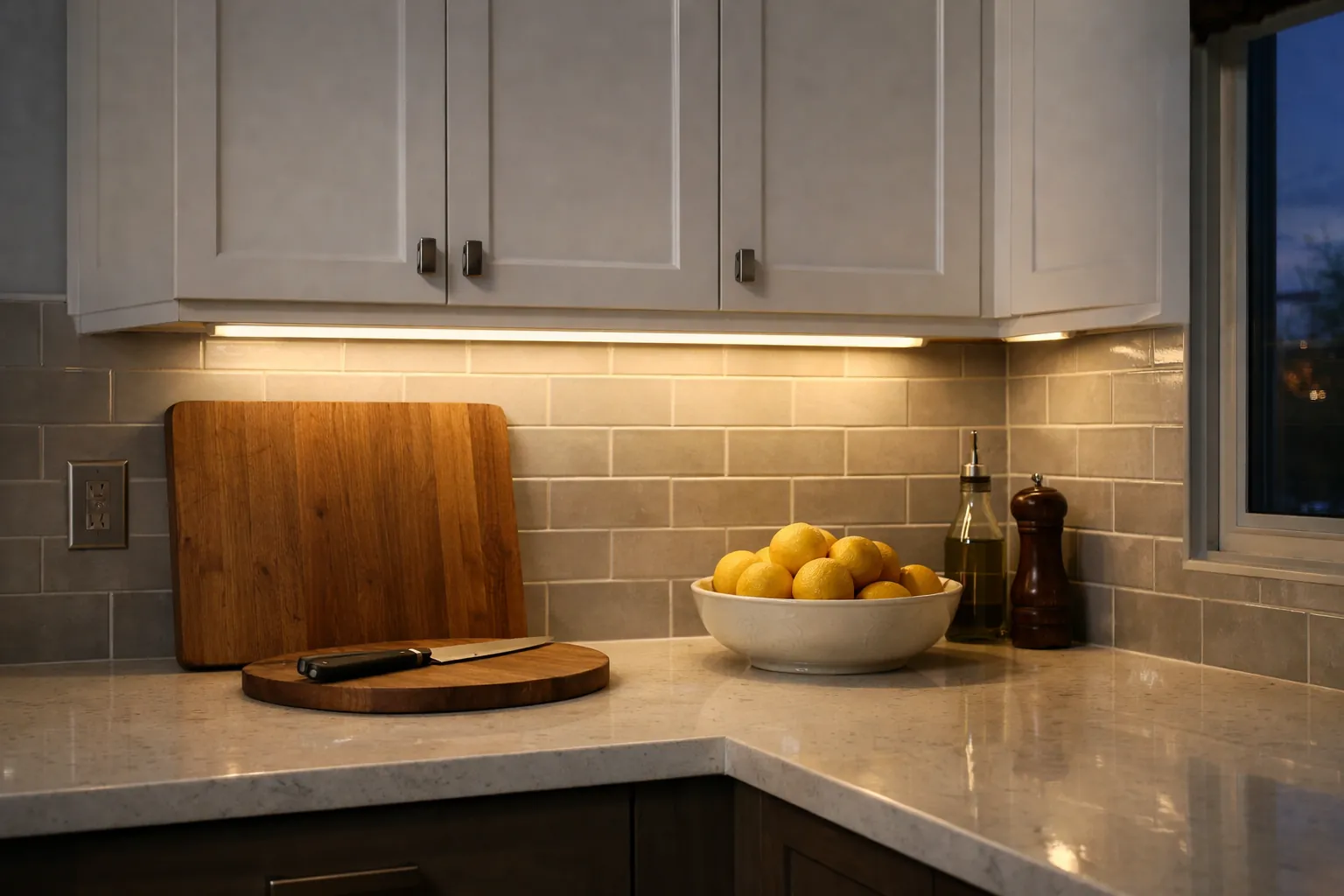
Under cabinet lighting cost for a standard 10x10 kitchen runs from about $80 to about $1,200, our calculation for the roughly 14 feet of upper cabinets that sit over the counter: a 16-foot plug-in LED tape kit lists at $79.47 and eight 18-inch plug-in GE bars at $187.92 at Target (prices checked 25 November 2026), while hardwired bars plus an electrician land at $538 to $1,114 once you add 3 to 6 hours at the $70 to $131 hourly rate Fixr reports. The lights are cheap. The wire is what you pay for, and the electricity to run them is about $8 to $26 a year at the EIA 2025 average of 17.23 cents per kWh.
- Low
- $80 10x10 kitchen, 14 ft of uppers
- Hardwired, low end
- $540 10x10 kitchen, 14 ft of uppers
- High
- $1,200 10x10 kitchen, 14 ft of uppers
A 10x10 kitchen has about 14 feet of cabinet bottom to light
Cost guides price this job per fixture or per light, which tells you little until you know how many you need. So we started from the room. The 10x10 that cabinet sellers price is an L of two 10-foot walls, 20 feet in all, as our 10x10 kitchen cabinet cost breakdown explains. Take out a 30-inch range (the cabinet above it usually holds a hood or microwave, not a task light) and a 36-inch refrigerator opening, and 14.5 feet of upper cabinet sits over counter. We round down to 14 feet because the blind or diagonal corner and the end panels eat a few inches. That is our assumption, not a published figure; measure your own uppers and scale every number on this page by your feet divided by 14.
Light bars do not come in 14-foot lengths. A run of eight 18-inch bars covers 12 feet, which is how most people fill a set of 15 to 36 inch cabinets: one bar per cabinet, a few inches shorter than the box. Tape is cut to length, so one 16-foot reel covers the whole run with a little left over.
Installed cost for a 10x10 kitchen, light type by light type
Fixture prices are the listed prices on each product page at Target on 25 November 2026, before tax. Labor is our calculation: 3 to 6 electrician hours times Fixr‘s $70 to $131 hourly range, which covers tapping a nearby circuit and fishing one cable to the run. Wattage is from the product page or the GE spec page; the tape figure is 36 W scaled to the 14 feet you would use.
| Light type and example | Fixtures for 14 ft | Electrician | Installed total | Power draw |
|---|---|---|---|---|
| Plug-in LED tape, Feit 16 ft, dimmable | $79.47 (1 reel) | None (plugs in) | $79 | About 32 W |
| Plug-in LED bars, GE 18 in, linkable | $187.92 (8 at $23.49) | None (plugs in) | $188 | 80 W |
| Plug-in puck lights, GE Cync smart 3-pack | $179.97 (3 packs, 9 pucks) | None if plugged in | $180 | Not listed |
| Hardwired LED bars, GE 18 in direct wire, warm white | $327.92 (8 at $40.99) | $210 to $786 | $538 to $1,114 | 104 W |
| Hardwired smart bars, GE Cync 24 in color changing | $407.94 (6 at $67.99, 12 ft) | $210 to $786 | $618 to $1,194 | Not listed |
Sources: product listings at Target (accessed 25 Nov 2026); GE Lighting spec page; labor from Fixr, Electrician Cost (updated 31 Jan 2025). Totals are our calculation, before tax and permit fees.
The electrician, not the fixture, sets the price of a hardwired run
On the hardwired rows above, labor is 34 to 71 percent of the total, our calculation (labor divided by installed total at each end of the range). That matches what the published guides say in their own units. Homewyse puts a basic hardwired under-cabinet install at $531 to $673 for a single fixture in its May 2026 estimate, a number that mostly reflects the electrician’s minimum visit, and Inch Calculator quotes $500 to $550 for five LED strips installed by an electrician (a page last updated in September 2023). Fixr lists a typical electrician service visit at $176 to $327, which is the floor for any hardwired job, however few lights it has.
What pushes a job toward the top of the range is how far the nearest usable power is. If there is a receptacle or junction box behind the uppers, or the walls are open during a remodel, a few hours covers it. If the electrician has to cut into finished drywall to drop a new feed from a wall switch, add patching and painting, which neither guide prices. The wage underneath is lower than the bill: the median electrician earned $63,190 in May 2025 according to BLS, about $30.38 an hour on a 2,080-hour year (our calculation). The gap to a $70 to $131 billed rate is insurance, the truck, travel and unbillable time, and it has widened as demand grew; our electrician shortage report tracks openings and the apprentice pipeline.
The cheapest moment to hardwire under-cabinet lights is during a remodel, when the electrician is already there and the cabinets are not yet hung. Ask for the feed and a switch box to be roughed in even if you buy the fixtures later.
Lumens per foot is the number that tells you if the counter will be lit
Two products that look the same in a photo can differ by a factor of 20 in light output. We divided each product’s listed lumens by its length. The cheapest 10-foot tape gives 32 lumens per foot, which is glow, not task light; the bars give 16 to 23 times that.
| Product | Listed lumens | Length | Lumens per ft | Lumens per watt |
|---|---|---|---|---|
| GE 10 ft plug-in tape | 320 lm | 10 ft | 32 | Not listed |
| Feit 16 ft plug-in tape | 2,950 lm | 16 ft | 184 | 82 |
| GE 18 in plug-in bar | 800 lm | 1.5 ft | 533 | 80 |
| GE 18 in direct wire bar | 900 lm | 1.5 ft | 600 | 69 |
| GE Cync 24 in smart bar | 1,500 lm | 2 ft | 750 | Not listed |
Sources: lumens and watts from the product pages at Target and the GE Lighting spec page (10 W, 800 lm), accessed 25 Nov 2026. Per-foot and per-watt figures are our calculation.
Tape is the cheapest strip and the easiest one to buy too dim
Tape wins on price and on a clean look, because a cut reel runs the full length without the dark gaps you get between bars. But tape is sold by the reel, and the reel price hides the brightness. In the table above the 10-foot GE reel costs $27.49 and puts out less light across its whole length than a single 18-inch bar. If you are choosing tape for chopping and reading recipes, compare lumens per foot first and price second, and pick a dimmable kit so a bright strip can be turned down at night.
Lumens per watt matters less than people think at this scale. Every product we priced that lists both numbers converts 69 to 82 lumens per watt, our calculation, so the running cost difference comes from how many watts you install, not from which LED is more efficient.
Running them for four hours a day costs $8 to $26 a year
Method: watts times 4 hours a day times 365 days, divided by 1,000 for kWh, times the price. We use the EIA 2025 national average residential price of 17.23 cents per kWh and the EIA Short-Term Energy Outlook projection of 18.2 cents for 2026. Four hours a day is our assumption; halve it and the cost halves.
| Setup | kWh per year | At 17.23 cents (2025) | At 18.2 cents (2026 proj.) |
|---|---|---|---|
| Plug-in tape, 14 ft (about 32 W) | 46 kWh | $7.92 | $8.37 |
| Eight plug-in bars (80 W) | 117 kWh | $20.12 | $21.26 |
| Eight direct wire bars (104 W) | 152 kWh | $26.16 | $27.63 |
Sources: prices from EIA Form EIA-861 2025 final data and EIA Short-Term Energy Outlook (October 2026); wattage from product pages. Our calculation.
Against a $151 monthly bill, the lights barely register
The average US household paid $150.68 a month for electricity in 2025, or $1,808 a year, per EIA. Eight plug-in bars at $20.12 a year are about 1.1 percent of that, our calculation. One hour of the 80-watt setup costs about 1.4 cents. Your own rate can be far from the average; our average electric bill by state shows the spread, and in a high-price state the yearly figure can roughly double. Even then, the running cost will never decide this purchase. Brightness and installation will.
Plug-in lights need no electrician; a new hardwired feed usually does
Plug-in kits are made for owners to install: they stick or screw to the cabinet bottom and plug into a receptacle. The two GE bars in the table are sold as both plug-in and direct wire, and Target‘s listing marks them as not requiring hardwired installation, so you can start plugged in and have them wired later. The trade-off is a visible cord running to an outlet, and in most kitchens that outlet is a countertop receptacle you lose for the toaster.
Hardwiring means a new connection to the house wiring, often with a new wall switch. Many cities require a permit for new wiring even in a single room, and whether you can pull it yourself as a homeowner depends on your jurisdiction; our guide to kitchen remodel permits covers how to check. If you hire it out, use the same vetting you would for any trade, as set out in how to choose a remodeling contractor. This page is not electrical or legal advice.
Frequently Asked Questions
How much does it cost to install under cabinet lighting?
How much does an electrician charge for under cabinet lighting?
Do you need an electrician to install under cabinet lighting?
Not for plug-in kits, which mount with screws or tape and plug into an outlet. A hardwired run that connects to house wiring or adds a switch is electrical work that many jurisdictions require to be permitted, and most owners hire a licensed electrician for it. Check your local building department.
Is under cabinet lighting worth it?
Are puck lights or strip lights cheaper to run?
Both are LED and convert power to light at similar rates (69 to 82 lumens per watt on the products we priced, our calculation). Cost to run depends on total watts installed, and for a typical kitchen it is under $30 a year either way at the EIA 2025 average price.
Sources
- Target, Under cabinet lighting search results and product pages (Feit 16 ft tape, GE 18 in plug-in and direct wire bars, GE Cync 24 in bar and puck 3-pack, GE 10 ft tape) (2026)
- GE Lighting, GE LED Undercabinet Light Fixture, Plug-in Integrated Bar Light, 18in (spec page) (2026)
- Fixr, Electrician Cost (2025)
- Homewyse, Cost to Install Under Cabinet Lighting (May 2026) (2026)
- Inch Calculator, Cost to Install Under Cabinet Lighting (2023)
- U.S. Energy Information Administration, Form EIA-861 2025 final data (average bill and price) (2026)
- U.S. Energy Information Administration, Short-Term Energy Outlook: Electricity, Coal and Renewables (October 2026) (2026)
- U.S. Bureau of Labor Statistics, OEWS May 2025 national estimates, Electricians (47-2111) (2026)
- City of Roseville, California, 2025 Residential Energy Code: Mandatory Measures for New Lighting (revised 1 Jan 2026) (2026)