Kitchen costs
Cost to install a pot filler: the fixture, the pipe and the wall, priced line by line
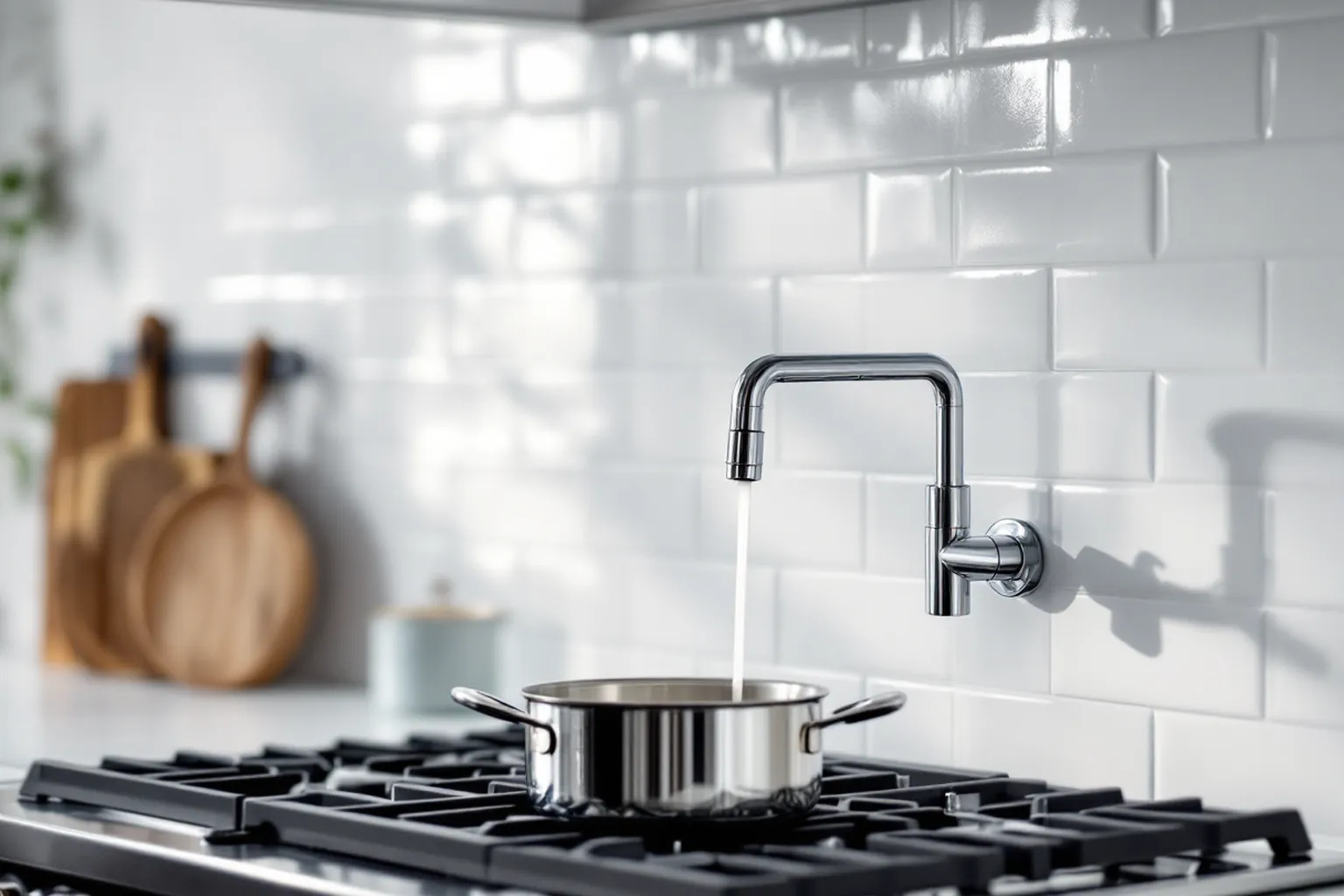
The cost to install a pot filler runs about $1,200 to $2,100 when a capped water line already waits behind the range, and about $2,000 to $3,400 when a plumber has to run a new line through a finished, tiled wall. Those totals are our calculation: base-finish list prices of $770 to $1,465 for six models from four makers (Delta Faucet, Moen, Kohler, Grohe), plus Fixr‘s $400 to $640 for pot filler piping, or Homewyse‘s $935 to $1,138 per new piping run and the wall and tile repair that run leaves behind. The fixture is often the smaller half of the bill; the pipe and the wall decide where you land.
- Low
- $1,170 installed, fixture included
- Midpoint
- $2,280 installed, fixture included
- High
- $3,390 installed, fixture included
Six wall-mount pot fillers, four makers: $770 to $1,465
Retail ranges in cost guides are usually a single line with no models behind them. We opened the maker pages instead and recorded the list price for the base chrome or steel finish of each wall-mount model. The median of the six is $908 (our calculation: the midpoint of $870 and $946). Special finishes cost more: Delta Faucet‘s own pot filler page shows the same models in other finishes at up to $1,213.
| Model | List price | Flow (maker spec) | Note |
|---|---|---|---|
| Delta 1177LF Traditional, chrome | $770 | 4.0 gpm | Dual shut-off valves on the arm |
| Delta 1165LF Contemporary, chrome | $813 | 4.0 gpm | 1/2 in IPS connection |
| Delta 1190LFL, chrome | $870 | 4.0 gpm | 1/2 in IPS connection |
| Moen S664 Traditional, chrome | $946 | 5.5 gpm max | Web price $678.77 when archived |
| Kohler Artifacts 99270-CP | $1,150 | 3.2 gpm | 22 in reach; sale $862.50 when archived |
| Grohe Zedra 31075DC2, SuperSteel | $1,465 | not recorded | List (compare-at) price |
Sources: Delta Faucet product pages for 1177LF, 1165LF and 1190LFL (opened 2026-11-24); Moen S664 page (Internet Archive copy, April 2026); Kohler 99270 page (Internet Archive copy, October 2025); Grohe Zedra page (Internet Archive copy, September 2026). Street prices are often lower than list.
The fixture is the part you control; the pipe run is the part you don't
Shopping a pot filler feels like the main decision, but the six list prices above sit inside a $695 band. The plumbing side swings more. Fixr prices pot filler piping alone at $400 to $640, “depending on the model and how far the water line needs to run,” and $600 to $1,840 with the fixture included. That range assumes reasonable access. Once the line has to be fished through a finished wall, the better comparison is Homewyse‘s May 2026 estimate for moving plumbing: $935 to $1,138 per piping run, which covers up to 30 feet of water line, the fittings and the leak test, and explicitly excludes restoring the wall or floor afterward.
One homeowner account shows how simple the easy case is. Diana Elizabeth paid $550 for about four hours of plumber labor, a few years ago, because a copper line had already been run from the sink and capped under the stove. The plumber added a 2x4 of backing so the wall-mounted arm would not flex. If your range wall has no stub, that sentence is the whole difference between the low and high scenarios below.
Three pot filler jobs, totaled line by line
Each column adds the same fixture range to a different wall. The figures are our calculation from the sourced line items in the next section; regional rates and a general contractor’s markup can push them higher.
| Line item | A: stub already there | B: new line, drywall | C: new line, tiled wall |
|---|---|---|---|
| Fixture (list) | $770 to $1,465 | $770 to $1,465 | $770 to $1,465 |
| Piping and hookup | $400 to $640 | $935 to $1,138 | $935 to $1,138 |
| Drywall patch | none | $297 to $472 | $297 to $472 |
| Tile patch, 6.25 sq ft | none | none | $177 to $311 |
| Total | $1,170 to $2,105 | $2,002 to $3,075 | $2,179 to $3,386 |
Our calculation. Fixture: maker list prices above. Piping: Fixr (scenario A), Homewyse per piping run (B and C). Drywall: Homewyse per repair. Tile: Homewyse $28.31 to $49.78 per sq ft times 6.25 sq ft. Permit fees and sales tax not included.
Where each line item comes from
- Piping when a stub exists: Fixr lists $400 to $640 for pot filler piping. This is the new-build or open-wall case, where the plumber only extends a capped line and mounts the arm.
- Piping when there is no stub: Homewyse lists $935 to $1,138 per piping run in readily serviceable conditions, including up to 30 feet of water line. Most kitchens can tee off the sink’s cold supply within that distance, but a range on the opposite wall from the sink is the expensive layout.
- Drywall: Homewyse puts a drywall repair at $297 to $472 per repair in May 2026, with painting the patch as a separate line.
- Tile: Homewyse prices tile backsplash installation at $28.31 to $49.78 per square foot with a two-hour labor minimum. We used a 30 by 30 inch patch, 6.25 square feet (our calculation: 2.5 ft times 2.5 ft), for the area a plumber typically opens behind a range.
- Supervision: all three Homewyse estimates exclude general contractor overhead and say to add 13 to 22 percent if a GC runs the job.
The tile line hides the real risk. If the original tile is discontinued, a patch will not match, and the honest fix is retiling the whole backsplash. That is why a pot filler costs least when it is planned with a new backsplash, and why it fits well in a kitchen remodel done in stages where the backsplash phase is still ahead.
A pot filler pours two to three times faster than your sink
The flow ratings on the maker pages are the quiet reason pot fillers exist. A 2 gallon (8 quart) stockpot fills in about 22 seconds at the 5.5 gpm Moen rates for the S664, 30 seconds at Delta‘s 4.0 gpm and 38 seconds at Kohler‘s 3.2 gpm (our calculation: 2 gallons divided by gallons per minute, times 60). Kitchen faucets are held to much lower flow limits; our kitchen faucet GPM report has the federal and state caps and real fill times at the sink. The trade-off is that you still carry the full pot back to the sink to drain it, so the filler saves the heavy trip in one direction only.
Ask your inspector whether the arm's valves count as the shutoff
Plumbing codes generally want an accessible shutoff on each fixture’s supply, and a pot filler is awkward because its supply lives inside the wall behind the range. Some models solve this on the fixture: Delta describes the 1177LF as a dual swing-joint design with dual shut-off valves. At least one state writes that solution into code. Utah Code 15A-3-205 replaces the first sentence of IRC P2903.9.3 with: “Unless the plumbing appliance or plumbing fixture has a wall-mount valve, shutoff valves shall be required on each fixture supply pipe to each plumbing appliance and to each plumbing fixture other than bathtubs and showers.” Other jurisdictions may want a separate stop valve, often placed in the sink base or a basement where it can be reached. Ask before the wall closes, because adding an access panel after tiling is the expensive way to comply. Our guide to when a kitchen remodel needs a permit covers when new supply piping triggers a plumbing permit, and our building permit cost data shows what cities charge. This is not legal or engineering advice; your local code and inspector decide.
You are paying for a half day of plumber time, and plumbers are scarce
Fixr puts plumber rates at $75 to $150 an hour, which is why the four-hour Diana Elizabeth job and the Fixr piping range land close together. Behind the billed rate, plumbers earned a median $30.67 an hour in May 2025 according to BLS OEWS data; our contractor hourly rate report shows how trade wages vary by state. Scheduling can matter more than the rate. BLS projections show about 42,000 openings a year for plumbers from 2025 to 2035, and our plumber shortage analysis explains why apprenticeships are not keeping up. A pot filler is a small job, so bundle it with other plumbing work if you can; the same plumber visit that handles a sink move, like the one in our cost to move a kitchen sink to an island guide, can stub the range wall for little extra.
Four downsides to weigh before you open the wall
- A slow drip lands on the cooktop. Models with dual shut-off valves, such as the Delta 1177LF, let you close the arm while you wait for a replacement cartridge; a filler without them may need a stop valve elsewhere.
- An exterior wall can freeze. Many ranges sit on outside walls, and a cold water line in that cavity has no heat. Our pipe freezing data shows which counties see the nights that crack pipes; route the line on the warm side of the insulation or skip the filler.
- It is usually cold water only. A pot filler is plumbed to one supply, so it fills pots; it does not replace a second sink.
- The range hood and filler compete for the same wall. Check that the folded arm clears the hood and backsplash outlets before you buy; our sibling guide on whether you really need a range hood covers that wall’s other occupant.
Price your own pot filler in four checks
- Step 1
Look for a stub
Pull the range out and check the wall and the cabinet beside it for a capped water line. A stub puts you in scenario A.
- Step 2
Measure to the nearest cold line
Measure the route from the sink supply to the center of the range. Within 30 feet matches the Homewyse piping run; farther, or across a doorway, expect more.
- Step 3
Check what covers the wall
Drywall patches cleanly. Tile needs spare tiles from the original lot or a plan to redo the backsplash.
- Step 4
Choose the fixture last
With the wall cost known, pick a model whose reach covers your back and front burners; Kohler lists 22 inches for the Artifacts arm.
Frequently Asked Questions
Is it expensive to have a pot filler installed?
How much do pot fillers cost?
List prices for six wall-mount models we checked run from $770 (Delta 1177LF, chrome, on Delta Faucet) to $1,465 (Grohe Zedra, on Grohe‘s archived page), with a median of $908 by our calculation. Street prices are often lower.
Is it worth installing a pot filler?
It is worth it if you cook in large pots often and the wall is open. At the 4.0 gpm Delta rates, a 2 gallon pot fills in about 30 seconds (our calculation), but you still carry it full to the sink to drain.
What is the downside of a pot filler?
Cost to retrofit, a drip over the cooktop if a valve wears, freeze risk on exterior walls, and possible code questions about the shutoff. Utah Code 15A-3-205 accepts a fixture’s wall-mount valve as the shutoff; other places may want a separate stop.
Sources
- Delta Faucet, Pot fillers: 1177LF, 1165LF and 1190LFL product pages (2026)
- Moen, S664 Traditional Chrome Two-Handle Pot Filler (Internet Archive copy) (2026-04-15)
- Kohler, Artifacts Wall-Mount Pot Filler K-99270 (Internet Archive copy) (2025-10-09)
- Grohe, GROHE Zedra 2-Handle Wall Mount Pot Filler (Internet Archive copy) (2026-09-10)
- Fixr, How Much Does It Cost to Install Plumbing in a Kitchen Remodel? (2025-01-30)
- Homewyse, Cost to Move Plumbing, 2026 (May 2026)
- Homewyse, Cost to Repair Drywall, 2026 (May 2026)
- Homewyse, Cost to Install a Tile Backsplash, 2026 (May 2026)
- Diana Elizabeth, How to Install a Pot Filler in the Kitchen + Cost (2021-02-19)
- Utah Legislature, Utah Code 15A-3-205, amendments to IRC plumbing provisions (2026)
- U.S. Bureau of Labor Statistics, OEWS May 2025 national estimates (2026-05-15)
- U.S. Bureau of Labor Statistics, Employment Projections 2025 to 2035, occupation tables (2026)