Kitchen materials
How Long Do Quartz Countertops Last? What 8 Maker Warranties Say
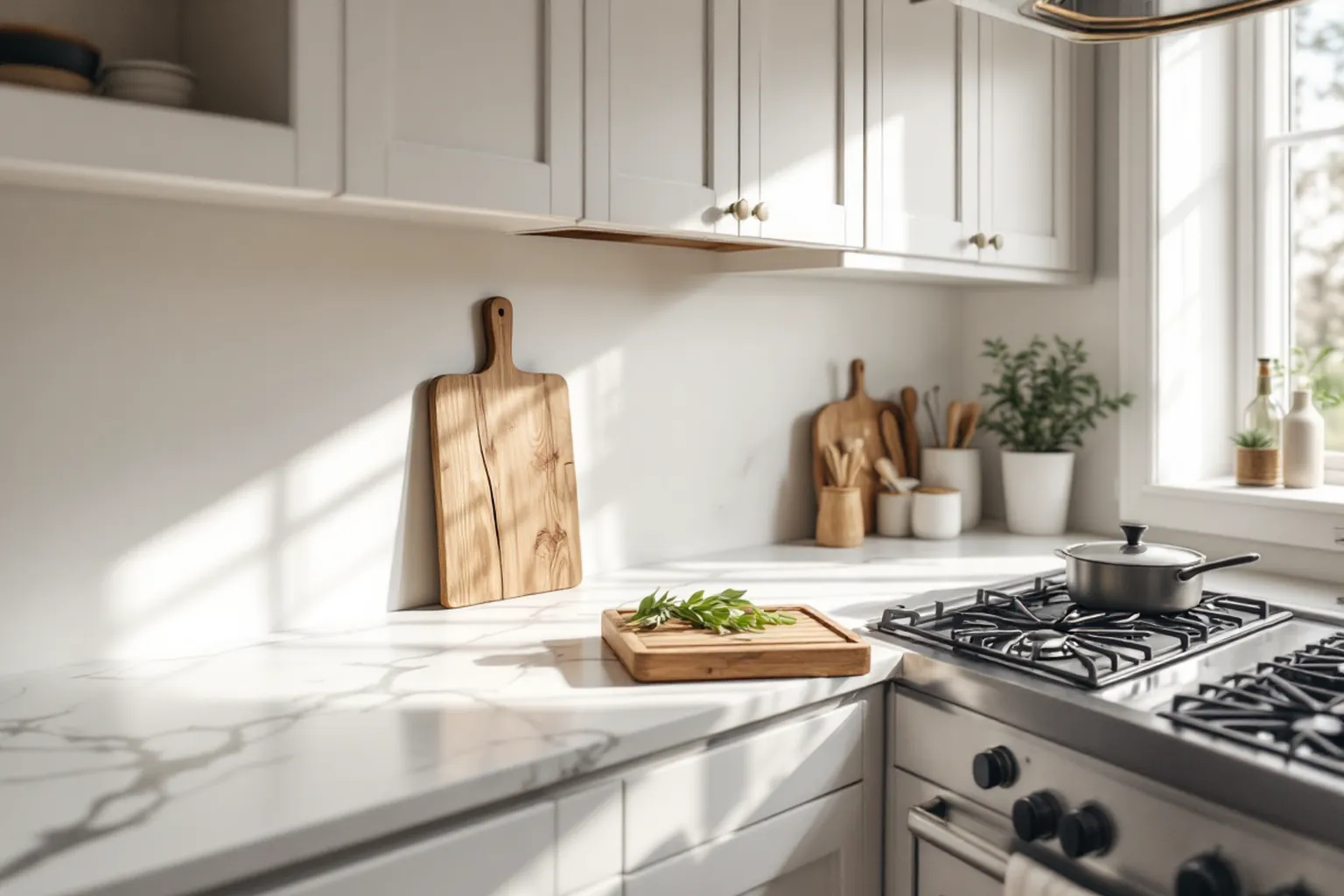
How long do quartz countertops last? In a normal indoor kitchen, longer than the kitchen around them: four of the eight quartz makers whose warranties we read (Caesarstone, Cambria, MSI Q and HanStone) cover the slab for its lifetime, Silestone covers 25 years, and the shortest term is Wilsonart‘s 10 years. No warranty treats age as the failure. What ends a quartz top early is heat, impact, a cabinet that settles, or sun on an outdoor or window-side run, and every warranty document we could read excludes those.
Nobody has measured quartz lifespan, including the study everyone quotes
Most pages that answer this question pick a number and move on. The figures in the current results range from 20 to 30 years (Chicago Countertop Co., no source given) to an informal 91 years that The Stone Collection builds by blending a 100-year stone figure with a 10-year resin figure, a method the page itself calls “by no means a rigorous scientific estimate.”
The study usually cited for countertop lifespans is the NAHB and Bank of America Study of Life Expectancy of Home Components from February 2007. We opened it. Its countertop table has exactly four rows: cultured marble 20 years, natural stone lifetime, tile lifetime and wood lifetime. There is no quartz or engineered stone row, and the authors note the report “should be used as a general guideline only.” So any page that says “NAHB gives quartz X years” is repeating something the study does not say.
That leaves the best evidence a homeowner can actually check: what the makers are willing to put in writing, and what they refuse to cover. A company that sells a lifetime warranty on a slab is betting money that the material itself will not fail. The exclusions tell you what does.
Eight quartz warranties side by side: term, transfer and what voids them
We read each maker’s US residential warranty document (Wilsonart only through its product page, because its warranty PDF has no readable text layer). Cells paraphrase the document linked in the source line; where a document is older, the date is in our sources list.
| Maker | Residential term | Transfers to next owner? | Register within | Excludes or voids |
|---|---|---|---|---|
| Caesarstone | Lifetime, original owner | Prorated, capped at 10 yrs from install | 30 days | Excessive heat, outdoor, non-certified fabricator, labor |
| Cambria | Lifetime | Yes, automatically | Optional | Direct or sustained heat, thermal shock, outdoor, unapproved fabricator |
| Silestone (Cosentino) | 25 years from purchase | Yes | 6 months | Direct heat cracks, exterior use, improper fabrication |
| MSI Q | Lifetime, original purchaser | No | 30 days | Excessive heat, outdoor, non-authorized fabricator, labor |
| HanStone (Hyundai L&C) | Lifetime, original owner | No | 30 days | Excess heat, thermal shock, exterior or UV exposure |
| Viatera (LX Hausys) | 15 years from install | Yes, re-register; remaining term | 6 months | Excessive heat, weather, UV, fabrication, labor |
| Vicostone | 15 years from install | No | 30 days | Excessive heat, outdoor, non-certified fabricator |
| Wilsonart | 10 years (limited) | Not stated on product page | Not stated | Full terms not readable to us |
Sources: Caesarstone US Residential Lifetime Warranty (Rev. 112020), Cambria Full Lifetime Warranty, US and Canada (version 18T-0620), Silestone Limited 25-Year Transferrable Residential Letter of Warranty, MSI Q Residential Lifetime Warranty, HanStone Residential Lifetime Limited Warranty, VIATERA Quartz Surface Limited Warranty (updated Oct 2025), Vicostone USA Residential Limited 15 Year Warranty (2019), Wilsonart Quartz product page.
Seven of seven readable warranties exclude heat and outdoor use
Read across the exclusion column and the pattern is plain. Every one of the seven documents we could read in full carves out heat damage, and every one limits coverage to interior installations. Cambria names “direct or sustained heat or cold, including sudden or rapid changes in temperature or thermal shock.” HanStone says “Trivets must be used for any hot pots, pans, crock pots, and for any heat generated items.” Silestone lists “the direct application of heat on the surface” among the main causes of cracking and says cracks are not a sign of defective material.
The second pattern is the fabricator. Caesarstone covers only material fabricated and installed by a Caesarstone Certified Fabricator, MSI requires an authorized Q fabricator, Vicostone a certified fabricator, and Cambria approved installers and fabricators. Even then, chips from impact are excluded in all seven documents, and most put seam failures and cracks from shifting cabinets on the installer or the owner, not the slab maker.
The third pattern is who pays to rip it out. Caesarstone, MSI and LX Hausys refuse the labor to remove and reinstall a defective top; HanStone and Silestone refuse the plumbing, electrical and tile work around it. Cambria is the outlier: it promises to repair or replace “at no additional charge to You,” or refund the purchase price.
What none of the documents mention is wear-out. There is no clause about resin breaking down after a set number of years indoors. The one age-related caution is light: Vicostone warns that “direct and constant exposure to the sun may cause differences in the appearance,” and HanStone excludes “exposure to UV.” A run under a south-facing window is the realistic place to see color shift over the years.
Buying a house with 6-year-old quartz: the warranty you actually inherit
“Lifetime” usually means the first owner’s lifetime in the house. To make that concrete, we applied each maker’s transfer clause to one case: the counters went in 6 years before you bought the home and the seller registered them on time. Years left is our calculation from the terms in the registry above.
| Maker | Transfer rule | Years left for the buyer (our calculation) |
|---|---|---|
| Cambria | Transfers automatically for the product’s life | Lifetime |
| Silestone | 25 years from purchase, transferable | 19 years |
| Viatera | 15 years from install; new owner re-registers | 9 years |
| Caesarstone | Prorated, max 10 years from original install; seller must register and notify in writing | 4 years |
| MSI Q | Original purchaser only | 0 |
| HanStone | Original owner only, non-transferable | 0 |
| Vicostone | First owner of record only | 0 |
Our calculation from Cambria, Silestone, LX Hausys Viatera, Caesarstone US, MSI, HanStone and Vicostone warranty documents. Wilsonart omitted: transfer terms not readable.
Heat, edges and cabinets end quartz tops, not years
Because the warranties put the risk on the owner and the installer, it is worth knowing which events actually retire a quartz top. Our list follows the exclusion language, ordered by how often the makers mention it:
- Heat and thermal shock. MSI says quartz normally tolerates about 150 degrees F before the resin starts to break down or discolor, and its own chart marks fresh coffee or tea at 160 to 185 degrees F and an in-use slow cooker at 150 to 200 degrees F or more as no direct contact.
- Seams and cutouts. Caesarstone names substrate movement and thermal shock as the two main reasons seams separate or crack, which is why a hot pan left beside the cooktop is the classic failure.
- Edge impact. Silestone says chipping “is the result of scraping and bumping objects against the edges,” not defective material. Eased or rounded edges chip less than sharp square ones.
- Support. Cambria, HanStone and LX Hausys all exclude cracks from settling, shifting or inadequate support. If you plan to replace cabinets without replacing the countertops, the slab’s survival depends on the new boxes being level.
- Chemicals. Caesarstone says chemicals with high or low pH “should be used with caution” and prolonged exposure may damage the surface; LX Hausys excludes stains from substances over pH 13.
The day-to-day care rules (trivets, no sealing, cutting boards) are laid out maker by maker in our butcher block vs quartz comparison, so we will not repeat them here. Later changes carry their own risk: anyone planning a new sink or cooktop opening should read how to cut a quartz countertop after installation first, because Caesarstone excludes material milled or reduced in thickness and HanStone excludes re-fabrication.
Why a cracked slab costs more than the slab
A replacement is priced like a new install. HomeAdvisor puts installed quartz at $50 to $200 per square foot, with a typical project between $1,500 and $8,000; Fixr gives $2,600 to $4,400 for a typical installation. Most warranties above would cover only the slab, so the fabrication, tear-out and plumbing reconnection usually sit with you.
Material prices are also moving. Imported quartz slabs face new duties, which we track in quartz countertop tariffs, and engineered stone fabrication is under rising regulatory pressure for worker safety, covered in engineered stone silicosis. A top that lasts is worth more when the next one costs more and takes weeks; see how long countertop fabrication takes for the template to install gap.
If you are still choosing a material, our quartz vs granite guide weighs the heat question the other way: granite tolerates hot pans far better but needs sealing. Countertops also tend to outlast the boxes under them; compare how long kitchen cabinets last before you plan a phased remodel.
Five paperwork steps that keep a lifetime warranty alive
- Step 2
Keep an invoice that names the fabricator
Caesarstone asks for a receipt showing the owner, authorized dealer and certified fabricator if no registration is on file. Ask for the fabricator’s certification before signing; our guide on choosing a contractor covers what else to get in writing.
- Step 4
Do not let anyone grind off the slab labels
MSI says removing the product information printed on the back of each slab voids the warranty.
Frequently Asked Questions
What are the negatives of quartz countertops?
Should you use Clorox wipes on quartz?
Not as routine cleaning. Caesarstone recommends a soft cloth with warm water and mild detergent and says chemicals with high or low pH should be used with caution; Cambria recommends warm water and mild soap. Rinse after any disinfectant.
Can I put a hot cup of coffee on quartz?
Use a coaster. MSI‘s own chart lists fresh-brewed coffee or tea at 160 to 185 degrees F and marks direct contact as no, above the roughly 150 degrees F it says quartz normally tolerates.
What is a fair price for a quartz countertop?
HomeAdvisor reports $50 to $200 per square foot installed, with a national average project of $4,500; Fixr gives $2,600 to $4,400 with an average of $3,500.
Sources
- National Association of Home Builders / Bank of America, Study of Life Expectancy of Home Components (NSF-hosted copy) (February 2007)
- Caesarstone USA, Residential Lifetime Warranty (Rev. 112020) (2020)
- Caesarstone USA, Warranty page (n.d.)
- Caesarstone USA, Care and Maintenance (n.d.)
- Cambria, Full Lifetime Warranty, United States and Canada (version 18T-0620, Home Depot-hosted copy) (2018)
- Cambria, Warranty page (n.d.)
- Cambria, Product Care FAQs (n.d.)
- Cosentino, Silestone Limited 25-Year Transferrable Residential Letter of Warranty (Lowe's-hosted copy) (2019)
- MSI, Q Premium Natural Quartz Residential Lifetime Warranty (2026)
- MSI, Everything You Need To Know About Protecting Your Quartz Countertop From Heat (2025-04-12)
- Hyundai L&C USA, HanStone Quartz Residential Lifetime Limited Warranty for North America (2020)
- LX Hausys, VIATERA Quartz Surface Limited Warranty (updated 10-08-25) (2025)
- Vicostone USA, Residential Limited 15 Year Warranty (2019)
- Wilsonart, Wilsonart Quartz (n.d.)
- HomeAdvisor (Angi Inc.), How Much Does It Cost to Install Quartz Countertops? (Updated 2026-06-19)
- Fixr, Quartz Countertop Installation Cost (Updated 2026-01-29)
- The Stone Collection, How Long Will Quartz Countertops Last? (n.d.)
- Chicago Countertop Co., How Long Do Countertops Last? Lifespan by Material (n.d.)