Bathroom comparisons
Half bath vs full bath: what counts, what it costs, and which to add
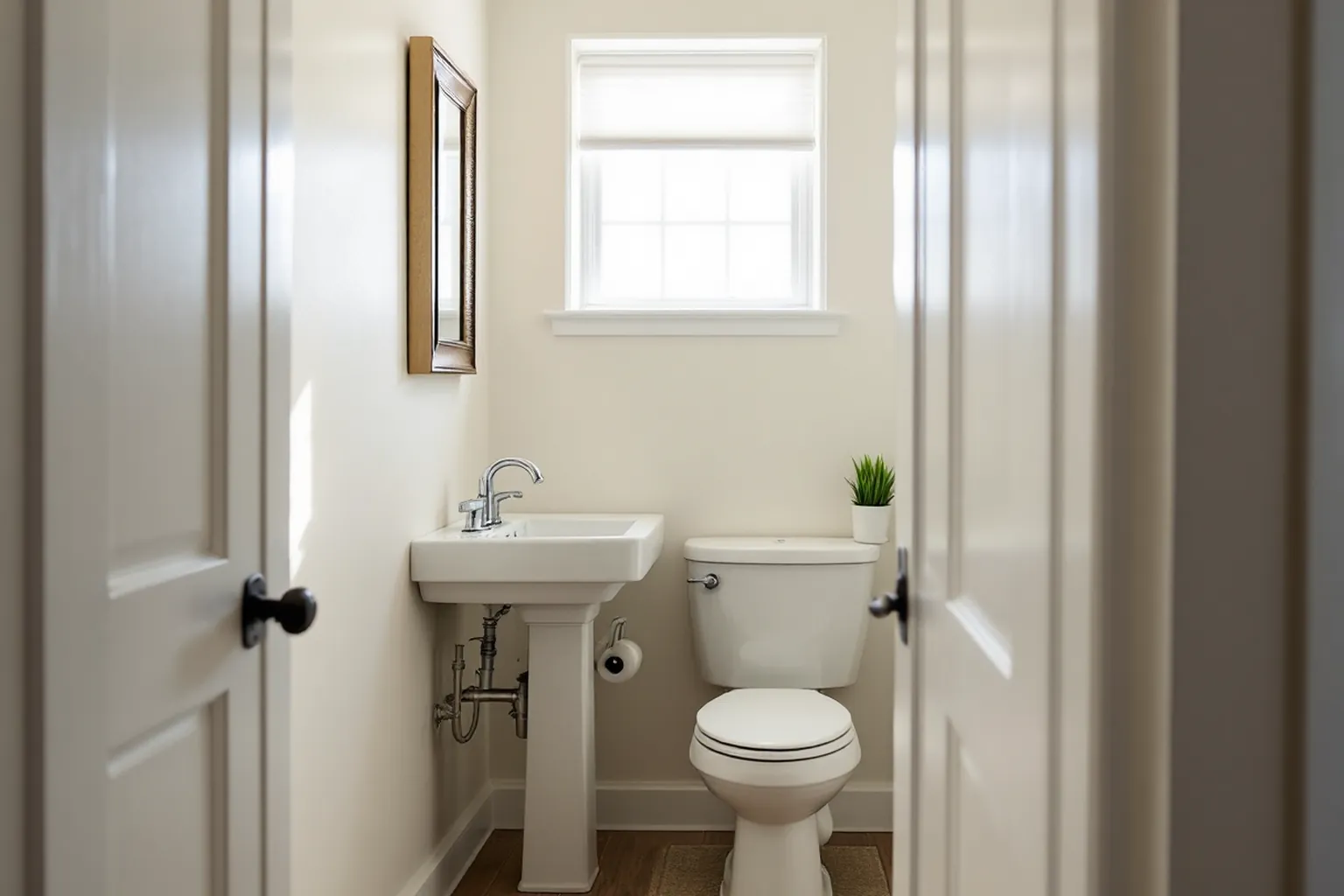
Half bath vs full bath comes down to one fixture: a half bath has only a toilet and a sink, while a full bath adds a place to bathe, a tub, a shower or both. On an appraisal the two are counted separately, so “2.1” means two full baths and one half bath, and a toilet, sink and shower room (a three-quarter bath) counts as full, per the Fannie Mae and Freddie Mac UAD specification. Adding one costs $5,000 to $15,000 for a half bath and $15,000 to $35,000 for a full bath, according to Fixr‘s 2026 cost guide.
A shower, not a tub, is what makes a bath full
Listing sites and appraisers use slightly different language, but the fixture rules line up. Redfin defines a full bath as a toilet, a sink and a tub, shower or combination, and a half bath as two fixtures, usually a toilet and a sink. The appraisal standard used for most U.S. mortgages adds two rules that settle the arguments: a three-quarter bath “is to be counted as a full bath in all cases” and a toilet-only room is “not to be included in the bathroom count” (Fannie Mae and Freddie Mac UAD specification).
| Room | Fixtures | Appraisal count | Listing shorthand |
|---|---|---|---|
| Full bath | Toilet, sink, tub and/or shower | 1 full | 1 bath |
| Three-quarter bath | Toilet, sink, shower (no tub) | 1 full | Sometimes 0.75 |
| Half bath (powder room) | Toilet and sink | 1 half | 0.5 |
| Quarter bath | Toilet only | Not counted | Sometimes 0.25 |
Sources: Fannie Mae and Freddie Mac, UAD Appendix D (2011); Redfin, What is a half bath.
On an appraisal, 2.1 is not a typo for 2.5
Real estate listings usually write a home with two full baths and a powder room as 2.5 baths, and Redfin notes that “1 1/2 baths” normally means one full plus one half, though not always (Redfin). Appraisers working to the Fannie Mae and Freddie Mac UAD specification must instead enter “the number of full and half baths… separated by a period,” with full baths to the left of the period and half baths to the right. Its own example: “3.2 indicates three full baths and two half baths above grade.” So a house with two powder rooms is 3.2 on the appraisal, which a listing might show as 4 baths.
Two practical consequences for a remodel:
- A three-quarter bath does not earn a lower count than a tub bath. If space is tight, a 30 inch shower gets you a full bath on paper (the minimum in IRC Figure R307.1); you do not need a tub to move from “.1” to a whole number. Read why many owners skip the tub in our guide on whether a primary bathroom needs a tub.
- The 2011 specification counts baths “above grade.” A basement bath may be reported elsewhere on the form, so ask your appraiser how a planned basement bath will be counted before you assume it raises the headline number.
Builders put half baths where the stairs are
No ranking page says how common half baths actually are. We computed it from the Census Survey of Construction microdata, which samples about 1 in 50 new houses and records full and half bathrooms separately (variables FULB and HAFB, per the Census microdata guide). Our calculation: the weighted share of houses completed in 2025 that have at least one half bath, using each record’s WEIGHT, with not-reported bath counts excluded. The pattern is stark. Fewer than 1 in 5 new one-story houses got a half bath, against nearly 3 in 4 two-story houses, because the half bath serves the main living floor when bedrooms and full baths are upstairs.
| New houses completed in 2025 | Sample houses | With 1+ half bath |
|---|---|---|
| All | 13,219 | 46.8% |
| One story | 6,084 | 18.7% |
| Two stories | 6,346 | 72.1% |
| Three or more stories | 779 | 84.8% |
| Detached | 10,999 | 41.0% |
| Attached (townhouse) | 2,219 | 72.6% |
| New England division | 295 | 64.2% |
| West South Central division | 2,320 | 40.6% |
Source: our calculation from U.S. Census Bureau and HUD, Survey of Construction microdata, 2025 file; variable codes from the SOC microdata guide. Weighted shares; microdata totals differ slightly from published tables.
The share of new homes with a powder room has barely moved since 1999
Running the same calculation on earlier files gives 47.1% for 1999, 50.2% for 2015 and 46.8% for 2025 (our calculation from the Census Survey of Construction microdata). In 1999, 18.5% of one-story houses and 73.5% of houses with two or more stories had a half bath, almost exactly today’s split. Two half baths are rare: 1.7% of 2025 completions (same source).
What has grown is the number of full baths. Census’s published table shows 32.1% of 2025 completions with three or more bathrooms and 4.5% with 1.5 or fewer (Census, Number of Bathrooms in New Single-Family Houses Completed). Our full report on average house size and bathrooms per house tracks that series back to 1973. The takeaway for an owner: in a two-story house, a missing powder room is the odd one out; in a ranch, it is normal and buyers rarely expect one.
What the code adds when a half bath becomes a full bath
Both rooms share the same toilet and sink rule. IRC P2705.1 item 5 says a water closet, lavatory or bidet “shall not be set closer than 15 inches (381 mm) from its center to any side wall, partition or vanity or closer than 30 inches (762 mm) center-to-center between adjacent fixtures,” with “not less than 21 inches (533 mm) in front” (ICC, IRC P2705.1 as printed in the 2018 code change proposals). The exact minimum room sizes are worked out in our sibling guide, how big a half bath needs to be.
Going to a full bath adds the shower. Figure R307.1 of the 2021 IRC shows a shower at least 30 inches by 30 inches inside, with a 24 inch clearance in front of the opening (2021 IRC Figure R307.1, Larimer County copy). Our calculation: 30 x 30 inches is 900 square inches, or 6.25 square feet, and a 24 by 30 inch clear zone is another 5 square feet, so about 11 square feet of floor before walls and finishes, though the shower’s clear zone may overlap the toilet’s 21 inch zone. Redfin’s rough sizes reflect that jump: about 18 to 24 square feet for a half bath and about 60 square feet for a typical full bath (Redfin).
The space is only part of it. A shower brings a new drain and trap, hot water, a wet-wall waterproofing job and usually a bigger exhaust fan, so check our table of bathroom exhaust fan sizes before you buy one. Not engineering advice; your local inspector has the final word.
- Low
- $5,000 to add a half bath
- Midpoint
- $10,000 to add a half bath
- High
- $15,000 to add a half bath
Adding a full bath runs about two to three times the half-bath price
Fixr‘s 2026 ranges for adding each type of bathroom are below. Its national average for any bathroom addition is $20,000, and it says labor averages 50% of the total. The bigger swing is where the room goes: Fixr puts converting existing space at $200 to $250 per square foot and building a new addition at $400 to $550 per square foot.
| Bathroom added | Fixr 2026 range | Midpoint (our calculation) |
|---|---|---|
| Half bath / powder room | $5,000 to $15,000 | $10,000 |
| Three-quarter bath | $10,000 to $22,000 | $16,000 |
| Full bath | $15,000 to $35,000 | $25,000 |
| Primary bath | $25,000 to $100,000+ | Open-ended |
Source: Fixr, How Much Does It Cost to Add a Bathroom in 2026. Midpoints are simple averages of the low and high figures.
Run the per-square-foot math before you pick
Our calculation, using Fixr‘s per-square-foot rates and Redfin’s typical sizes (Redfin): a 24 square foot half bath carved out of a closet or under a stair at $200 to $250 per square foot lands at $4,800 to $6,000, while a 60 square foot full bath built as a new addition at $400 to $550 per square foot lands at $24,000 to $33,000. That is why the same “add a bathroom” job can be quoted at five or six times the price.
- Plumbing distance moves the number more than fixture choice. Fixr notes costs rise when there is no nearby line to tie into or a new vent stack is needed; our guide to the cost to move a toilet shows how drain runs add up.
- Keeping fixtures on an existing wet wall is the cheapest route for either room; see a bathroom remodel without moving plumbing.
- For finishing an existing full bath rather than adding one, our bathroom remodel cost guide has the ranges, and walk-in shower costs cover the shower itself.
Let the floor plan pick the room
The Census pattern above is a good guide to what buyers expect. In a two-story or townhouse layout, 72.1% and 72.6% of new houses have a half bath (our calculation from the Census Survey of Construction microdata), so a main-floor powder room is the norm and adding one fixes a real gap. In a one-story house where the hall bath is already a few steps from the living room, a second full bath usually does more, because it is the room a guest, an in-law or a teenager can actually live with.
A three-quarter bath is the middle path: it counts as a full bath on the appraisal (Fannie Mae and Freddie Mac UAD specification) and costs $10,000 to $22,000 to add per Fixr, compared with $15,000 to $35,000 for a full bath. Get at least three written bids; our checklist on how to choose a remodeling contractor covers what each one should include.
Frequently Asked Questions
Can a half bath include a shower?
No. Once a room has a toilet, a sink and a shower it is a three-quarter bath, and the Fannie Mae and Freddie Mac UAD specification says a three-quarter bath is counted as a full bath in all cases.
Is a half bath worth it?
Usually yes in a two-story house or townhouse, where about 72% of new homes include one (our calculation from the Census Survey of Construction microdata). In a one-story house only about 19% do, so a second full bath often adds more use. Fixr puts a half bath addition at $5,000 to $15,000.
What is the purpose of a half bath?
It gives guests and the household a toilet and sink on the living floor so nobody has to walk through a bedroom or climb stairs. That is why it is usually near the entry or kitchen and why builders add one mostly to multi-story homes.
Is it okay to take a half bath every night?
That question is about bathing in a partly filled tub, not about the room. The room called a half bath has no tub or shower, so you cannot bathe in it at all; you need a three-quarter or full bath.
Does a three-quarter bath count as a full bath?
For an appraisal, yes. The Fannie Mae and Freddie Mac UAD specification says a three-quarter bath “is to be counted as a full bath in all cases” and that toilet-only quarter baths are not counted at all.
Sources
- Fannie Mae and Freddie Mac, Uniform Appraisal Dataset Specification, Appendix D: Field-Specific Standardization Requirements, v1.1 (2011)
- U.S. Census Bureau and HUD, Survey of Construction microdata files (2025 file) (2026)
- U.S. Census Bureau, Survey of Construction Microdata Files guide (variable definitions) (2026)
- U.S. Census Bureau and HUD, Number of Bathrooms in New Single-Family Houses Completed (2026)
- International Code Council, 2018 Group A proposed changes to the IRC, plumbing (reprints IRC P2705.1) (2018)
- Larimer County (ICC licensed copy), 2021 IRC Figure R307.1, Minimum Fixture Clearances (2020)
- Fixr, How Much Does It Cost to Add a Bathroom in 2026? (2026)
- Redfin, What is a half bath vs. three quarter vs. full? (2021)