Bathroom costs
Cost to Move a Toilet: What Sets the Price, Foot by Foot
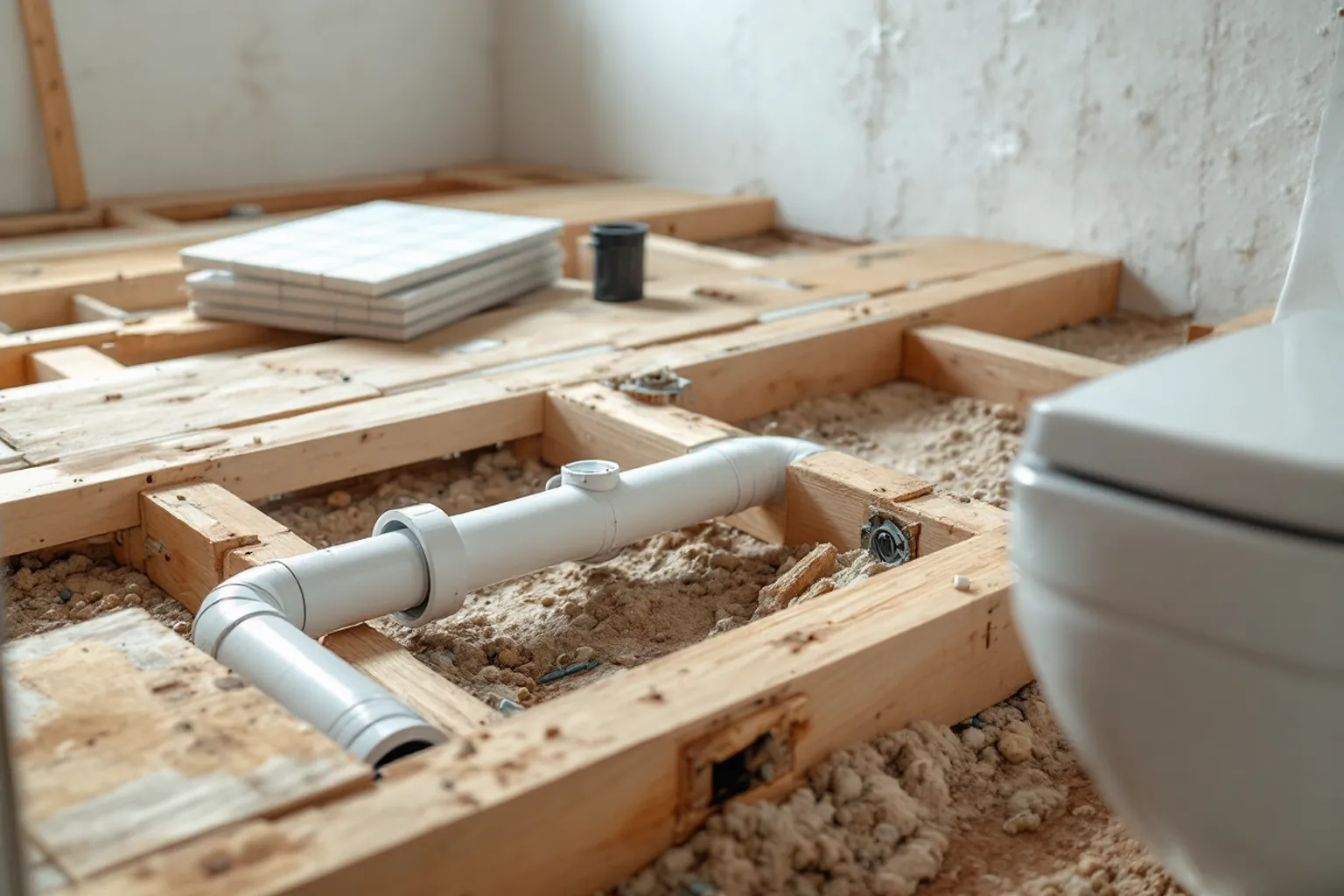
The cost to move a toilet is roughly $1,500 to $3,500 over a wood-framed floor and $2,500 to $6,000 or more on a concrete slab, according to Oakwood Remodel‘s published estimate ranges, and Homewyse prices the drain rerouting alone at $952 to $1,155 per piping run (May 2026). The distance on the floor plan is not what sets the price. What sets it is which way the new drain has to travel: along the floor joists, across them, or through concrete, and whether it stays close enough to an existing vent.
- Low
- $1,500 per toilet moved, excluding the toilet
- Wood floor midpoint
- $2,500 per toilet moved, excluding the toilet
- High
- $6,000 per toilet moved, excluding the toilet
Which way the drain runs matters more than how far
Every toilet sits on a 3-inch drain that has to fall continuously toward the main stack. That one fact explains most of the price spread. Under the Uniform Plumbing Code the fall is one quarter inch per foot (a City of Washougal UPC handout prints the rule), while the IPC and the 2021 IRC allow 3-inch to 6-inch pipe to run at one eighth inch per foot (ICC, IPC Code Essentials Table 5-2; Jaspector summary of IRC P3005.3). Many plumbers run a quarter inch on toilet drains anyway, and some inspectors expect it, so we price both.
Three situations cover almost every move:
- Along the joists, wood floor. The new pipe lies in the same joist bay as the old one. No framing is cut, the drain drops inside the bay, and the work is mostly opening the floor and patching it. This is the cheap end of the range.
- Across the joists, wood floor. The pipe must pass through each joist it crosses. Sawn joists may only be bored so far (the table below shows the limit), and a 3-inch drain is too fat for the common 2x10. Expect sistered joists, a dropped soffit in the ceiling below, or a redesign.
- On a slab. The drain is in the dirt under concrete. Oakwood Remodel lists saw-cutting, trenching and re-pouring at $1,000 to $2,500 or more, on top of the plumbing, and the patch has to cure before tile or vinyl goes back down.
What each extra foot costs in pipe fall
This is the table nobody on page one shows. Fall is simply slope times run: at a quarter inch per foot, a toilet moved 8 feet needs its drain 2 inches lower at the far end than at the old connection point. On a slab that is 2 inches of extra trench depth; in a wood floor it is 2 inches of joist you have to get through or under. The vent column uses the UPC rule that the pipe from a toilet’s closet flange to its vent may not exceed 6 feet (City of Washougal UPC handout, Table 10-1 note). Distances here are pipe length, which is longer than the straight line on the floor plan once elbows are counted. Fall figures are our calculation.
| Pipe run | Fall at 1/4 in/ft | Fall at 1/8 in/ft | Within UPC 6 ft vent limit? | What it usually means |
|---|---|---|---|---|
| 1 ft | 0.25 in | 0.125 in | Yes | Often one joist bay or one short trench |
| 2 ft | 0.5 in | 0.25 in | Yes | Often one joist bay or one short trench |
| 3 ft | 0.75 in | 0.375 in | Yes | Often one joist bay or one short trench |
| 4 ft | 1 in | 0.5 in | Yes | Usually crosses joists or a longer trench |
| 5 ft | 1.25 in | 0.625 in | Yes | Usually crosses joists or a longer trench |
| 6 ft | 1.5 in | 0.75 in | Yes | Usually crosses joists or a longer trench |
| 8 ft | 2 in | 1 in | No, needs a closer vent | New vent likely; consider a different layout |
| 10 ft | 2.5 in | 1.25 in | No, needs a closer vent | New vent likely; consider a different layout |
| 12 ft | 3 in | 1.5 in | No, needs a closer vent | New vent likely; consider a different layout |
Our calculation: fall = run x slope. Slopes from City of Washougal (UPC) and ICC IPC Code Essentials; vent limit from the UPC Table 10-1 note as printed by City of Washougal. ICC codes size vents differently; check your adopted code.
A 3-inch toilet drain will not legally fit through a 2x10
Schedule 40 PVC sold as 3-inch has an actual outside diameter of 3.500 inches (Charlotte Pipe product data sheet). The IRC lets you bore a sawn-lumber joist only if the hole is no more than one third of the joist depth and stays at least 2 inches from the top and bottom edges (City of Minneapolis, IRC R502.8.1 guide). Run those two rules together and the cheap fix disappears on most floors: the largest legal hole in a 2x10 is 3 1/8 inches, which is smaller than the pipe.
Where the pipe does fit, the 2-inch edge rule also caps how much the drain can drop while crossing joists. Our calculation: usable window = joist depth minus 4 inches minus a 3 3/4 inch hole; maximum run = window divided by the slope.
| Joist (nominal) | Actual depth | Largest legal hole | 3-in drain fits? | Max run across joists at 1/4 in/ft |
|---|---|---|---|---|
| 2x8 | 7 1/4 in | 2 3/8 in | No | None |
| 2x10 | 9 1/4 in | 3 1/8 in | No | None |
| 2x12 | 11 1/4 in | 3 3/4 in | Yes, barely | 14 ft (3.5 in of fall) |
| 2x14 | 13 1/4 in | 4 3/8 in | Yes | 22 ft (5.5 in of fall) |
Depths and hole limits: City of Minneapolis, Cutting, Notching and Boring Wood Frame Members; pipe OD: Charlotte Pipe; max run is our calculation. Engineered I-joists and trusses follow the maker’s hole chart instead (ICC CodeNotes, 2021 IRC).
The line items behind a toilet relocation quote
No single price list covers the whole job, so we stacked the named ranges for each piece. Our calculation adds the low and high ends of the items that apply to each floor type.
| Line item | Wood floor | Concrete slab | Whose range |
|---|---|---|---|
| New 3-in drain, fittings, flange | $150 to $500 | $150 to $500 | Oakwood Remodel |
| Plumbing labor, drain and vent reroute | $800 to $2,500 | $800 to $2,500 | Oakwood Remodel |
| Saw-cut, trench, re-pour concrete | Not needed | $1,000 to $2,500+ | Oakwood Remodel |
| Cap or abandon the old drain | $100 to $400 | $100 to $400 | Oakwood Remodel |
| Permit and inspection | $150 to $500 | $150 to $500 | Oakwood Remodel |
| Sum (our calculation) | $1,200 to $3,900 | $2,200 to $6,400+ | Our calculation |
| Flooring and ceiling patch | Extra | Extra | Not in any range above |
| General contractor markup | Add 13% to 22% | Add 13% to 22% | Homewyse |
Sources: Oakwood Remodel (Sacramento area estimate ranges, toilet excluded); Homewyse, Cost to Move Toilet Drain Plumbing (May 2026). Sums are our calculation.
The floor patch is the part quotes leave out
Homewyse is explicit that its $952 to $1,155 per run covers the flange and up to 30 feet of sloped drain, and excludes demolition, structural changes, surface restoration, permits and sales tax. That matters because the visible damage is usually bigger than the plumbing. A toilet that moves 4 feet across a tiled floor needs the tile opened along the whole pipe route, and matching 15-year-old tile is rarely possible, so the honest budget includes new flooring for the room. If there is a finished ceiling below, add drywall, tape and paint there too.
This is why a move is far cheaper inside a gut remodel than as a standalone job. When the floor is coming up anyway, the floor patch costs nothing extra; ZINTEX, a remodeler, makes the same point that a studs-to-done project absorbs a relocation proportionally better. Our small bathroom remodel cost guide shows where plumbing sits in a full-remodel budget.
The new spot needs 30 inches of width and clear floor in front
Before paying for pipe, check that the toilet will fit where you want it. The IRC requires at least 15 inches from the toilet’s centerline to any side wall, partition or vanity, and at least 21 inches of clear space in front of the bowl (Jaspector summary of IRC P2705.1; the NC Office of the State Fire Marshal points to the same R307.1 figure). California and other UPC states use 24 inches in front (Oakwood Remodel). Our calculation: 15 inches each side means a toilet needs a space at least 30 inches wide, centerline in the middle.
If the target spot fails this test, the move is not just expensive but unpermittable. A common case: sliding the toilet into a 27-inch gap beside a new vanity. It will not pass.
The vent can turn a short move into a wall opening
A drain that moves away from its vent eventually loses trap protection. In UPC states the developed length from the toilet’s closet flange to the vent is capped at 6 feet (City of Washougal UPC handout). ICC codes set trap-to-vent distances by pipe size in a table; for a 3-inch trap arm the limit summarized for the 2021 IRC is 12 feet (Jaspector summary of IRC Table P3105.1), and several state and city versions treat toilets differently, so your inspector’s reading is the one that counts.
If the new location is past the limit, the plumber must run a new vent up through a wall to tie into the existing vent or the roof. That means opening a wall, and in a two-story house possibly a wall in the room above. When a quote jumps by a thousand dollars between two nearby spots, the vent is usually why. Check which code your state uses on our plumbing code by state map.
Long, flat runs and low-flush toilets do not mix well
New toilets sold in the US use at most 1.6 gallons per flush, and WaterSense models use 1.28 gallons or less (EPA WaterSense). Less water means less push to carry waste down a long horizontal drain. EPA tests drainline transport as one of its four performance criteria, which tells you it is a real concern. If your move adds a long, nearly flat run, ask the plumber to hold a full quarter inch of slope rather than the code minimum, and read our low flow toilet data before choosing the bowl.
If the existing toilet is old, replace it during the move. Resetting a 25-year-old toilet on a brand-new drain wastes the labor; our toilet lifespan research covers what wears out first.
Five questions that expose a weak relocation quote
- Which way do the joists run, and will the new drain cross any of them?
- What slope will the drain have, and where does it tie in?
- Is the new location within the vent limit, or does a new vent go in a wall?
- Is the floor and ceiling patch in this price, or extra?
- Who pulls the plumbing permit, and is the old drain capped at the main or just plugged at the floor?
A plumber who answers the first three without opening anything is guessing. For checking licenses and comparing bids, use our guide to choosing a remodeling contractor, and see what the permit itself runs in our building permit cost data. Moving a kitchen sink raises the same slope and vent problems; our sink-to-island guide works through them for a smaller sink drain.
Frequently Asked Questions
Is it expensive to move the location of a toilet?
Usually yes compared with a swap. A same-spot toilet install averages about $450 per Fixr, while a relocation runs $1,500 to $3,500 on a wood floor and $2,500 to $6,000 or more on a slab per Oakwood Remodel.
How easy is it to move a toilet?
It is easy only when the new drain can stay in the same joist bay over a crawlspace or basement and stay within the vent limit. Crossing joists, cutting a slab or adding a vent makes it a permit job for a licensed plumber, plus flooring work.
How much does it cost to move a toilet 3 ft?
For a 3-foot move over a wood floor along the joists, expect roughly the Homewyse drain-run price of $952 to $1,155 plus permit and floor patch. On a slab, add the $1,000 to $2,500+ concrete work Oakwood Remodel lists. At a quarter inch per foot, 3 feet only needs 3/4 inch of extra fall (our calculation).
How much does it cost to move a toilet to another room?
Treat it as adding a bathroom. This Old House puts a toilet in a new bathroom with all-new plumbing at $3,000 to $5,000, and a basement without plumbing at $1,500 to $2,000 plus a pump system, before finishes. Most cross-room moves also need a new vent.
Do I need a permit to move a toilet?
Almost always. Relocation changes drain and vent piping, which needs a plumbing permit and inspection (Oakwood Remodel). Fixr puts typical plumbing permits at $50 to $300. Only pulling and resetting a toilet in the same spot is commonly exempt.
Sources
- Oakwood Remodel, Relocating a Toilet: Moving the Drain, Code and Cost (n.d.)
- Homewyse, Cost to Move Toilet Drain Plumbing (2026-05)
- Fixr, How Much Does It Cost to Install a Toilet? (2026-01-28)
- This Old House, New Toilet Cost (2026-06-05)
- ZINTEX Remodeling Group, How Much Does It Cost to Relocate a Toilet in My Bathroom Remodel? (n.d.)
- International Code Council, 2018 IPC Code Essentials, Table 5-2 Slope of horizontal drain pipe (2019)
- Jaspector, IRC 2021 drain pipe slope (P3005.3 summary) (n.d.)
- Jaspector, IRC 2021 trap to vent distance (Table P3105.1 summary) (n.d.)
- Jaspector, IRC 2021 water closet clearance (P2705.1 summary) (n.d.)
- City of Washougal, WA, Plumbing Basic Information (UPC trap arm table and slope) (n.d.)
- City of Minneapolis, Cutting, Notching and Boring Wood Frame Members (RES-MS-012) (2009-01)
- International Code Council, CodeNotes: IRC Cutting, Drilling and Notching (2021 IRC) (2024)
- Charlotte Pipe, Product Data Sheet PVC-40-PE-PIPE-322 (2022)
- US EPA WaterSense, Residential Toilets (n.d.)
- NC Office of the State Fire Marshal, Minimum Plumbing Fixture Clearances (R307.1) (2019-03-22)