Countertop comparison
Butcher Block vs Quartz: What the Makers' Care Rules Say
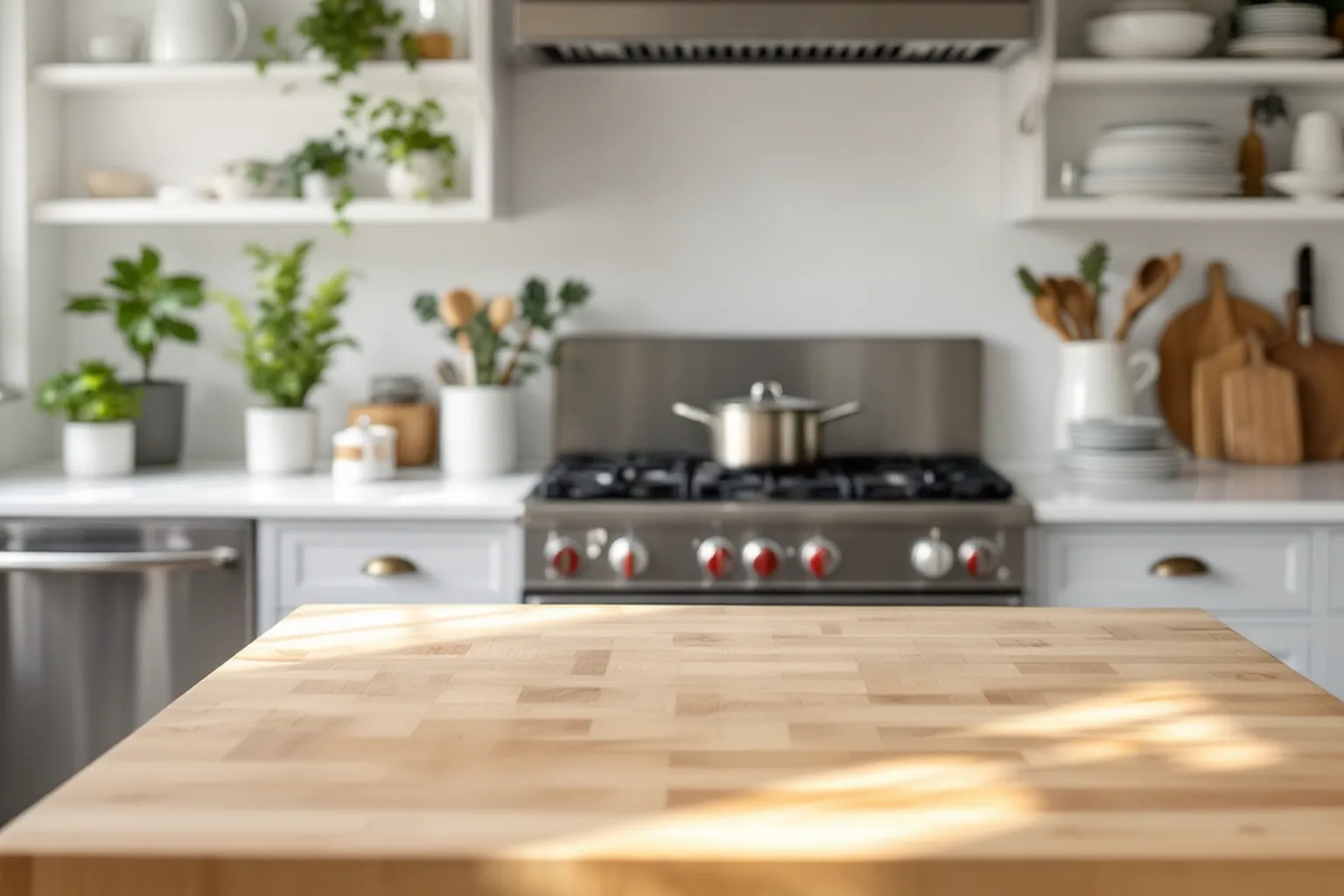
Butcher block vs quartz is mostly a choice about upkeep, not price. For a 30 sq ft kitchen run, the published ranges overlap: Fixr puts installed butcher block at $900 to $8,400 for 30 sq ft, and HomeAdvisor‘s $50 to $200 per sq ft for installed quartz works out to $1,500 to $6,000. The real split is in the makers’ own care rules: John Boos tells owners to oil a wood top at least once a month, while all four quartz makers we checked say it never needs sealing but must never take a hot pan without a trivet. Pick wood if you will oil it and want a surface you can sand back; pick quartz if you want to wipe it and forget it.
What seven makers actually tell owners to do
Ranking pages argue about whether quartz is heatproof or wood is sanitary. We skipped the arguments and compiled the care and warranty rules from each maker’s own documents: four quartz brands and three wood countertop sources (one maker, one store brand, one flat-pack line). Cells quote or closely paraphrase the document linked in the source line under the table.
| Maker | Hot pans | Seal or oil | Cutting | Warranty note |
|---|---|---|---|---|
| Caesarstone (quartz) | Trivet and hot pads, always | No sealing step listed | Cutting board, always | Limited lifetime; excludes flames or excessive heat |
| Cambria (quartz) | Hot pad or solid trivet, always | Never needs sealing | Chips at sink edges warned | Full lifetime, transferable |
| Silestone (quartz) | Not directly on surface | Do not use sealants | Cutting board advised | Care sheet warns of thermal shock cracks |
| MSI Q (quartz) | Trivet or hot pad; blog says about 150°F | No need to seal | Not addressed | Warns sustained heat near cutouts can crack |
| John Boos (wood) | Not addressed | Oil at least monthly | Do not cut in one spot | Not stated on care page |
| Hardwood Reflections (wood) | Not addressed | Seal all sides within 2 to 4 hours of unwrapping; re-oil every few weeks to months | Board or mat advised | Not stated on sheet |
| IKEA KARLBY (wood) | Not addressed | Oil when needed; more often near sink and hob | Not addressed | See IKEA terms |
Sources: Caesarstone care page, Caesarstone US Residential Limited Lifetime Warranty (June 2025), Cambria care FAQ, Cambria warranty page, Cosentino Silestone care sheet (2012, Lowe’s copy), MSI Q care page, MSI heat article (April 2025), John Boos countertop care, Hardwood Reflections use and care sheet, IKEA KARLBY manual. Compiled 2026-11-21.
Zero of four quartz makers allow a hot pan; three of three wood sources want oil
Read across the rows and the pattern is clean. Every quartz maker in the table puts a trivet or hot pad between the counter and hot cookware, and every one of them says or implies you never seal it. Caesarstone‘s warranty goes further and lists damage from “flames or excessive heat” as abuse it does not cover. MSI names crock pots, deep fryers, hot pots and electric skillets as things that need a trivet, and warns that sustained heat near edges and cutouts can crack the slab.
The wood side is the mirror image. None of the three wood documents talks about heat at all, but all three expect you to keep feeding the surface oil. John Boos says a minimum of once a month for oil-finished tops. The Hardwood Reflections sheet (the butcher block sold at Home Depot) gives a looser “every few weeks to every few months” and insists the block be sealed on all surfaces within two to four hours of removing the shrink wrap. IKEA says to oil when needed and more often around the sink and hob, which is where wood tops fail first.
So the honest summary of the manufacturer record is this: quartz asks you to change one habit (where you set pans down), and wood asks you to add one chore (oiling), on a schedule of roughly 4 to 17 times a year by our calculation, reading “every few weeks to every few months” as every 3 weeks (52 divided by 3) to every 3 months (12 divided by 3).
The 150 degree claim, and why trivets matter on both
Several ranking pages say quartz resin scorches somewhere around 300°F. The only maker figure we found is lower: MSI writes that quartz “will normally tolerate heat up to roughly 150 degrees F before the resin starts to break down or discolor” and notes that cast iron pans and oven trays run far hotter. Treat that as a cautious marketing number rather than a lab test, but it tells you the maker does not expect a hot pan to be safe.
The Silestone care sheet is more specific about the failure: hot pans, pots or small appliances used directly on the surface “can cause scorching, dull areas and cracks,” and it singles out crock pots, electric skillets and griddles. Air fryers and toaster ovens count too; MSI says rubber feet are not enough protection.
Wood is more forgiving in one way: a scorch mark is in the top layer of a solid board and can be sanded out, while a burned spot in quartz is permanent. It is not heatproof either. A hot pan leaves a ring, and repeated heat dries the wood around a cooktop, which is why IKEA tells you to oil that zone more often. The practical rule is the same for both: keep a trivet beside the range.
A 30 sq ft run priced four ways
Thirty square feet is about 14 linear feet of standard 25 inch deep counter (30 times 144 square inches, divided by 25 inches), a common L-shaped run without an island. We multiplied each named per sq ft range by 30; where a source gives material and labor separately, we added them first. The math is shown in each row.
| Material | Source | Per sq ft | 30 sq ft (our calculation) |
|---|---|---|---|
| Butcher block | Fixr (2022) | $30 to $280 | $900 to $8,400 (Fixr avg $3,750) |
| Butcher block | Homewyse (May 2026) | $67.08 to $94.27 | $2,012 to $2,828 |
| Quartz | HomeAdvisor (2026) | $50 to $200 installed | $1,500 to $6,000 |
| Quartz | Fixr (Jan 2026) | $50 to $200 + $10 to $35 labor | $1,800 to $7,050 |
Sources: Fixr, Butcher Block Countertop Installation Cost; Homewyse, Cost to Install a Butcher Block Countertop; HomeAdvisor, Quartz Countertops Cost; Fixr, Quartz Countertop Installation Cost. Multiplication by 30 sq ft is our calculation.
Species and grain decide the wood price more than the vs question
The wide butcher block range is mostly species and construction. Fixr lists material at $40 to $45 per sq ft for maple versus $110 to $120 for walnut and $130 to $150 for teak, and end grain blocks cost more than edge or face grain. A maple top can land below most quartz quotes; a walnut or teak top can pass them. Fixr also adds $100 to $150 per sink cutout, which matters because an undermount sink in wood needs careful sealing of the cut edge.
Quartz pricing moves on brand tier, thickness and edge profile, and lately on import duties. Since August 15, 2026 a Section 201 safeguard adds a 25 percent in-quota duty on imported quartz surface products, on top of older antidumping orders against Chinese quartz, per the Federal Register. Our quartz countertop tariffs report tracks which countries the duty covers and where imports moved. Butcher block is outside those orders.
Upkeep is the hidden line item on wood. Fixr puts mineral oil at under $5 per application; at the John Boos minimum of 12 oilings a year, that is under $60 a year in oil by our calculation, plus a sanding and refinish every few years if the top gets marked. Quartz has no recurring product cost beyond mild soap.
The rule of 7 is a blog schedule, not a maker rule
One People Also Ask question is “what is the 7 rule for butcher block?” It comes from a Tasting Table article (July 2026), which says to oil a new top “once a day for seven days, once a week for seven months, and finally, once a month for seven months.” By our calculation that is about 44 oilings in the first 14 months: 7 daily, about 30 weekly (7 months times 4.3 weeks) and 7 monthly.
None of the three wood documents in our table uses it. John Boos says monthly at minimum; Hardwood Reflections says a liberal coat on all surfaces at install, then every few weeks to every few months. A heavy first year of oiling does no harm on an oil finish, but if your top came with a factory film finish such as varnish, follow that maker’s sheet instead, because extra oil will not soak into a sealed surface.
The silica issue is about the people who cut quartz
“Why is quartz on the decline?” and “why avoid quartz countertops?” mostly trace back to worker health. Engineered stone is often over 90 percent crystalline silica by weight, compared with under 45 percent for granite, according to the CDC. Cutting and grinding it without water and ventilation releases dust that causes silicosis. The California Department of Public Health has identified 644 silicosis cases among engineered stone countertop workers, with at least 35 deaths. Safe Work Australia banned the manufacture, supply, processing and installation of engineered stone from July 1, 2024.
An installed, finished quartz counter in your kitchen is not the hazard described in these reports; the exposure happens in the fabrication shop and during on-site cutting. If the issue weighs on you, ask your fabricator how they control dust (wet cutting, local exhaust, respirators) or consider a lower-silica product or a different material. Our engineered stone silicosis report lays out the case counts and the rules state by state. This is not medical or legal advice.
Where each one earns its keep in a working kitchen
Butcher block
Pros
- Scorches, scratches and knife marks sand out
- Warm look, quieter when you set dishes down
- Maple can undercut most quartz quotes
Cons
- Needs oil on a schedule, more near the sink
- Standing water, brine and meat juices soak in and swell the wood
- Seams and the sink cutout are where it fails first
Quartz
Pros
- No sealing, ever, per Cambria, MSI and Silestone
- Stain resistant; mild soap is the whole routine
- Long transferable warranties from some brands
Cons
- Heat damage is permanent and usually excluded from warranty
- Chips at sink and dishwasher edges
- Import duties and silica rules are pushing prices and supply
Using both: quartz on the perimeter, wood on the island
Many kitchens settle the question by splitting it. Quartz goes on the perimeter where the sink, dishwasher and range sit, because that is where water and heat do their damage. Butcher block goes on an island used for prep and eating, away from standing water. If you are pricing that layout, our guide to the cost to add a kitchen island breaks out the base, top and electrical. If you are keeping existing counters while swapping cabinets, read replacing cabinets without replacing countertops first, since a stone top is far harder to lift and reuse than a wood one.
If quartz is on your list, compare it with natural stone too: quartz vs granite covers sealing, heat and price for the two stones. If budget is the driver, laminate vs solid surface covers the two cheaper options. You can plug any of these into the remodel cost calculator to see what the top does to the whole project.
Frequently Asked Questions
Is butcher block better than quartz?
Neither wins outright. Wood is repairable and can be cheaper in maple, but John Boos expects oil at least monthly. Quartz needs no sealing per Cambria, but heat damage is permanent and Caesarstone excludes excessive heat from its warranty.
Why is quartz on the decline?
Two pressures: worker silicosis linked to cutting high-silica engineered stone, which led Australia to ban it in 2024, and new US import duties, including a 25 percent Section 201 safeguard from August 2026 per the Federal Register. Quartz is still widely sold in the US.
What is the 7 rule for butcher block?
A schedule from Tasting Table: oil daily for seven days, weekly for seven months, then monthly for seven months. Wood makers such as John Boos give a simpler rule: at least once a month.
Why avoid quartz countertops?
Common reasons are heat (hot pans can scorch or crack it, per the Silestone care sheet), chipped edges near sinks, and concern about silica exposure for fabricators, documented by the California Department of Public Health. A finished counter in your home is not the exposure source.
Can you put a hot pan on butcher block?
It will not crack, but it can leave a scorch ring and dry the wood. A scorch can be sanded out, unlike on quartz, but the maker documents we read (for example IKEA) still expect extra oil near the hob. Use a trivet.
Sources
- Fixr, How much does it cost to install butcher block countertops? (Updated 2022-08-18)
- Homewyse, Cost to Install a Butcher Block Countertop (May 2026)
- HomeAdvisor (Angi Inc.), How Much Does It Cost to Install Quartz Countertops? (Updated 2026-06-19)
- Fixr, Quartz Countertop Installation Cost (Updated 2026-01-29)
- Caesarstone, Care and Maintenance (n.d.)
- Caesarstone, US Residential Limited Lifetime Warranty (June 2025)
- Cambria, Product Care FAQs (n.d.)
- Cambria, Warranty (n.d.)
- Cosentino, Silestone care and maintenance sheet (copy hosted by Lowe's) (2012)
- MSI, Q Quartz Care and Maintenance (n.d.)
- MSI, Everything You Need To Know About Protecting Your Quartz Countertop From Heat (2025-04-12)
- John Boos, Caring for countertops and worktops (n.d.)
- Hardwood Reflections (Home Depot), European Walnut butcher block use and care instructions (n.d.)
- IKEA, KARLBY custom made worktop manual (n.d.)
- Tasting Table, This Rule Of 7 Keeps Butcher Block Countertops In Tip-Top Shape (2026-07-22)
- Centers for Disease Control and Prevention, Severe Silicosis in Engineered Stone Fabrication Workers (MMWR 68(38)) (2019)
- California Department of Public Health, Comments to OSHSB on the silica standard (2026-09-30)
- Safe Work Australia, Engineered stone ban (2024)
- Federal Register, Proclamation 11051: safeguard on quartz surface products (2026-08-05)